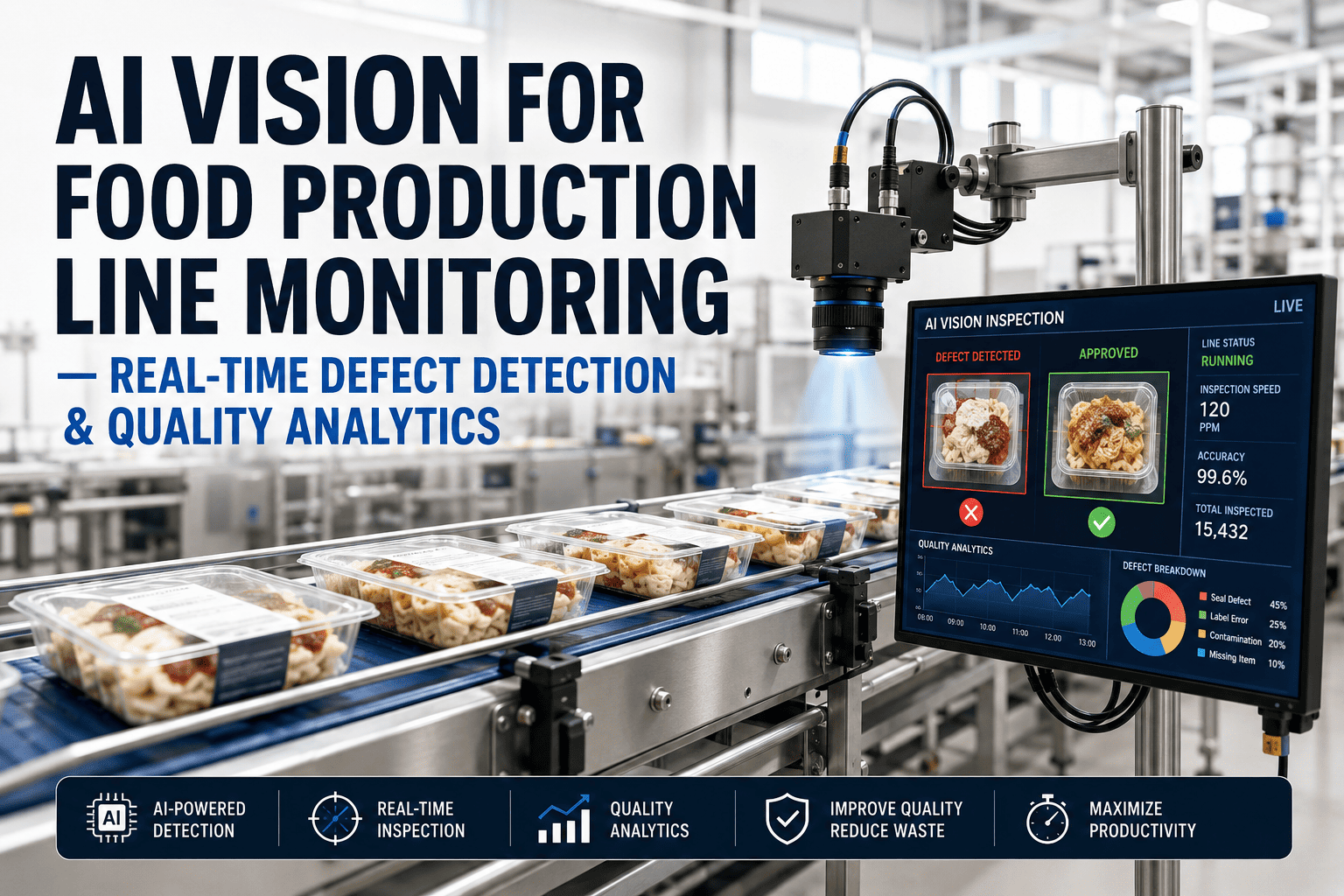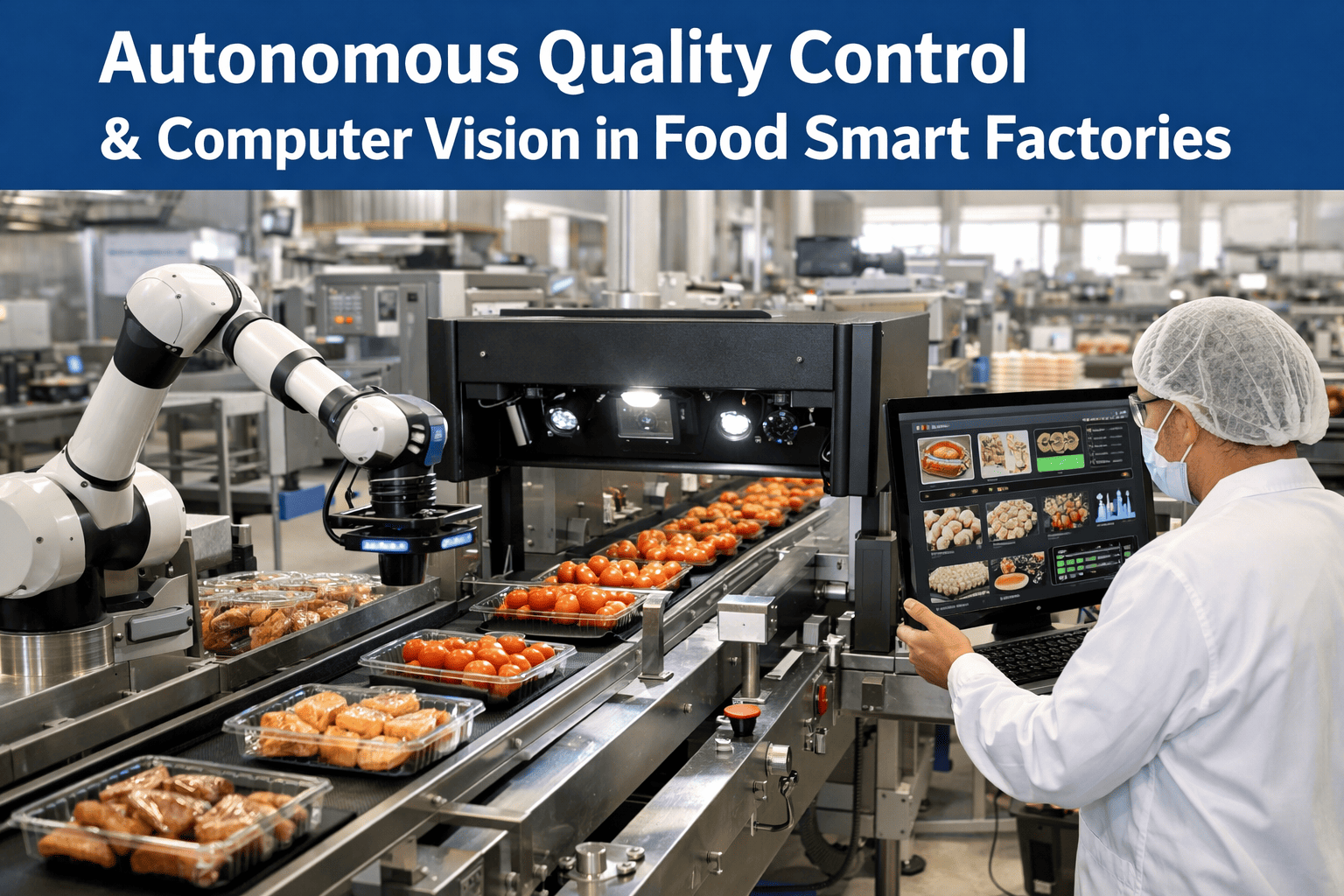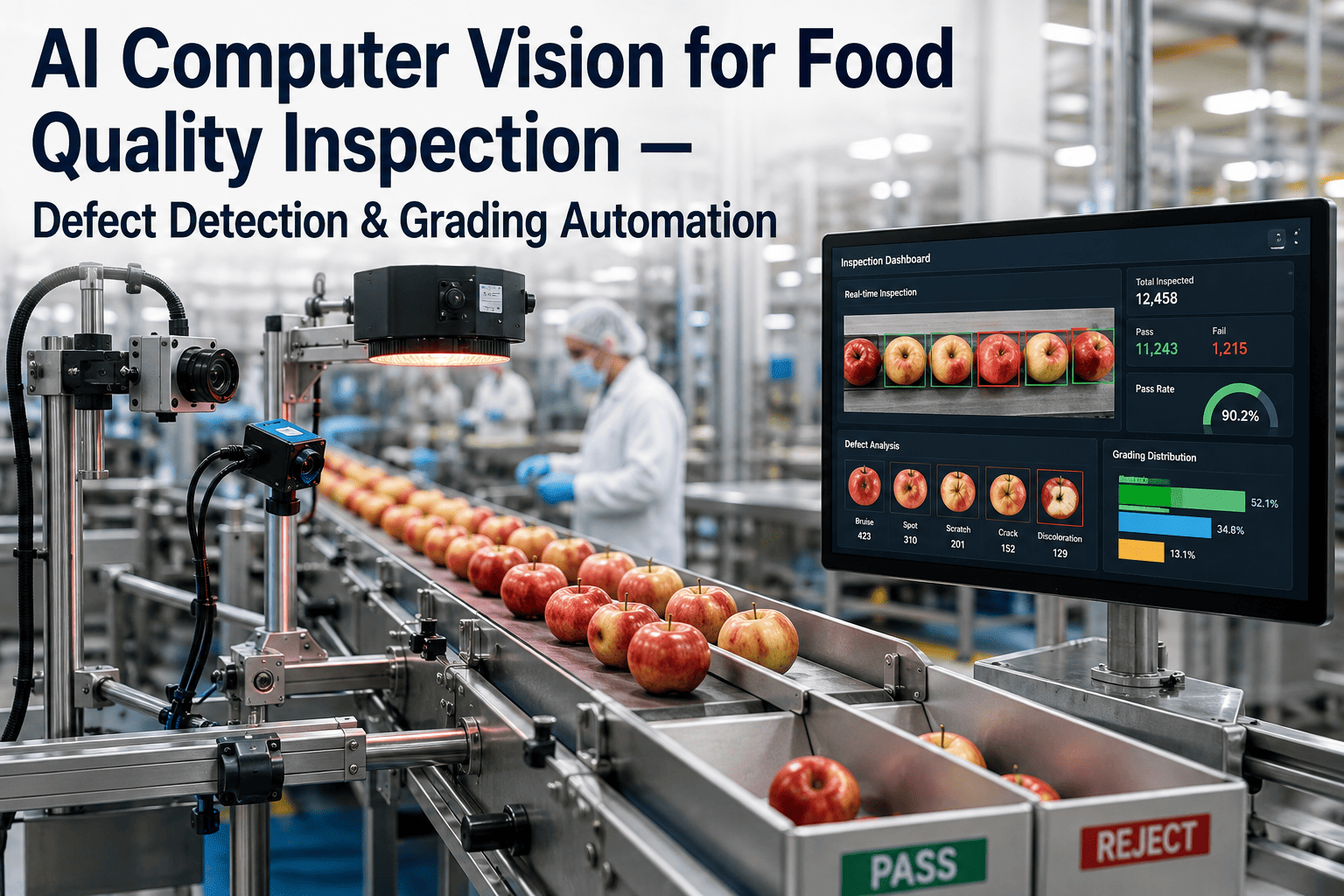
A human inspector on a bakery or produce line can realistically catch a fraction of the defects passing in front of them at full line speed, and fatigue makes that fraction shrink further as a shift goes on. AI computer vision changes what is physically possible to inspect, watching every single unit at full line speed and flagging color, shape, size, and packaging defects that a tired eye would miss entirely. For quality managers under pressure to cut customer complaints without slowing the line down, this is less an upgrade and more a different category of inspection altogether. Quality teams ready to see this running on their own product can book a demo.
AI COMPUTER VISION · FOOD QUALITY INSPECTION · 2026
Catch Every Defect, Not Just the Obvious Ones
Real-time visual inspection across bakery, meat, produce, and packaging lines, with automated reject sorting that keeps pace with full production speed.
The Limits of Manual Inspection at Line Speed
Manual visual inspection was never designed for the speeds modern food lines actually run at. A packaging line moving several hundred units a minute gives a human inspector a fraction of a second per unit, which is enough time to catch an obviously misshapen product but not enough to reliably catch a hairline seal defect, a slightly under-filled package, or a subtle discoloration that signals a quality drift starting further upstream. Add in fatigue over an eight or twelve hour shift, and detection rates on subtle defects fall even further, which is exactly the category of defect most likely to trigger a customer complaint or a retailer chargeback.
AI computer vision does not get tired and does not blink. Cameras positioned along the line capture every unit, and trained models compare each one against a defined quality standard in milliseconds, triggering an automated reject mechanism the instant something falls outside spec, without slowing the line to do it.
1
Capture
High-speed cameras positioned at key points capture every unit passing the inspection zone, from raw product to finished pack.
2
Classify
Trained models compare each image against defect signatures for color, shape, size, foreign material, and packaging integrity.
3
Reject
Units outside spec are diverted automatically by synchronized reject mechanisms before they reach the next stage of the line.
4
Record
Every inspection result is logged automatically, building a defect trend history without a single manual entry required.
SEE IT ON YOUR OWN PRODUCT
Watch Computer Vision Inspect Your Actual Line
Get a walkthrough of detection accuracy on your specific product, defect types, and line speed.
Defect Detection by Product Category
Different food categories fail in different ways, so inspection models are trained around the specific defect patterns that matter most for each product type rather than one generic visual standard.
| Product Line | Common Defects Caught | Inspection Point |
|---|---|---|
| Bakery | Color variation, shape irregularity, under-baking | Post-oven, pre-pack |
| Meat & Protein | Foreign material, fat content variance, portion size | Post-trim, pre-pack |
| Produce | Bruising, blemishes, size and ripeness grading | Post-wash, pre-sort |
| Packaging | Seal integrity, fill level, label placement | Final packaging stage |
MANUAL INSPECTION
Inspects a sample, not every unit
Accuracy drops as shift fatigue sets in
Subtle defects frequently pass through
Results logged manually, if at all
AI COMPUTER VISION
Inspects every single unit at full line speed
Consistent accuracy across an entire shift
Subtle defects flagged in milliseconds
Every result logged automatically for trend analysis
What Quality Managers Are Saying
We were catching maybe half our seal defects with manual spot checks, and the other half showed up as retailer chargebacks weeks later. Since installing vision inspection on the packaging line, we catch them before the case even leaves the plant, and our chargeback rate has dropped to almost nothing.
Quality Manager, Packaged Snack Foods Plant
Frequently Asked Questions
How accurate is AI computer vision compared to a trained human inspector?
Once trained on enough labeled examples of your specific product and defect types, computer vision models typically match or exceed the detection accuracy of a trained human inspector, and do so consistently across every unit rather than a sample. The key difference is not just accuracy but consistency, since a human's detection rate naturally varies with fatigue, shift timing, and attention, while a properly calibrated model performs the same way on unit one thousand as it does on unit one.
Does this require replacing our existing packaging or sorting equipment?
No, cameras and reject mechanisms are typically added to your existing line rather than requiring a full equipment replacement. Reject mechanisms are synchronized with the existing line speed and integrated at natural diversion points, so most installations are completed during planned downtime rather than an extended shutdown. Teams can review integration specifics for their own line layout through support.
How long does it take to train the model on our specific products?
Initial model training typically takes two to four weeks, depending on how many product variants and defect types need to be covered, and relies on a set of labeled example images collected during that period. Accuracy continues to improve after go-live as the model sees more real production volume and edge cases that were not present in the original training set, which is why a validation period is built into every rollout before full reliance on automated rejects.
Can the system distinguish between a true defect and normal product variation?
Yes, this is one of the core design goals, since food products naturally vary in shape, color, and size within an acceptable range that should never trigger a reject. Models are trained with both defect examples and acceptable variation examples so they learn the actual boundary of your specification rather than an overly rigid standard that would reject good product. This calibration is refined during the validation period specifically to minimize false rejects.
What kind of ROI timeline should quality managers expect?
Most plants see the fastest returns in reduced customer complaints and retailer chargebacks, since those costs are usually far higher per incident than the cost of catching the defect on the line. Labor reallocation is a secondary benefit, as inspectors previously doing full-time visual checks shift toward exception handling and process improvement instead. Quality teams can book a demo to get an ROI estimate based on their own defect and complaint history.
AI COMPUTER VISION · FOOD QUALITY INSPECTION
Inspect Every Unit, Not Just a Sample
Join food manufacturers already catching defects at full line speed with automated visual inspection.