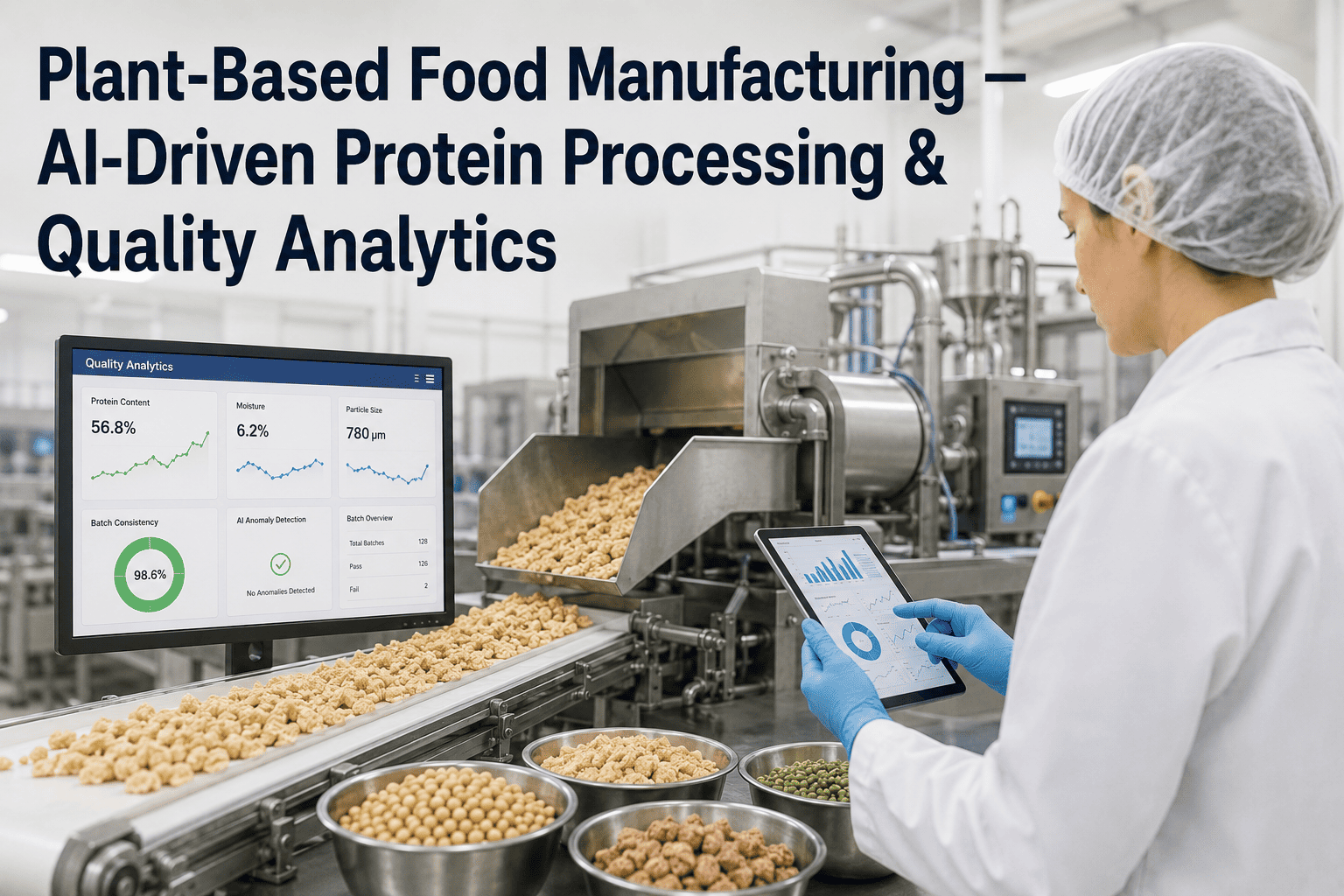
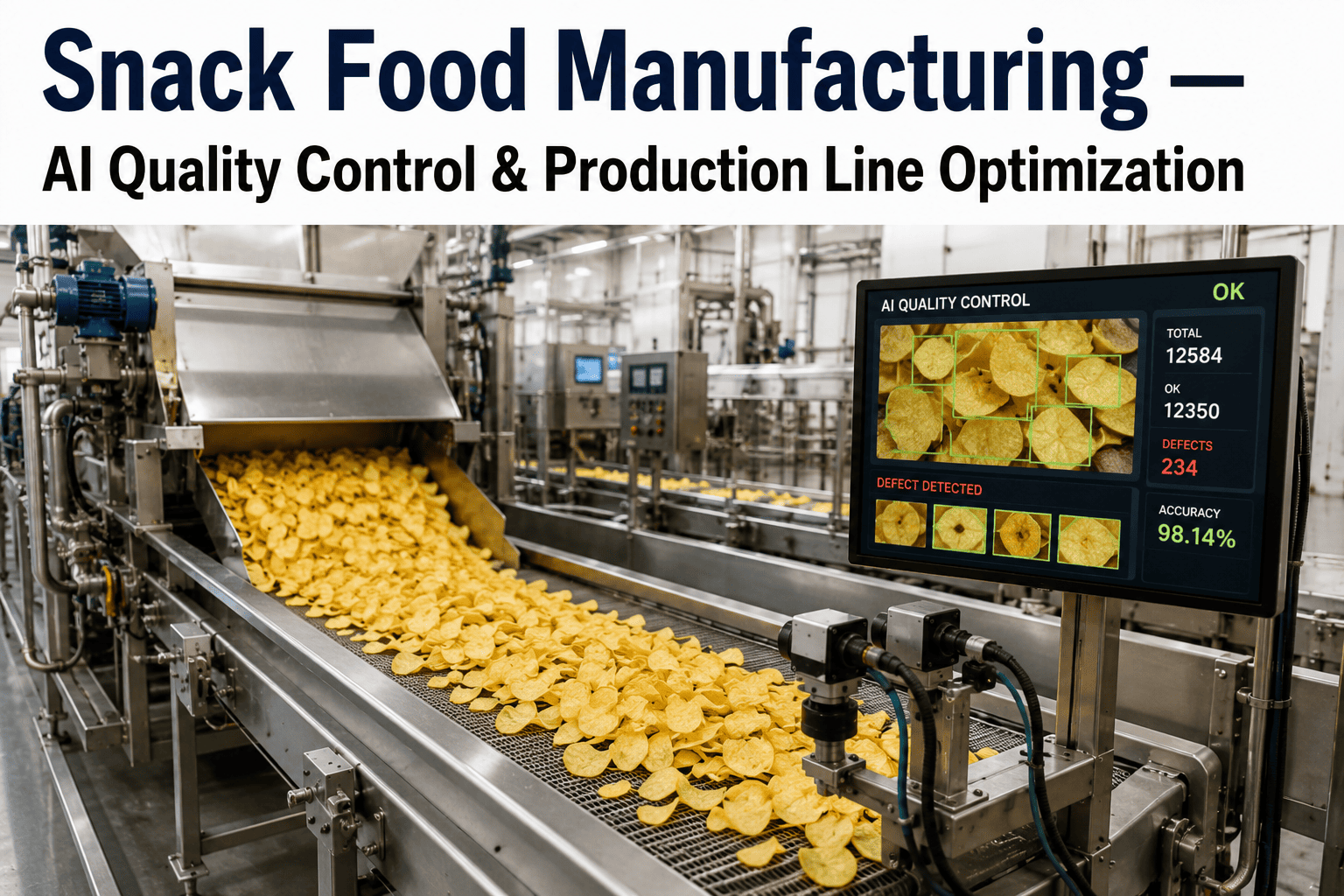
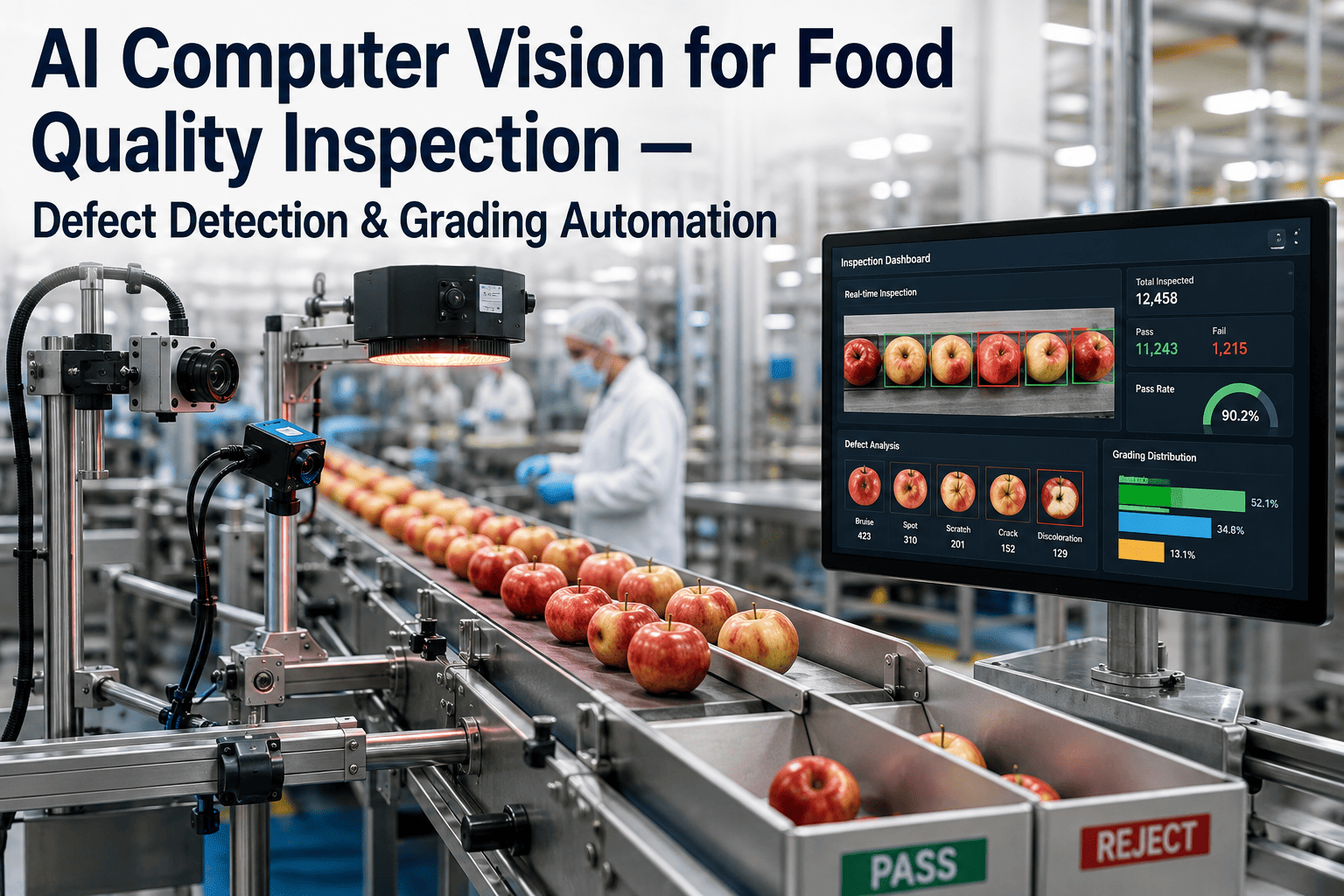
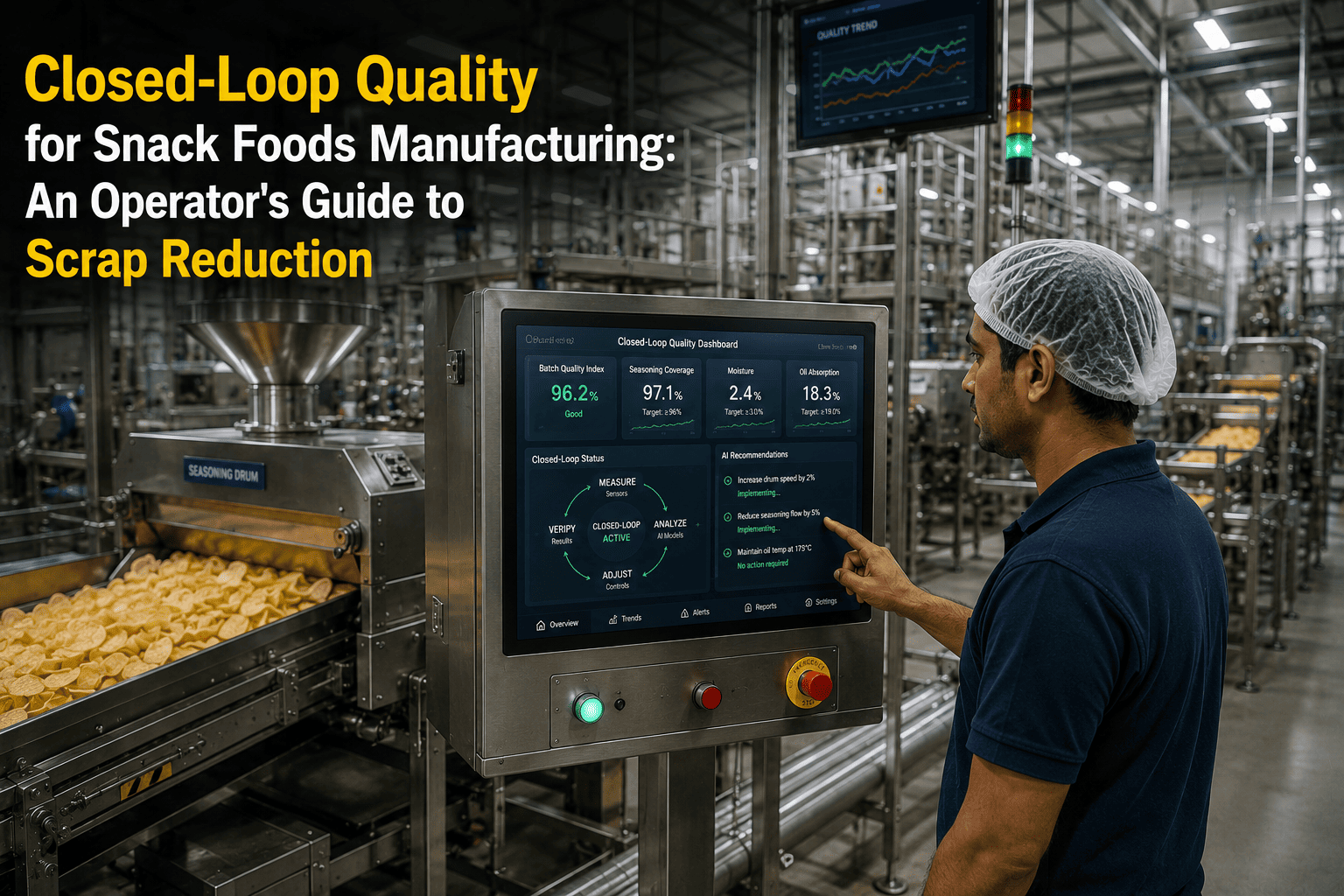
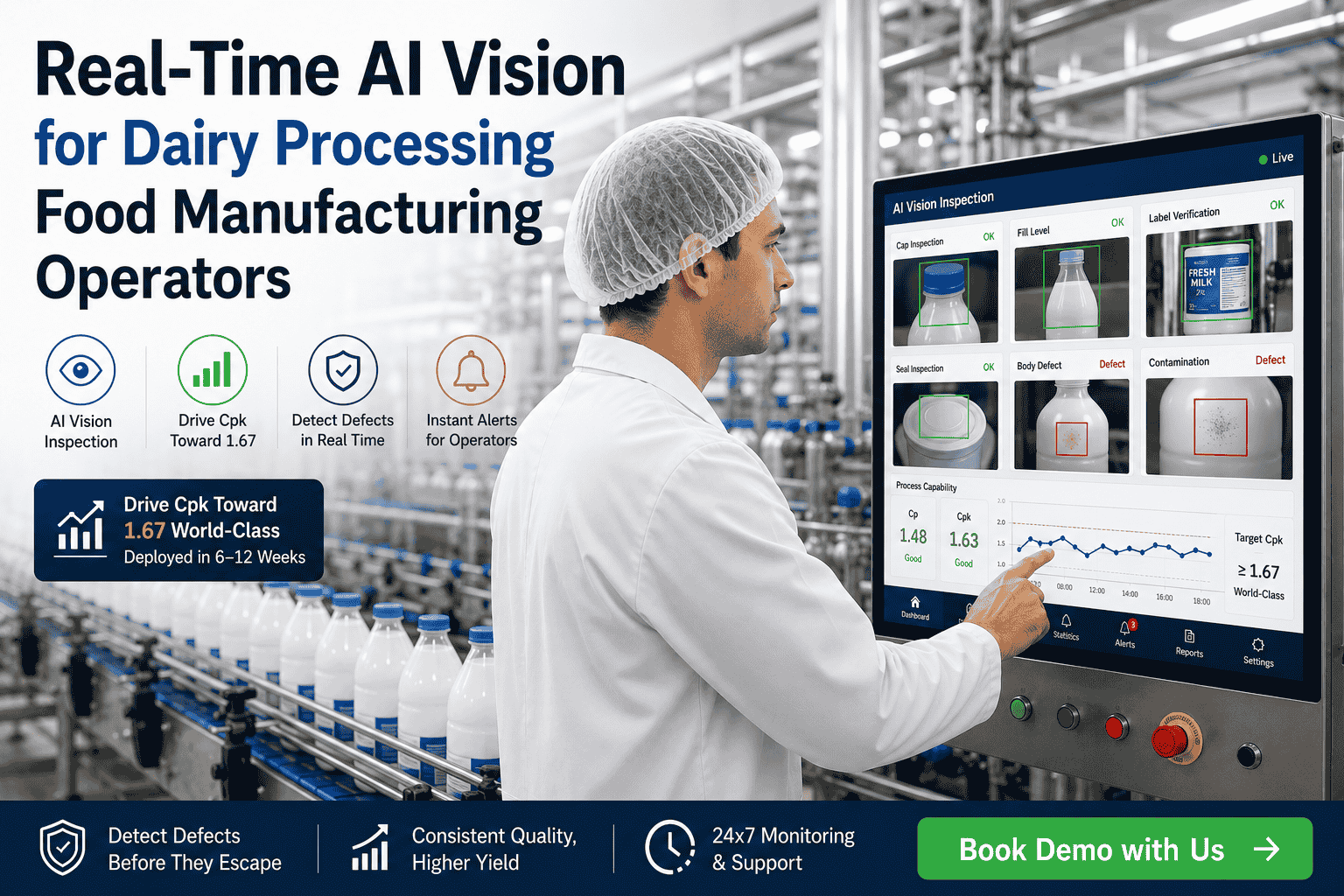
AI-powered quality control in food manufacturing is transforming how production facilities detect defects, reduce waste, and maintain compliance — delivering results that traditional sampling-based inspection methods simply cannot match. As consumer expectations tighten and regulatory requirements grow more demanding, quality managers across dairy, bakery, beverage, and packaged goods operations are turning to machine vision systems and AI-driven inspection platforms to eliminate quality failures before they reach distribution. This article examines how automated defect detection, real-time production line inspection, and HACCP-integrated AI platforms are reshaping food production quality from the ground up.
AI QUALITY CONTROL · MACHINE VISION INSPECTION
See AI Quality Inspection in Action on Your Production Line.
Discover how iFactory's machine vision and AI-driven quality analytics platform reduces defect rates, eliminates waste, and strengthens HACCP compliance across every production shift.
Why Traditional Quality Control Falls Short in Food Manufacturing
Manual and sampling-based quality control methods were designed for a slower production era. Today's high-speed food processing lines — running at 300 to 1,200 units per minute — produce defects faster than human inspectors can observe, log, and respond. Statistical sampling catches quality trends after they have already propagated across thousands of units. Visual inspection fatigue introduces variability across shifts. And paper-based HACCP records create traceability gaps that regulators and retail buyers find increasingly unacceptable. The limitations are structural, not personnel-based — and AI-powered quality control in food manufacturing addresses each of them at the systems level.
How Machine Vision Food Inspection Works at Production Speed
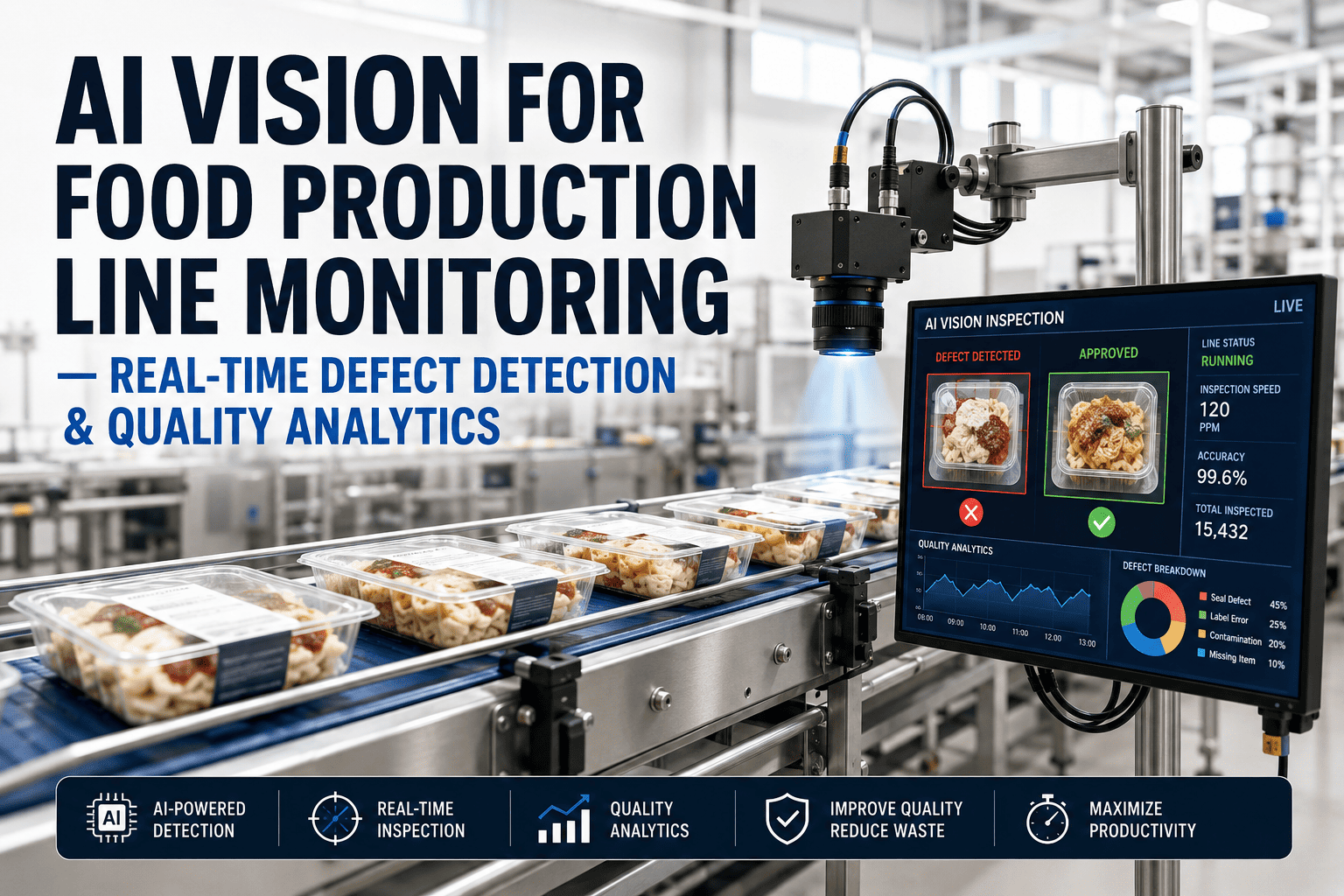
Machine vision food inspection systems deploy high-resolution industrial cameras — often hyperspectral, multispectral, or near-infrared — positioned at critical control points along the production line. Deep learning models trained on tens of thousands of product images analyze every unit in milliseconds, classifying defects by type, severity, and location. Unlike rule-based vision systems that require manual threshold configuration, AI models learn product-specific quality characteristics and improve detection accuracy with every production run. Book a Demo to see how machine vision deploys across packaging, filling, and sealing operations.
Image Acquisition at Line Speed
Industrial cameras capture 2D, 3D, and spectral images of every product unit as it moves through the line — without slowing production or introducing physical contact that could cause contamination.
Deep Learning Defect Classification
Convolutional neural networks classify each image against trained quality models — identifying surface defects, packaging failures, fill level deviations, label errors, and contamination indicators in under 10 milliseconds.
Automated Rejection and Routing
Non-conforming units trigger automated rejection mechanisms — pneumatic ejectors, diverter gates, or conveyor stops — without human intervention, maintaining line throughput while isolating defective product.
Real-Time Quality Data Logging
Every inspection event is time-stamped and linked to batch, shift, and equipment records — creating a complete quality audit trail that supports HACCP documentation, regulatory compliance, and root cause investigations.
Automated Defect Detection: Key Application Areas in Food Processing
Automated defect detection in food manufacturing covers a broader inspection scope than many quality managers initially recognize. Modern AI vision systems do not just check for visible surface defects — they inspect packaging integrity, verify labeling accuracy, detect foreign objects below visible threshold, and monitor fill levels simultaneously on a single production pass. For quality managers evaluating AI food safety investments, understanding the full detection capability spectrum is essential for calculating true ROI. Book a Demo to map inspection requirements across your specific product lines.
| Defect Category | Traditional Detection Method | AI Vision Capability | Detection Improvement |
|---|---|---|---|
| Packaging Seal Failures | Manual visual sampling (1–2%) | 100% in-line thermal seal inspection | 98% leaker escape rate reduction |
| Foreign Object Contamination | Metal detection only | Multispectral imaging + X-ray AI | Detects non-metallic, glass, bone fragments |
| Fill Level Deviation | Checkweigher sampling | Real-time volumetric AI measurement | 30–45% overfill waste reduction |
| Label Accuracy | Manual spot-check per SKU changeover | OCR + barcode verification every unit | Allergen mislabeling events eliminated |
| Surface / Colour Defects | Human visual inspection (fatigues) | Hyperspectral colour anomaly detection | 35–50% defect escape rate reduction |
Foreign Object Detection: Closing the Gap That Conventional Systems Miss
Foreign object detection is the most high-stakes quality challenge in food processing — a single contamination event can trigger a nationwide recall costing an average of $10 million in remediation, regulatory response, and brand damage. Traditional metal detectors and basic X-ray systems miss non-metallic contaminants including glass fragments, hard plastic pieces, rubber gasket materials, and bone splinters below certain size thresholds. AI-driven inspection platforms running multispectral and X-ray AI models detect these materials based on density signatures, spectral absorption profiles, and geometric anomaly patterns — providing a detection capability several orders of magnitude beyond threshold-based approaches. Book a Demo to review foreign object detection capabilities for your product category.
AI Food Safety and HACCP Quality Compliance Integration
HACCP quality compliance frameworks require documented critical control point (CCP) monitoring with verifiable corrective action records. AI-powered quality platforms automate this documentation layer — logging inspection results, flagging CCP deviations, triggering corrective action workflows, and generating audit-ready reports without manual data entry. For quality managers facing SQF, BRC, FSSC 22000, or FDA FSMA audits, AI-integrated HACCP platforms eliminate the documentation burden that consumes 30–40% of QA team time in conventionally managed facilities. Book a Demo to see automated HACCP documentation and CCP monitoring in practice.
Automated CCP Monitoring and Alerting
AI platforms continuously monitor temperature, pressure, pH, water activity, and visual inspection data at defined critical control points — triggering instant alerts when parameters breach HACCP limits and automatically logging the deviation with timestamp, severity, and affected batch identifiers.
Corrective Action Workflow Automation
When a quality deviation triggers a HACCP alert, AI systems automatically initiate corrective action workflows — notifying responsible personnel, holding affected product lots, and documenting the response chain in a format that satisfies third-party auditor requirements.
Audit-Ready Traceability Records
Every inspection event, parameter deviation, and corrective action is linked to batch genealogy records — providing end-to-end traceability from raw material receipt through finished goods dispatch that meets FDA FSMA recordkeeping requirements.
Predictive Non-Conformance Detection
Machine learning models analyze process parameter trends to identify conditions that historically precede quality failures — enabling corrective intervention before CCPs are breached rather than responding after the fact.
Food Waste Reduction Through AI-Driven Quality Optimization
AI quality control delivers a counterintuitive outcome that surprises many quality managers: it reduces both defect escape rates and food waste simultaneously. Traditional over-specification of quality thresholds — set conservatively to compensate for human inspection variability — results in substantial false rejection of acceptable product. AI inspection systems, with consistent sub-millisecond decision accuracy, allow threshold recalibration to true quality boundaries rather than compensatory buffers. Food manufacturers deploying AI-driven quality control report food waste reductions of 15–28% from false reject elimination alone, before accounting for the upstream waste prevented by catching process deviations earlier in the production run.
Predictive Quality Analytics: From Inspection to Prevention
The highest-value capability in AI food manufacturing quality platforms is not detection — it is prediction. Predictive quality analytics models correlate real-time process parameters (mixing time, temperature profile, ingredient batch characteristics, equipment vibration signatures) with historical quality outcomes to forecast end-product quality before offline lab testing confirms it. Quality managers gain the ability to intervene — adjusting process parameters or diverting product for enhanced inspection — hours before quality failures would otherwise materialize at the finished goods stage. This predictive layer is what separates AI-driven quality control from AI-assisted inspection, and it is where the largest ROI is realized.
Ingredient Variability Compensation
AI models detect batch-to-batch variability in raw material quality and automatically recommend process parameter adjustments to maintain consistent finished product quality despite upstream supply inconsistency.
Equipment Degradation Quality Correlation
Condition monitoring data from fillers, sealers, and mixing equipment is correlated with quality outcomes — flagging equipment whose degradation trajectory predicts imminent quality failures before they begin.
In-Process Quality Prediction
Multivariate models estimate final product quality attributes — texture, moisture content, microbial load, sensory profile — from in-process sensor data, providing quality confirmation hours ahead of lab results.
Statistical Process Control Automation
Automated SPC charts continuously monitor quality KPIs across all production lines — detecting mean shifts, increasing variance, and special cause events that manual charting would miss between sampling intervals.
ROI Framework: Measuring the Financial Impact of AI Quality Control
For quality managers building the business case for AI food safety investments, the ROI calculation spans multiple value streams that individually justify deployment and collectively deliver payback periods of 12–18 months in most food manufacturing environments. Recall avoidance — preventing a single $10M recall event — typically covers the full platform deployment cost. Operational savings from waste reduction, rework elimination, and QA labor reallocation provide the ongoing positive cash flow that makes AI quality control a financially compelling investment at virtually every production scale.
Implementation Roadmap: Deploying AI Quality Control in Food Facilities
Successful AI quality control deployment in food manufacturing follows a staged implementation model that delivers measurable value at each phase while managing integration complexity. Phase 1 deploys machine vision at the highest-risk inspection point — typically sealing or labeling — to demonstrate detection capability and establish baseline data. Phase 2 expands coverage to additional CCPs and integrates inspection data with existing MES and HACCP documentation systems. Phase 3 introduces predictive quality models trained on accumulated historical data. This progression allows quality teams to build internal capability, validate ROI, and scale investment in proportion to demonstrated results.
PREDICTIVE QUALITY ANALYTICS · AI-DRIVEN PRODUCTION INTELLIGENCE
Build a Defect-Free Production Environment with iFactory AI.
From machine vision inspection to predictive quality analytics and automated HACCP compliance — iFactory's AI quality platform integrates with your existing production systems to eliminate defects, reduce waste, and protect your brand from recall risk.
Frequently Asked Questions
What is AI-powered quality control in food manufacturing?
AI quality control uses machine vision cameras, deep learning algorithms, and predictive analytics to inspect 100% of production output at full line speed — detecting defects, contamination, and process deviations that sampling-based manual methods routinely miss.
How does machine vision food inspection differ from traditional X-ray or metal detection?
Machine vision detects surface defects, fill levels, label accuracy, and packaging integrity that X-ray and metal detection cannot assess. Combined with multispectral imaging, AI vision also identifies non-metallic foreign objects, colour anomalies, and contamination indicators beyond the capability of conventional detection technologies.
Can AI quality control platforms integrate with existing HACCP systems?
Yes. Modern AI quality platforms integrate with HACCP documentation systems through standard APIs — automatically logging CCP monitoring data, triggering corrective action workflows, and generating audit-ready reports that satisfy SQF, BRC, FSSC 22000, and FDA FSMA requirements.
What ROI can food manufacturers expect from AI quality control investments?
Most food facilities achieve payback within 12–18 months from defect reduction, waste elimination, recall risk mitigation, and QA labor redeployment. A single avoided recall event typically covers the full platform deployment cost multiple times over.
How long does AI quality control deployment take in a food plant?
Focused deployments for a single inspection point complete in 6–10 weeks. Multi-line implementations with full MES and HACCP integration typically require 3–6 months. Staged approaches deliver value incrementally from the first deployed inspection station.
Does AI quality control work for small and mid-size food manufacturers?
Cloud-based AI quality platforms with modular deployment models make inspection AI accessible without large capital investments. Small and mid-size manufacturers can start with targeted deployments at highest-risk inspection points and expand as ROI is demonstrated.
FOOD MANUFACTURING AI · ZERO-DEFECT QUALITY PROGRAM
Stop Reacting. Start Preventing Quality Failures at the Source.
Join food manufacturers achieving 30–50% defect escape rate reductions with iFactory's AI quality platform — purpose-built for dairy, bakery, beverage, and packaged goods operations.