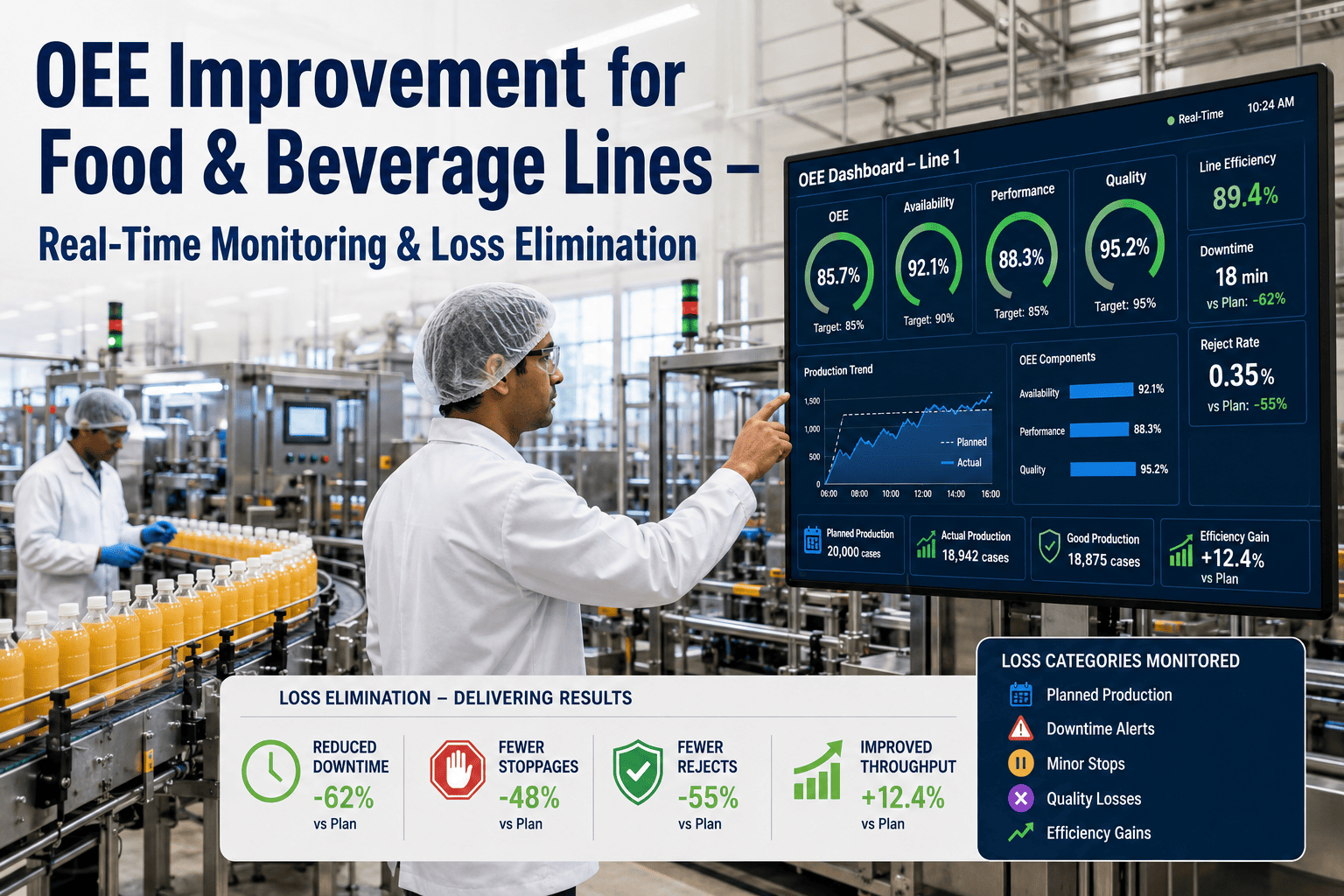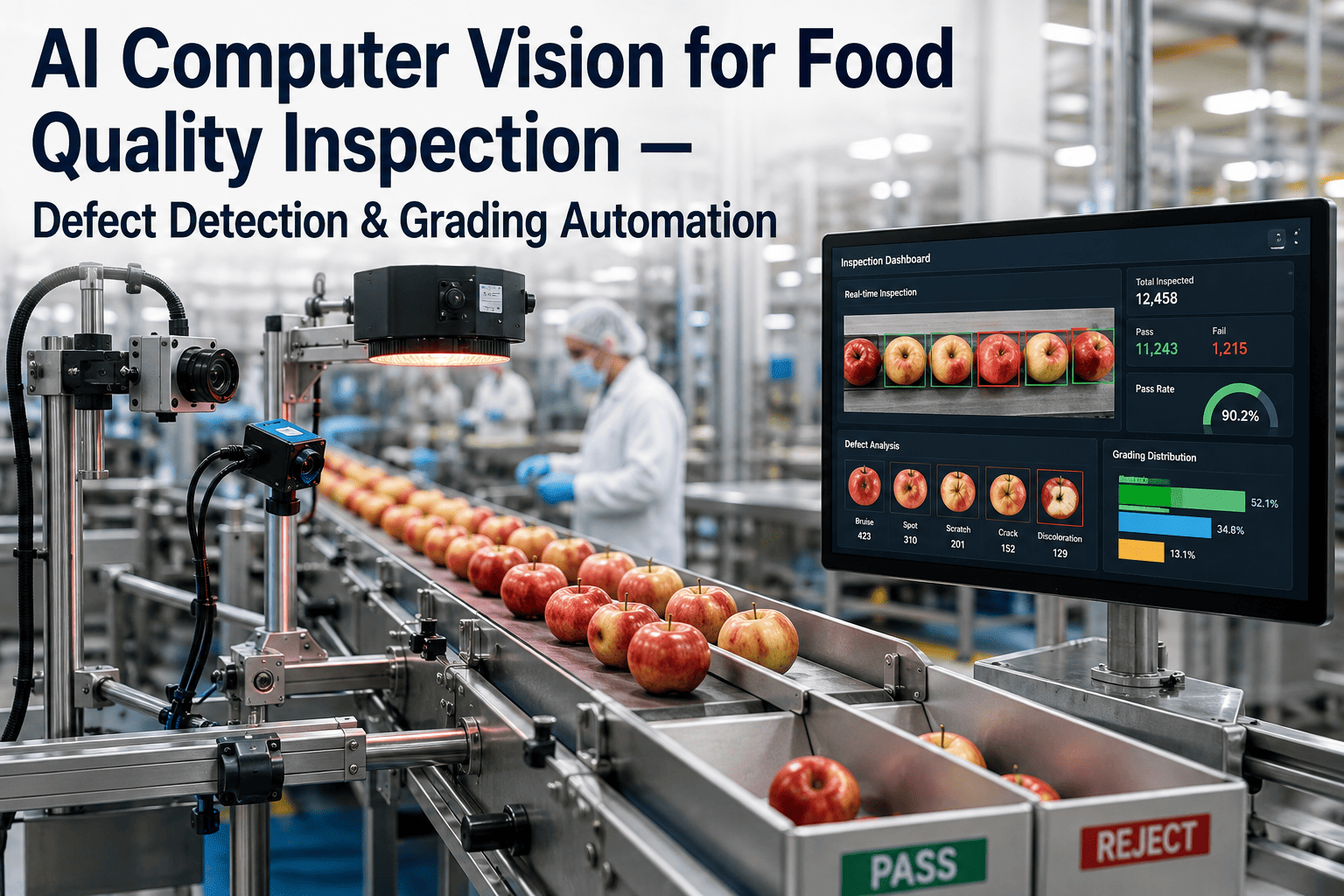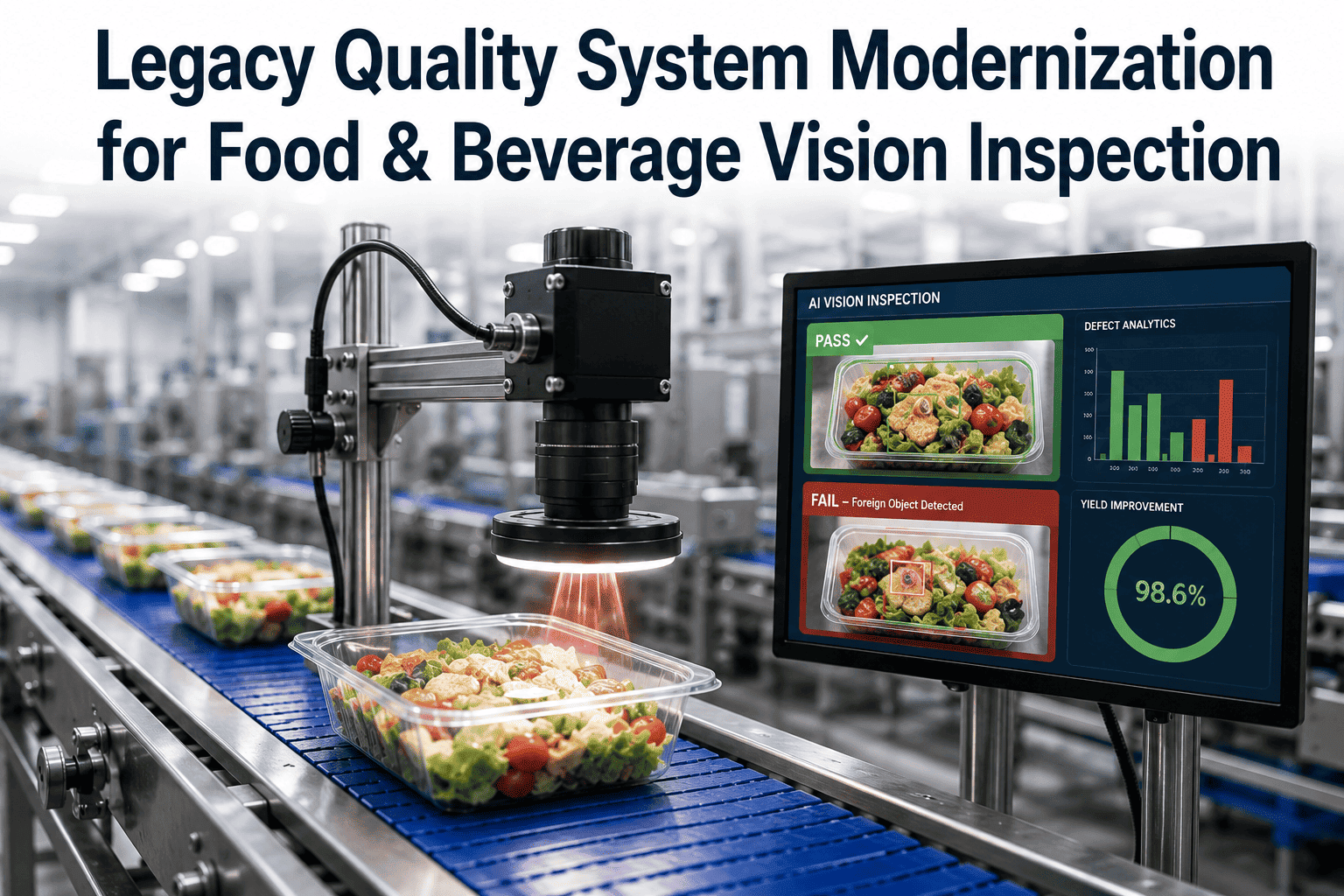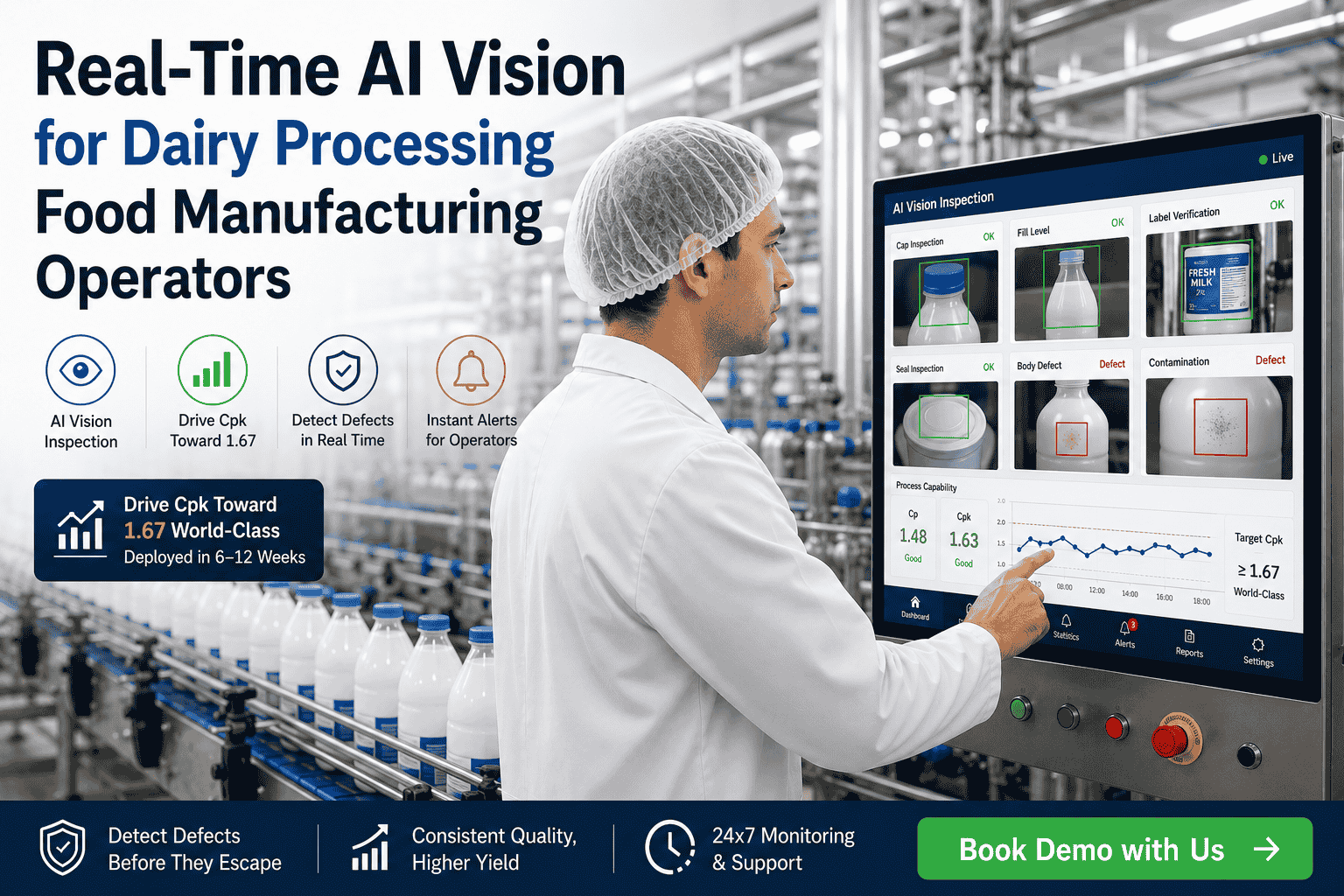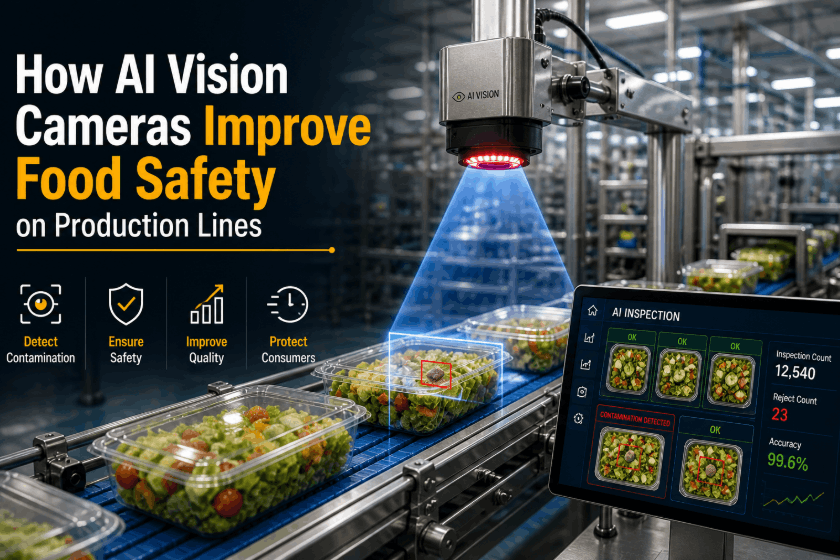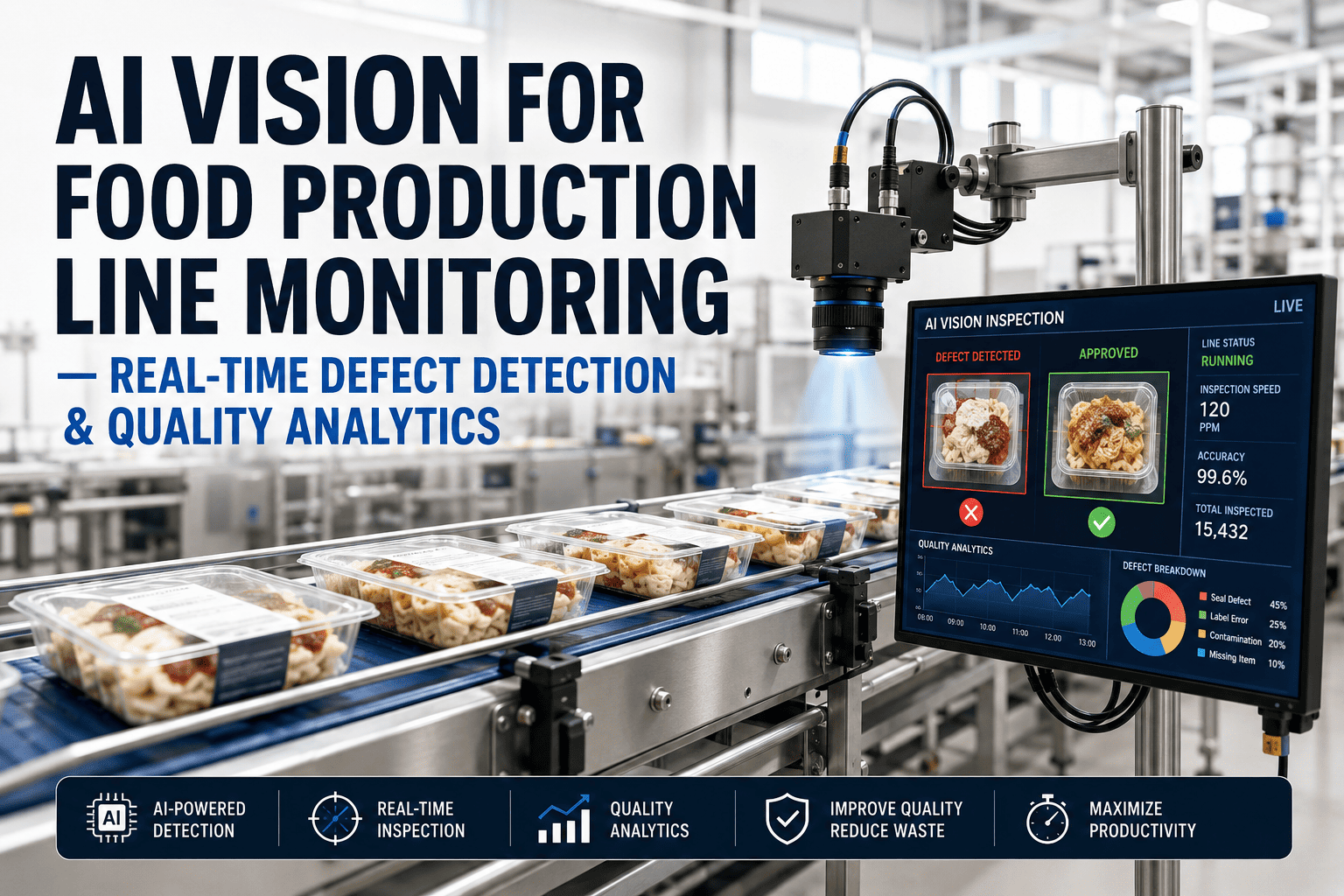
Food production lines are the backbone of global food supply, yet they face persistent quality challenges: foreign objects, discoloration, shape anomalies, and packaging defects. Traditional manual inspection is slow, inconsistent, and costly, often missing critical defects as line speeds increase. AI vision systems, powered by deep learning and computer vision, offer a transformative solution by enabling continuous, real-time defect detection at speeds exceeding 600 products per minute. This article provides a comprehensive technical guide for deploying AI vision on food production lines, covering camera placement strategies, lighting optimization, defect classification model training, real-time alert configuration, and seamless integration with automated reject systems. By leveraging advanced neural networks and edge computing, manufacturers can achieve near-zero defect escape rates while reducing waste and operational costs. Whether you are a quality manager, process engineer, or plant director, this guide will equip you with actionable insights to modernize your quality control pipeline. Book a Demo today to see how AI vision can transform your production line.
AI Vision for Food Production Line Monitoring
Real-time defect detection and quality analytics at line speed.
Why Traditional Inspection Fails
Human Fatigue
Manual inspectors miss up to 30% of defects after 20 minutes of continuous work, especially on high-speed lines. AI vision never tires, maintaining consistent accuracy throughout shifts.
Inconsistent Standards
Different inspectors apply subjective criteria, leading to variable quality. AI models enforce uniform defect classification based on trained parameters, ensuring every product meets the same high standard.
Slow Response
By the time a human spots a defect trend, hundreds of faulty products may have passed. Real-time AI alerts enable immediate corrective action, minimizing waste and rework.
Limited Traceability
Manual inspection lacks digital records. AI vision logs every defect with timestamps and images, providing full traceability for audits and continuous improvement.
Camera Placement Strategies
Optimal camera positioning is critical for capturing high-quality images. Consider these placement principles:
Overhead Mount
Best for inspecting flat products like cookies, slices, or packaged items. Provides a top-down view to detect surface defects, discoloration, and foreign objects.
Side-Angle Mount
Ideal for cylindrical or irregular shapes (bottles, cans, fruits). Multiple side cameras capture the entire circumference, detecting dents, labels, and seal integrity.
Multi-Angle Array
For complex products, deploy an array of cameras at different angles. Synchronized capture creates a 3D-like representation for thorough defect analysis.
| Product Type | Recommended Mount | Camera Resolution | Frame Rate (fps) |
|---|---|---|---|
| Bakery items | Overhead | 5 MP | 30 |
| Beverage bottles | Side-angle | 12 MP | 60 |
| Fresh produce | Multi-angle | 20 MP | 90 |
Lighting Optimization for Consistent Imaging
Proper lighting reduces shadows, reflections, and glare, ensuring consistent image quality for AI analysis.
Diffuse Lighting
Use diffusers to soften light and eliminate harsh shadows. Ideal for shiny surfaces like plastic packaging or glass.
Backlighting
Place lights behind the product to create a silhouette, enhancing edge detection for shape and size verification.
Structured Light
Project a known pattern onto the product to detect surface deformities and 3D irregularities.
Defect Classification Model Training
Training a robust AI model requires labeled datasets of both normal and defective products. Follow these steps:
Data Collection
Capture at least 10,000 images per product type under varying lighting and angles. Include examples of all defect classes: foreign objects, discoloration, shape anomalies, packaging tears, and missing components.
Annotation
Use bounding boxes or segmentation masks to label each defect. For foreign object detection, pixel-level annotation yields higher accuracy. Ensure inter-annotator agreement by having multiple experts review.
Model Selection
Choose a lightweight architecture like YOLOv8 or EfficientDet for real-time performance. For high-accuracy needs, consider Vision Transformers (ViT) but account for higher computational cost.
Training & Validation
Split data 80-20 for training and validation. Use data augmentation (rotation, flipping, brightness changes) to improve generalization. Monitor precision, recall, and F1-score. Achieve at least 99% accuracy before deployment.
Ready to Deploy AI Vision on Your Line?
Our experts will guide you from camera placement to model training. Get a customized demo for your production environment.
Real-Time Alerts & Dashboard
Configure alerts to notify operators and managers instantly when defects exceed thresholds.
Visual Dashboard
Real-time display of defect rates, product counts, and line speed. Color-coded indicators (green, yellow, red) show line health at a glance.
SMS/Email Alerts
Set thresholds for defect rate (e.g., >2%) to trigger immediate notifications. Include defect images in alerts for rapid assessment.
Trend Analysis
Historical charts show defect trends by shift, product, or machine. Identify recurring issues and schedule preventive maintenance.
Integration with Reject Systems
Automated reject systems remove defective products without slowing the line. Integration steps:
Pneumatic Pushers
For lightweight items, pneumatic arms push defective products off the conveyor. AI triggers the arm within 50ms of detection.
Air Blast Rejectors
For small, fast-moving items (nuts, seeds), compressed air jets blow defects into a reject bin. Suitable for speeds up to 1000 ppm.
Robotic Pick-and-Place
For fragile or irregular products, collaborative robots gently pick defects and place them in a reject tray. Ideal for baked goods or fresh produce.
| Reject Method | Speed (ppm) | Best For | Cost |
|---|---|---|---|
| Pneumatic Pusher | 600 | Packaged goods | Low |
| Air Blast | 1000 | Small items | Medium |
| Robotic Pick-and-Place | 200 | Fragile products | High |
Frequently Asked Questions
How long does it take to train an AI vision model for food defect detection?
Training time depends on dataset size and model complexity. For a typical production line with 10,000 images, training a YOLOv8 model on a single GPU takes 4-8 hours. However, the entire process including data collection, annotation, and validation may take 2-4 weeks. Our team can accelerate this using pre-trained models and transfer learning. Book a Demo to see a live training session.
Can AI vision handle different product sizes and shapes on the same line?
Yes, by training a single model on multiple product variants using data augmentation and multi-class labeling. The model learns to distinguish between acceptable variations and true defects. For extreme size differences, consider using multiple cameras with different fields of view or a dynamic cropping algorithm. Contact Support for custom integration guidance.
What is the ROI of deploying AI vision on a food production line?
Typical ROI is achieved within 6-12 months through reduced waste (up to 80%), lower labor costs, fewer customer complaints, and increased throughput. For a mid-sized line producing 10 million units annually, savings can exceed $500,000 per year. Book a Demo for a personalized ROI calculator.
How does AI vision integrate with existing PLC and SCADA systems?
AI vision systems output standard protocols like OPC-UA, MQTT, or Modbus TCP. These can be directly ingested by PLCs for reject control or SCADA for dashboards. Our middleware provides a no-code interface to map AI outputs to existing control signals. Contact Support for a technical whitepaper on integration patterns.
What lighting conditions are best for AI vision in food production?
Consistent, diffuse lighting with a color temperature of 5000K-6500K (daylight) is ideal. Avoid direct sunlight or overhead fluorescent flicker. Use LED arrays with diffusers and polarizing filters to reduce glare from shiny packaging. Book a Demo to see our lighting optimization tool in action.
Transform Your Quality Control Today
Implement AI vision on your food production line. Reduce waste, improve safety, and boost profitability. Get started with a free consultation.