Food manufacturing has entered a new era where AI computer vision for food quality inspection is no longer experimental — it's the operational standard for facilities that compete at scale. Traditional manual inspection misses up to 15% of defects at high line speeds, while automated food inspection systems powered by machine vision deliver 99%+ accuracy across every unit, every shift, with zero fatigue. This guide breaks down exactly how AI-powered food defect detection works, what it detects, and why leading food manufacturers are deploying it now. Book a Demo to see real-time AI inspection in action at your facility.
Why Manual Food Quality Inspection Is Failing
Human inspectors remain the weakest link on high-speed production lines. The data is clear — and the liability is growing.
Defect Miss Rate
Manual inspection at production speed misses roughly 1 in 7 defects — defects that reach consumers, retailers, and regulators.
Average Recall Cost
A single product recall triggered by a missed contaminant or labeling defect costs millions before brand damage is calculated.
Inspector Fatigue Risk
Accuracy drops significantly in the final hours of any shift — creating inconsistent quality windows that AI systems eliminate entirely.
AI Response Time
Machine vision flags and ejects defective units in real time — no delay, no second-guessing, no missed batches.
How AI Computer Vision Detects Food Defects in Real Time
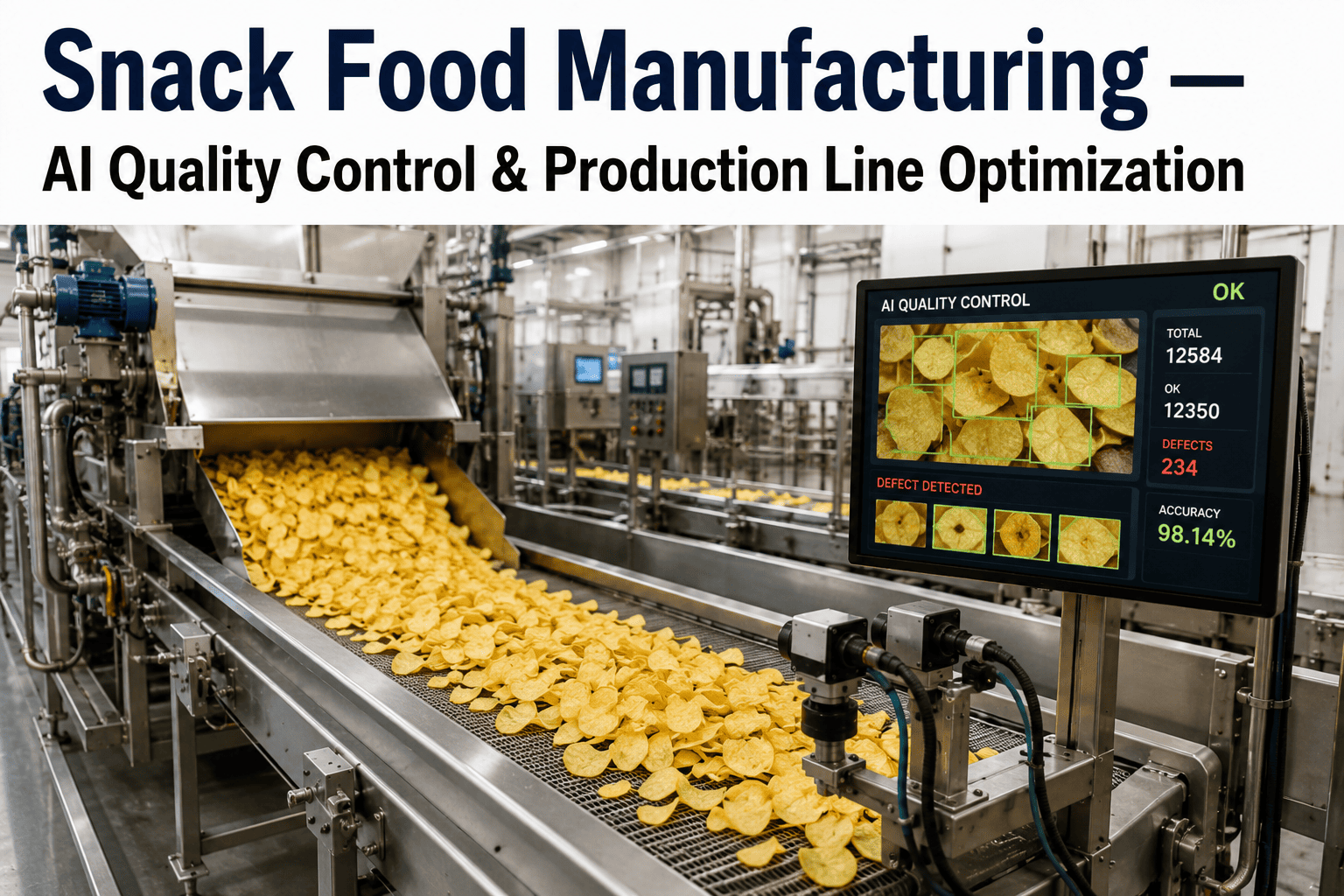
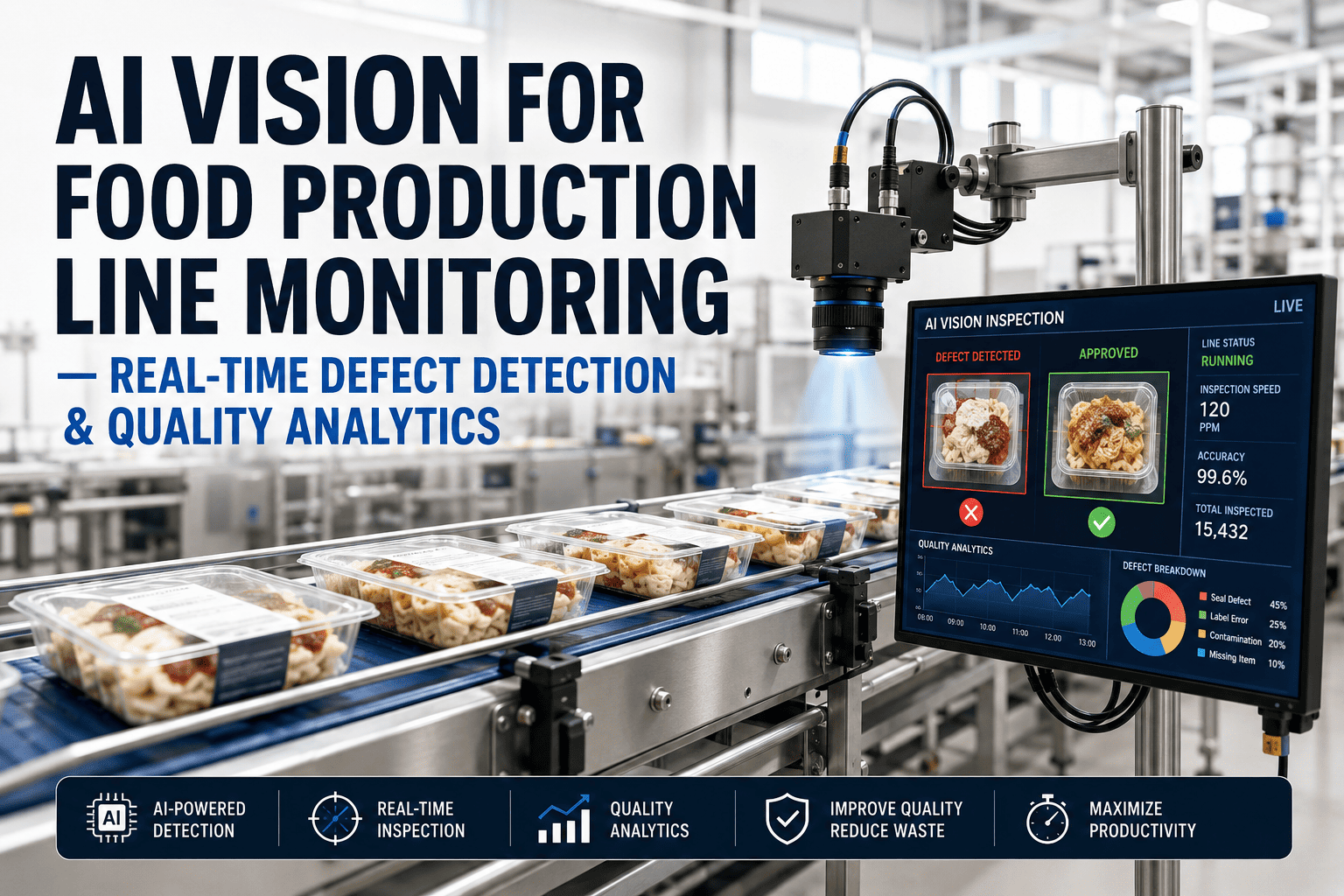
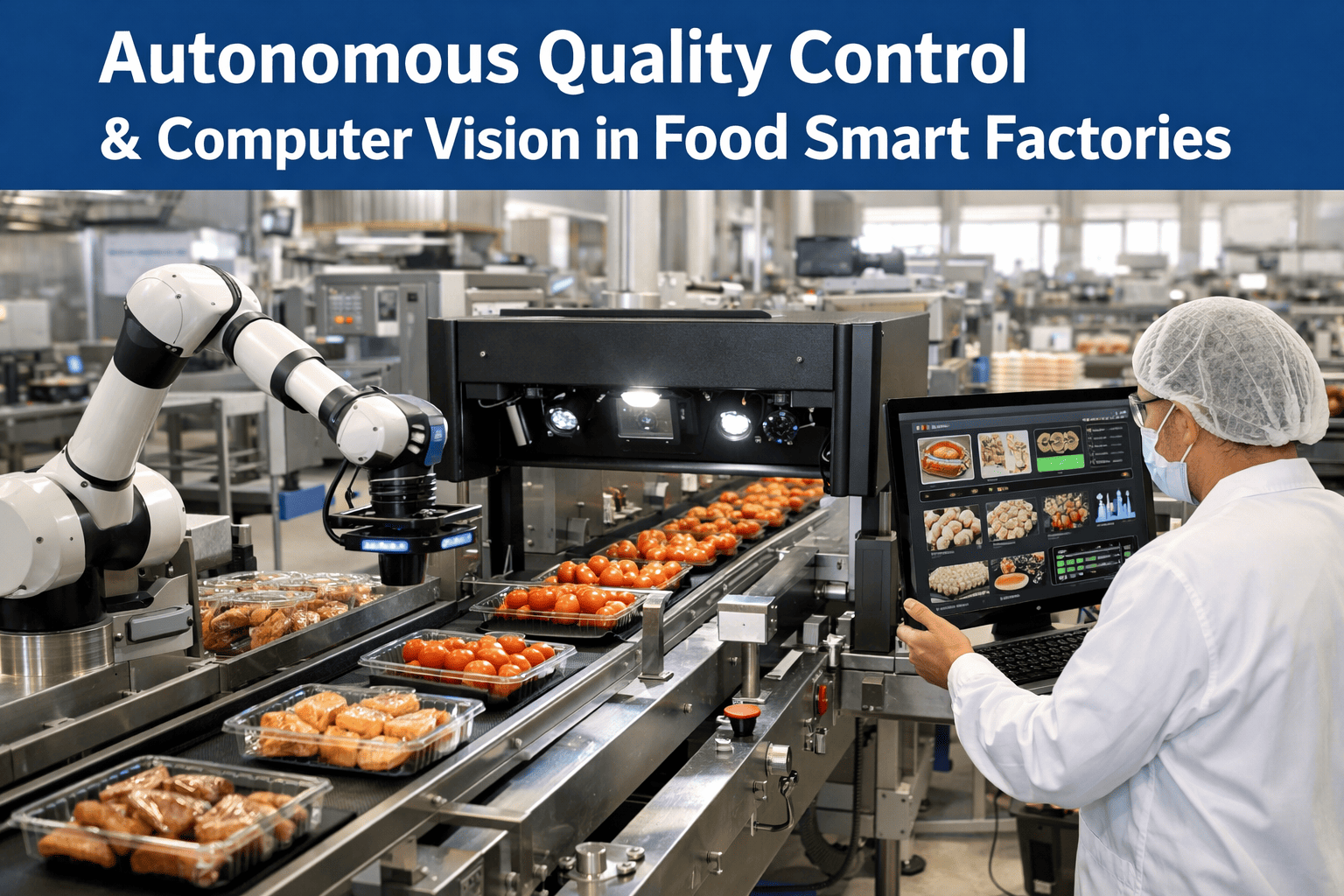
Modern AI food safety inspection systems combine deep learning, high-resolution imaging, and edge computing to deliver production-speed defect detection without line slowdowns.
Multi-Spectrum Image Capture
High-speed cameras capture RGB, hyperspectral, X-ray, and near-infrared imagery simultaneously — detecting surface defects, internal contamination, and foreign objects invisible to the human eye. Every unit is imaged in milliseconds.
Deep Learning Classification Engine
Convolutional neural networks trained on millions of labeled food images classify each unit across dozens of defect categories simultaneously — shape deviations, color anomalies, contamination signatures, and packaging faults — all in under 10ms per frame.
Automated Rejection & Traceability Link
Defective units trigger pneumatic rejection mechanisms in real time. Every rejection event is logged with image evidence, defect classification, timestamp, and lot code — feeding directly into your traceability system for full FSMA 204 compliance.
Continuous Model Learning
The AI model improves with every production run. Inspection data feeds back into model retraining cycles, improving detection accuracy over time and adapting to new product SKUs without manual reprogramming.
What AI Food Defect Detection Actually Catches
A complete computer vision food quality control system covers far more defect categories than traditional cameras or human inspection.
| Defect Category | Detection Method | Detection Accuracy | Action Triggered |
|---|---|---|---|
| Foreign Object Contamination | X-ray + AI classification | 99.7% | Immediate line rejection + alert |
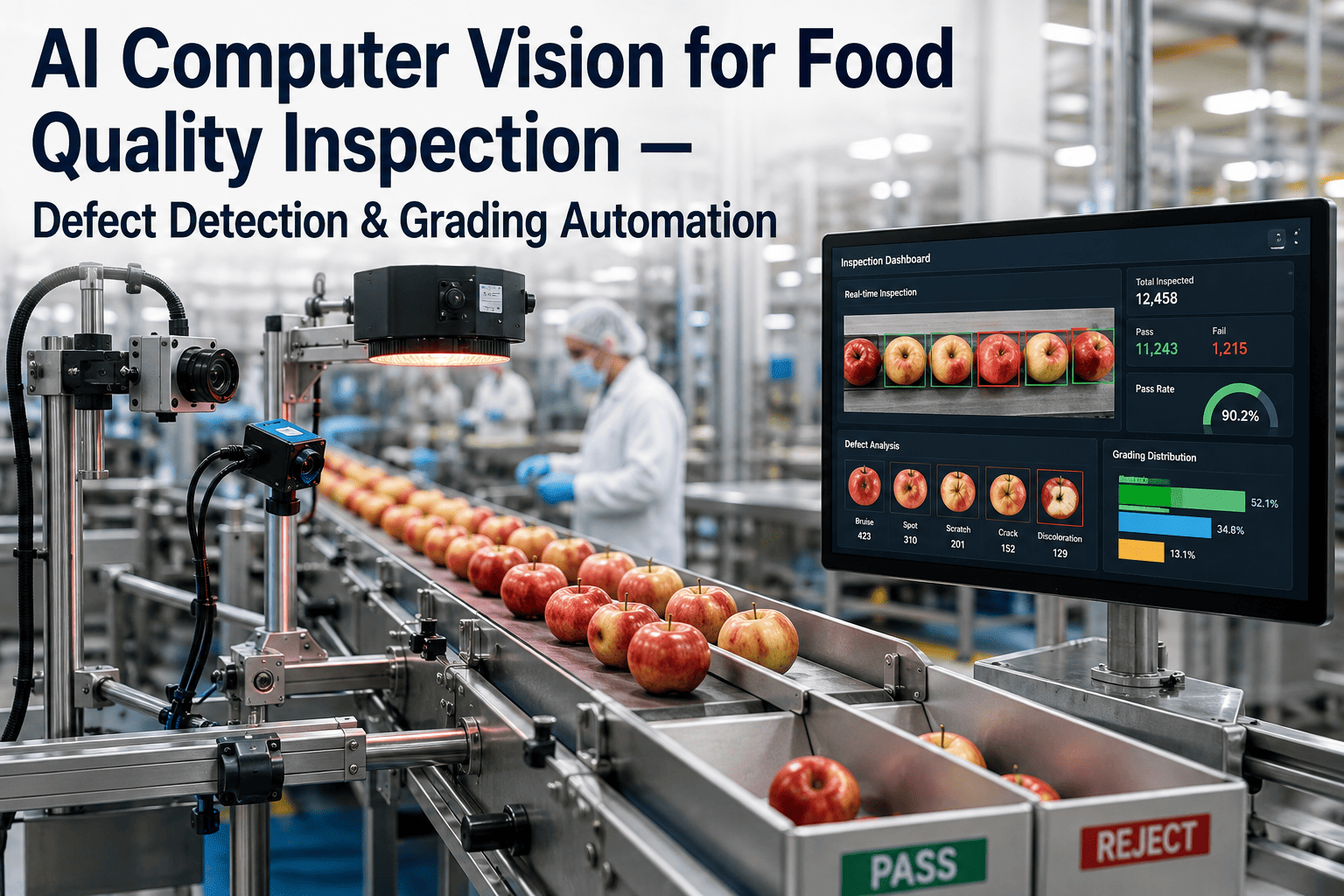
| Surface Defects (bruising, mold, cuts) | RGB + hyperspectral imaging | 99.2% | Grade-based routing or reject |
| Shape & Size Deviation | 3D vision + dimensional AI | 99.8% | Rework queue or reject |
| Color Anomalies (undercooking, spoilage) | Near-infrared spectroscopy + AI | 98.9% | Hold for QC review |
| Packaging Defects (seal, label, fill) | Machine vision + OCR AI | 99.5% | Repack or reject |
| Allergen Cross-Contact Indicators | Hyperspectral + residue AI | 98.4% | Line stop + sanitation alert |
| Weight & Fill Underfill | Vision + checkweigher integration | 99.9% | Reject + filler calibration flag |
5 AI Vision Capabilities Transforming Food Quality Control
The essential machine vision food processing capabilities that replace manual QC across the entire production line.
Real-Time Defect Classification
AI models classify defects across 50+ categories simultaneously at full line speed — no sampling, no batch delays.
Packaging Integrity Inspection
Verify seal quality, label accuracy, barcode readability, and fill levels on every unit before it leaves the line.
Foreign Object & Contaminant Detection
X-ray and hyperspectral AI catches metal, glass, bone, rubber, and biological contaminants before products ship.
Automated Food Grading & Sorting
AI grades produce, proteins, and processed foods by size, color, and quality — routing each unit to the right channel automatically.
Predictive Quality Analytics
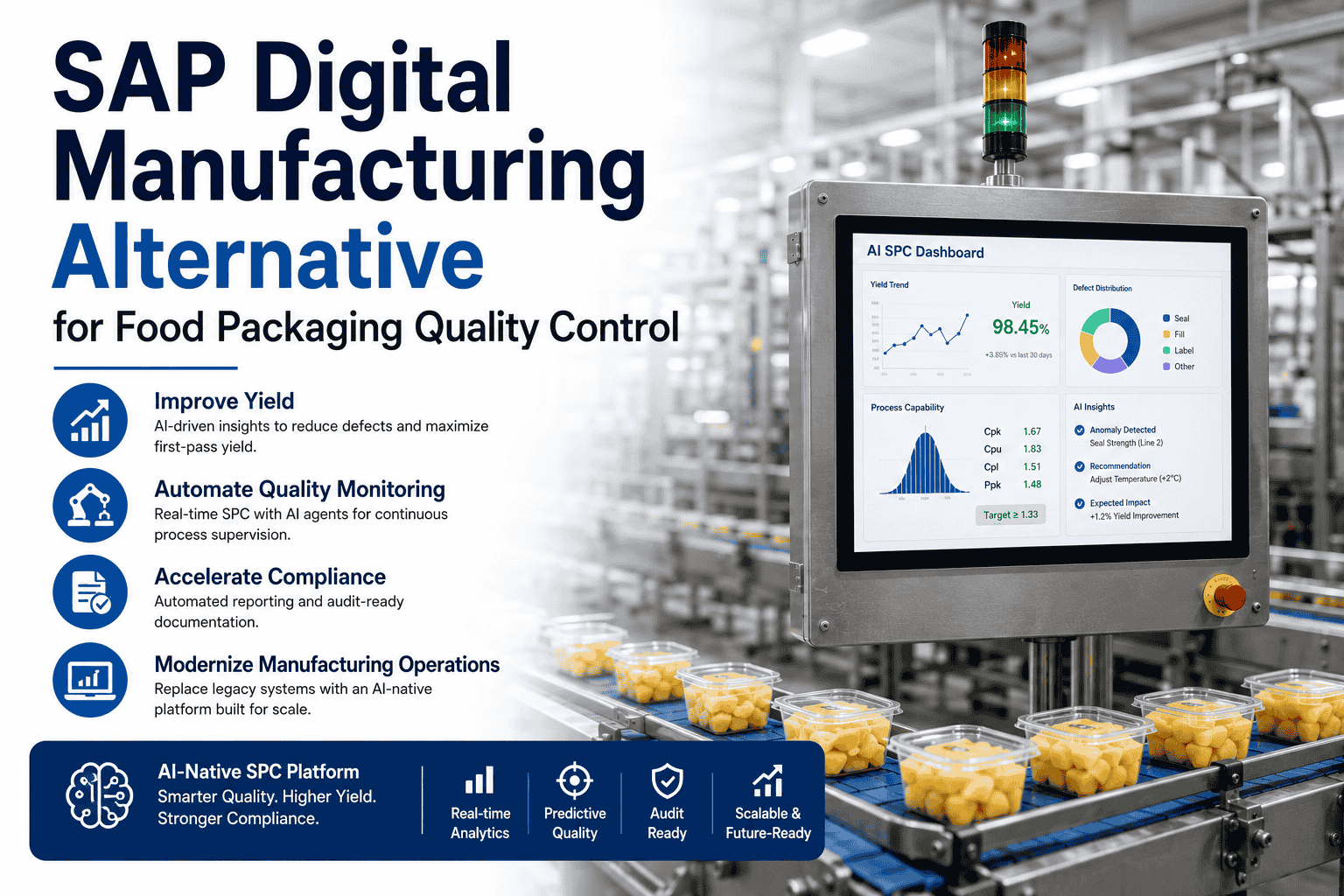
AI aggregates inspection data across shifts and lines to predict quality drift before defect rates spike — enabling proactive intervention.
AI Food Inspection vs. Traditional Quality Control: A Direct Comparison
The operational gap between automated food inspection AI and legacy QC methods is widening fast. Here's where the difference shows up on your bottom line.
| Capability | Manual / Traditional | AI Computer Vision |
|---|---|---|
| Inspection Speed | 200–400 units/min max | 3,000+ units/min |
| Detection Accuracy | 85% (fatigue-dependent) | 99%+ consistently |
| Defect Categories Detected | 5–10 visible categories | 50+ including internal defects |
| Compliance Documentation | Manual logs, incomplete | Auto-generated, image-evidenced |
| Consistency Across Shifts | Drops by 20–30% end of shift | 100% consistent 24/7 |
| Integration with Traceability | Siloed — no data linkage | Real-time lot-level data feed |
| ROI Timeline | Ongoing labor cost with no ROI | Payback in 8–14 months typical |
Measurable ROI from AI Food Quality Automation
Deploying AI quality control for food manufacturing delivers returns across waste reduction, compliance, and recall prevention from the first production shift.
Reduction in Quality Escapes
Defective units reaching consumers drop dramatically when 99%+ detection replaces sampling-based inspection.
Lower QC Labor Costs
AI handles 100% inline inspection. Human QC staff shift to exception handling, calibration, and process improvement.
Waste & Rework Reduction
Precise defect data pinpoints process drift early — stopping defects upstream before they create waste at scale.
AI Vision Quality Inspection Across Food Categories
Modern vision system food plant deployments cover every category from fresh produce to packaged goods, beverages, and proteins.
Fresh Produce
Detect bruising, mold, shape defects, and color anomalies on fruits and vegetables at sorting line speed. AI grading replaces manual size-based sorting entirely.
Meat & Seafood
Identify bone fragments, fat distribution deviations, color spoilage indicators, and packaging seal failures across high-speed protein processing lines.
Bakery & Confectionery
Validate shape consistency, surface finish, decoration accuracy, and packaging completeness across thousands of units per minute on bakery lines.
Packaged & Processed Foods
Inspect fill levels, seal integrity, label accuracy, and allergen declaration completeness before any case is palletized — full FSMA 204 compliance built in.
Beverages & Liquids
Detect fill deviations, cap seal failures, label placement errors, and foreign particle contamination in transparent and opaque containers at full line speed.
Dairy & Eggs
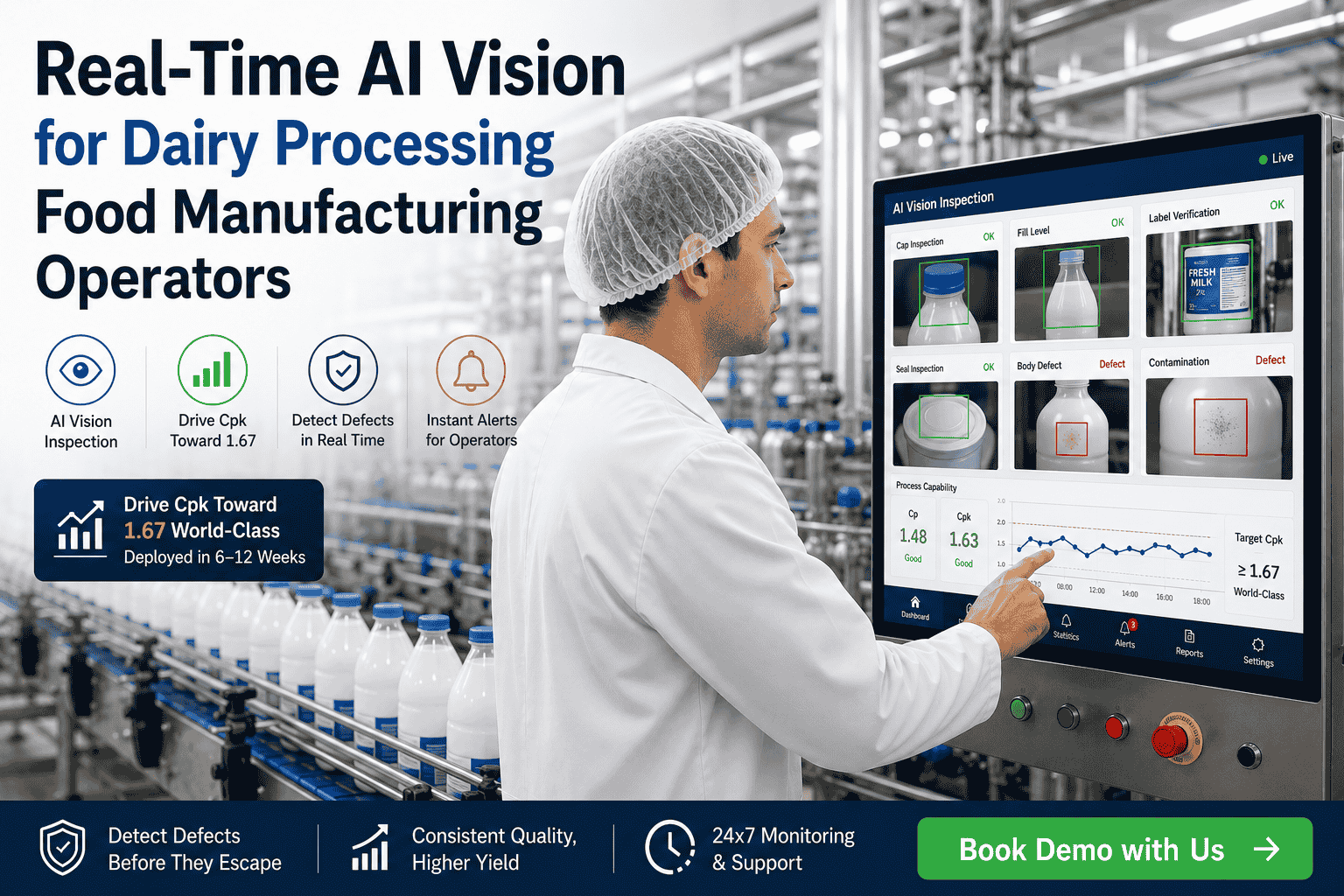
AI vision inspects eggshell cracks, dairy packaging defects, and label compliance across automated dairy lines with zero human touchpoints required.
Ready to Deploy AI Vision Quality Inspection?
In 30 minutes, we'll show you how iFactory's AI food quality inspection system integrates with your line — detecting defects, logging compliance data, and feeding traceability records automatically from day one.
Deploying AI Food Quality Inspection: What to Expect
A structured implementation ensures your automated food inspection system is production-ready fast — with minimal disruption to existing operations.
Line Assessment & Camera Positioning
Engineers map inspection points, select imaging modalities (RGB, X-ray, NIR), and finalize hardware placement for your specific line layout and SKUs.
AI Model Training & Calibration
The defect classification model is trained on your product images and defect library. Initial calibration runs validate accuracy against your quality standards before go-live.
Integration & Compliance Setup
The vision system connects to your ERP, MES, and traceability platform. Rejection logs, defect images, and lot-level data flow automatically to your compliance dashboard.
Go-Live & Continuous Improvement
Full production deployment with live monitoring. The AI model continues improving with every shift — detection accuracy increases as more product data accumulates.
AI Food Quality Inspection — Questions Answered
The most common questions from food manufacturers evaluating computer vision food processing systems.
Q: How accurate is AI food defect detection compared to human inspection?
AI computer vision systems achieve 99%+ detection accuracy consistently across all shifts and line speeds. Human inspection typically achieves 85–88% accuracy at best — dropping further during end-of-shift fatigue periods. The accuracy gap widens significantly for internal defects, micro-contamination, and high-speed production scenarios.
Q: Can AI vision systems handle multiple SKUs on the same line?
Yes. Modern AI food quality automation systems use recipe-based profiles — the vision system switches defect classification models automatically when the line changes SKU. No hardware changes, no manual recalibration. New SKUs are added by training a new model profile, typically completed in 24–48 hours.
Q: Does the AI inspection system integrate with FSMA 204 traceability requirements?
Directly. Every inspection event generates a time-stamped, lot-linked data record with image evidence and defect classification — meeting FDA's requirement for electronic records producible within 24 hours. The system also supports GS1 data standards for supply chain traceability. Book a Demo to see the compliance data trail.
Q: What production line speeds can AI vision systems handle?
Current AI vision hardware handles 3,000+ units per minute at full inspection coverage — no sampling required. For specialized applications like whole poultry or large produce, systems are configured for the specific throughput and imaging requirements of that line. Speed is not a limitation for modern machine vision food processing deployments.
Every Defect Caught. Every Batch Documented. Every Audit Ready.
AI computer vision for food quality inspection isn't a future investment — it's the baseline for manufacturers who want to compete on quality, compliance, and cost efficiency in 2026. Let iFactory deploy it for your facility.