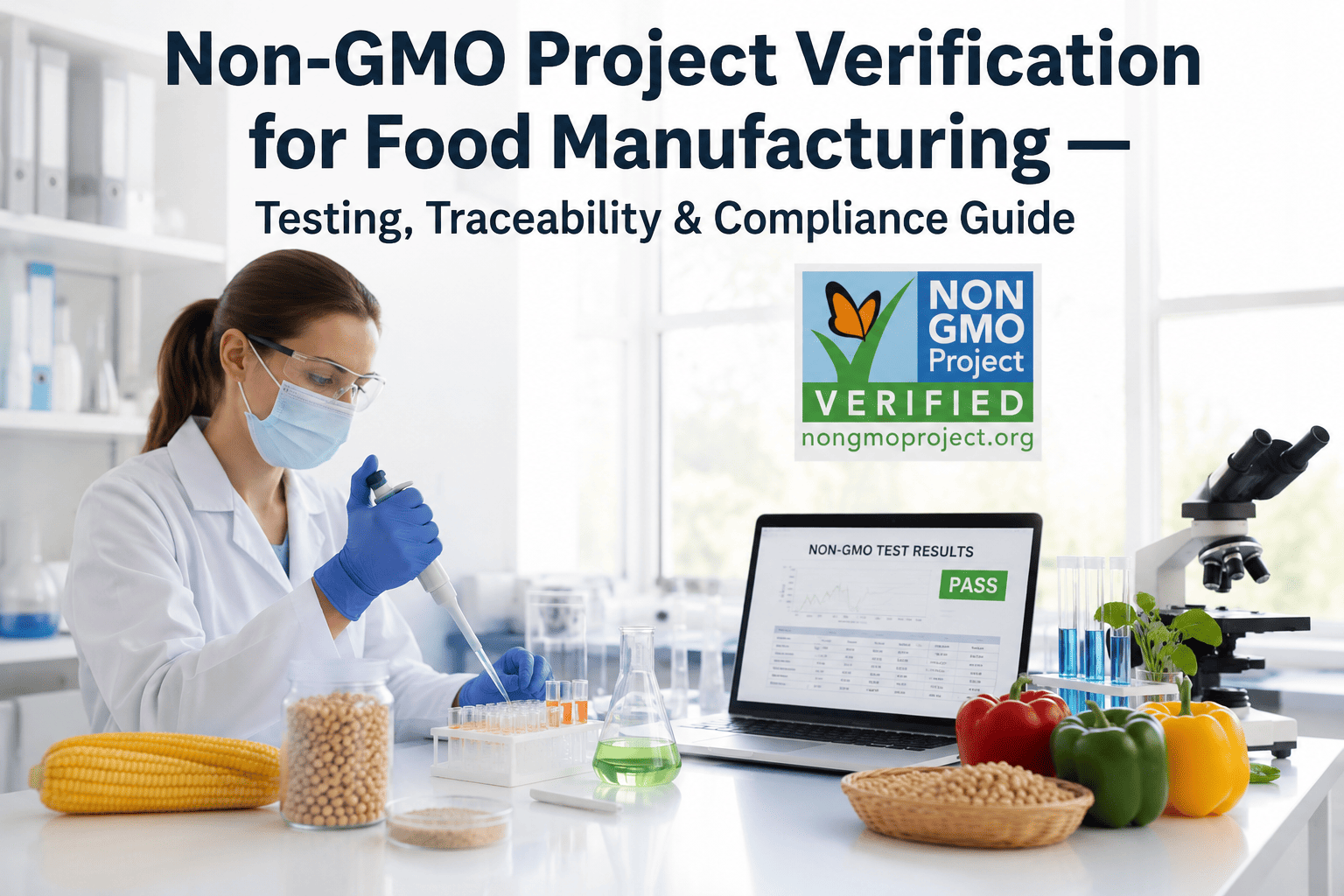
Retailers are no longer asking whether a product avoids GMOs — they are asking for proof, and that proof has a name: the Non-GMO Project Verified Butterfly. Quality managers who once treated non-GMO claims as a marketing checkbox are now discovering that verification touches ingredient sourcing, supplier documentation, lab testing, and production line segregation all at once. Getting it wrong means a rejected retail listing or a costly re-audit; getting it right opens shelf space that private-label and organic-only claims cannot reach. iFactory AI helps quality teams manage the traceability, testing records, and supplier documentation that Non-GMO Project Verification requires, without adding a second system nobody has time to maintain.
Why Non-GMO Verification Has Become a Retail Requirement, Not a Nice-to-Have
Major retailers and distributors increasingly treat Non-GMO Project Verification as a prerequisite for shelf placement in the natural and specialty channel, and a growing number of conventional grocers now request it for private-label reformulations. For a quality manager, that shift means the verification decision is no longer driven only by marketing — procurement and sales are pushing it too, often on a timeline set by a buyer meeting rather than an internal roadmap. The challenge is that verification is not a single test; it is an ongoing program of ingredient risk classification, supplier attestations, laboratory testing at critical control points, and facility segregation practices that has to hold up to annual re-evaluation.
High-risk crops — corn, soy, canola, sugar beets, papaya, and summer squash among them — trigger mandatory lot-level testing wherever they enter a formulation, and every one of those test results needs a paper trail a Technical Administrator can trace back to a specific production run. Manufacturers running multiple SKUs across shared lines often underestimate how many ingredient touchpoints actually qualify as high-risk until an initial documentation review flags gaps they did not know existed.
The Five-Phase Path to Non-GMO Project Verification
Select a Technical Administrator and Sign On
Choose one of the four independent Technical Administrators, sign a contract with them and a license agreement with the Non-GMO Project, and enroll the specific products you intend to verify.
Classify Every Ingredient by GMO Risk
Map every formulation ingredient against the Non-GMO Project's high-risk crop list, then gather supplier affidavits, certificates of analysis, and origin documentation for each one before submission.
Test High-Risk Inputs at Critical Control Points
Submit samples of high-risk ingredients for genetics-based testing at an ISO-17025 accredited lab, following a sampling plan that meets the Standard's statistical confidence requirement.
Demonstrate Segregation and Facility Controls
Show documented cleaning validation, dedicated or sequenced production runs, and storage controls that prevent cross-contact between verified and non-verified ingredient streams.
Receive Your Certificate and Plan for Annual Renewal
Once your Technical Administrator confirms compliance, you receive a Certificate of Verification valid for one year, after which a renewal evaluation repeats the documentation and testing review.
GMO Testing Methods Compared
Not every testing method answers the same question, and Technical Administrators expect the method to match the ingredient and the risk it presents. Understanding the differences helps quality teams budget testing costs accurately instead of over-testing low-risk inputs or under-testing the ones that actually matter.
| Testing Method | What It Detects | Typical Use Case | Turnaround |
|---|---|---|---|
| PCR (Polymerase Chain Reaction) | Presence of specific genetically engineered DNA sequences | Raw high-risk commodities like corn and soy | 2–5 business days |
| ELISA Protein Testing | Genetically engineered proteins in processed ingredients | Screening processed derivatives where DNA is degraded | 1–3 business days |
| Lot-Specific Genetic Testing | Compliance of an individual incoming lot against the 0.9% threshold | Critical control point testing required by the Standard | 3–7 business days |
| Supplier Affidavit Review | Documented sourcing and segregation practices upstream | Low-risk ingredients not requiring lab testing | Ongoing documentation cycle |
Is Your Facility Ready? A Pre-Verification Checklist
Corn, soy, canola, sugar beets, papaya, and summer squash derivatives all require documented sourcing evidence before submission.
Missing or outdated supplier paperwork is the single most common cause of delayed initial evaluations.
Technical Administrators expect written, followed procedures, not verbal practices, especially where lines run both verified and non-verified SKUs.
Verification lapses most often when renewal deadlines fall through organizational gaps rather than failed testing.
Quality Manager Perspective
I manage quality for a mid-size snack manufacturer running four SKU lines through two Technical Administrator renewals so far, and the lesson that stuck with me is that verification is won or lost in the paperwork, not the lab. Our first submission stalled for almost six weeks because two ingredient suppliers had not sent updated affidavits, and nobody on our team had a single place to check what was outstanding. Since we started tracking supplier documentation status against every high-risk ingredient in one system, our renewal reviews close in under two weeks instead of dragging into a second month, and I no longer find out about an expired certificate of analysis from the Technical Administrator instead of from us.
— Quality Manager, Regional Snack Food ManufacturerConclusion
Non-GMO Project Verification rewards manufacturers who treat it as an ongoing documentation and testing discipline rather than a one-time project. The Butterfly seal now influences retail listing decisions directly, and the quality teams who keep their supplier affidavits, testing records, and segregation procedures current year-round are the ones who sail through annual renewal instead of scrambling for it. Book a demo to see how iFactory AI keeps your verification file audit-ready between renewals.
Frequently Asked Questions
Initial verification generally takes several weeks to a few months depending on how many high-risk ingredients are involved and how quickly supplier documentation is available. Products with few or no high-risk inputs move faster, while multi-ingredient formulations with several high-risk crops require more testing and documentation review. Contact support for a readiness assessment specific to your formulation.
No. USDA Organic addresses farming and production practices broadly, while Non-GMO Project Verification specifically requires genetics-based testing of high-risk ingredients and does not have the enforcement gap that exists in organic certification for GMO contamination. Many brands hold both certifications simultaneously since they address different consumer concerns and can often be bundled with the same auditor for cost savings.
Ingredients derived from crops with commercially available genetically engineered varieties — corn, soy, canola, sugar beets, papaya, and summer squash — require lot-level testing at critical control points. Ingredients outside this high-risk list generally require documentation review rather than laboratory testing, though a Technical Administrator can request testing if traceability documentation is incomplete.
Shared lines are allowed but require documented segregation controls, including validated cleaning procedures between runs, sequencing that minimizes cross-contact risk, and clear labeling during production. Technical Administrators will review these procedures during both initial evaluation and annual renewal, and gaps here are a common source of nonconformities. Book a demo to discuss segregation documentation for shared-line facilities.
Renewal happens annually and re-evaluates whether the product still complies with the current Non-GMO Project Standard, which means any ingredient changes, new suppliers, or Standard revisions since the last review need to be documented. Renewals move fastest when documentation has been maintained continuously through the year rather than rebuilt from scratch at renewal time.