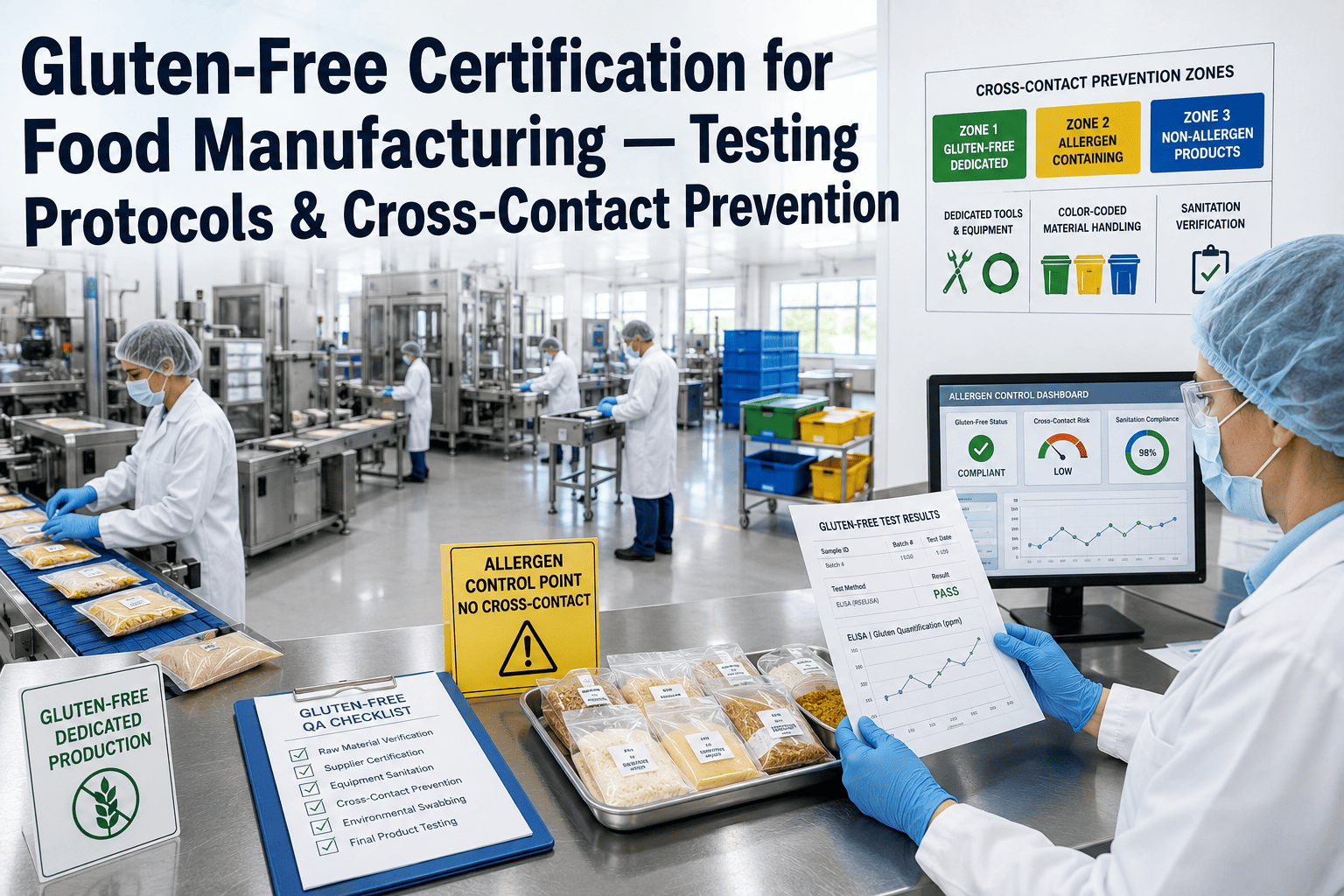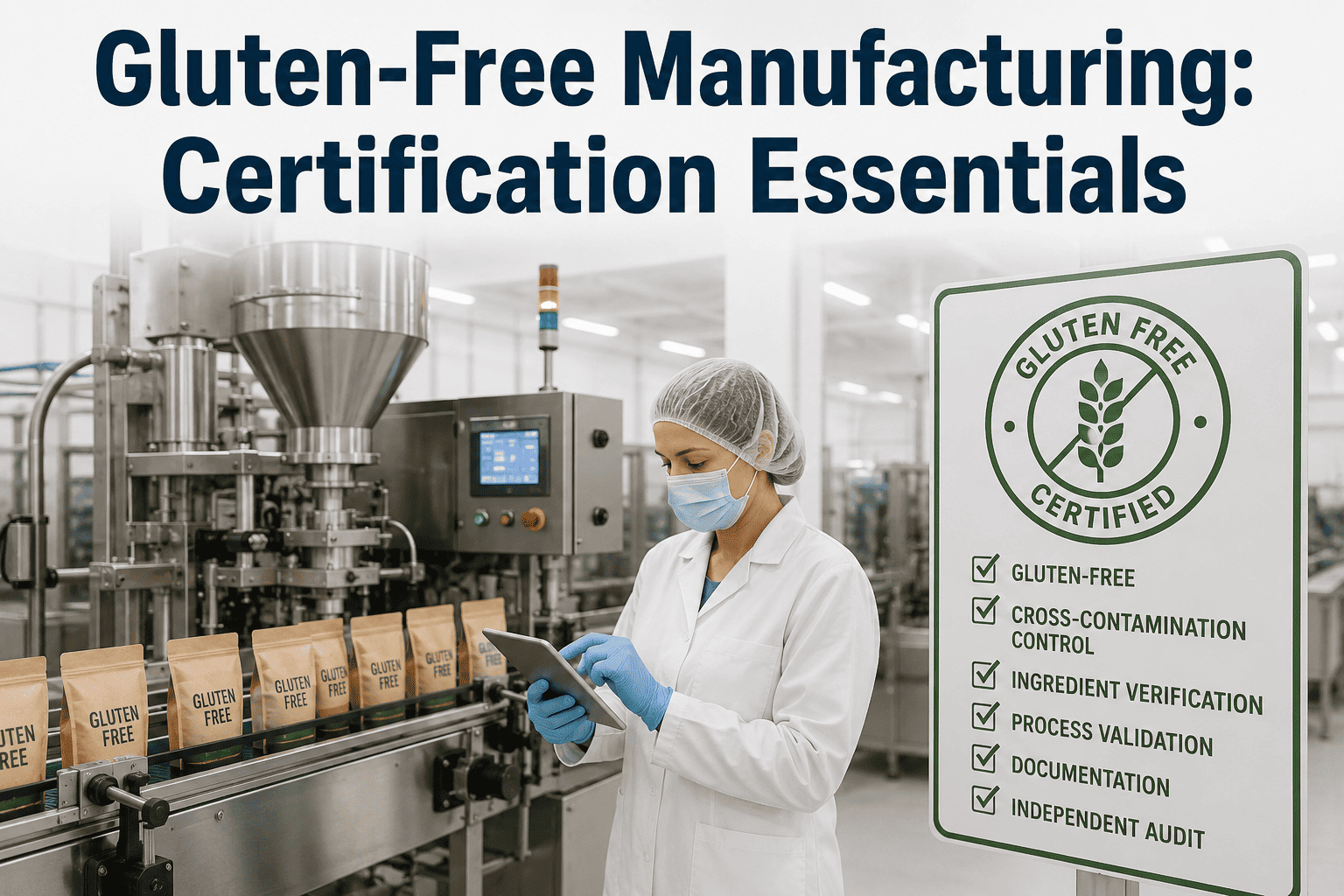
A gluten-free label is one of the few claims on a food package that a consumer with celiac disease treats as a medical decision rather than a preference. That trust is built entirely on testing discipline inside the plant, and it can be destroyed by a single cross-contact event that never shows up on a finished label. The FDA sets the federal threshold for a gluten-free claim at under 20 parts per million, matching the Codex Alimentarius international standard, while third-party certifiers such as GFCO apply a stricter 10 parts per million ceiling across both ingredients and finished product. Manufacturers who only test finished goods and skip ingredient-level and environmental verification are the ones who discover contamination after a customer complaint, not before a shipment leaves the dock. Book a demo to see how iFactory tracks gluten testing results, changeover verification, and supplier documentation in one connected system.
Twenty Parts Per Million Is the Federal Limit. Ten Is What Certification Actually Requires.
iFactory connects ingredient testing, changeover verification, and finished product results into one gluten-free compliance record, so every batch that leaves your facility can be traced back to the data that proves it belongs on the shelf.
How Gluten-Free Thresholds Compare Across Regulatory and Certification Bodies
Manufacturers selling into multiple markets or pursuing third-party certification often discover that no single threshold governs every claim they want to make. Understanding where each standard sits relative to the others determines which testing target actually protects your ability to sell in every channel you serve.
Because GFCO certification requires that all starting ingredients and finished products test at or below 10 parts per million, or the regulatory threshold of the destination market, whichever is lower, a facility that builds its internal testing program to the strictest applicable number automatically satisfies every looser standard it might also need to meet. Building your quality system around the loosest number you are legally allowed to use is the strategy that eventually produces a labeling problem when you expand into a market or certification program with a tighter requirement.
Dedicated Lines Versus Shared Lines: Where the Real Risk Trade-Off Sits
The single biggest operational decision in gluten-free manufacturing is whether a product runs on a dedicated gluten-free line or a shared line that also processes gluten-containing ingredients on a rotating schedule. Both are viable paths to certification, but they carry fundamentally different risk profiles and cost structures.
Shared lines are not inherently non-compliant, but they demand a testing and documentation discipline that many facilities underestimate when they first add a gluten-free SKU to an existing production schedule. Every changeover between a gluten-containing run and a gluten-free run needs a validated cleaning procedure and a verification test before the gluten-free product starts, and skipping that verification even once is the most common root cause of a failed retail shelf test.
Five Points in the Production Flow Where Cross-Contact Risk Concentrates
Gluten cross-contact does not require large quantities of gluten-containing material to push a product above threshold; airborne flour dust and residue on shared surfaces are both potent enough to matter. The following five points represent where risk concentrates most consistently across gluten-free production environments.
Building a Testing Program That Actually Catches Contamination Before Shipment
GFCO's 80-point certification standard requires that all starting ingredients and finished products test below the applicable threshold, that manufacturers participate in proficiency testing to confirm they are testing correctly, and that facilities undergo at minimum annual on-site audits with quarterly submission of testing results for review. A testing program built to satisfy these requirements typically layers four distinct testing checkpoints across the production cycle rather than relying on a single finished-product test.
Why Oats Require a Separate Risk Category in Any Gluten-Free Program
Oats are naturally gluten-free as a grain, but conventional oat supply chains are so consistently cross-contaminated with wheat, barley, and rye during farming, harvest, and transport that oats have to be treated as a distinct, higher-scrutiny ingredient category rather than assumed safe by default.
| Oat Source Type | Typical Contamination Risk | Certification Treatment |
|---|---|---|
| Conventional commodity oats | High, frequent wheat and barley cross-contact | Not eligible for gluten-free certification |
| Purity-protocol gluten-free oats | Low, dedicated fields and equipment | Eligible with lot-level testing |
| Mechanically sorted oats | Moderate, depends on sorting validation | Requires supplier validation data |
Some certification programs and export markets, including Australia and New Zealand, prohibit oats in gluten-free products entirely regardless of purity protocol sourcing, which is a detail manufacturers exporting internationally frequently miss until a shipment is rejected at a border inspection.
Common Questions About Gluten-Free Manufacturing Certification
Is FDA compliance at 20 ppm enough, or do I need third-party certification?
FDA compliance at under 20 parts per million is legally sufficient to make a gluten-free claim on a product label sold in the United States, and many smaller brands operate successfully on FDA compliance alone. Third-party certification through a program such as GFCO adds a stricter 10 parts per million threshold, mandatory proficiency testing to confirm your lab technique is accurate, annual on-site facility audits, and a recognizable logo that many consumers with celiac disease specifically look for before trusting a product. Whether certification is worth the added cost depends heavily on your sales channel: certification is frequently a hard requirement for major retail buyers and increasingly expected by consumers who have been burned by mislabeled products in the past. Book a demo to model the testing program required for certification.
How often does GFCO require testing results to be submitted for review?
GFCO requires certified manufacturers to submit testing results for review on a quarterly basis, and if gluten is detected above 10 parts per million in any product or ingredient at any point, that result must be reported to GFCO immediately, before the affected product leaves the production facility. This quarterly cadence is a minimum, not a ceiling; facilities running shared lines with frequent changeovers typically test far more often than the quarterly reporting requirement because every changeover represents an independent contamination risk that needs its own verification. Manufacturers also must periodically demonstrate their testing competency through proficiency testing administered by the certifying body, ensuring that a passing result reflects accurate testing technique rather than a false negative from an improperly executed test. Contact support for testing cadence templates.
Can a shared line ever be as safe as a dedicated gluten-free line?
A well-managed shared line can consistently produce compliant gluten-free product, but it requires a level of procedural discipline that many facilities underestimate when they first add a gluten-free SKU. Every element of the changeover, including disassembly of equipment to access hidden residue points, validated cleaning chemistry, dry versus wet cleaning method selection appropriate to the equipment, and a verification swab test before the gluten-free run begins, has to be executed correctly every single time with no exceptions for schedule pressure. The facilities that run into contamination problems on shared lines are almost always the ones where changeover verification gets skipped occasionally to hit a production deadline, which is why building automated changeover verification into your production schedule rather than relying on manual sign-off is one of the highest-value process investments a shared-line facility can make. Book a demo to see automated changeover tracking.
What should happen if a batch tests above the certification threshold?
Any batch that tests above the applicable gluten-free threshold must be held and prevented from shipping as a certified gluten-free product, and under GFCO's requirements, results above 10 parts per million must be reported to the certifying body immediately rather than at the next scheduled reporting interval. The affected batch can potentially still be sold without the gluten-free claim if it otherwise meets quality specifications, but the root cause investigation matters more than the immediate disposition decision. A single elevated result usually traces back to an incomplete changeover, a contaminated ingredient lot, or an equipment issue such as a worn seal allowing residue accumulation, and each of those root causes requires a different corrective action. Facilities that treat an elevated result as an isolated incident without investigating the root cause tend to see the same failure recur within a few production cycles. Contact support for root cause investigation frameworks.
Do all export markets accept the same gluten-free threshold as the United States?
No, and this is one of the most common compliance gaps for manufacturers expanding internationally. Most major markets, including the European Union under Codex-aligned rules, use the same 20 parts per million threshold for a standard gluten-free claim, but some markets apply additional restrictions such as prohibiting oats in gluten-free products regardless of purity protocol sourcing, a rule applied in Australia and New Zealand. Certification bodies such as GFCO account for this by requiring products to test below the threshold of the destination market or 10 parts per million, whichever is lower, which means a facility building its testing program around the strictest applicable number across all its sales markets avoids discovering a labeling problem only after a shipment is rejected at a border inspection. Book a demo to map your export compliance requirements by market.
One Missed Changeover Verification Is All It Takes to Lose Certification
iFactory gives your quality team a single connected record of ingredient testing, changeover verification, and finished product release, so every gluten-free claim you make is backed by data you can produce instantly during an audit.