The Hidden Cost of Reactive analytics in Schools and Universities (2026 Guide)

By Frank Lampard on May 21, 2026

hidden-cost-reactive-analytics-schools-universities-2026

Across K-12 districts and university campuses, a quiet crisis is consuming budgets that should be funding classrooms, faculty, and students. Reactive analytics costs U.S. educational institutions an estimated $14 billion annually in avoidable emergency repairs, compliance penalties, and deferred capital decisions made without current condition data. With the 2026 enrollment cliff reducing revenue, OSHA and EPA requirements tightening compliance costs, and credit agencies now factoring deferred maintenance documentation into institutional assessments, schools still operating reactively are not just spending more. They are borrowing more and planning less. Book a Demo to see how AI-driven analytics transforms your campus from reactive to predictive.

EDUCATION INDUSTRY · AI-DRIVEN CAMPUS ANALYTICS
The Hidden Cost of Reactive Analytics in Schools and Universities (2026 Guide)
Discover how reactive analytics is draining school and university budgets and how predictive AI-driven software reduces downtime, improves compliance, and cuts facility costs without adding staff or disrupting classes.
$14BAnnual Reactive Cost U.S. Education

40%+Districts Still Fully Reactive

3-5xEmergency vs Planned Repair Cost

18-30%Cost Reduction with Predictive AI

Why This Issue Demands Attention in 2026

Educational facilities are among the most complex built environments in the public sector. A mid-sized school district manages hundreds of buildings, thousands of HVAC units, aging electrical infrastructure, and compliance requirements spanning fire safety, indoor air quality, ADA accessibility, and energy reporting. All of this runs on budgets growing 2-3% annually while deferred maintenance backlogs compound at 6-8% per year. The result is a structural gap that reactive operations cannot close.

Three converging forces make 2026 a defining year for campus facility analytics. The enrollment cliff driven by the post-2008 birth rate decline is reducing tuition and per-pupil revenue while fixed facility costs remain constant. New federal compliance mandates including OSHA 2026 Heat Illness Prevention and expanded EPA testing are adding cost pressure that reactive budgets cannot absorb. Credit agencies now explicitly factor deferred maintenance documentation into institutional credit assessments, meaning schools that cannot substantiate their facility condition pay higher borrowing rates than those that can. Book a Demo to map these pressures to your campus analytics profile.

Industry ScopeK-12 public and private districts, community colleges, and four-year university campuses across the U.S.
Facility TypesClassrooms, labs, dormitories, athletic facilities, administrative buildings, utility and energy systems
Compliance ExposureOSHA 2026, EPA expanded testing, ADA, state infrastructure reporting, accreditation body requirements
Primary Pain PointReactive complaint-driven maintenance with no predictive data layer or unified asset condition registry
Technology GapSiloed spreadsheets, paper work orders, manual assessments, no cross-building data integration
Solution CategoryAI-driven predictive analytics platform, automated PM scheduling, capital planning dashboard, compliance reporting
Typical Portfolio Size200 to 10,000+ tracked infrastructure assets across multiple campus buildings and utility systems

The Hidden Costs: What Reactive Analytics Actually Costs Schools

The problem with reactive analytics is that most of its cost never appears on a single line item. Emergency repair overruns are buried in contingency funds. Compliance penalties are categorized as legal expenses. Lost instructional time from a broken HVAC unit is absorbed as a scheduling disruption rather than a facilities cost. The true price of reactive operations only becomes visible when measured systematically and the numbers are significant across every institution type.

Institutions operating at full reactive maturity have no cost data, no asset history, and no basis for defensible capital planning. Whoever complains loudest gets service first. Emergency budgets consume 60-75% of available maintenance spend at peak reactive failure rates, leaving preventive programs perpetually underfunded. Without lifecycle tracking, install dates, replacement schedules, or condition scoring, replacement needs are discovered only after failures occur at 3-5x planned cost.

3-5x
Emergency repair premium over planned maintenance costs. Districts spending $4.85 per square foot reactively can cut that figure 18-30% with predictive scheduling on the same asset, the same building, managed proactively. Overtime labor, expedited parts, and equipment rentals during catastrophic failures add costs that planned intervention never incurs. Hotel accommodations for displaced dormitory residents and refunds for disrupted services add further hidden expense that rarely appears in maintenance budgets.
$112B
Estimated deferred capital renewal backlog across U.S. colleges and universities. With more than 6 billion square feet of campus space supported by just $37 billion in annual maintenance funding according to APPA, institutions are structurally underfunding renewals. Reactive operations prevent the data-driven capital arguments that could close the gap because boards cannot approve what they cannot verify.
60%+
Of higher education facilities reported in fair or poor condition per Gordian 2023. More than half of institutions admitted lacking a formal asset inventory. Without lifecycle tracking, install dates, replacement schedules, and condition scoring, replacement needs are discovered reactively at 3-5x planned cost. The backlog grows 6-8% per year while budgets grow only 2-3%.
40%+
Of U.S. school districts still operating at full reactive maturity level in 2026. At this maturity level there is no cost data, no asset history, and no basis for defensible capital planning. Emergency budgets consume 60-75% of available maintenance spend. Institutions at this level also face the highest compliance exposure as new federal mandates require maintenance documentation that reactive systems cannot produce.
$14B
Annual energy spend across U.S. K-12 and higher education combined, the second-largest operating expense after personnel. Without AI-driven energy monitoring and maintenance optimization, institutions have no visibility into per-building utilization or the maintenance failures driving inefficiency. Documented deployments show 15-19% energy cost reductions post-implementation, representing millions in annual savings redirected to instructional programs.
26 mo
Average age of asset condition data at reactive institutions at time of compliance audit. Capital requests built on stale condition data routinely miss actual scope by 20% or more, creating the primary source of budget overruns, mid-project reauthorizations, and loss of board confidence. When condition assessments are 18-26 months old, every capital planning decision rests on a foundation that cannot be defended.
Schools are not failing to maintain their buildings. They are failing to know which buildings need attention, at what cost, and when. Reactive analytics is the root cause of every budget overrun, compliance gap, and capital planning failure that follows.

2026 Compliance Pressures Making Reactive Operations Indefensible

For years, reactive facility management was tolerated as a funding problem. In 2026 it has become a compliance and creditworthiness problem. Three regulatory and financial developments are eliminating the margin for institutions that cannot document facility condition and maintenance performance systematically. Institutions without a continuous data layer are exposed on all three fronts simultaneously.

OSHA Heat Illness Prevention 2026

New federal rule requires documented HVAC maintenance schedules and temperature monitoring records in all occupied spaces. Reactive operations with no maintenance records cannot demonstrate compliance and face penalty exposure on every building without documentation.

Expanded EPA Testing Requirements

Lead, air quality, and chemical exposure testing now require documented facility condition baselines and maintenance histories. Schools without continuous data systems face retroactive testing costs, remediation exposure, and potential enforcement action that reactive paper trails cannot defend against.

Credit Agency Deferred Maintenance Factor

Credit agencies now explicitly factor deferred maintenance backlogs into institutional credit assessments. The district that can present a Facility Condition Index with documented remediation trajectory borrows at a lower rate than the one that cannot. Undocumented backlogs translate directly to higher debt service costs year over year.

The enrollment cliff multiplier: As traditional-age student populations decline through 2026-2030, every dollar lost to reactive overruns comes directly from instructional budgets, faculty positions, or student services. Fixed facility costs do not decline with enrollment. Reactive analytics converts a revenue challenge into a structural institutional threat that compounds annually without a data-driven intervention.

The Solution: AI-Driven Predictive Analytics for Campus Facilities

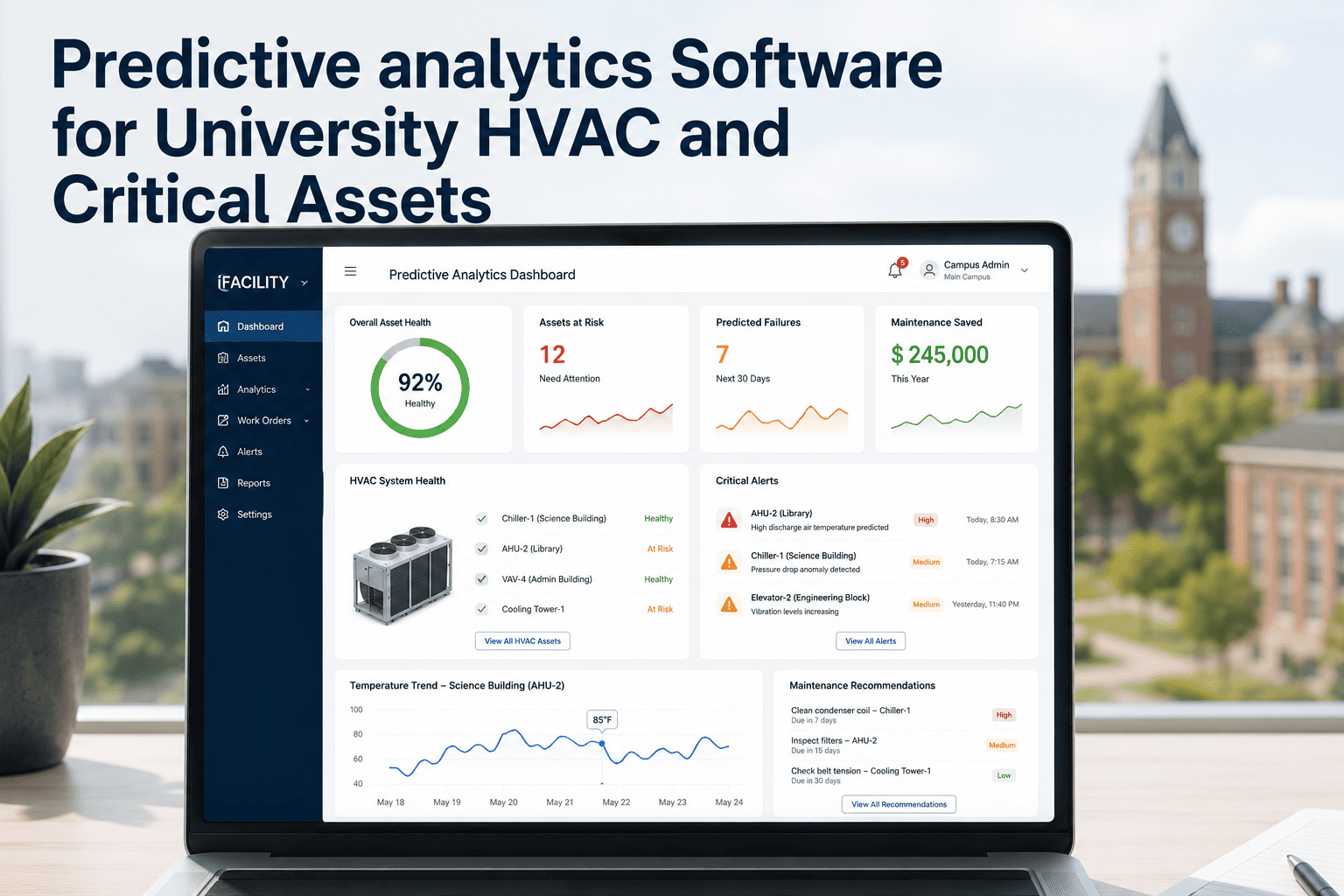
The shift from reactive to predictive analytics is not a technology purchase. It is an operational transformation. Institutions that have made this transition report documented cost reductions of 18-30% on the same budget, 60-75% fewer emergency work orders, and the ability to present capital plans to boards with defensible Facility Condition Index data rather than anecdotal crisis summaries. The platform capabilities that enable this outcome operate across six integrated functions that replace every siloed spreadsheet-dependent process that allowed reactive liability to accumulate. Book a Demo to see how each function applies to your campus infrastructure portfolio.

01
Unified Campus Asset Registry
  • All buildings, systems, and equipment in a single tracked record with full lifecycle data
  • Install dates, lifecycle estimates, and condition scores maintained per asset continuously
  • Cross-building deduplication and standardization eliminates conflicting records
  • Real-time sync removes manual data transfer and reconciliation burden from staff
02
AI Condition Scoring Engine
  • Deterioration modeling predicts condition changes between physical inspections continuously
  • Facility Condition Index calculated per building and updated automatically
  • Alert triggers notify managers when condition thresholds are breached before failure occurs
  • Condition data never more than 30 days stale versus 18-26 months at reactive institutions
03
Automated PM Scheduling
  • Preventive work orders generated from AI condition forecasts without manual scheduling
  • Summer break mega-scheduling for dormitory turnarounds and major renovations automated
  • PM completion rates tracked by building, department, and asset class in real time
  • Planned-to-reactive maintenance ratio monitored with department-level accountability
04
Capital Planning Dashboard
  • All capital requests scored on a unified defensible 100-point methodology
  • Multi-year CIP scenarios modeled with live FCI data replacing stale spreadsheet estimates
  • Five-year total cost of deferral calculated per building to support board presentations
  • Board-ready and lender-ready audit package export in one click
05
Energy Monitoring Integration
  • Per-building energy utilization tracked continuously against baseline benchmarks
  • Maintenance failures driving energy inefficiency flagged automatically for resolution
  • Documented campus deployments show 15-19% energy cost reduction post-implementation
  • EPA and state energy reporting automated directly from live operational data
06
Compliance and Audit Reporting
  • OSHA, EPA, and ADA compliance documentation generated automatically from live data
  • Maintenance history records current and exportable for every tracked asset at all times
  • Accreditation and state reporting packages produced on demand without manual assembly
  • Credit-agency-ready deferred maintenance documentation with FCI trajectory reporting

The Transition Path: From Reactive to Predictive in Four Phases

Transitioning from reactive to predictive campus analytics does not require a budget increase or a service disruption. The program is structured in four phases sequenced to deliver measurable compliance and cost outcomes first while building the long-term AI model that makes predictive scheduling increasingly accurate over time. Core data integration and initial condition scoring are operational within 60-90 days of deployment.

Months 1-2Foundation
Asset Registry and Data Integration
  • All campus systems connected to unified platform via open API
  • Asset registry standardized and validated across all buildings
  • Condition data age: 18-26 months reduced to 8 months average
  • All facilities staff onboarded and operational in under 12 hours
Months 3-6Automation
AI Scoring and PM Scheduling Live
  • AI condition scoring engine active across all campus asset classes
  • Automated PM scheduling live for HVAC, electrical, and facility systems
  • Reactive maintenance rate begins structural measurable decline
  • First compliance-ready reporting cycle produced automatically
Months 7-12Capital Integration
FCI Dashboard and Board Reporting
  • Capital planning dashboard deployed across all campus departments
  • FCI calculated per building in board-ready capital request format
  • Five-year cost-of-deferral modeling activated for all critical assets
  • Emergency work orders down 40-60% from pre-deployment baseline
Months 13-18Full Optimization
Predictive Model Maturity
  • 18-30% total maintenance cost reduction fully documented
  • Condition data under 30 days for all asset classes across campus
  • Zero compliance audit deficiencies across all tracked systems
  • AI model sharpens continuously as campus-specific data accumulates

Results: What Predictive Analytics Delivers for Education

Across K-12 school districts and university campus deployments, the transition from reactive to AI-driven predictive analytics has produced documented measurable outcomes across every dimension that determines facility management performance including cost, compliance, capital planning, and staff efficiency. All results are measured against the same operational budget with no additional funding allocated. Book a Demo to see how these outcomes translate to your institution's specific profile and asset portfolio.

Total Maintenance Cost Per Square Foot
Reactive Operations
$4.85 per sq ft, budget-consuming, unpredictable overruns
Predictive AI Platform
$3.40-$3.99 per sq ft, 18-30% cost reduction documented
The cost reduction is achieved on the same operational budget with no additional funding required. AI-driven scheduling converts reactive emergency spend into planned preventive work at a fraction of per-event cost, with the model improving in accuracy each month as it accumulates campus-specific deterioration history. Districts redirecting these savings have funded instructional programs and faculty positions from existing maintenance budgets.
Emergency Work Order Volume
Reactive Operations
60-75% of maintenance budget consumed by emergency events
Predictive AI Platform
60-75% fewer emergencies documented across campus deployments
AI-driven condition scoring alerts managers to deteriorating assets before they fail, converting the majority of emergency events into scheduled work orders at planned cost. One university deployment documented emergency work orders down 62% within 18 months while simultaneously reducing energy costs 19% and improving the FCI score of 14 buildings from Poor to Fair through the same platform operation.
Asset Condition Data Currency
Reactive Operations
18-26 months average data age, indefensible for capital planning
Predictive AI Platform
Under 30 days, continuously updated via AI deterioration modeling
Capital requests built on stale condition data routinely miss actual scope by 20% or more, generating the mid-project reauthorizations and board confidence losses that define reactive capital planning. Current FCI data eliminates this variance and makes capital planning defensible to elected boards, state oversight bodies, and credit agencies reviewing institutional creditworthiness on an annual basis.
Board Capital Approval Rate
Reactive Operations
Anecdotal crisis requests with frequent deferrals and second reviews
Predictive AI Platform
FCI-backed requests approved in single session across documented deployments
One facilities director opened a board presentation with a per-building FCI dashboard showing 14 buildings improved from Poor to Fair, emergency work orders down 62%, energy costs down 19%, and a five-year cost-of-deferral analysis for remaining critical buildings. The full capital request was approved in a single session with no deferral. The difference was not the dollar amount requested. It was the data supporting it.
Energy Cost Reduction
Reactive Operations
No per-building visibility, maintenance failures compound energy waste continuously
Predictive AI Platform
15-19% energy cost reduction documented across campus deployments
Energy is the second-largest operating expense in education facilities after personnel, averaging $14 billion annually across U.S. K-12 and higher education combined. AI-driven maintenance optimization identifies and resolves the equipment failures that drive energy inefficiency, delivering documented savings that compound annually as the model matures with campus-specific operational data and seasonal patterns.
Analytics Staff Hours Per Reporting Cycle
Reactive Operations
Approximately 140 hours per quarterly reporting cycle of manual assembly
Predictive AI Platform
Approximately 18 hours, 87% reduction through automated report generation
Automated data consolidation, AI-generated condition narratives, and one-click audit export eliminate the manual assembly process that previously consumed the majority of facilities team quarterly capacity. Reclaimed staff hours are redirected toward field inspection depth, capital planning coordination, and proactive engagement with state oversight officials on compliance improvements.
Metric Reactive Baseline Predictive AI Platform Change
Maintenance Cost per Sq Ft $4.85 average reactive $3.40-$3.99 documented -18% to -30%
Emergency Work Orders 60-75% of total budget 60-75% fewer events -60% to -75%
Asset Condition Data Age 18-26 months average Under 30 days -98%
Energy Operating Costs No per-building visibility 15-19% reduction documented -15% to -19%
Compliance Audit Deficiencies Undocumented exposure Zero findings documented -100%
Capital Planning Defensibility Anecdotal crisis requests FCI-backed single-session approvals Transformational
Staff Hours per Reporting Cycle Approx 140 hrs manual Approx 18 hrs automated -87%
Deferred Maintenance Trajectory +6-8% per year compounding Actively managed and declining Structurally reversed
Capital Project Cost Variance 22% average overage 6% average documented -73%
18-30%
Cost Reduction
-75%
Fewer Emergencies
Zero
Audit Deficiencies
-87%
Reporting Hours
Your Campus Can Make This Transition Without a Budget Increase.
AI-driven campus analytics are deployable now with documented ROI across school districts and universities managing 200 to 10,000+ assets. The first step is a conversation about where your reactive analytics liability stands today.

Key Benefits for Schools and Universities

The transition to AI-driven predictive analytics delivers compounding value across budget performance, compliance standing, capital credibility, and long-term institutional sustainability. Each outcome reinforces the institution's ability to serve students in an increasingly resource-constrained environment where every dollar lost to reactive overruns competes directly with instructional investment.

01
Maintenance costs reduced 18-30% on the same operational budget.

No new funding is required. AI-driven scheduling converts reactive emergency spend at 3-5x planned cost into preventive work orders that cost a fraction of the emergency equivalent. The savings compound annually as the model sharpens with campus-specific data and seasonal operational patterns unique to each institution.

02
Board capital requests approved faster and at higher rates with FCI data.

FCI-backed capital plans with five-year cost-of-deferral analysis replace anecdotal crisis summaries. Documented deployments show boards approving full capital requests in single sessions when condition data is current and defensible rather than presenting estimated costs based on assessments that are years out of date.

03
OSHA, EPA, and ADA compliance documentation automated completely.

The 2026 compliance environment requires documentation that reactive operations cannot produce: maintenance schedules, condition records, and testing histories across all occupied spaces. The platform generates all required reports automatically from live data, eliminating manual assembly burden and compliance exposure in every building simultaneously.

04
Credit rating exposure from undocumented deferred maintenance eliminated.

Credit agencies now factor deferred maintenance documentation into institutional credit assessments. The platform generates the FCI reports and capital replacement schedules that allow institutions to demonstrate stewardship and borrow at rates commensurate with properly managed assets rather than paying an undocumented-backlog premium on every bond issuance.

05
Energy costs reduced 15-19% through maintenance-driven efficiency improvements.

Energy is the second-largest campus operating expense after personnel. AI-driven maintenance optimization resolves equipment failures that compound energy inefficiency, delivering documented savings from existing infrastructure without capital investment in new energy systems. These savings redirect to instructional programs and student services immediately.

06
Analytics ROI compounds continuously without added headcount or budget.

Each month of platform operation adds campus-specific deterioration data that improves AI model accuracy, sharpens PM scheduling, and reduces capital cost variance. The cost savings documented at month 18 are a documented floor. The trajectory is upward as the model matures and the institution accumulates multi-year condition history across every tracked asset.

At month 18, institutions that make this transition have not simply resolved a maintenance backlog. They have transformed their relationship with campus infrastructure data. Every capital decision now rests on a foundation that is current, defensible, and continuously improving.

Conclusion

Reactive analytics is not a symptom of underfunding. It is a cause of it. U.S. K-12 districts and universities spend an estimated $14 billion annually on avoidable emergency repairs, compliance exposure, and capital decisions made without current data. In 2026, with enrollment revenue declining, compliance requirements tightening, and credit agencies evaluating deferred maintenance documentation, the cost of remaining reactive is no longer purely financial. It is institutional.

The institutions achieving 18-30% cost reductions, 60-75% fewer emergencies, and clean compliance audits are not operating on larger budgets. They are operating on better data. AI-driven predictive analytics platforms convert the same maintenance dollar from reactive emergency spend into planned preventive work and generate the capital planning documentation that gives boards confidence to fund infrastructure rather than defer it indefinitely.

The cost of deploying AI-driven analytics infrastructure is fixed and quantifiable. The cost of the reactive liability it prevents is neither. Book a Demo or Contact Support to begin quantifying your institution's reactive analytics exposure today.

Frequently Asked Questions

How is the 18-30% cost reduction figure calculated and verified?
The figure represents documented outcomes across K-12 and university deployments measured against the same operational budget before and after implementation. Cost reductions reflect avoided emergency repair premiums, reduced reactive labor costs, and lower per-event maintenance costs for assets managed on planned schedules. Ready to see your number? Book a Demo.
Does the platform integrate with existing school district work order and ERP systems?
Yes. The platform integrates via open API with common campus CMMS, ERP, GIS, and energy management systems without requiring system replacement or manual data migration by facilities staff. Most campuses complete core integration within 60-90 days of deployment. contact support to review compatible systems.
What institution sizes are suitable for this platform?
The platform is designed for K-12 districts and universities managing between 200 and 10,000+ infrastructure assets across classroom, dormitory, athletic, and utility portfolios. Both small rural districts and large multi-campus university systems have achieved documented results on the same platform architecture. Book a Demo to assess your fit.
How does the platform support OSHA, EPA, and accreditation compliance documentation?
The platform automatically generates federal-standard and state-formatted performance reports, maintenance history records, and condition assessment documentation from live data. Compliance-specific templates are configured during implementation based on the institution's applicable regulatory framework. Contact Support to review compliance coverage.
How quickly do measurable results appear after deployment?
Initial condition data improvements appear within 60-90 days as historical data is validated. Emergency work order reductions begin in months 3-6 as PM scheduling activates. Full cost reduction documentation and AI model maturity typically require 12-18 months. Book a Demo for a deployment timeline specific to your campus.
Can the platform generate the Facility Condition Index reports that credit agencies now require?
Yes. The capital planning dashboard produces per-building FCI scores, multi-year cost-of-deferral projections, and capital replacement schedules in board-ready and lender-ready formats. Institutions using this documentation have demonstrated improved credit positioning and higher board capital approval rates. Contact Support to get started.
Does implementation require adding staff or disrupting existing service delivery?
No. The platform is designed to reduce staff burden, not increase it. All campus staff are onboarded in under 12 hours. Service delivery is uninterrupted throughout all four phases of the implementation program. Results are achieved by redirecting existing maintenance spend more effectively rather than adding new budget lines. Book a Demo to see the onboarding process.
How does the AI model improve over time after initial deployment?
Each month of platform operation adds campus-specific deterioration data that improves AI condition scoring accuracy for your buildings specifically. The model becomes more accurate in predicting HVAC failures, roofing deterioration, and electrical system degradation as it accumulates multi-year seasonal patterns unique to your campus portfolio. Contact Support to begin building your model today.
CAMPUS ANALYTICS ROI · PROVEN RESULTS IN EDUCATION
Ready to Move Your Campus From Reactive to Predictive?
AI-driven campus analytics are proven, deployable, and built for school districts and universities operating under real budget, compliance, and capital planning pressure. The first step is a 30-minute conversation about your institution's reactive analytics exposure.

Share This Story, Choose Your Platform!