Top 12 Benefits of AI-driven Software for Schools and Universities
By Jack Ryder on June 3, 2026
Educational institutions face a growing facilities crisis: the average college campus carries $156 per square foot in deferred maintenance, with total K‑12 and university backlog estimated between $750 billion and $950 billion. Aging HVAC systems, outdated electrical infrastructure, and rising compliance requirements overwhelm facility teams. AI‑driven software transforms how schools manage assets, schedule work, and protect student safety. By predicting equipment failures weeks in advance, automating regulatory inspections, and optimizing energy use across every building, AI reduces emergency repairs by up to 71% and cuts scheduling time by 85%. This guide covers the 12 most impactful benefits of AI‑driven software for schools and universities. To see how your campus can benefit, book a demo with our team.
Education Facilities · AI Analytics · Automation
Top 12 Benefits of AI‑Driven Software for Schools and Universities
12 Benefits of AI‑Driven Software for Schools and Universities
01
Reduced Emergency Repairs
Predictive AI catches equipment faults 4–6 weeks before failure, reducing emergency callouts by 71%. A research university with 48 buildings saved $1.5M annually, funding two additional facilities positions. Classroom disruptions drop dramatically.
02
Automated Regulatory Compliance
AI schedules every inspection (fire, environmental, ADA) and captures records automatically. Of all school compliance citations, 68% are for documentation gaps. AI eliminates this category entirely.
03
Academic Calendar Scheduling
AI integrates class schedules, exam periods, and holidays to plan maintenance during low‑occupancy windows. No more noisy construction during finals or HVAC shutdowns on school days.
04
Energy Savings and Sustainability
Machine learning optimizes HVAC schedules based on room occupancy, weather forecasts, and real‑time usage. Schools report 22% energy cost reduction from HVAC optimization alone.
05
Teacher and Staff Request Portal
A branded, mobile‑friendly portal lets faculty submit work requests with automatic routing. Facilities phone call volume drops 70% within the first week. Response times improve by 50%.
06
Deferred Maintenance Analytics
AI identifies which deferred maintenance items pose highest risk to operations and safety using condition scoring and lifecycle forecasts. Schools prioritize bond funding based on actual data.
07
Improved Student Safety and Indoor Air Quality
AI integrates with CO2, particulate, humidity, and vaping sensors. Automated HVAC adjustments improve ventilation immediately, and real‑time alerts ensure safer learning environments.
08
Asset Lifecycle Optimization
Track every campus asset from HVAC systems to classroom technology. AI recommends optimal replacement timing to avoid unexpected failures while minimizing capital expenses.
09
Vendor and Contractor Coordination
AI schedules external vendors based on lead times, contract terms, and campus access policies, eliminating double‑booking or missed service visits.
10
Real‑Time Occupancy Insights
Sensor data shows which buildings and rooms are actually used. Underutilized spaces can have reduced HVAC schedules, often revealing 15‑20% of square footage that can operate more efficiently.
11
Budget Forecasting Accuracy
AI predicts maintenance and utility costs 12 months ahead with 90%+ accuracy. Schools allocate resources confidently without surprise emergency expenditures.
12
Staff Productivity Gains
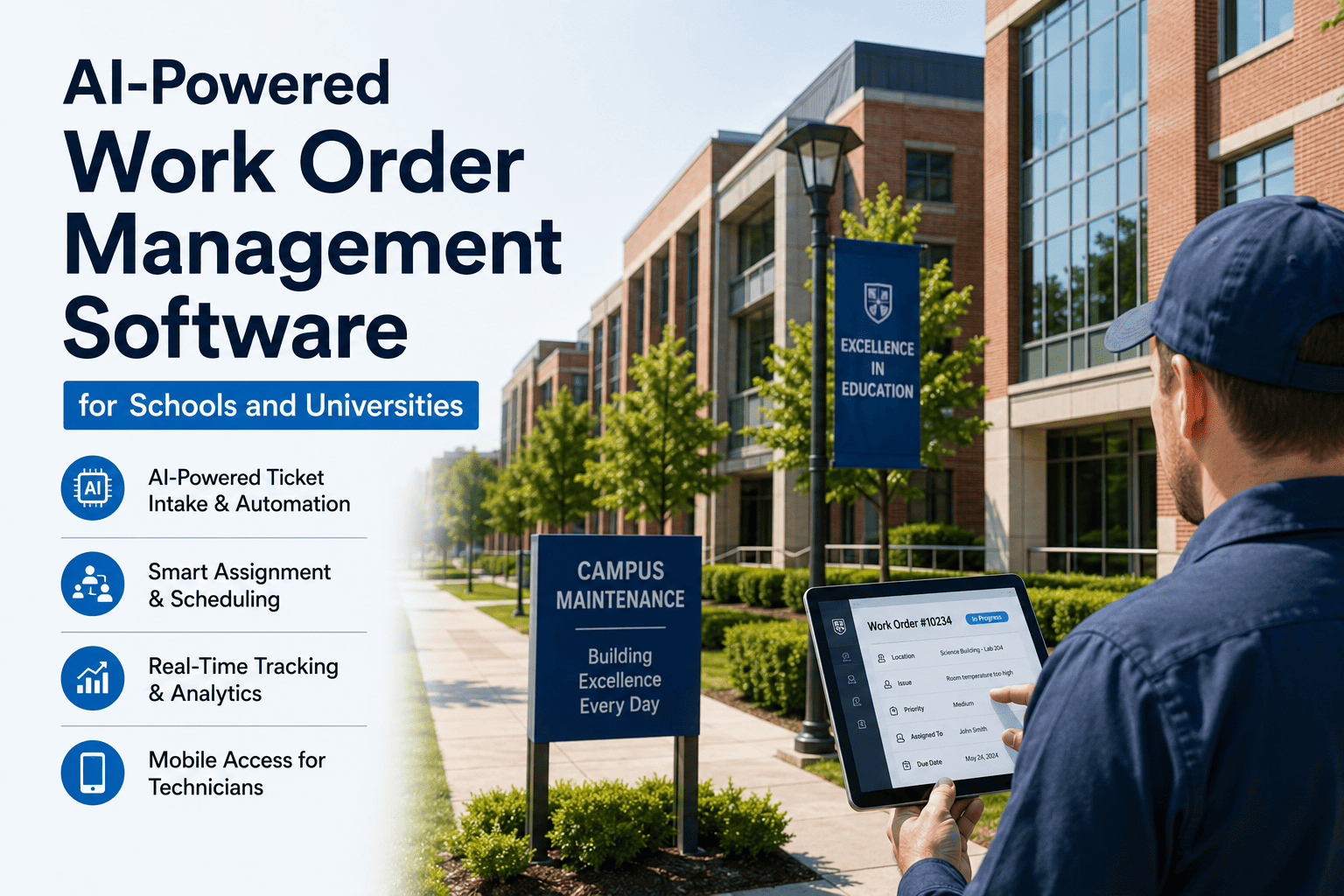
Custodial and maintenance teams spend less time on scheduling. AI automates work order routing, and mobile‑first access allows technicians to view tasks and manuals from any device.
Manual vs AI Driven Campus Operations
Manual Operations (Current State)
1. Reactive Maintenance
Staff responds to failures after they occur. Classroom disruptions last 2‑3 days. Emergency budgets depleted monthly.
2. Paper Compliance
Fire, environmental, and ADA inspections tracked on spreadsheets. 68% of citations are for missing documentation.
3. Manual Scheduling
Facilities managers spend 20‑25 hours weekly assigning work orders by hand. 30% of preventive tasks never get scheduled.
Result: High costs, frequent emergencies, compliance risks
AI Driven Operations (Optimized)
1. Predictive Maintenance
AI analyzes equipment sensor data to predict failures 4‑6 weeks early. Repairs scheduled before disruption occurs.
2. Automated Compliance
Every inspection is scheduled, assigned, and documented automatically. Audit‑ready records eliminate citation risks.
3. Autonomous Scheduling
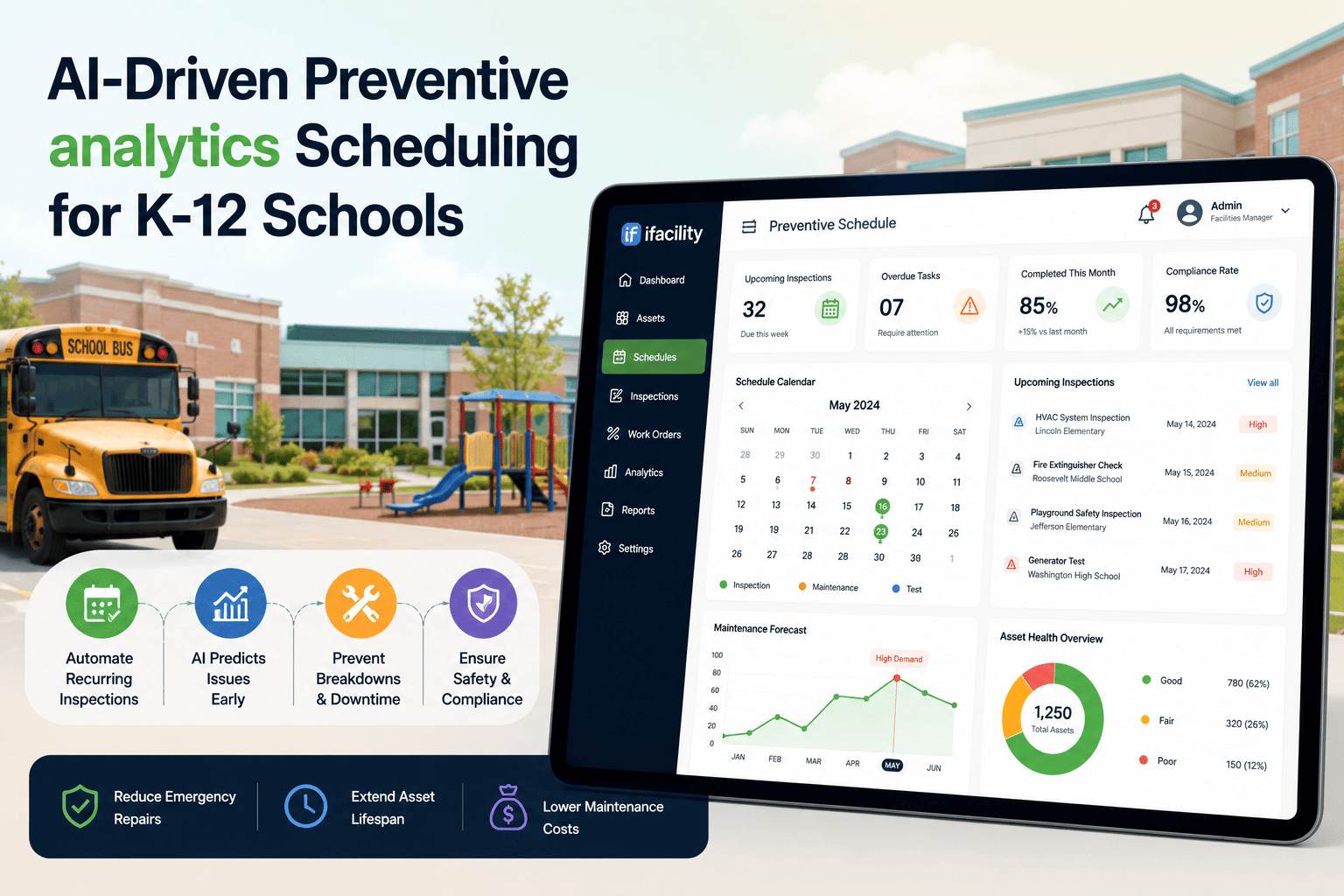
AI generates optimized weekly schedules in 5 minutes. 100% of work orders assigned based on risk and technician skills.
Result: 71% fewer emergencies, 85% faster scheduling, full compliance
Performance Impact Before vs After AI Adoption
Metric
Before AI (Manual)
After AI (12 Months)
Improvement
Emergency work orders per month
45‑60
12‑18
70‑75% reduction
Hours spent weekly on scheduling
20‑25 hours
2‑3 hours
85% faster
Energy cost per square foot
$1.85
$1.40
24% savings
Compliance citation rate
Baseline
68% reduction
Documentation gaps eliminated
Teacher request response time
48 hours
12 hours
75% faster
Three Campus Scenarios Optimized by AI
Preventive MaintenanceAutonomous Prevention Work SchedulingWeekly optimization
AI identifies 40‑50 preventive maintenance tasks needed this week across campus buildings. Manually prioritizing these would take a director 8‑10 hours. AI generates optimal schedule in 5 minutes: groups jobs by building, assigns to qualified technicians with spare capacity, schedules around class occupancy. 100% of prevention work gets scheduled instead of deferring to backlog.
Emergency IntegrationReal Time Re‑Optimization on Critical FailuresInstant replan
Monday 8:00 AM: optimized weekly schedule live. 8:47 AM: main chiller fails, affecting 8 buildings. Manual process takes 1‑2 hours of calls and rescheduling. AI process: system detects emergency, re‑optimizes entire schedule in 90 seconds, reassigns available technician, notifies all teams via app. Director approves in 1 minute.
Emergency response time90 seconds vs 60‑120 minutes
Facilities director plans staffing 4 weeks out. AI generates forward plan using current asset risk data, identifying all high‑risk work due within 4 weeks, distributing evenly across team capacity, highlighting bottlenecks. Director sees weekly utilization forecast and can add temporary staff before overload occurs.
No. AI eliminates tedious coordination work. Managers focus on strategy, staffing, and problem solving instead of daily scheduling. The role evolves to higher value work.
Typical deployment is 4‑12 weeks depending on campus size. Core features go live within 2 weeks, with predictive models maturing after 3 months of data collection.
Minimum: work order backlog, technician skills, asset inventory. Advanced: IoT sensors, BMS integration, real‑time alerts. Even with basic data, AI outperforms manual processes.
The platform is FERPA compliant with role‑based access. Facility data is segregated from student information systems. AI processes equipment and building data only.
You can book a demo for a personalized walkthrough or contact support to discuss pricing. Both options are free with no obligation.
Start Your AI‑Driven Campus Transformation
Join leading schools and universities that use predictive analytics to reduce costs, improve safety, and free up staff for what matters most. iFactory's AI‑native platform delivers all 12 benefits in one unified system.