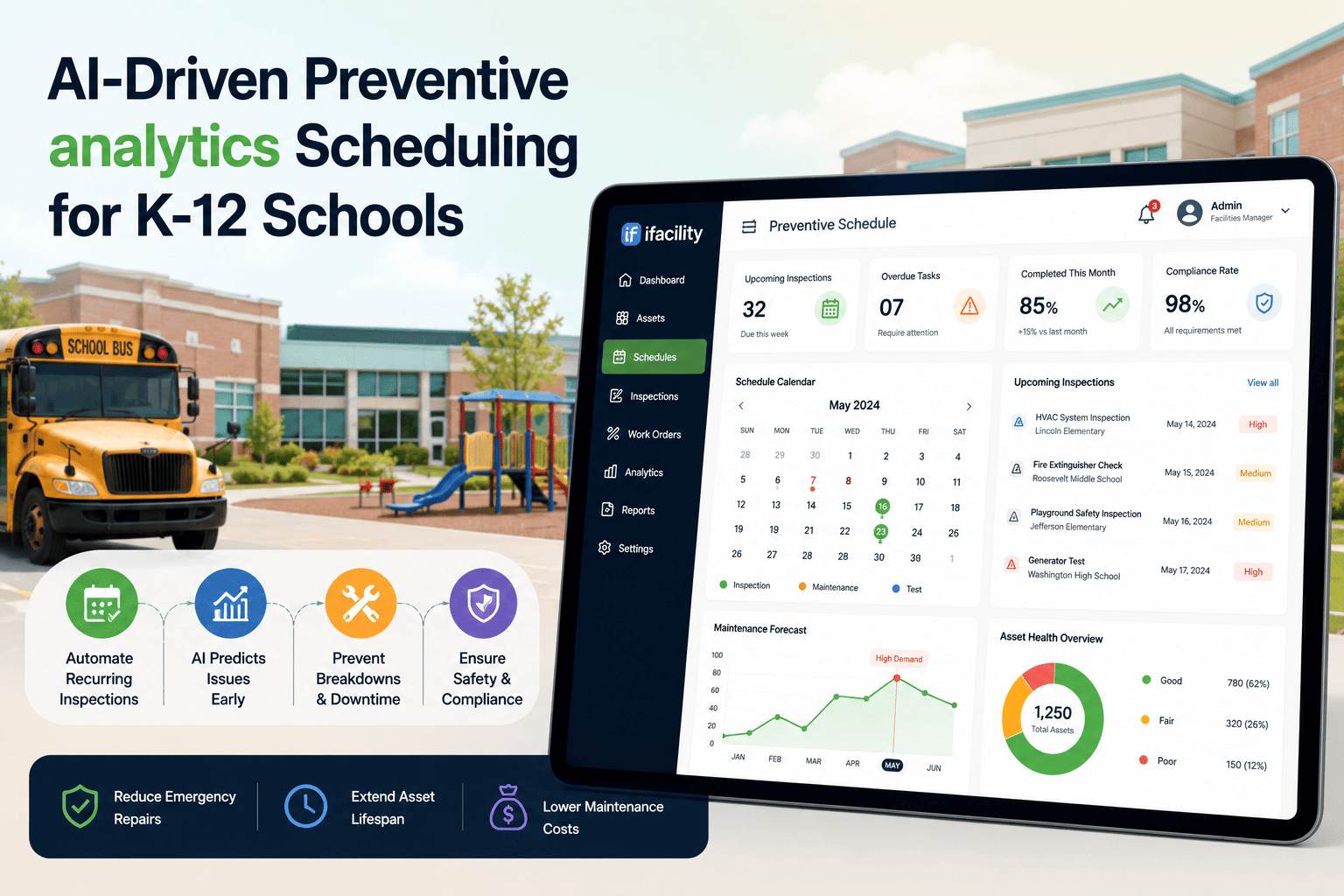
K-12 school districts are required to complete thousands of preventive maintenance tasks every year — HVAC filter changes, emergency light tests, fire extinguisher inspections, boiler checks, playground safety audits. Most districts still schedule these tasks with wall calendars, spreadsheets, or memory. The result: missed deadlines, expired compliance certificates, emergency breakdowns that could have been prevented, and unbudgeted repair costs. AI-driven preventive maintenance scheduling changes this by automatically generating task schedules based on asset type, usage, and condition data — not static calendars. For school facility directors and superintendents, this means fewer emergencies, lower repair costs, and audit-ready compliance documentation. See how AI preventive scheduling works for your district — Book a Demo.
Automate recurring inspections, reduce emergency repairs by 40%, and stay compliance‑ready with intelligent scheduling that adapts to your district's actual asset conditions.
The Preventive Maintenance Problem in K‑12 Schools
A typical school district with 10 schools has over 2,000 assets requiring preventive maintenance: 500+ fire extinguishers (monthly checks), 1,200 emergency lights (monthly tests), 200+ HVAC units (quarterly filter changes), 20+ boilers (daily logs, annual inspections), playground equipment (monthly visual), kitchen hoods (semi‑annual), and more. The total annual preventive tasks easily exceed 10,000. Manual scheduling — paper calendars, spreadsheets, or memory — leads to predictable gaps. The filter that gets changed every 3 months becomes every 4, then 5. The emergency light test scheduled for March gets postponed to April, then forgotten. The result is equipment running outside manufacturer specifications, compliance failures, and preventable emergency repairs that cost 3‑5x more than planned maintenance.
- HVAC efficiency drops 15‑25% with dirty filters
- Emergency lighting failures discovered during fire drill
- Boiler breakdown in winter — $20K+ emergency repair
- Fire extinguisher inspection missing — citation risk
- Playground equipment rust uncaught — safety hazard
- Fire extinguishers: 6,000+ checks
- Emergency lights: 14,400+ tests
- HVAC filters: 800+ changes
- Boiler logs: 7,300+ daily entries
- Total: Over 28,000 PM tasks/year
How AI-Driven Preventive Scheduling Works
Unlike calendar‑based systems that trigger the same task on the same date regardless of actual equipment condition, AI‑driven scheduling adapts. The platform ingests data from your CMMS, BMS, and IoT sensors — run hours, cycle counts, filter pressure drop, vibration, temperature — then dynamically adjusts task frequencies. An air handler in a high‑use gymnasium gets more frequent filter changes than one in an administrative office. A chiller showing early efficiency degradation triggers an inspection before failure. A generator with low run hours extends its oil change interval safely. The result is maintenance exactly when needed — not too early (wasting resources) and not too late (risking failure).
Key Features of AI Preventive Maintenance Scheduling for Schools
Manual PM vs AI‑Driven PM Scheduling: A Side‑by‑Side Comparison
| Aspect | Manual / Spreadsheet | AI‑Driven Scheduling |
|---|---|---|
| Task creation | Manual entry, prone to omission | Automatic, based on asset data |
| Frequency adjustment | Static calendar, never changes | Dynamic, adapts to usage |
| Missed tasks | Common — no reminders | Rare — automated alerts |
| Compliance tracking | Paper logs, hard to audit | Digital trail, instant reports |
| Emergency repairs | Higher frequency | 40% fewer |
| Staff time on scheduling | 10+ hours/week | Under 1 hour/week |
Compliance Calendar: Critical PM Tasks for K‑12 Schools
| Asset / System | Required Frequency | Regulation | AI Scheduling Benefit |
|---|---|---|---|
| Fire extinguishers | Monthly visual, annual maintenance | NFPA 10 | Auto‑reminders, QR scan completion |
| Emergency lighting | Monthly 30‑sec, annual 90‑min | NFPA 101 | Schedule generator, photo proof |
| Fire alarm systems | Quarterly, semi‑annual, annual | NFPA 72 | Test logging, deficiency alerts |
| Boilers & pressure vessels | Daily logs, annual inspection | ASME / Local code | Digital log sheets, cert expiry alerts |
| HVAC filters | Quarterly or by pressure drop | Manufacturer spec | Condition‑based trigger |
| Playground equipment | Monthly visual, annual certified | CPSC guidelines | Checklist + photo documentation |
| Kitchen hood suppression | Semi‑annual service | NFPA 17A | Vendor scheduling, record storage |
| Backflow preventers | Annual testing | Local water authority | Test renewal alerts, report export |
Measurable Results from School Districts Using AI Preventive Scheduling
Frequently Asked Questions
Automate Your District's Preventive Maintenance
Join school districts using iFactory to reduce emergency repairs by 40%, never miss a compliance deadline, and extend equipment life — all with AI‑driven scheduling.