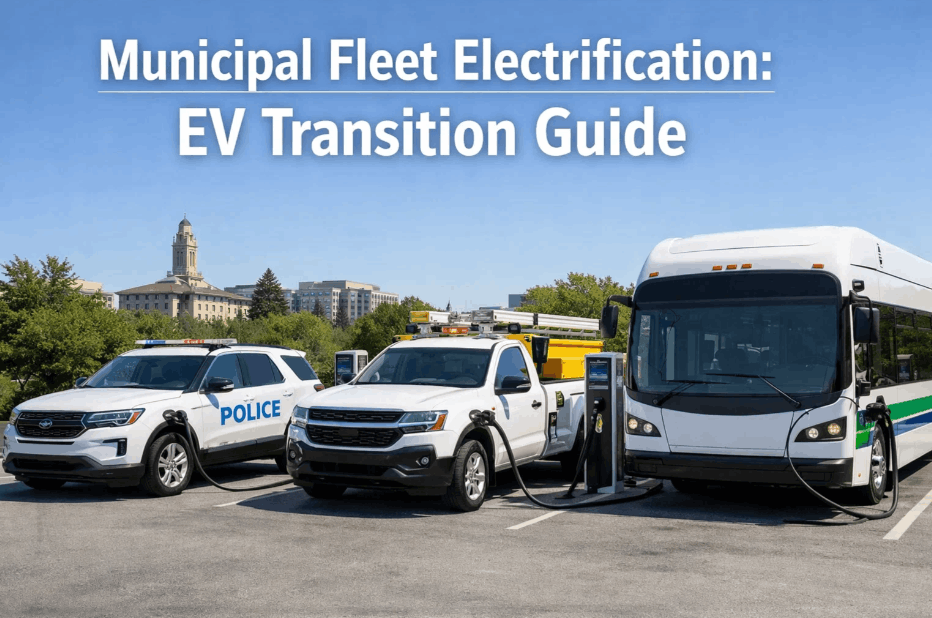
Municipal fleet electrification is no longer an aspirational policy goal — it is an active operational transition reshaping how government transportation departments plan vehicle acquisition, infrastructure investment, and fleet analytics. For fleet managers navigating a shift from internal combustion to electric vehicles, the challenge is not the decision to electrify. The challenge is executing a phased EV transition that maintains service continuity, satisfies public reporting requirements, and builds the data infrastructure needed to optimize a mixed fleet at scale. Agencies that approach municipal EV transition with a structured analytics platform close the operational gap between legacy fleet management and the performance demands of a fully electrified government vehicle fleet. Book a demo to see how iFactory's fleet analytics layer maps directly to your electrification transition roadmap.
MUNICIPAL FLEET ELECTRIFICATION PLATFORM
One Platform. Every Phase of Your EV Fleet Transition.
EV acquisition planning, charging infrastructure analytics, route optimization, and compliance reporting — purpose-built for government fleet electrification programs.
What Is Municipal Fleet Electrification and Why Is It Accelerating Now?
Municipal fleet electrification refers to the systematic replacement of government-owned gasoline and diesel vehicles — police cruisers, public works trucks, transit buses, maintenance vans — with battery electric vehicles supported by charging infrastructure and updated fleet management systems. The transition is accelerating across US, UK, Canadian, and Australian local governments for three converging reasons: federal and state EV incentive programs that materially reduce acquisition cost, total cost of ownership data demonstrating that electric fleet government vehicles cost significantly less to operate and maintain over a 10-year lifecycle, and net-zero commitments that make fleet decarbonization a public accountability metric rather than a long-range goal.
For fleet directors, the operational complexity of the transition — not the policy mandate — is the primary management challenge. A government EV fleet requires coordinated decisions across procurement, infrastructure, IT, and finance that legacy fleet management workflows were not designed to support. Agencies that treat electrification as a vehicle swap rather than a system transformation consistently encounter charging capacity shortfalls, range anxiety during deployment, and analytics blind spots that prevent data-driven optimization of the new fleet.
The Five Pillars of a Successful Municipal EV Transition Strategy
A structured municipal electrification plan addresses five interdependent workstreams simultaneously. Agencies that sequence these correctly — rather than treating them as independent projects — achieve faster deployment timelines, lower total program cost, and measurably better fleet performance outcomes from day one of full EV operation.
Fleet Usage and Duty Cycle Analysis
Before selecting a single EV model, agencies must map actual vehicle utilization against EV range capabilities. Telematics data from the existing ICE fleet — daily mileage, idle time, peak usage windows, and seasonal variation — defines which vehicle categories are immediate electrification candidates and which require extended-range solutions or deferred replacement. This analysis prevents the most common municipal EV transition failure: acquiring EVs that cannot complete assigned duty cycles on a single charge. Agencies using analytics platforms to conduct this analysis prior to procurement consistently achieve higher first-deployment success rates and avoid the costly redeployment of EVs assigned to incompatible use cases. Book a demo to see how iFactory's duty cycle analysis module maps your existing fleet data to EV suitability scores by vehicle category.
EV Acquisition Planning and Government Procurement
Government EV fleet procurement operates under unique constraints — public tender requirements, multi-year budgeting cycles, cooperative purchasing agreements, and federal incentive eligibility rules. A well-structured EV acquisition plan for municipal use defines vehicle specifications by category, sequences replacements to align with existing vehicle retirement schedules, and structures phased budget requests that capture available incentives without creating funding gaps between procurement and infrastructure readiness. Agencies that align procurement timing with charging infrastructure installation avoid the operational gap where EVs are delivered before charging is available — a scenario that regularly sets back municipal electrification timelines by six to twelve months.
Municipal EV Charging Infrastructure Planning
Charging infrastructure is the longest-lead-time component of any municipal EV transition and the most common source of deployment delays. A rigorous infrastructure plan determines Level 2 versus DC fast charging allocation by depot, electrical service upgrade requirements, smart charging scheduling to manage demand charges, and the utility interconnection timeline that governs when charging capacity is actually available. Agencies serving rural or distributed facility portfolios face additional infrastructure complexity — satellite depots with limited electrical service require different solutions than a centralized urban fleet yard. The infrastructure planning phase must be initiated 18 to 24 months before first EV delivery for large fleet programs. Book a demo to review iFactory's charging infrastructure modeling tool for your depot locations.
Fleet Management System Adaptation for Electric Vehicles
Legacy fleet management systems built around fuel consumption, oil change intervals, and engine diagnostics do not natively support the operational data streams that define EV fleet performance: state of charge, charging session records, battery health degradation, regenerative braking efficiency, and thermal management event logs. Transitioning to a fleet analytics platform that supports both ICE and EV data simultaneously — without maintaining two parallel systems — is essential for agencies managing a mixed fleet through a phased transition period that may span five to ten years. The analytics adaptation workstream should be scoped and implemented before the first EV enters service, not after.
Workforce Training and Change Management
Municipal EV transition success depends as much on operator behavior as on vehicle and infrastructure readiness. Drivers accustomed to ICE vehicles require structured training on EV range management, charging protocol compliance, regenerative braking utilization, and climate control impact on range. Fleet technicians need certification in EV-specific maintenance procedures and high-voltage safety protocols. Agencies that invest in structured change management programs before full deployment consistently report higher charging compliance rates, lower battery degradation from misuse, and faster operator adaptation to EV-specific operational requirements.
Phased EV Transition Roadmap: From Pilot to Full Government Fleet Electrification
A four-phase electrification roadmap structures the transition from pilot program to full municipal electric vehicle fleet in a sequence that manages operational risk, captures learnings at each stage, and builds internal capacity before scaling. Agencies that attempt full-fleet electrification without a structured phase gate process consistently encounter mid-transition operational disruptions that erode political and public support for the program.
Deploy 5–15% of highest-suitability vehicles — typically light-duty sedans and vans with predictable daily routes. Validate charging infrastructure performance, operator training effectiveness, and analytics data integration before committing to full acquisition contracts.
Scale to 25–50% of target EV fleet based on pilot learnings. Introduce medium-duty categories — utilities, inspections, and public works vehicles. Expand charging infrastructure to satellite depots. Refine smart charging schedules to optimize demand charge management.
Achieve 50–80% EV penetration. Introduce heavy-duty and specialized categories — refuse collection, transit, and emergency response where technology and range requirements permit. Full analytics dashboard transition from mixed-fleet to EV-primary performance monitoring.
Complete the electric fleet government transition for all eligible categories. Maintain residual ICE or alternative-fuel vehicles only for documented operational exceptions. Report fleet carbon reduction outcomes against public commitments with full telematics data support.
Municipal EV Charging Infrastructure: Planning Requirements by Fleet Category
Charging infrastructure requirements vary significantly by vehicle category, shift structure, and depot configuration. Understanding the charging load profile of each fleet segment — and planning electrical service capacity accordingly — prevents the most expensive infrastructure rework scenario: installing charging stations that cannot support actual fleet demand at peak charging windows. Book a demo to walk through a charging load modeling session for your fleet categories.
| Fleet Category | Typical Daily Mileage | Recommended Charging Level | Charging Window | Infrastructure Priority |
|---|---|---|---|---|
| Admin / Inspection Sedans | 30–80 miles/day | Level 2 (7.2 kW) | Overnight depot | Immediate — highest suitability |
| Light-Duty Vans | 60–120 miles/day | Level 2 (7.2–11 kW) | Overnight + midday top-up | Phase 1–2 priority |
| Public Works Trucks | 50–150 miles/day | DC Fast (50 kW) | Overnight + opportunity | Phase 2–3 with depot upgrades |
| Transit Buses | 150–300 miles/day | DC Fast (150–350 kW) | Depot overnight + en-route | Phase 3 — requires major electrical upgrade |
| Police / Emergency | 100–200 miles/day | DC Fast (50–150 kW) | Shift-end charging + rapid topping | Phase 2–3 — requires dedicated circuit allocation |
| Refuse Collection | 60–100 miles/day | DC Fast (150 kW) | Depot overnight | Phase 3–4 pending heavy EV availability |
Fleet Analytics Adaptation for Electric Government Vehicles
The shift from ICE to electric fleet government vehicles changes the fundamental data streams that define fleet performance. Fuel economy gives way to energy consumption per mile and state-of-charge trend analysis. Scheduled engine maintenance is replaced by battery health monitoring, thermal event detection, and charging system diagnostics. Fleet analytics platforms that cannot ingest EV telematics data natively — or that require manual data reconciliation between EV and ICE systems — create the analytics blind spot that prevents data-driven management of a transitioning fleet.
Real-time and historical SoC tracking by vehicle, depot, and route segment — enabling proactive range management intervention before vehicles enter service at insufficient charge levels. Directly replaces fuel level monitoring in the operational dashboard.
Per-session charging records capturing energy delivered, session duration, charger ID, and charging speed — structured for both operational optimization and utility cost reconciliation. Supports accurate cost-per-mile calculation for government EV fleet reporting.
Longitudinal battery capacity monitoring identifies vehicles approaching replacement threshold and flags charging behavior patterns — frequent DC fast charging, chronic deep discharge — that accelerate degradation and reduce asset life expectancy.
Smart charging schedule optimization that staggers vehicle charging windows to prevent simultaneous peak demand events — reducing utility demand charges that can otherwise represent 30–50% of a fleet depot's electricity cost.
Automated emissions reduction calculations comparing EV energy consumption against equivalent ICE fuel use — generating the fleet decarbonization metrics required for public reporting, council presentations, and federal program compliance documentation.
Unified visibility across ICE and EV assets during the transition period — allowing fleet managers to track electrification progress, compare total cost of ownership by powertrain type, and make evidence-based decisions about the pace of ongoing replacement cycles. Book a demo to see how iFactory's mixed-fleet dashboard unifies your ICE and EV performance data.
Total Cost of Ownership: The Financial Case for Government Fleet EV Transition
The TCO case for municipal electric vehicles has shifted decisively in favor of electrification for high-utilization fleet categories. While acquisition cost premiums for EVs remain real — typically 15–30% higher than equivalent ICE vehicles before incentives — fuel and maintenance savings over a 10-year vehicle lifecycle produce net positive TCO outcomes that justify the transition on purely financial grounds, independent of carbon commitments.
Electricity cost per mile consistently outperforms gasoline at commercial rates, with the margin widening further for agencies with access to off-peak utility tariffs or on-site renewable generation.
Elimination of oil changes, transmission service, exhaust system repairs, and coolant maintenance removes a significant portion of recurring fleet maintenance cost — particularly for high-mileage categories like police and transit.
The Inflation Reduction Act's commercial clean vehicle credit — up to $7,500 for light-duty and $40,000 for heavy-duty EVs — materially reduces net acquisition cost for qualifying government fleet purchases.
When fuel savings, maintenance reduction, and incentive capture are modeled together against infrastructure and acquisition premiums, most municipal EV programs achieve positive ROI within a single vehicle lifecycle.
Common Challenges in Municipal Fleet Electrification and How to Resolve Them
Range Anxiety and Duty Cycle Mismatches
Assigning EVs to routes that exceed comfortable single-charge range generates operator resistance and service disruptions. Resolving this requires pre-deployment duty cycle analysis that matches each vehicle's realistic usable range — accounting for seasonal temperature impact on battery performance — to actual route demands before assignment.
Charging Infrastructure Delays and Electrical Service Constraints
Depot electrical service upgrades are subject to utility interconnection queues that frequently run 12–24 months. Agencies that initiate infrastructure permitting before finalizing EV procurement avoid the gap where vehicles arrive before charging is available. Temporary Level 2 charging solutions can bridge short-term gaps while permanent infrastructure is completed.
Budget Cycle Misalignment
Multi-year municipal budget cycles and annual procurement appropriations create funding sequencing challenges for programs that span both infrastructure and vehicle acquisition across different fiscal years. A multi-year electrification financial model that maps incentive capture timing to budget cycle constraints allows finance and fleet teams to structure requests that maximize available federal and state program participation.
Legacy Fleet Management System Incompatibility
Agencies using fleet management software built before EVs entered the commercial market often discover that their systems cannot ingest charging data, report on energy consumption, or support battery health monitoring. Selecting a fleet analytics platform with native EV telematics integration — before first EV delivery — prevents the operational data gap that forces manual reconciliation across disconnected systems.
Operator and Technician Resistance
Front-line operators and maintenance technicians who have worked with ICE vehicles for decades often approach EVs with skepticism. Structured training programs that demonstrate the operational simplicity of EVs — and EV-specific maintenance certification pathways for technicians — convert resistance into advocacy. Agencies that invest in workforce preparation before full deployment report measurably higher first-year EV utilization rates.
Best Practices for Building a Data-Driven Municipal Electrification Plan
Start with Telematics-Based Fleet Suitability Scoring
Use 12 months of telematics data from your existing fleet to rank every vehicle by electrification suitability — daily mileage, route predictability, and depot return reliability. This data-driven prioritization eliminates guesswork from pilot vehicle selection and builds the evidence base for acquisition planning.
Integrate Infrastructure and Procurement Timelines
Map charging infrastructure installation milestones against vehicle delivery schedules as a single integrated project plan — not two separate workstreams. The most common municipal EV transition delay is vehicle delivery preceding infrastructure readiness by six to eighteen months.
Model Total Cost of Ownership Before Acquisition Decisions
Build a 10-year TCO model for each vehicle category that captures acquisition premium, incentive offsets, fuel savings, maintenance reduction, charging infrastructure amortization, and residual value — before committing to procurement. The model output defines the financial case for council approval and structures the multi-year budget request.
Deploy Fleet Analytics Before the First EV Enters Service
Configure your fleet analytics platform to ingest EV telematics data before first deployment. Establishing baseline performance benchmarks from day one — SoC patterns, charging compliance, energy per mile — gives fleet managers the data they need to optimize operations within the first month rather than the first year.
Build Public Reporting Into the Analytics Architecture
Municipal electrification programs operate under public accountability requirements that ICE fleet management never faced. Design your analytics dashboard to automatically generate carbon reduction metrics, fleet electrification progress percentages, and cost savings summaries in a format ready for council reporting and public communications — making transparency a byproduct of normal operations rather than a separate reporting effort.
Frequently Asked Questions: Municipal Fleet Electrification
Which government fleet vehicles are the best candidates for immediate electrification?
Light-duty sedans and vans used for administrative, inspection, and field service roles — with predictable daily mileage under 100 miles and consistent overnight return to a central depot — represent the highest-suitability immediate candidates. These vehicles align closely with the duty cycle and charging window characteristics that current EV technology handles most reliably.
How long does a typical municipal EV transition program take from planning to full deployment?
Most comprehensive municipal electrification programs span five to ten years from initial planning to full fleet conversion, depending on fleet size, budget cycle constraints, and the proportion of heavy-duty vehicles requiring specialized EV solutions. Light-duty fleet segments can typically complete transition within three to five years when infrastructure planning is initiated early.
What federal funding is available for municipal fleet electrification?
Available federal programs include the IRA Commercial Clean Vehicle Credit (up to $7,500 for light-duty, $40,000 for heavy-duty), EPA Clean School Bus and Clean Ports programs, and FHWA Congestion Mitigation and Air Quality funding. State-level incentive programs and utility rebates for commercial charging infrastructure layer additional funding on top of federal programs in most jurisdictions.
How should fleet management software be updated to support electric vehicles?
Fleet management platforms must add native support for EV-specific data streams: state of charge, charging session records, battery health indicators, and energy consumption per mile. Platforms that require separate EV modules or manual data import from charger networks create the operational data fragmentation that prevents effective mixed-fleet management during the transition period.
What is the typical payback period for municipal EV charging infrastructure investment?
When combined fuel and maintenance savings are applied against infrastructure amortization, most municipal charging infrastructure investments achieve payback within three to five years — assuming fleet utilization levels that keep EVs charging regularly and federal or utility rebates that offset 20–50% of hardware and installation cost.
READY TO ACCELERATE YOUR EV FLEET TRANSITION
From ICE Fleet to Electric Government Fleet — One Analytics Platform, Every Phase.
iFactory's fleet electrification analytics module delivers duty cycle suitability scoring, charging infrastructure load modeling, mixed-fleet performance dashboards, and carbon reduction reporting — purpose-built for municipal EV transition programs across light-duty, medium-duty, and heavy-duty government vehicle categories.






-complete-guide.png)