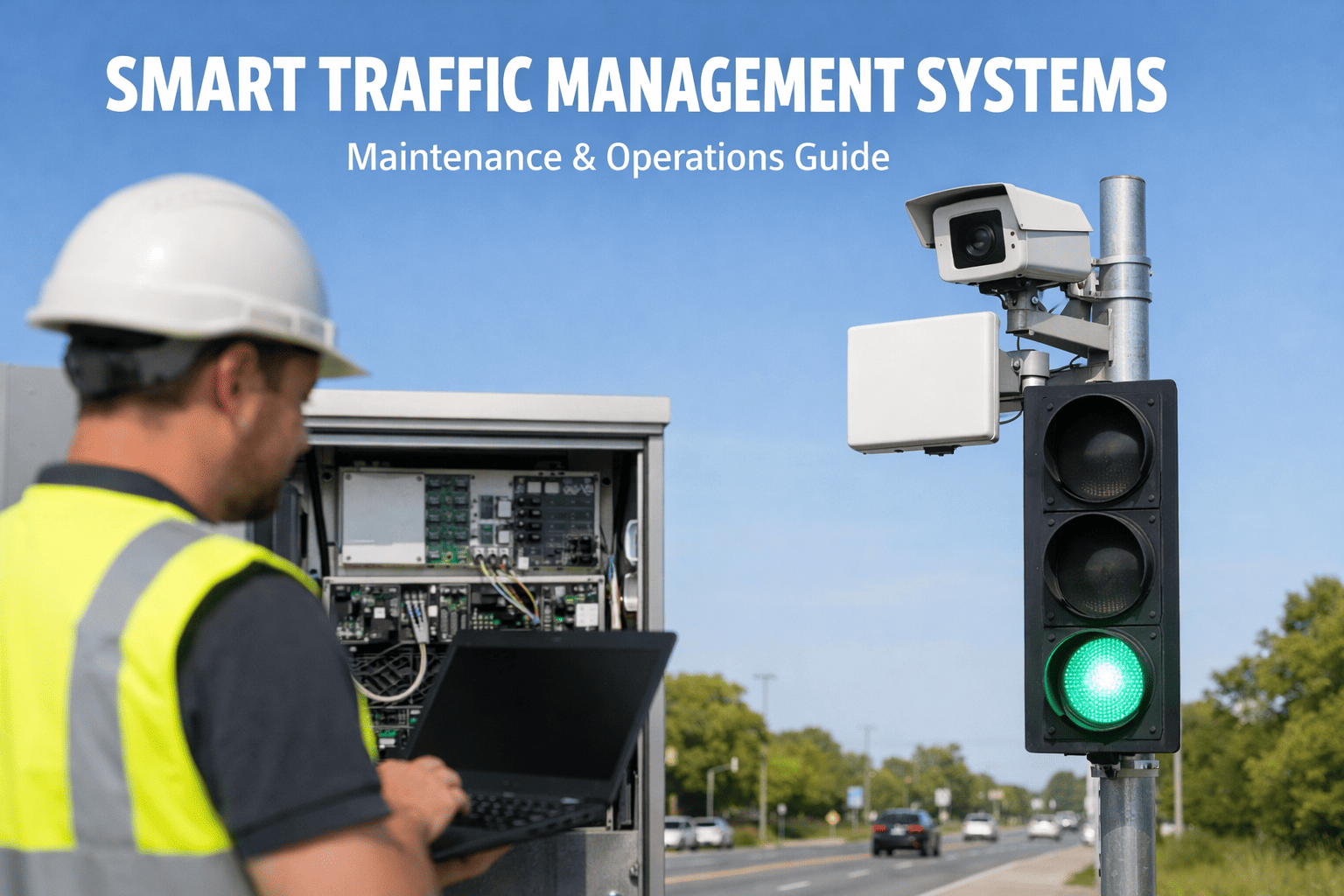
Every day, over 330,000 signalized intersections across the United States direct millions of vehicles through complex urban networks—and when even one fails, the ripple effects cascade into gridlock, safety hazards, and costly emergency callouts. The global intelligent traffic management market is on track to exceed $68 billion by 2036, yet most transportation agencies still rely on handwritten maintenance logs and reactive repair cycles that leave critical infrastructure vulnerable. Modern AI-powered platforms now combine real-time diagnostics, predictive failure modeling, and automated work order systems to transform how cities maintain their traffic infrastructure. Schedule a free demo to see how AI-driven maintenance protects traffic networks in real time.
What Makes Traffic Signal Infrastructure So Hard to Maintain?
Traffic signal systems are among the most safety-critical and operationally demanding assets any city manages. Unlike building HVAC or factory equipment, a failed traffic controller creates an immediate public safety emergency with legal liability under MUTCD standards. Understanding why conventional maintenance falls short is the first step toward building a smarter approach.
High-Consequence Failures
A single controller malfunction turns a busy intersection into the most dangerous point in the road network—exposing agencies to tort liability for every crash at a non-compliant signal
Massive Asset Diversity
Each intersection combines controllers, conflict monitors, LED heads, detection sensors, communication links, pedestrian equipment, and structural elements—each with unique maintenance cycles
Legacy Infrastructure Gaps
Many cities run aging controllers incompatible with modern monitoring protocols, making centralized visibility impossible without strategic upgrade planning and retrofit solutions
$68B
Intelligent traffic management market projected by 2036, growing at 14.9% CAGR globally
43 hrs
Average annual hours lost per U.S. driver to traffic congestion, costing billions in productivity
30%
Congestion reduction achieved by cities deploying AI-driven adaptive signal control systems
How Adaptive Signal Control Depends on Equipment Health
Adaptive traffic control—the technology that adjusts signal timing in real-time based on actual traffic conditions—can only perform as well as the sensors, controllers, and communication links that feed it data. When a video detection camera drifts out of calibration or a loop detector degrades, the adaptive algorithm receives corrupted inputs and makes poor timing decisions that worsen congestion rather than reduce it. Get Support to explore how continuous equipment health monitoring keeps adaptive signals accurate.
Signal System Health Chain
When any link weakens, the entire intersection degrades
1
Sensors & Detectors
Video cameras, inductive loops, radar, and LiDAR units measure vehicle presence, speed, and queue length. Calibration drift or lens fouling feeds bad data to the controller.
2
Controller Logic
Traffic signal controllers execute timing plans and manage intersection safety logic. Firmware corruption, relay failure, or conflict monitor faults create immediate safety risks.
3
Communication Network
Fiber optic, cellular, and wireless mesh links connect field devices to central management. Latency spikes or connectivity drops disable remote monitoring and adaptive coordination.
4
Central Management
ATMS and SCADA platforms aggregate network-wide data for adaptive control, incident management, and performance reporting. Database issues or integration failures blind operators.
Is equipment degradation silently undermining your traffic network? Join agencies using continuous health monitoring to catch problems before they impact intersection performance.
Preventive Maintenance Schedules That Reduce Emergency Callouts by 75%
Agencies with documented, structured preventive maintenance programs consistently report 60-75% fewer emergency signal callouts compared to reactive-only operations. The key is automating the scheduling, assignment, and documentation of every maintenance task so nothing falls through the cracks—especially the quarterly and semi-annual inspections that catch degrading components before they fail completely.
Traffic Signal PM Schedule Framework
Cycle
Critical Maintenance Tasks
Equipment Covered
Why It Matters
Monthly
Visual signal head check, conflict monitor test, detector verification, pedestrian button test, communication link check
Signal heads, detection, pedestrian systems
Catches visible degradation and safety-critical failures early
Prevents heat-related failures and power supply degradation
Semi-Annual
LED intensity measurement, preemption system validation, surge protector inspection, timing accuracy review
LED modules, EVP systems, power protection
Ensures MUTCD luminous intensity and preemption compliance
Annual
Full intersection audit, signal timing optimization, ADA pedestrian review, asset condition scoring, capital planning
Complete intersection systems
Drives budget-accurate 5-year capital replacement programs
Biennial
Structural pole and mast arm assessment, foundation inspection, grounding resistance test, full electrical audit
Poles, foundations, grounding, conduit
Structural safety—failure creates immediate hazard zone
Using Predictive Analytics to Forecast Traffic Equipment Failures
Predictive maintenance applies machine learning to historical failure data, real-time sensor readings, and environmental conditions to forecast when a traffic component will degrade below acceptable performance. Instead of discovering a failed detector during a rush-hour emergency, agencies receive alerts weeks in advance—scheduling repairs during planned maintenance windows that minimize traffic disruption and crew overtime costs.
Anomaly Detection
AI continuously monitors controller performance, detector sensitivity, and network latency against learned baselines. Deviations trigger prioritized alerts within minutes—identifying failing components before intersection operations are affected.
Remaining Life Estimation
Machine learning models trained on thousands of failure records predict remaining useful life for LED modules, conflict monitors, and controller boards—transforming capital replacement planning from guesswork into data-driven budgeting.
Weather & Stress Correlation
AI correlates equipment degradation with temperature extremes, humidity cycles, salt exposure, and lightning history. Intersections in high-stress zones automatically receive accelerated PM schedules and earlier replacement triggers.
Auto Work Order Creation
When predictive models flag an impending failure, the CMMS automatically generates a work order with GPS location, component specs, repair procedures, and parts list—dispatched to the nearest qualified technician instantly.
Network Cascade Modeling
AI simulates the ripple-effect traffic impact of every potential signal failure, automatically prioritizing maintenance on intersections where outages would cause the most congestion and safety risk across the corridor.
Digital Twin Simulation
Virtual replicas of traffic infrastructure allow agencies to test timing changes, evaluate upgrade scenarios, and simulate maintenance impacts before deploying changes on live, safety-critical intersections.
See predictive failure alerts in action. Book a live walkthrough showing how AI identifies at-risk equipment across your signal network before failures happen.
Why Reactive Signal Repair Costs 5x More Than Planned Maintenance
The math is straightforward: an emergency callout during peak traffic hours involves overtime labor, rush parts procurement, extended signal outage time, and potential accident liability. Planned maintenance during off-peak windows uses standard labor rates, pre-staged parts, and creates zero unexpected traffic disruption. Agencies that shift from reactive to predictive approaches consistently report dramatic cost and performance improvements.
Maintenance Strategy Impact Comparison
4.2 hrsavg outage with reactive repair
vs
47 minavg restoration with CMMS dispatch
Fix-on-Failure Approach
AI-Driven Predictive Strategy
No advance warning of equipment degradation
Failure prediction weeks before component loss
Handwritten logs with zero analytical value
Full digital asset profiles with condition scoring
Rush-hour emergency dispatch at overtime rates
Planned repairs in scheduled maintenance windows
No compliance documentation for MUTCD audits
Automated MUTCD compliance documentation
Cascading congestion during outage window
Zero-disruption repairs with pre-staged parts
Shift from Emergency Repairs to Precision-Scheduled Maintenance
iFactory helps transportation agencies connect every signal, sensor, and communication link into a unified maintenance intelligence platform—automating PM schedules, generating predictive alerts, and documenting compliance across your entire network.
Traffic Infrastructure Asset Tracking: What Your CMMS Must Monitor
Effective smart city traffic operations require tracking dozens of asset types across hundreds or thousands of intersections. Every component—from a $15,000 controller cabinet to a $20 pedestrian pushbutton—has distinct failure characteristics, replacement costs, and safety implications that your maintenance management system must capture and analyze.
Medium—supports operations, not intersection-critical
Measuring the ROI of Smart Traffic Maintenance Programs
The business case for intelligent traffic maintenance is built on measurable outcomes: fewer emergency dispatches, longer equipment life, faster outage recovery, and reduced litigation exposure. Agencies that digitize their maintenance operations also unlock the historical data foundation needed for future predictive AI capabilities.
Documented Operational Improvements
Based on transportation agency CMMS deployment data
75%
Fewer emergency signal callouts with structured PM
40%
Longer component lifecycles via condition-based replacement
85%
Faster outage response with automated technician dispatch
55%
Reduction in compliance reporting and documentation time
Want to model savings for your specific signal network? Our team will build a custom ROI analysis based on your intersection count, current callout rates, and maintenance budget.
Step-by-Step: Deploying a Traffic CMMS Across Your Agency
Moving from spreadsheets and paper logs to an intelligent maintenance platform follows a proven phased approach that delivers early wins while building toward full predictive capability. The critical success factor is digitizing your asset register and maintenance history first—because every work order logged today becomes training data for tomorrow's AI prediction models. Book a demo to get a step-by-step deployment plan tailored to your signal infrastructure.
Implementation Roadmap
1
Week 1-3
Inventory & Baseline
Complete digital asset inventory across all intersectionsCondition assessment scoring for every component classHistorical maintenance record digitization and migration
2
Week 4-6
Platform Configuration
Asset hierarchy and criticality rating setupPM schedule automation with mobile checklist deploymentWork order workflow configuration and technician onboarding
3
Week 7-9
Integration & Go-Live
SCADA/ATMS data feed connection for real-time monitoringHands-on field technician training with supervised PM runsPerformance dashboard and management reporting activation
4
Week 10+
Predictive Intelligence
AI failure prediction model calibration on your operational dataAutomated predictive alert rollout across high-priority corridorsContinuous model refinement and network-wide optimization
Overcoming Common ITS Maintenance Implementation Barriers
Every transportation agency faces unique obstacles when modernizing traffic infrastructure maintenance—from legacy hardware compatibility to workforce digital readiness. Understanding these barriers and their proven solutions helps agencies plan realistic timelines and avoid common pitfalls.
Implementation Challenge Guide
Barrier
Operational Impact
Proven Resolution
Aging controller hardware
Incompatible with modern monitoring and communication protocols
Phased controller upgrades prioritized by traffic volume and safety risk; retrofit communication adapters for interim connectivity
Siloed maintenance records
No cross-intersection pattern analysis or failure trend visibility
Centralized CMMS with standardized data entry; historical record migration with validation and deduplication
Cybersecurity exposure
Unauthorized access risk to safety-critical traffic control systems
Start with highest-risk intersections; document early ROI from callout reduction to justify phased expansion funding
Maintenance and reliability are critical as traffic systems grow more complex. The agencies that invest in structured, data-driven maintenance programs today are building the intelligence foundation that powers smarter, safer infrastructure decisions for the next two decades.
— Smart City Transportation Director
Build Data-Driven Traffic Operations That Prevent Failures
Your paper maintenance logs cannot predict a controller failure at the city's busiest intersection next Tuesday morning. iFactory helps transportation agencies deploy AI-powered maintenance intelligence across every signal, sensor, and communication link—transforming operations from reactive firefighting into precision-scheduled upkeep that keeps intersections safe, compliant, and optimized around the clock.
How does a CMMS reduce traffic signal outage response time?
A CMMS transforms outage response by automatically generating priority work orders routed to the nearest available technician with GPS directions, cabinet access codes, controller model details, and intersection wiring diagrams. Agencies using CMMS-powered dispatch consistently report reducing average signal outage duration from over 4 hours to under 47 minutes. Schedule a demo to see how automated dispatch cuts your signal outage response time.
What types of traffic equipment can predictive maintenance track?
Predictive platforms monitor every component across the signal network—controller boards, LED signal modules, conflict monitors, detector cards, communication modems, UPS batteries, and structural elements. Each component receives a digital profile containing installation date, manufacturer data, firmware version, complete maintenance history, condition score, and projected replacement date to support precise capital planning.
Can AI-powered maintenance work with older traffic signal controllers?
Yes. Predictive analytics platforms deliver value even with legacy infrastructure by analyzing maintenance history patterns, failure frequency data, and component age profiles. As agencies upgrade controllers and add sensors, AI models gain richer real-time data that improves prediction accuracy over time. A phased approach allows agencies to prove ROI before committing to full-scale modernization. Get Support to start a phased predictive maintenance rollout for your legacy signal equipment.
How does automated maintenance documentation help with MUTCD compliance?
AI-powered CMMS platforms automatically record every preventive maintenance task, inspection result, and repair action with timestamped entries, technician identification, and photographic evidence. This creates the auditable compliance trail that proves adherence to MUTCD standards during legal proceedings—protecting agencies from tort liability at every intersection they manage.
What ROI timeline should agencies expect from traffic CMMS deployment?
Most agencies identify measurable savings within the first 60 days through automated PM scheduling and faster outage response. Emergency callout reduction alone typically recoups the system cost within 6-9 months. Long-term benefits compound as predictive models mature and capital replacement planning transitions from age-based assumptions to condition-based precision. Schedule a demo to model the exact ROI your signal network can achieve with predictive maintenance.