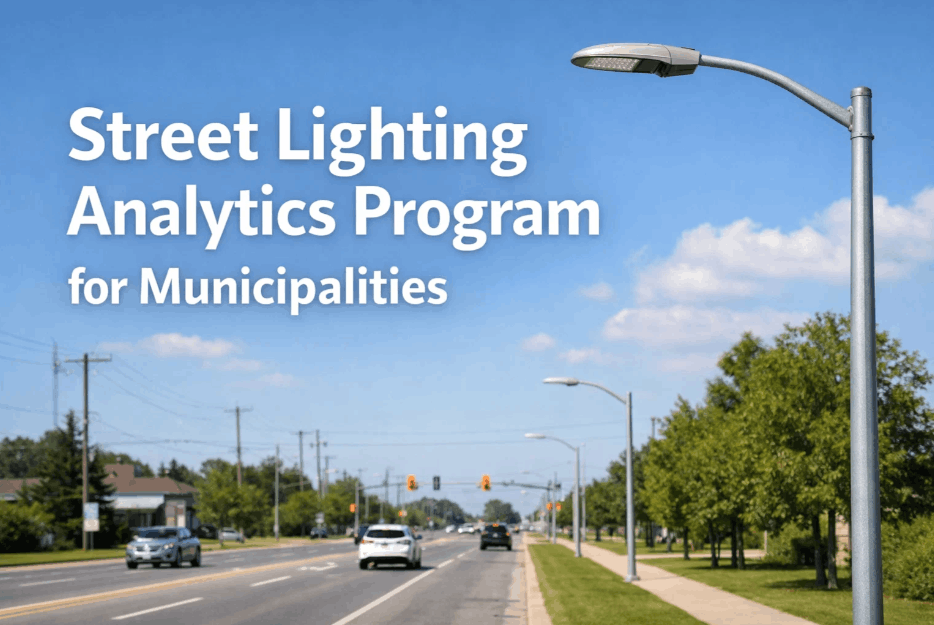
Municipal street lighting analytics programs are transforming how cities manage their public lighting infrastructure. From detecting street light outages in real time to optimizing energy consumption across thousands of fixtures, a well-built street lighting analytics program gives municipalities the visibility and control they've never had before. Whether your department is planning an LED street lighting retrofit, replacing aging photocells, or building a preventive maintenance schedule, this guide covers everything you need to reduce costs, extend asset life, and keep streets safe. Book a demo to see how automated lighting analytics can work for your city today.
What Is a Street Lighting Analytics Program?
A street lighting analytics program is a structured framework that uses data collection, monitoring technology, and maintenance management software to oversee the complete lifecycle of public lighting infrastructure. Unlike reactive maintenance—where crews respond only after a light goes dark—a modern municipal lighting analytics program uses sensor data, work order tracking, and energy benchmarking to drive proactive decisions. Cities using these programs report 20–40% reductions in energy costs and significant drops in citizen complaints about dark streets.
The foundation of any effective program is asset visibility. Municipalities must know the location, type, age, and condition of every street light fixture in their inventory. Without that baseline, scheduling photocell replacement cycles, planning LED retrofits, or identifying chronic outage zones is impossible. Street lighting analytics software bridges this gap by connecting field data to a centralized dashboard that maintenance supervisors and city managers can act on daily.
Why Municipal Street Light Management Can't Stay Manual
Paper logs and spreadsheets worked when cities had a few hundred fixtures and crews who knew every pole by memory. Today's municipalities manage tens of thousands of street lights across multiple districts, maintenance zones, and utility billing accounts. Manual tracking creates dangerous blind spots—outages that linger for weeks, photocell failures that cause lights to run 24 hours a day wasting energy, and compliance gaps that auditors flag during federal reviews.
The shift toward digital street lighting management isn't optional—it's driven by budget pressure, federal energy mandates, and growing public expectations for responsive city services. Departments that adopt a data-driven street light analytics program consistently outperform those still relying on citizen call-in reports and paper repair tickets. When a resident reports a dark intersection today, your team should already have a work order in progress—not just learning about the problem.
Core Components of an Effective Municipal Lighting Analytics Program
The most successful municipal programs integrate five core components that eliminate outage blind spots, reduce energy waste, and keep maintenance teams efficient. Book a demo to see how these map to your city's current operations.
LED Street Lighting Retrofit: Planning, ROI, and Grant Documentation
LED street lighting retrofits deliver 50–70% energy reductions per fixture and represent the single highest-ROI capital investment available to municipal lighting programs. The key is sequencing—prioritize high-wattage fixtures in high-traffic corridors first, then use documented savings to justify continued investment to city councils. Federal grant programs like FHWA's Highway Safety Improvement Program require detailed pre- and post-retrofit energy documentation, and a street lighting analytics platform generates this automatically. Cities that can demonstrate quantified energy optimization results consistently win larger grant allocations in subsequent funding cycles.
| Fixture Type | Legacy Wattage | LED Wattage | Energy Reduction | Avg Payback Period | Annual Savings/Fixture |
|---|---|---|---|---|---|
| High-Pressure Sodium (HPS) | 250W | 100W | 60% | 4–6 years | $85–$120 |
| Metal Halide Cobra Head | 400W | 150W | 63% | 3–5 years | $130–$175 |
| Mercury Vapor (Legacy) | 175W | 70W | 60% | 5–7 years | $60–$95 |
| Fluorescent Pole-Top | 150W | 60W | 60% | 4–6 years | $55–$80 |
| Induction Street Light | 200W | 80W | 60% | 5–7 years | $70–$105 |
Street Light Outage Detection: From Reactive to Real-Time
Traditional outage management depends on citizen complaints—a delayed, geographically biased system that leaves dark corridors, park pathways, and cul-de-sacs unreported for weeks. Modern street light outage detection uses smart node sensors and utility interval data analysis to surface failures citywide the moment they occur, automatically generating work orders and escalating high-priority locations like school zones and major intersections. Most municipal programs combine both technologies based on district priority and budget. Book a demo with our team to walk through a deployment scenario built for your city's infrastructure and maintenance model.
Photocell Replacement Programs: The Hidden Driver of Lighting Energy Waste
A failed photocell causes a fixture to run 24 hours a day instead of dusk-to-dawn—silently doubling its energy cost. In a city with 20,000 street lights and just a 2% failure rate, that's 400 fixtures burning around the clock, generating thousands in unnecessary monthly utility costs. A preventive replacement program schedules photocell swaps on a rolling 5–7 year cycle before failures occur, batching replacements by route for maximum field efficiency. Cities implementing structured photocell PM report 15–25% reductions in street lighting energy spend within the first year—independent of any LED activity. Book a demo to see how automated replacement scheduling works across large fixture inventories.
Lighting Energy Optimization: Beyond LED Retrofits
LED retrofits deliver the biggest single reduction, but lighting energy optimization goes further. Adaptive dimming schedules reduce fixture output by 30–50% during late-night low-traffic hours—pushing total savings beyond 70% compared to legacy HPS systems when combined with LED technology. Analytics platforms track consumption at the fixture, circuit, and zone level, surfacing anomalies that indicate ballast faults, meter billing errors, or unauthorized lamp swaps before they compound into significant budget losses. Book a demo to see live energy dashboards built for municipal street lighting portfolios of all sizes.
Building a Street Lighting PM Program: 90-Day Implementation Roadmap
Most municipalities reach a fully operational, data-driven street lighting preventive maintenance program within 90 days using a phased approach. The critical success factor is sequencing—start with asset data quality before layering in automation. Departments that implement everything at once typically face integration delays and crew adoption friction that stretch timelines by months.
Inspection Schedules by Lighting Infrastructure Type
Different street lighting infrastructure types require different inspection frequencies based on technology lifecycle, location risk, and regulatory requirements. The table below reflects minimum recommended inspection frequencies for a comprehensive street lighting preventive maintenance program.
| Infrastructure Type | Photocell Check | Luminaire Inspection | Pole Structural Review | Electrical Connection Check |
|---|---|---|---|---|
| Highway & Arterial Corridors | Semi-annual | Annual | Every 3 years | Annual |
| Residential Streetlights | Annual | Every 2 years | Every 5 years | Every 2 years |
| School & Pedestrian Zones | Quarterly | Semi-annual | Annual | Semi-annual |
| Park & Trail Lighting | Semi-annual | Annual | Every 3 years | Annual |
| Tunnel & Underpass Lighting | Monthly | Quarterly | Annual | Quarterly |
| Decorative / Historic District | Semi-annual | Semi-annual | Annual | Semi-annual |