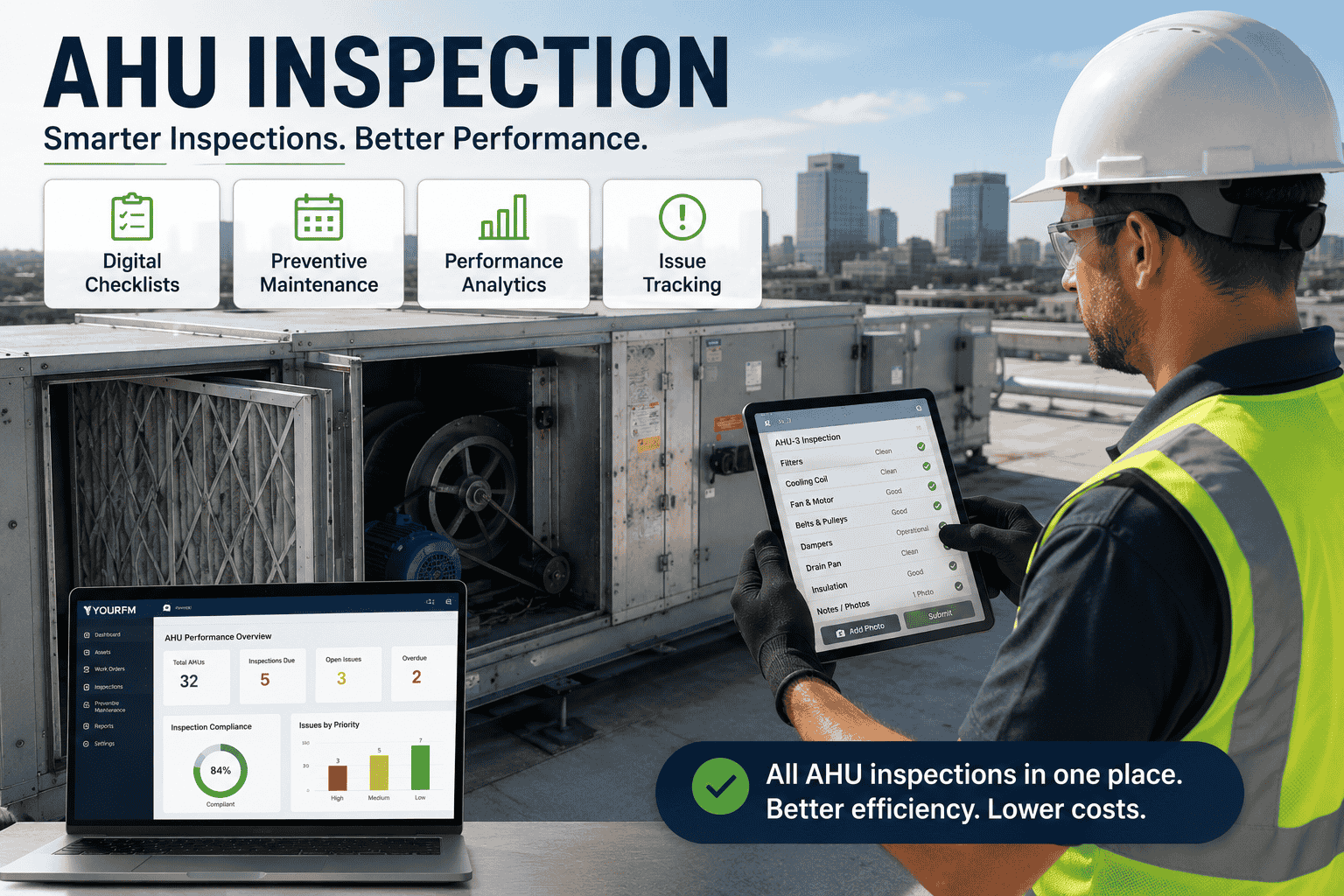
Air Handling Units are the lungs of every commercial building — and when they're neglected, every system downstream pays for it. Fouled coils waste 20-30% in fan energy, slipping belts cut another 5-10%, and stuck economizer dampers can burn through $2,000-$8,000 per AHU annually in lost free cooling. iFactory AHU Operations Intelligence tracks every filter ΔP, coil approach temperature, and belt vibration reading across your portfolio — turning AHU maintenance from reactive guesswork into measured discipline. Book a demo to walk through a complete AHU PM program built for commercial properties.
The Complete AHU Maintenance Playbook
A practical inspection guide covering all six AHU components, the performance benchmarks that signal trouble, and the frequency rhythm that keeps air handlers efficient — circuit by circuit, season by season.
The Anatomy of a Commercial Air Handling Unit
An AHU is a sequence of stages — air enters, passes through filters and coils, gets moved by fans, modulated by dampers, and delivered to occupied spaces. Each stage has its own performance signature. Understanding the airflow path is the first step to inspecting it properly.
The Numbers That Tell You an AHU Is Healthy
Visual inspection tells you what looks wrong. Performance benchmarks tell you what actually is wrong. These are the measurable readings every AHU technician should record at every visit — and the ranges that separate normal operation from emerging trouble.
Above range signals filter loading and reduced airflow
High amps = belt slip, motor wear, or filter blockage
Drift indicates coil fouling and heat transfer loss
Loose belt = slipping; tight belt = bearing wear
Rising vibration signals bearing wear before failure
Deviation indicates linkage or actuator failure
Where Poor AHU Maintenance Actually Bleeds Budget
"Maintenance costs money" is a half-truth. Lack of maintenance costs dramatically more — and the costs are distributed across utility bills, equipment lifespan, and emergency repairs in ways most facility budgets don't capture clearly.
Fouled Cooling Coils
Dirt buildup on coil fins reduces heat transfer, forcing fans to push harder for the same conditioning effect. Chillers compensate with higher compressor runtime.
Stuck Economizer Dampers
Damper failures eliminate free cooling opportunities entirely. In temperate climates this is often the single largest source of avoidable HVAC energy waste — up to $8,000 per AHU annually.
Loaded Filters Past Optimal ΔP
Calendar-based filter changes either replace too early (waste) or too late (energy penalty). Differential pressure monitoring eliminates both failure modes.
Miscalibrated Sensors
A 3°F drift in a mixed-air sensor can override economizer free cooling for months. Calibration takes under an hour; ignoring it costs more than the sensor is worth.
Slipping Belt Drives
Belt slip wastes mechanical energy as heat. Visible belt dust in drive guards is the early warning sign — by then, fan RPM has already dropped below design.
Map Every AHU in Your Portfolio to a Live PM Schedule
Our team takes your AHU inventory, design specifications, and current service vendor relationships — and configures the full ASHRAE 180-aligned PM calendar in iFactory with mobile workflows for every technician.
A Year of AHU Inspection Cadence
ASHRAE Standard 180 recommends a tiered inspection rhythm based on component criticality. The matrix below shows what gets checked when — every item should already be a recurring work order in your platform, not a calendar reminder on a clipboard.
Six Early Warning Signs You're About to Have an AHU Problem
AHUs rarely fail suddenly — they degrade over weeks or months while sending unmistakable signals. Teams that read these signals early prevent emergency calls; teams that miss them respond to occupant complaints with overtime crews.
Motor Amps Climbing Above Nameplate
Amp draw 10%+ above FLA signals filter blockage, belt slip, or motor deterioration. Immediate inspection prevents motor burnout.
Belt Dust in Drive Guards
Black rubber dust accumulating around the belt drive indicates slippage. Fan RPM has already dropped — and energy is being wasted as heat.
Rising Coil Approach Temperature
When leaving-air temperature drifts away from design by more than 2°F, coils are fouling. Cleaning before next season prevents major efficiency loss.
Increased Tenant Comfort Complaints
Multiple zones reporting temperature issues simultaneously often trace back to a single AHU. Cluster analysis catches it before all zones complain.
Standing Water in Drain Pan
Sluggish or backed-up condensate drainage signals clog risk and biological growth. Mold remediation is dramatically more expensive than drain maintenance.
Unexplained BMS Alarm Patterns
Recurring nuisance alarms in BAS logs often indicate sensor drift or damper response issues. Patterns matter more than individual events.
Frequently Asked Questions
How often should AHU filters actually be replaced?
Filter replacement should be driven by differential pressure, not calendar dates. Industry guidance suggests replacement at roughly 0.5 in. w.c. above the clean baseline — typically 3 to 6 months depending on filter type and environment. Calendar-based replacement either wastes filters (replacing too early) or wastes energy (replacing too late).
What's the single highest-ROI AHU maintenance task?
For most commercial AHUs, annual coil cleaning delivers the highest energy savings per dollar spent. A dirty cooling coil running 4°F higher approach temperature forces the chiller to work substantially harder for every hour it runs. Properly cleaned coils typically improve heat transfer efficiency by 15–25% and recover quickly in fan energy savings.
How are AHU maintenance schedules best tracked across multiple buildings?
A CMMS with mobile workflows is the modern standard. Each AHU becomes its own asset with recurring work orders scheduled by frequency. Technicians scan QR codes at the unit, load the appropriate checklist, record measurements, and generate corrective work orders automatically when thresholds are exceeded. Manual spreadsheets become unmanageable beyond 5–10 AHUs.
Can BAS integration replace manual AHU inspections?
No — but it dramatically reduces them. BAS data catches sensor drift, alarm patterns, and performance trends in real time. Physical inspection is still required for belt wear, drain pan cleanliness, filter visual condition, and damper linkage integrity. The best programs combine BAS-driven alerts with structured monthly physical inspections.
What's the realistic energy savings from a complete AHU PM program?
For a medium-sized commercial AHU, combined annual savings typically range from $8,000 to $15,000 from clean coils, properly loaded filters, functioning economizer dampers, and optimized belt tension. Buildings with multiple AHUs see proportionally larger absolute savings. Most properties pay back the program investment within the first year through energy reduction alone.
Run Every AHU in Your Portfolio Like an Engineering Discipline
Stop running AHUs on calendar guesswork and reactive complaints. Track every filter ΔP, coil approach temperature, and belt vibration reading in one operational platform built for commercial HVAC teams.