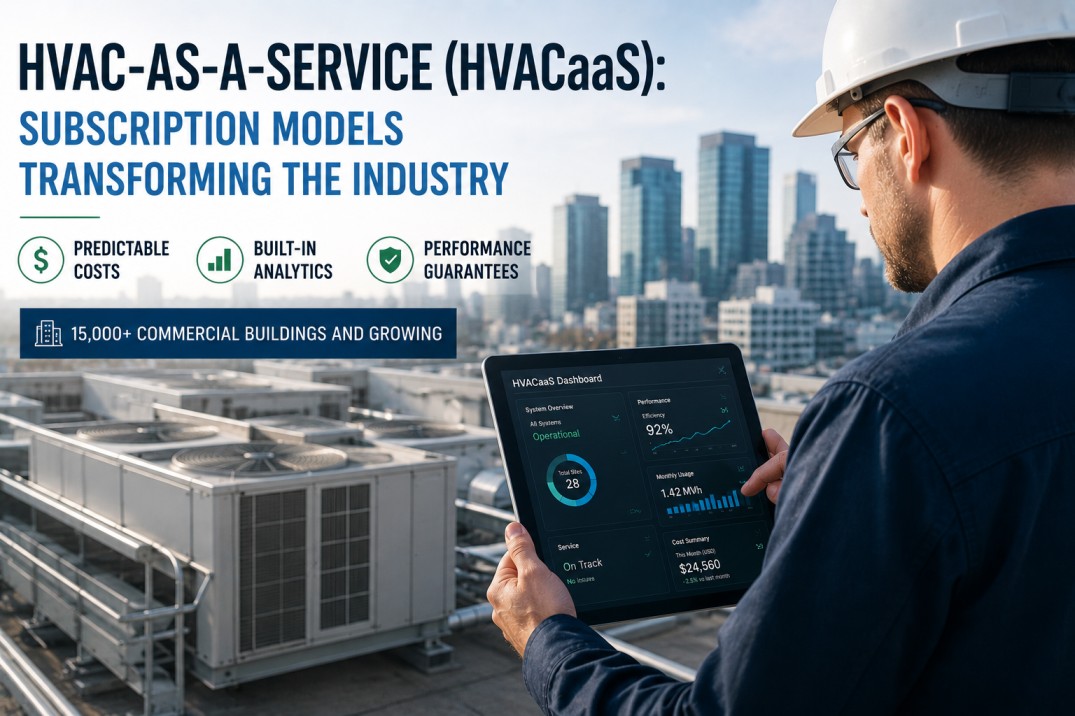
HVAC-as-a-Service (HVACaaS) is transforming the commercial HVAC industry from a capital-intensive equipment procurement model into a subscription-based service relationship where building owners pay predictable monthly fees for delivered heating and cooling outcomes rather than purchasing and maintaining equipment themselves, with over 15,000 commercial buildings across North America now operating under HVACaaS agreements and the market growing at 28 percent annually as property owners recognize the operational, financial, and strategic advantages of shifting HVAC from a capital expenditure to an operating expense. This comprehensive HVACaaS guide examines the five critical dimensions every building owner and facility manager needs to understand in 2026: the HVACaaS Service Tier Pyramid mapping four subscription tiers from Essential Basic through Enterprise that define scope of coverage, monthly fee ranges, performance guarantees, and technology inclusion levels so property owners can match service depth to building complexity and budget requirements; the HVACaaS vs Traditional Cost Breakdown Flow comparing how each dollar of HVAC spending is allocated across equipment, installation, maintenance, energy, administration, and profit categories under traditional ownership versus HVACaaS, revealing the structural cost differences that drive subscription model economics; the Leading Provider Capability Profiles evaluating major HVACaaS providers including Trane Rental Services, Carrier Service Agreements, Daikin One Service, Johnson Controls Metasys, and independent HVACaaS specialists across market presence, contract flexibility, technology integration, sustainability services, and customer satisfaction dimensions with detailed feature capability assessments; the Contract Term Comparison Grid analyzing four common HVACaaS contract durations from 3-year short-term agreements through 15-year full-lifecycle partnerships with fee structures, escalation clauses, buyout provisions, equipment upgrade schedules, and renewal terms that determine total contract value and flexibility; and the Building Type Decision Scoring Matrix applying six weighted evaluation criteria including cost savings, risk transfer effectiveness, technology access, operational flexibility, sustainability outcomes, and operational simplicity across four building profiles including small commercial properties, mid-rise office buildings, large commercial portfolios, and industrial facilities to identify which building types achieve the strongest HVACaaS value proposition based on their specific operational and financial characteristics.
Evaluate HVACaaS for Your Commercial Property Portfolio
iFactory's Vendor Management Module provides HVACaaS contract analysis, provider comparison tools, cost modeling, and performance tracking to help property managers evaluate subscription HVAC models against traditional ownership. Book a demo to see how HVACaaS analytics simplifies your equipment investment decisions.
HVACaaS Service Tier Pyramid — Four Subscription Levels From Essential to Enterprise
HVACaaS providers typically offer tiered subscription packages that scale from basic equipment coverage for small buildings through comprehensive full-lifecycle service agreements for large commercial portfolios, with each tier defining scope of included maintenance, repair responsibility, equipment upgrade schedules, energy management services, and performance guarantee levels. The tier pyramid below profiles four HVACaaS subscription levels with coverage details, fee ranges, and recommended building profiles for each tier.
HVACaaS vs Traditional Cost Breakdown — Where Each Dollar Goes
Understanding how HVAC spending is allocated under traditional ownership versus HVACaaS reveals the fundamental economic differences between the two models and explains why subscription HVAC can deliver comparable or lower total cost of ownership while eliminating capital expenditure and transferring performance risk. The cost breakdown flow below compares spending allocation across six categories for a typical 200-ton commercial HVAC system over a 15-year lifecycle.
Compare HVACaaS Cost Models for Your Properties
iFactory's platform provides HVAC cost comparison modeling, total cost of ownership analysis, service tier evaluation, and contract term optimization tools that help property managers determine whether HVACaaS delivers better financial outcomes than traditional equipment ownership. Book a demo to see how cost analytics drives smarter HVAC procurement decisions.
Leading HVACaaS Provider Capability Profiles — Market Presence and Service Comparisons
The HVACaaS market features a mix of major HVAC manufacturers offering subscription services through their established dealer networks and independent HVACaaS specialists building purpose-built service platforms, each with distinct strengths in contract flexibility, technology integration, geographic coverage, and sector specialization. The provider cards below profile five leading HVACaaS providers with capability assessments, market metrics, and service differentiators.
HVACaaS Contract Term Comparison — Duration Options, Fee Structures, and Flexibility Trade-offs
HVACaaS contract duration significantly influences monthly fee rates, equipment upgrade frequency, buyout options, and overall program flexibility, with longer terms typically offering lower monthly costs but reduced adaptability to changing building requirements. The contract term grid below compares four common HVACaaS duration options across pricing, flexibility, and key provisions that building owners must evaluate when selecting their preferred contract structure.
Building Type Decision Scoring Matrix — Where HVACaaS Delivers the Strongest Value
HVACaaS value proposition varies significantly across building types due to differences in HVAC system complexity, ownership structure, occupancy stability, capital budget availability, and sustainability requirements. The decision scoring matrix below evaluates HVACaaS suitability across four building profiles using six weighted criteria with total scores that identify which building types achieve the strongest subscription model benefits.
Frequently Asked Questions About HVAC-as-a-Service Models
What is HVAC-as-a-Service and how does the subscription model work?
HVAC-as-a-Service (HVACaaS) is a subscription-based business model where a service provider retains ownership of the HVAC equipment and charges the building owner a monthly fee for delivered heating and cooling services, fundamentally shifting HVAC from a capital-intensive ownership model to a predictable operating expense. Under HVACaaS, the provider finances, installs, owns, and maintains all HVAC equipment including chillers, boilers, rooftop units, air handlers, pumps, and controls, charging a monthly fee typically ranging from $0.03 to $0.18 per square foot per month depending on equipment scope, service tier, contract duration, and building complexity. The provider assumes full performance risk including equipment reliability, efficiency degradation, refrigerant compliance, and maintenance costs, and guarantees minimum performance levels including temperature setpoint accuracy, energy efficiency thresholds, and uptime commitments, with financial penalties if performance targets are missed. Building owners benefit from elimination of capital expenditure requirements typically $180,000 to $350,000 for a 200-ton commercial system, predictable monthly costs that simplify budgeting and eliminate surprise repair expenses, access to advanced analytics and monitoring technology that might be cost-prohibitive under ownership, automatic equipment upgrades at contract midpoints that ensure the building always has current-generation HVAC technology, and transfer of refrigerant transition compliance risk which is increasingly significant under the AIM Act phasedown schedule. HVACaaS agreements typically run 5 to 15 years with annual escalation clauses of 1.5 to 3 percent, buyout provisions allowing ownership transfer at defined points in the contract, and equipment refresh schedules that replace major components at mid-term intervals. The market is growing at 28 percent annually and approximately 15,000 commercial buildings in North America currently operate under HVACaaS agreements, with major manufacturer offerings from Trane Rental Services, Carrier Service Agreements, Daikin One Service, and Johnson Controls Metasys, plus independent HVACaaS specialists serving specific regions and building types. HVACaaS is most cost-effective for buildings over 30,000 square feet with annual HVAC energy costs above $80,000 where the efficiency improvement from modern equipment generates sufficient savings to offset provider margins, though smaller buildings can benefit from standardized tiered packages offered through dealer networks.
How does HVACaaS pricing compare with traditional HVAC ownership costs?
HVACaaS total cost of ownership over a 15-year lifecycle typically runs 10 to 20 percent lower than traditional HVAC ownership when all costs are accounted for including equipment purchase, installation, maintenance, repairs, energy management, administration, and compliance, with the additional benefit of eliminating the $180,000 to $350,000 upfront capital expenditure for a typical 200-ton commercial system. The cost comparison for a 100,000 square foot commercial building over 15 years demonstrates the financial dynamics: under traditional ownership, the owner spends approximately $345,000 total including $104,000 for equipment purchase, $62,000 for installation and commissioning, $76,000 for preventive and emergency maintenance over 15 years, $35,000 for energy management systems and monitoring, $41,000 for administration including contractor procurement, invoice processing, compliance documentation, and refrigerant tracking, and $28,000 in contractor margins embedded in time-and-materials service calls. Under HVACaaS, total spending is approximately $298,000 including $198,000 in monthly subscription fees covering equipment ownership and comprehensive service, $45,000 for enhanced energy optimization services including AI-powered analytics and continuous commissioning, $22,000 for performance monitoring and sustainability reporting included at the premium tier, and $23,000 in reduced administration costs because the provider handles all contractor management, compliance, and reporting. The HVACaaS model achieves these savings through provider economies of scale in equipment procurement, standardized maintenance procedures that reduce labor costs by 20 to 30 percent compared to ad-hoc service arrangements, continuous optimization that improves system efficiency by 12 to 18 percent, and risk pooling across thousands of buildings that enables predictable cost structures. Beyond the direct cost comparison, HVACaaS delivers significant financial benefits including conversion of $280,000 in capital expenditure to operating expense improving balance sheet metrics, elimination of budget variances from unexpected equipment failures which average $12,000 to $25,000 per major repair event, and avoidance of refrigerant compliance costs under the AIM Act phasedown which are expected to add 15 to 25 percent to equipment operating costs for R-410A systems by 2028.
What HVAC contract terms are available and which duration is best?
HVACaaS contract terms typically range from 3 to 15 years with distinct trade-offs between monthly cost, flexibility, equipment upgrade frequency, and contract value that building owners must evaluate based on their hold period, occupancy certainty, and budget priorities. Three-year short-term agreements offer maximum flexibility with monthly fees of $0.08 to $0.14 per square foot and 3 to 5 percent annual escalation rates but provide no equipment upgrades during the term and require market re-rate at renewal, making them suitable for buildings with uncertain occupancy, short-term ownership planned under five years, or organizations piloting HVACaaS before committing to longer terms. Five-year agreements are the most popular HVACaaS contract duration, accounting for approximately 45 percent of new agreements in 2026, with monthly fees of $0.06 to $0.10 per square foot and 2 to 3 percent annual escalation, offering a balanced combination of cost savings, reasonable commitment period, and minor equipment upgrades at mid-term, ideal for standard commercial buildings with stable occupancy. Ten-year agreements deliver the best overall value with monthly fees as low as $0.05 to $0.08 per square foot and 1.5 to 2.5 percent escalation capped at 3.5 percent, including a full equipment refresh at year 5 that replaces compressors, heat exchangers, and controls with current-generation technology, making them optimal for owner-occupied buildings and long-term hold investments. Fifteen-year full-lifecycle agreements achieve the lowest monthly rates at $0.04 to $0.07 per square foot with 1 to 2 percent escalation capped at 3 percent and include two equipment refreshes at years 5 and 10, providing maximum cost certainty over the full equipment life, most suitable for institutional owners, government buildings, and core portfolio assets with indefinite hold periods. Key contract provisions to negotiate include escalation rate caps, buyout schedule percentages which determine the cost to terminate early or purchase equipment at contract end, technology upgrade commitments specifying compressor and controls replacement timing, performance guarantee parameters defining acceptable temperature ranges and uptime percentages, and force majeure clauses addressing energy price spikes or regulatory changes that could affect provider costs.
Which buildings benefit most from HVACaaS versus traditional ownership?
HVACaaS delivers the strongest value for large commercial portfolios over 500,000 total square feet achieving total suitability scores of 85 to 95 out of 100 across six weighted evaluation criteria, because portfolio-scale agreements enable maximum provider cost efficiencies, standardized service delivery across multiple buildings, and comprehensive technology deployment including AI analytics, predictive maintenance, and energy optimization that individual buildings cannot justify economically. Large portfolios score 85 to 95 in cost savings through volume pricing and standardized equipment specifications, 85 to 95 in risk transfer because portfolio-level performance guarantees protect the entire real estate investment, 90 to 100 in technology access including enterprise analytics platforms and AI optimization, 75 to 85 in flexibility through multi-building contract structures with building-level opt-out provisions, 85 to 95 in sustainability outcomes through portfolio-wide decarbonization planning and carbon reporting, and 80 to 90 in operational simplicity by eliminating the need for in-house HVAC engineering teams. Mid-rise office buildings from 30,000 to 150,000 square feet achieve total scores of 70 to 80 representing the optimal individual building profile for HVACaaS, because these buildings have sufficient HVAC complexity to benefit from professional management but lack the scale to justify dedicated engineering staff, making subscription HVAC the most cost-effective path to modern system performance. Small commercial buildings under 30,000 square feet score 50 to 65 due to higher per-square-foot pricing from lack of scale, though standardized lower-tier packages can still be beneficial for owners without HVAC expertise. Industrial facilities score 45 to 55 because process heating requirements often exceed standard heat pump and chiller capabilities, though HVACaaS works well for process cooling, office areas, and warehouse HVAC within industrial complexes. Property types with the highest HVACaaS adoption rates include Class A office buildings at 38 percent, healthcare facilities at 35 percent, higher education at 32 percent, and government buildings at 40 percent, driven by these organizations' focus on predictable operating costs, risk avoidance, and sustainability outcomes that align closely with HVACaaS value proposition.
What should building owners look for when evaluating HVACaaS providers?
Building owners evaluating HVACaaS providers should assess five critical dimensions: contract flexibility, technology integration capability, geographic service coverage, financial stability, and performance guarantee structure, with provider suitability varying significantly based on building type, portfolio size, and strategic priorities. Contract flexibility assessment should include minimum and maximum contract term options with the most flexible providers offering terms from 3 to 20 years, escalation clause structures including fixed, CPI-linked, and capped escalation with preference for caps below 3.5 percent annually, buyout schedule transparency with declining percentages that should not exceed 50 percent of remaining equipment value after the halfway point, and building-level opt-out provisions for portfolio agreements that allow individual property release without portfolio-wide penalties. Technology integration capability is increasingly critical as smart HVAC systems become standard, requiring providers to demonstrate their analytics platform capabilities including real-time monitoring dashboards, predictive maintenance algorithms, energy optimization models, refrigerant leak detection, and sustainability reporting, with preference for cloud-based platforms that support BACnet and MQTT open protocols for integration with existing building management systems. Geographic service coverage must match building locations with guaranteed response times of 2 to 4 hours for critical repairs and 24 hours for standard service, verified through current customer references in the same region and building type. Financial stability assessment should include review of the provider's credit rating minimum BBB or equivalent, audited financial statements showing positive EBITDA for the past three years, and evidence of insurance coverage including general liability of at least $5 million, workers compensation, and professional liability coverage that protects the building owner from provider-related claims. Performance guarantee structure should specify minimum efficiency levels measured in kW per ton or COP targets, maximum downtime measured in hours per year with escalating financial credits starting at 5 percent of monthly fee for the first violation and increasing to 25 percent or more for repeated violations, temperature setpoint accuracy within plus or minus 1 degree Celsius during occupied hours, and refrigerant compliance guarantees that hold the provider responsible for all AIM Act phasedown compliance costs and refrigerant transition expenses. Building owners should request proposals from at least three providers, conduct site visits to existing HVACaaS installations of comparable size and type, review contract terms with legal counsel experienced in service agreements, and establish baseline energy consumption data at least 12 months before contract commencement to enable accurate performance measurement and savings verification throughout the agreement term.
Evaluate HVACaaS Providers and Contracts With Comprehensive Vendor Analytics
iFactory's Vendor Management Module provides HVACaaS provider comparison tools, contract term analysis, cost modeling, performance tracking, and portfolio-wide vendor management capabilities that help property managers select, negotiate, and manage optimal HVACaaS agreements. Book a demo to see how vendor analytics transforms your HVAC procurement strategy and reduces total cost of ownership.