.png)
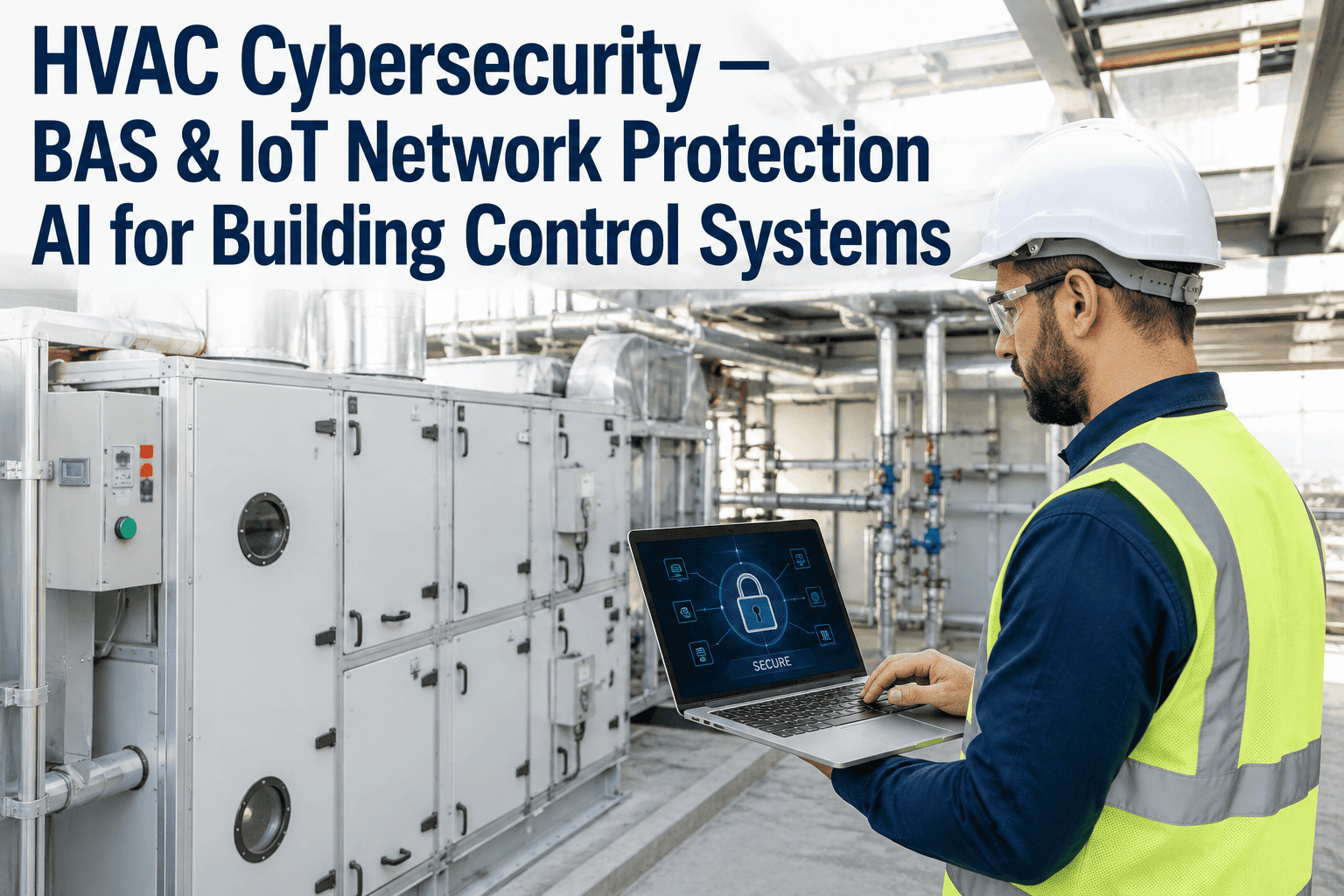
Smart buildings run on hundreds of connected devices—HVAC, access readers, elevators, lighting—and every one is a potential entry point for attackers. iFactory Building System Cybersecurity hardens your BMS and IoT fleet with network segmentation, encrypted protocols, and continuous vulnerability monitoring. Book a security audit to find where your property is exposed today.
Stop Hackers Before They Reach Your HVAC, Elevators, or Door Controllers
Continuous vulnerability discovery, network segmentation, and encrypted access control across every BMS, IoT, and OT device in your portfolio.
Why Smart Buildings Are a Prime Target
Most BMS and IoT devices were built for uptime, not security. Default passwords, unpatched firmware, and flat networks let attackers move from a thermostat to a server room in minutes. The cost of a single BAS breach can exceed $80,000 per day in disrupted operations alone—before you count utility spikes, evacuation costs, or tenant compensation.
The Five Attack Vectors Targeting Building Systems
Understanding how attackers actually breach building systems is the first step to defending them. These are the most common attack vectors property security teams face today.
Default Credentials & Weak Passwords
CriticalAttackers scan the internet for BACnet, Modbus, and KNX devices left with factory credentials. Once in, they pivot laterally across the BMS network and reach access control, HVAC, and elevator systems.
Unpatched Firmware Vulnerabilities
HighIoT and OT devices rarely receive firmware updates. Known CVEs in HVAC controllers, IP cameras, and badge readers stay exploitable for years, giving attackers a reliable entry path.
Ransomware on Building Networks
CriticalRansomware actors increasingly target OT environments. A successful encryption attack on a BMS can shut down HVAC in a hospital, lock tenants out of office floors, or disable elevator dispatch portfolio-wide.
Flat Networks & Lateral Movement
HighWhen IT and OT networks share the same broadcast domain, a phishing victim's laptop can reach the fire panel. Segmentation is rarely enforced because BMS installers prioritize commissioning speed.
Third-Party & Vendor Backdoors
MediumHVAC contractors, elevator service vendors, and integrators often retain remote access for maintenance. Compromise of a single vendor account opens dozens of buildings simultaneously.
The Five-Layer Defense Architecture
Effective building cybersecurity is built in layers. Each layer addresses a different attack surface, and a breach in one layer is contained before it reaches the next.
Governance & Compliance
Documented policies, vendor risk assessments, incident response runbooks, and ongoing compliance reporting for cyber insurance underwriters and regulators.
Monitoring & Detection
Continuous anomaly detection on BACnet, Modbus, and KNX traffic. Behavioral baselines flag command-injection attempts and unusual setpoint changes in real-time.
Identity & Access Control
Multi-factor authentication, role-based permissions, and Zero Trust verification for every BMS console login, vendor remote session, and OT command issued.
Network Segmentation
VLAN and microsegmentation isolate IoT, OT, and IT networks. Lateral movement is blocked at the firewall, so a compromised camera cannot reach the access-control server.
Device Hardening
Default credentials replaced, unused services disabled, firmware patched, and TLS encryption enforced on every controller, sensor, and gateway in the building.
Get a Free Smart Building Vulnerability Assessment
Our team performs a passive scan of your BMS and IoT fleet, identifies devices running with default credentials or known CVEs, and delivers a prioritized remediation roadmap—no agent install required.
How a BMS Breach Actually Unfolds
Two real-world attack patterns property managers should understand. Each shows how a small lapse compounds into significant operational and financial damage.
HVAC Ransomware via Vendor Portal
Attacker phishes credentials from an HVAC service contractor
Logs into the vendor remote-access portal, reaches the building's BMS
Deploys ransomware that encrypts setpoint schedules and disables overrides
HVAC runs at minimum cooling for 72 hours — tenants evacuate, lawsuits follow
Access Control Bypass via IoT Camera
Attacker exploits a known CVE on an unpatched IP camera in the parking deck
Camera and badge readers share a flat VLAN — lateral movement is trivial
Attacker writes a forged badge credential into the access control database
After-hours physical entry; tenant property theft, no audit trail flagged
10-Point Building Cybersecurity Checklist
A practical, prioritized checklist property and facility managers can use to assess current posture and plan a hardening program.
Where Does Your Building Cybersecurity Stand?
Most commercial properties fall somewhere between Level 1 and Level 3. The goal is to move steadily upward — each step measurably reduces breach probability and insurance premium exposure.
Reactive — Default State
Devices run on factory credentials. Flat network. No inventory, no monitoring, no incident plan. Breach detection happens only after operational disruption.
Basic — Passwords & Patching
Credentials changed, ad-hoc firmware patching, basic firewall between IT and BMS. Vendor access still loosely managed. No active monitoring.
Structured — Segmented & Audited
Full VLAN segmentation, MFA on consoles, quarterly patching cadence, documented vendor access reviews. Cyber insurance qualifies at improved rates.
Proactive — Continuous Defense
Real-time OT monitoring, Zero Trust access, automated firmware rollouts, tested incident response. Breach attempts are detected and contained automatically.
Outcomes Properties See After Hardening
Buildings deploying iFactory cybersecurity controls report measurable shifts in breach exposure, insurance posture, and operational continuity within the first quarter.
Reduction in Exposed Devices
After credential rotation, segmentation, and firmware patching
Faster Incident Containment
With network segmentation and OT monitoring in place
Lower Cyber Insurance Premiums
Typical reduction with documented Level 3+ posture
Vendor Access Audited & Logged
Every remote session traced to a specific identity and purpose
Frequently Asked Questions
Will iFactory cybersecurity tools require us to replace existing BMS hardware?
No. Our platform is brand-agnostic and overlays existing BMS infrastructure—Honeywell, Siemens, Johnson Controls, Schneider, Trane, and others. We work with BACnet, Modbus, KNX, and LonWorks protocols, providing security telemetry without forcing hardware replacement.
How disruptive is the deployment to live building operations?
Minimal. Initial deployment uses passive network monitoring—no agents on devices, no production downtime. Hardening steps like credential rotation and segmentation are scheduled during low-occupancy windows and verified against operational baselines.
What if a vendor needs remote access for emergency repairs?
Vendors use time-bound, MFA-protected sessions through a managed access gateway. Every command and configuration change is logged with the vendor's identity, the device touched, and the session duration—giving you a complete audit trail without blocking legitimate maintenance.
Does this help us qualify for cyber insurance?
Yes. Insurers increasingly require documented controls: MFA, segmentation, patch management, and incident response. Our platform generates the evidence packages underwriters request, often resulting in lower premiums or improved coverage terms at renewal.
How do we know which devices are most at risk right now?
A baseline assessment identifies devices running default credentials, unpatched firmware with known CVEs, and exposure on the public internet. Each finding is scored by severity and ease of remediation, so your team works on the highest-impact items first instead of chasing every alert.
Protect Your Building Before the Next Attack Reaches Your BMS
Discover exposed devices, segment your networks, and lock down vendor access — without disrupting live building operations.