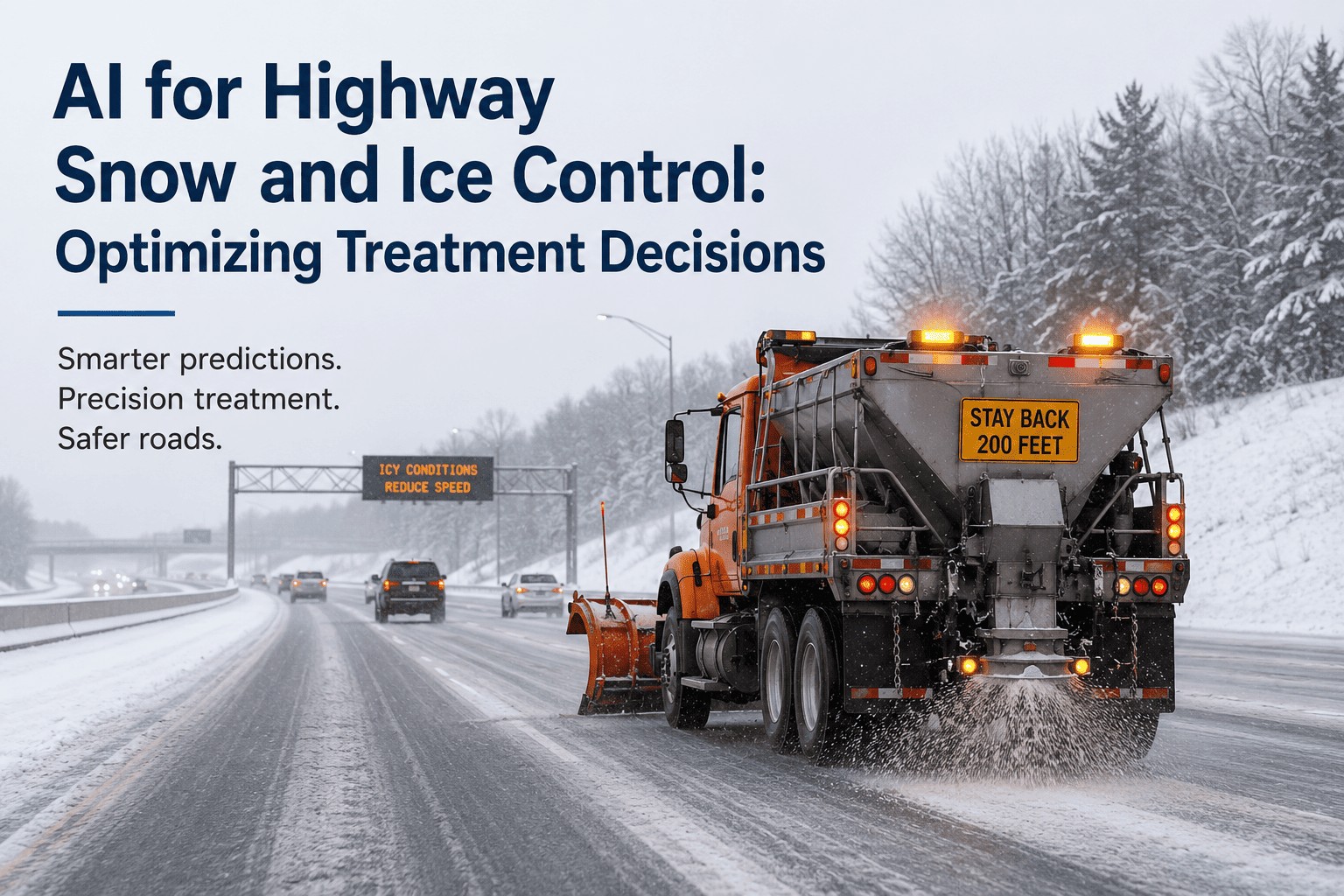
Winter highway operations have always run on a difficult bargain: spread enough salt to keep roads safe, but not so much that you burn through budget, corrode infrastructure, and contaminate waterways. For decades, that decision was made by a dispatcher looking at a weather forecast and a crew supervisor checking the sky. Today, the same decision is being made by AI systems processing real-time sensor data from the road surface itself — and the results are transforming what winter maintenance costs, how safely it performs, and how little material it wastes. This is the practical guide to how AI highway snow and ice control treatment actually works, and why agencies deploying it are consistently cutting salt usage by 20–25% while improving road safety outcomes. Book a Free Demo to see iFactory's intelligent infrastructure platform in action.
Why Traditional Winter Treatment Keeps Failing Agencies
Most highway agencies still operate winter maintenance on one of two outdated models: reactive treatment (wait for ice to form, then respond) or scheduled treatment (apply material every 4–6 hours whether the road needs it or not). Both models have the same flaw — they treat the road based on time or visible conditions, not on what is actually happening at pavement level, right now.
The AI Snow and Ice Control Stack — From Sensor to Salt Spreader
AI-driven winter highway treatment is a connected system of data collection, prediction, and decision support — four layers working together to move treatment decisions from human intuition to sensor-verified intelligence.
The Real Numbers Behind AI Winter Treatment Optimization
Winter road maintenance accounts for roughly 20% of state DOT maintenance budgets — and yet motorists still lose more than 500 million hours per year to weather-related delays. The financial and safety case for smarter treatment is not theoretical. It is documented.
| Factor | De-Icing (Reactive) | Anti-Icing (AI-Predictive) | Advantage |
|---|---|---|---|
| Treatment timing | After ice forms | Before freezing point reached | Proactive |
| Salt / brine required | 3–5x more material | Minimum effective dose | −60–80% material |
| Road safety window | Closed — ice already present | Maintained — surface stays clear | Zero ice formation |
| Truck deployments | Emergency call-out + repeat passes | Single planned treatment run | Fewer dispatches |
| Infrastructure impact | Higher chloride load, accelerated corrosion | Minimal salt — lower long-term damage | Extends asset life |
| Environmental cost | High chloride runoff | Significantly reduced | Lower ecological risk |
What Winter Maintenance Managers Ask About AI Treatment Systems
AI Maintenance Decision Support Systems (MDSS) calculate optimal salt application rates by combining real-time road surface data (pavement temperature, surface state, humidity) from RWIS sensors with weather forecast models, historical treatment outcome data, and traffic load patterns. The system uses reinforcement learning to simulate multiple treatment scenarios — different rates, different timings, different product types — and selects the one that maintains target friction levels with minimum material. This eliminates both under-treatment (safety risk) and over-treatment (material waste and infrastructure damage). The rate is calculated per road segment, not per route, recognizing that a 50km highway corridor can have dramatically different conditions at different points due to elevation, shade exposure, and bridge locations.
Full AI winter treatment optimization typically uses two layers of sensing. Fixed RWIS stations — installed at strategic points including bridges, high-elevation sections, and freeze-prone intersections — measure pavement surface temperature, air temperature, wind, humidity, and surface state (dry, wet, icy) every few minutes. Mobile RWIS units mounted on maintenance vehicles fill coverage gaps as trucks travel routes, providing condition data from between fixed stations. Modern Virtual RWIS systems — like those pioneered by AI weather analytics providers — can now estimate road surface temperature and conditions at any location using machine learning models trained on nearby physical station data, significantly reducing the hardware investment needed for network-wide coverage.
Yes — modern AI winter maintenance platforms, including iFactory, are built specifically to connect with existing fleet management systems, CMMS, and GIS platforms through standard APIs and data connectors. The AI layer ingests RWIS sensor data and weather forecast streams, generates optimized treatment plans, and pushes work orders directly to your existing fleet dispatch system — specifying which trucks go where, with what product, at what spreader rate, and at what time. No fleet replacement is required. Integration with GPS and AVL systems on existing vehicles allows live monitoring of treatment progress and immediate adjustment if road conditions change faster than forecast. Implementation timelines are typically 30–60 days, with minimal disruption to existing winter operations.
The environmental benefit of AI-optimized winter treatment is directly proportional to the salt reduction achieved. Agencies consistently report 20–25% reductions in material usage when AI decision support replaces schedule-based treatment — and anti-icing strategies (pre-treating before ice forms) can require 60–80% less material per treatment event compared to reactive de-icing after ice is established. Since chloride from road salt is the primary source of freshwater contamination near highways — affecting aquatic ecosystems and drinking water supplies — a 20–25% salt reduction represents a significant and immediate improvement in the environmental footprint of winter operations. Several agencies have used documented salt reduction figures to meet environmental compliance obligations and qualify for sustainability grant funding.
Return on investment from AI winter treatment platforms is typically realized within the first full winter season of operation. Michigan DOT's MDSS deployment demonstrated $2.1 million in annual savings from salt reduction alone — achieved with 340 vehicles and covering multiple districts. Broader economic analysis shows that every $1 invested in road weather information technology returns $2.50 in direct operational savings, with economy-wide benefits reaching $20 for every $1 invested when accident reduction, fuel savings, and infrastructure longevity are included. The fastest return comes from agencies with high current salt usage rates, large fleet sizes, and networks that include many bridge structures — where AI-predicted freeze risk is most different from ground-level forecast data and treatment timing decisions matter most.