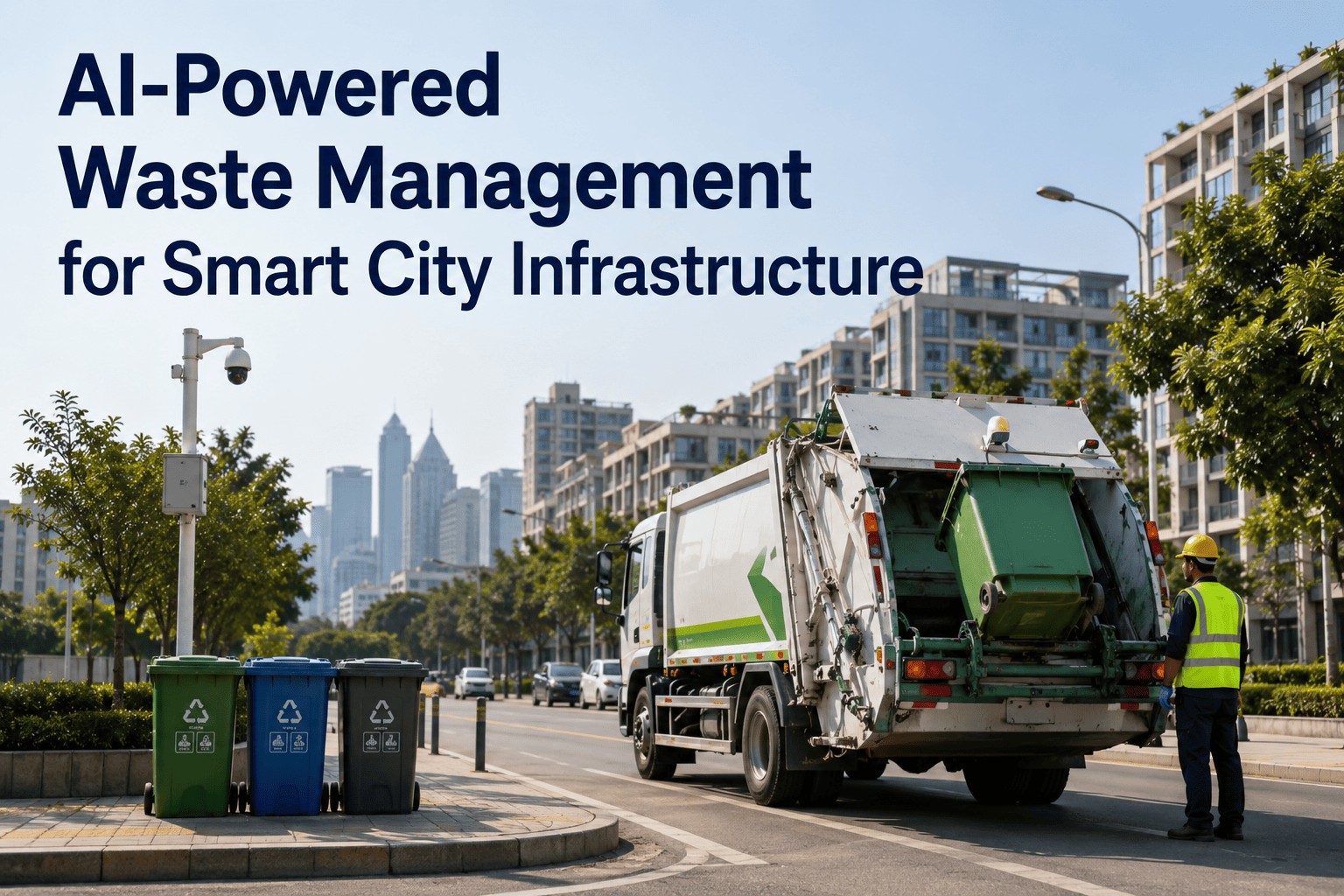
Most city managers believe their waste collection is running efficiently — until they look at the data. Trucks completing full routes to pick up bins that are 20% full. Overflowing bins on Tuesday because the last pickup was Thursday. Diesel fuel burned on roads that didn't need a truck that day. AI-driven waste management for smart city infrastructure eliminates every one of those inefficiencies by connecting IoT fill sensors, machine learning, and dynamic route optimization into one continuous system. Schedule Your Free Demo to see how iFactory's intelligent infrastructure platform is helping cities cut collection costs by up to 30%.
Why Fixed-Schedule Waste Collection Is Failing Modern Cities
The Hidden Drain Behind "Business as Usual" Waste Operations
The majority of municipal waste fleets still operate on fixed schedules set weeks or months in advance — the same routes, the same days, regardless of what is actually happening in the bins. This approach was designed for a pre-sensor world where there was no alternative to guessing. That world no longer exists. IoT fill sensors cost under $400 per unit. Cloud AI platforms process millions of data points in real time. And yet most cities are still dispatching trucks to bins that are 20–40% full while overflowing bins two streets over go unserviced until the next scheduled round.
The consequence is not just operational waste — it is a compounding financial liability. Every unnecessary truck run burns diesel, adds kilometers to vehicle maintenance cycles, and ties up crew hours. Every overflow event generates citizen complaints, cleanup costs, and in regulated jurisdictions, potential fines. A mid-sized city managing 1,000 collection points on fixed schedules is almost certainly running 30–40% more vehicle trips than actually needed.
How AI Waste Management Actually Works — The Full Technology Stack
From Sensor Signal to Optimized Route in Under 60 Seconds
AI-driven smart waste management is not a single technology — it is an integrated stack of hardware, connectivity, machine learning, and operational software working in concert. Understanding each layer clarifies why the results are so consistently strong across diverse deployment environments.
Measured Impact: What Cities Are Actually Achieving
Published Research and Live Deployment Numbers — Not Vendor Projections
Traditional vs. AI-Driven Waste Collection — Side by Side
The Numbers That Make the Case for Every Budget Conversation
| Metric | Fixed-Schedule Collection | AI + IoT Optimization | Improvement |
|---|---|---|---|
| Route efficiency | Baseline (static routes) | 32% more efficient | +32% |
| Fuel consumption | Full baseline burn | Reduced 20–37% | −20–37% |
| Overflow incidents | Unpredictable / frequent | Reduced up to 80% | −80% |
| Vehicle maintenance cost | Reactive, unplanned | 18% lower costs | −18% |
| CO₂ emissions | Full route footprint | Reduced 29–60% | −29–60% |
| Operational costs | Full burden | Reduced 13–40% | −13–40% |
| Transportation distances | Full static distances | Reduced up to 36.8% | −36.8% |
Where the Savings Come From — ROI by Category
For a Mid-Sized City Managing 500–2,000 Smart Bins
For a mid-sized city managing 500 to 2,000 smart bins, combined annual savings from avoided unnecessary routes, reduced overflow incidents, optimized fleet maintenance, and labor efficiencies consistently exceed $200,000 — against a platform investment that pays back within 12 to 18 months.
How iFactory Integrates with Your Existing Waste Infrastructure
No Rip-and-Replace. No 18-Month Implementations. Value in 60 Days.
The most common concern we hear from operations directors is integration complexity. iFactory is built to work with what you already have — your fleet management system, your CMMS, your existing SCADA or GIS platform — without requiring infrastructure replacement or service disruption.
Frequently Asked Questions
How quickly does AI waste management start producing cost savings?
Most cities see measurable fuel and route savings within 30 to 60 days of deployment. The first phase is baseline learning — the AI models analyze fill history across your bin network and build predictive profiles. By day 30 to 45, dynamic routing is active and unnecessary trips begin to be eliminated. Documented ROI through reduced fuel costs and avoided overflow incidents is typically confirmed within 90 days. Full payback on platform and hardware investment is commonly achieved within 12 to 18 months.
What fill sensors do smart bins use, and how accurate are they?
The most widely deployed technology is ultrasonic fill-level sensing — a small device mounted inside the bin lid that uses sound pulses to measure the distance to the waste surface, calculating fill percentage from the bin's known dimensions. These sensors are highly accurate (typically within ±2cm), low-power, and require minimal maintenance. Battery life ranges from 5 to 8 years depending on transmission frequency. More advanced deployments also include weight sensors, temperature probes for fire/hazard detection, motion sensors to flag illegal dumping events, and gas detectors for odor management. Data is transmitted over LoRaWAN or NB-IoT networks — both designed for low power consumption and city-wide range.
Can AI route optimization work with our existing fleet management software?
Yes. Modern AI waste management platforms, including iFactory, are built to integrate with existing municipal ERP systems, fleet management tools, and GIS platforms rather than replace them. Integration happens via standard APIs or direct data connectors. The AI layer consumes fill-level data and pushes optimized route plans to your existing fleet dispatch system — no infrastructure replacement required. Implementations following this approach go live within 60 to 90 days with minimal IT involvement.
Is AI-driven smart waste management only viable for large cities?
No — and this is one of the most common misconceptions. Per-sensor hardware costs have dropped below $200–$400 in most markets, and cloud-based AI platforms scale efficiently down to municipalities with fewer than 200 bins. Research-validated deployments have been conducted in mid-sized cities, district-level pilots, and densely populated neighborhoods. The economic logic — fewer unnecessary truck runs, fewer overflow events — applies at any scale where the current operating model is fixed-schedule collection. Smaller cities often see faster payback because their existing inefficiency is proportionally higher.
How does smart waste management help cities hit carbon reduction targets?
Municipal waste collection fleets are among the heaviest diesel emitters in city operations — compactors running full-day routes contribute meaningfully to scope 1 emissions. AI route optimization directly reduces kilometers driven and therefore diesel burned. Published research shows 29–60% reductions in collection-related CO₂ emissions in optimized deployments. This makes smart waste management one of the fastest and most documentable decarbonization pathways for transport-heavy city operations, and is increasingly eligible for green bond financing, carbon credit programs, and EPA/state sustainability grant funding.
What is the difference between AI predictive maintenance and GPS fleet tracking for waste trucks?
GPS fleet tracking tells you where your trucks are. AI predictive maintenance tells you what is about to go wrong with them — before it happens. The two are complementary but solve entirely different problems. GPS improves dispatch visibility and route verification; AI predictive maintenance monitors vehicle health signals — engine temperature, hydraulic pressure, compactor vibration signatures — and detects degradation 2–4 weeks before breakdown. Platforms like iFactory combine both: route data feeds into AI to optimize dispatch, while asset health monitoring prevents the emergency repair events ($15,000–$45,000 per incident) that consistently blow municipal maintenance budgets.