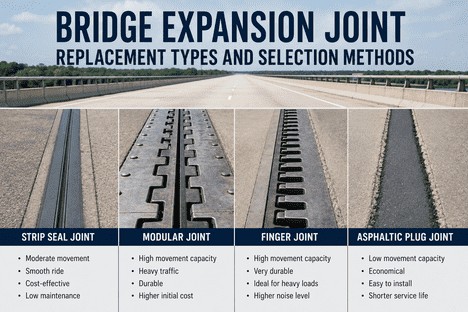
Every bridge deck in North America that is not built as an integral or semi-integral structure depends on expansion joints to survive seasonal thermal cycles. A bridge expansion joint that leaks salt-laden water onto the girder ends, bearings, and pier caps for even a single winter will initiate corrosion damage that compounds across every subsequent freeze-thaw cycle. The question is not whether the joint system will need replacement. It is whether the replacement is being selected based on the movement range, traffic volume, and life-cycle cost profile of that specific structure, or on whatever procurement template was used the last time. The five bridge expansion joint types available today -- strip seal, modular (MBEJ), finger plate, asphaltic plug, and compression seal -- each occupy a distinct performance envelope defined by movement capacity, watertightness reliability, ride quality, and replacement interval that together determine whether a joint replacement project delivers 30 years of service or becomes a recurring maintenance obligation that drains preservation budgets.
What a Bridge Expansion Joint Actually Does -- and Why Getting It Wrong Is One of the Most Expensive Mistakes in Bridge Engineering
A bridge expansion joint performs three simultaneous functions that are easy to specify but difficult to sustain across decades of thermal cycling, live-load fatigue, and chemical exposure. First, it accommodates the calculated movement range of the superstructure -- thermal expansion and contraction, concrete creep and shrinkage, live-load deflection and rotation, and in some cases seismic displacement -- without restraining those movements or transferring unintended forces to the substructure. Second, it prevents water, de-icing chemicals, and debris from reaching the bearings, girder ends, and pier caps beneath the joint. Third, it transfers wheel loads across the gap with a ride quality that does not generate impact forces, noise complaints, or deterioration of the adjacent deck surface.
The fundamental design parameter of any expansion joint is its total movement range, calculated per AASHTO LRFD Section 14.5 as the sum of the factored thermal movement, creep and shrinkage effects, and live-load rotation at the joint location. Once the total design movement is established, the joint system family is constrained: compression seals and asphaltic plug joints serve movement ranges up to approximately 50 mm, strip seal joints cover the range up to approximately 100 mm, finger plate joints span 100 to 300 mm, and modular bridge expansion joints (MBEJ) handle everything from 100 mm to more than 800 mm. Specifying a joint beyond its proven movement capacity is the single most consistent cause of premature joint failure documented in NCHRP Report 402 and the FHWA Bridge Preservation Guide.
The Five Bridge Expansion Joint Types at a Glance
Every expansion joint replacement decision reduces to a comparison across five system families. The following table summarises the movement envelope, typical service life, relative cost, and primary application window for each. The detailed profiles that follow explain the engineering basis for these ranges.
| Joint Type | Movement Range | Typical Span | Service Life | Relative Cost | Best Application |
|---|---|---|---|---|---|
| Compression Seal | Up to 50 mm | Short to medium | 15-25 years | $ | Low-traffic decks with asphalt overlay |
| Asphaltic Plug (APJ) | Up to 38 mm | Under 18 m | 7-12 years | $ | Asphalt-surfaced overlays, low movement |
| Strip Seal | Up to 100 mm | Medium | 20-30 years (gland 10-15) | $$ | Most common replacement joint for moderate movement |
| Finger Plate | 100 to 300+ mm | Long steel girder | 30+ years | $$$ | Long-span bridges, noise-sensitive zones |
| Modular (MBEJ) | 100 to 800+ mm | Long, large movement | 25-35 years | $$$$ | Cable-stayed, suspension, long-span steel |
Joint Type Profiles: Engineering Characteristics That Determine the Replacement Decision
The Selection Decision: Movement Range Is the Gate, but Traffic, Skew, and Header Condition Are the Filters
The movement range calculation per AASHTO LRFD Section 14.5 establishes which joint families are structurally admissible for a given bridge. But the replacement decision is refined through three additional filters that determine whether an admissible joint is also a durable joint. Traffic volume during construction dictates whether a joint that can be installed in staged night closures (strip seal, compression seal) is preferred over one requiring multi-week lane shifts (MBEJ). Bridge deck skew angle affects every joint type differently -- strip seal and MBEJ tolerate high skew with appropriate corner detailing, finger joints require careful tooth geometry adjustment, and asphaltic plug joints should not be used at skew angles exceeding 20 degrees. Existing header concrete condition determines whether the joint can be anchored into sound concrete or whether header replacement is required, which can add 40-60% to the installed cost of any joint system.
Common Failure Modes: Why Expansion Joints Fail Before Their Design Life
Every expansion joint system has a characteristic failure pattern that is predictable from the joint type and the service conditions. Understanding these patterns is essential for specifying the correct replacement system and for designing the inspection and maintenance schedule that will maximise the service life of the new joint.
The FHWA Bridge Preservation Guide and NCHRP Report 402 both document that over 60% of expansion joint replacement projects in the United States are driven by corrosion damage to the superstructure caused by joint leakage, not by mechanical failure of the joint itself. The joint that is selected, installed, and maintained to remain watertight across its design life is the joint that protects the bridge. The joint that leaks at year 8 because it was selected at the wrong movement capacity or installed with inadequate header concrete is the joint that causes a bearing replacement at year 12 and a girder end repair at year 18.
Life-Cycle Cost Comparison: What Each Joint Type Actually Costs Over 30 Years
The initial installed cost of an expansion joint is a fraction of its 30-year life-cycle cost. The significant cost elements are the interval between replacements, the traffic management cost during each replacement event, and the downstream cost of corrosion damage if the joint leaks. Strip seal joints with one gland replacement at year 12 and full joint replacement at year 25 typically deliver the lowest 30-year cost per linear foot for movement ranges between 50 and 100 mm on medium-span bridges with moderate traffic. MBEJ systems with proactive gland replacement at year 10 and bearing inspection at year 15 avoid the full replacement event at year 20 that would otherwise be required if the elastomeric components are allowed to fail. Finger joints with an annual trough cleanout programme and periodic finger plate resurfacing can exceed 30 years without full replacement if the drainage system is maintained. APJ joints require replacement every 8-12 years, and on high-traffic routes the traffic management cost of each replacement can exceed the installed cost of the joint itself.
Conclusion: The Joint Replacement Decision Is a Bridge Preservation Decision
Expansion joint replacement is not a maintenance activity. It is a bridge preservation intervention that determines whether the girder ends, bearings, and pier caps beneath the joint will remain protected for the next 20 to 30 years or will begin accumulating corrosion damage that eventually requires structural repair. The movement range calculation is the starting point, but the replacement decision must also account for traffic staging constraints, deck skew, header concrete condition, and the maintenance capability of the agency responsible for the bridge. A strip seal joint with a replaceable gland that is actually replaced at the recommended interval will outperform a more expensive MBEJ system if the MBEJ elastomeric components are not proactively maintained. An APJ joint that is selected for rapid installation but placed on a bridge with 60 mm of movement will leak within two winter cycles. Every joint system has a performance envelope, and the replacement that fails is almost always the one that was specified outside that envelope.
iFactory provides expansion joint replacement assessment services -- movement capacity verification per AASHTO LRFD, header condition evaluation, joint type selection with life-cycle cost analysis, and installation quality assurance. Every replacement recommendation is based on the measured condition of that specific bridge, not on a procurement template. Book a Demo to review your bridge joint inspection data and receive a joint type recommendation with 30-year cost projection, or talk to an expert about developing a system-wide expansion joint replacement strategy for your bridge inventory.