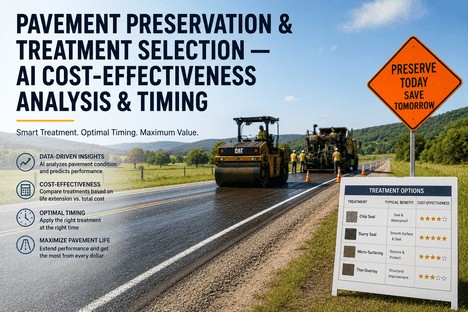
The Foundation for Pavement Preservation states it in seven words: the right treatment on the right road at the right time. That single sentence distills the entire discipline of pavement preservation into a decision-making framework that, when applied systematically, produces the most cost-effective pavement management outcome possible. The framework is called a treatment selection decision tree — a structured set of rules that maps pavement condition data, distress type, traffic level, and functional classification to a specific preservation treatment. Agencies that implement formal decision trees consistently achieve 30 to 50 percent more lane-miles of preservation per dollar compared to agencies that select treatments based on institutional knowledge, engineer judgment, or the contractor's recommendation. The difference between a crack seal applied at PCI 72 and a structural overlay required at PCI 48 is a factor of 5 to 10 in cost per square yard, and the decision tree is the tool that ensures your agency applies the first instead of the second.
The Preservation Decision Tree: From PCI to Treatment
A treatment selection decision tree is a logic structure that takes the available pavement condition data for a segment and outputs a recommended treatment. The most common decision trees in agency pavement management systems use PCI as the primary gate, distress type as the secondary discriminator, and traffic level or functional classification as the tertiary filter. The tree must be calibrated to the agency's specific conditions — climate, material availability, contractor capability, and budget — but the structure is transferable and the principles are universal. An agency without a formal decision tree is making treatment selection decisions by committee every spring, and those decisions will be inconsistent across districts, across years, and across pavement types.
The Six Standard Preservation Treatments: What, When, and Why
The FHWA Pavement Preservation Checklist Series and the NCAT preservation group experiment have established standard performance expectations for the six most common preservation treatments. Each treatment has a defined PCI application window, a typical service life under normal traffic conditions, and a set of distress conditions under which it is effective — and under which it will fail prematurely. The decision tree must encode these boundaries to prevent the most common and costly preservation error: applying a surface treatment to a pavement with structural distress that requires an overlay.
The Distress Discriminator: Why PCI Alone Is Not Enough
A decision tree that uses only PCI to select treatments will produce incorrect recommendations on a significant percentage of segments, because PCI aggregates multiple distress types into a single number and two segments with identical PCI can have completely different treatment needs. A segment at PCI 65 with predominantly low-severity block cracking and raveling is an ideal microsurfacing candidate. A segment at PCI 65 with alligator cracking concentrated in the wheelpath and moderate rutting needs a thin overlay because the alligator cracking signals structural base distress that microsurfacing will not address. The decision tree must include a distress discriminator that identifies the dominant distress type and severity before the final treatment is selected.
Traffic and Functional Class: The Third Decision Layer
After PCI and distress type have narrowed the treatment candidates, traffic level and functional classification provide the final filter. A chip seal that performs well on a rural collector with ADT of 1,500 will fail within 12 months on an urban arterial with ADT of 15,000. A microsurfacing that is ideal for a high-volume suburban arterial is over-engineered and overpriced for a low-volume residential street. The decision tree must encode traffic-dependent rules that adjust the treatment recommendation based on average daily traffic, truck percentage, and speed limit.
The Cost of Getting It Wrong: Misapplied Preservation Treatments
The most expensive mistake in pavement preservation is not failing to treat a road — it is applying the wrong treatment to a road that needed something else. A slurry seal applied over a pavement with active alligator cracking traps moisture in the structural layer and accelerates base failure, turning a $5 per SY preservation treatment into a $40 per SY reconstruction within 3 years. A thin overlay applied to a pavement at PCI 82 that needed only crack seal wastes $10 to $15 per SY that could have treated 3 additional lane-miles with the right treatment for the same budget. The decision tree exists to prevent both errors — the over-treatment that wastes money and the under-treatment that accelerates deterioration.
When we implemented a formal PCI-based decision tree, the first thing we discovered was that we had been over-treating approximately 25% of our preservation program — applying microsurfacing to roads that needed only crack seal, and applying thin overlay to roads that would have performed well with microsurfacing. We were spending preservation money on the wrong treatments because our engineers were making decisions based on what the road looked like rather than what the PCI and distress data said. The first year after implementation, we treated 38% more lane-miles with the same budget, and our average post-treatment PCI was 4 points higher than the previous year. The decision tree did not constrain our engineers — it gave them a defensible framework that eliminated the variability between districts.
— Pavement Preservation Program Manager, Western State DOT — First-Year Results of Decision Tree ImplementationBuilding a Decision Tree for Your Agency: Five Essential Steps
Implementing a treatment selection decision tree does not require custom software or a research project. The most effective decision trees in agency practice are built from five components that any pavement management program already has access to: PCI data, distress data, treatment performance history, unit cost data, and an executive policy that commits to following the tree. The implementation process follows a standard sequence that produces a working decision tree within a single budget cycle.
Map your network PCI distribution and set treatment windows based on historical performance and FHWA guidance for each treatment type.
Identify which distress types at which severity levels disqualify or require specific treatments — alligator cracking blocks surface seals.
Set ADT thresholds and functional class rules that override the base treatment recommendation where traffic volume demands higher-performance materials.
Run the decision tree against 3 to 5 years of historical treatment data. Adjust thresholds where the tree contradicts field-proven outcomes.
Embed the decision tree in your pavement management system so treatment recommendations are generated automatically when PCI data is updated.
Conclusion
The pavement preservation treatment selection decision tree is the single most impactful tool an agency can implement to improve the cost-effectiveness of its pavement program. It replaces subjective judgment with systematic logic, ensures that the right treatment is applied based on objective condition data rather than institutional memory or contractor preference, and provides a transparent and defensible rationale for every treatment selection decision that can be communicated to elected officials, funding authorities, and the public. The agencies that have implemented formal decision trees consistently report 30 to 50 percent more lane-miles treated per dollar, higher average post-treatment PCI, and fewer premature treatment failures caused by mismatched treatment and condition.
The cost of implementing a decision tree is negligible compared to the cost of a single misapplied preservation treatment. The data is already in your pavement management system — PCI scores, distress surveys, traffic counts, and treatment history. What is missing is the structured logic that connects that data to the right treatment decision, consistently, across every district, every year, every budget cycle. That is the gap that a well-designed decision tree fills.
iFactory helps agencies build, validate, and integrate treatment selection decision trees into their pavement management workflows — from PCI-based treatment rules and distress discriminator logic to traffic-adjusted filters and lifecycle cost optimization. Book a demo to see how iFactory can help your agency build a treatment selection decision tree, or talk to an expert about the first steps toward moving from subjective treatment selection to a data-driven decision framework.