Condition-Based Infrastructure Budgeting — AI Needs Projection & Funding Gap Analysis
By Johnson on August 20, 2026
Every capital budget cycle, asset managers submit funding requests built on the same foundation their predecessors used a decade ago — trended historical spending, extrapolated forward, with a contingency line added for whatever nobody saw coming. Finance committees have grown skeptical of that model, and reasonably so, because a budget built on what an agency spent last year says very little about what its assets actually need next year. Condition-based budgeting replaces that assumption with evidence: continuously collected condition data, deterioration modeling, and AI-generated needs projections that tie every requested dollar to a documented, inspectable reason. The agencies making this shift are not simply getting more requests approved — they are approving the right requests, ranked by risk instead of by which line item was easiest to defend in committee. This walkthrough covers how condition-based budgeting works end to end, from data collection through the funding gap analysis finance committees actually respond to, and where a structured AI needs projection model fits into your next budget cycle.
Capital Planning · Asset Management
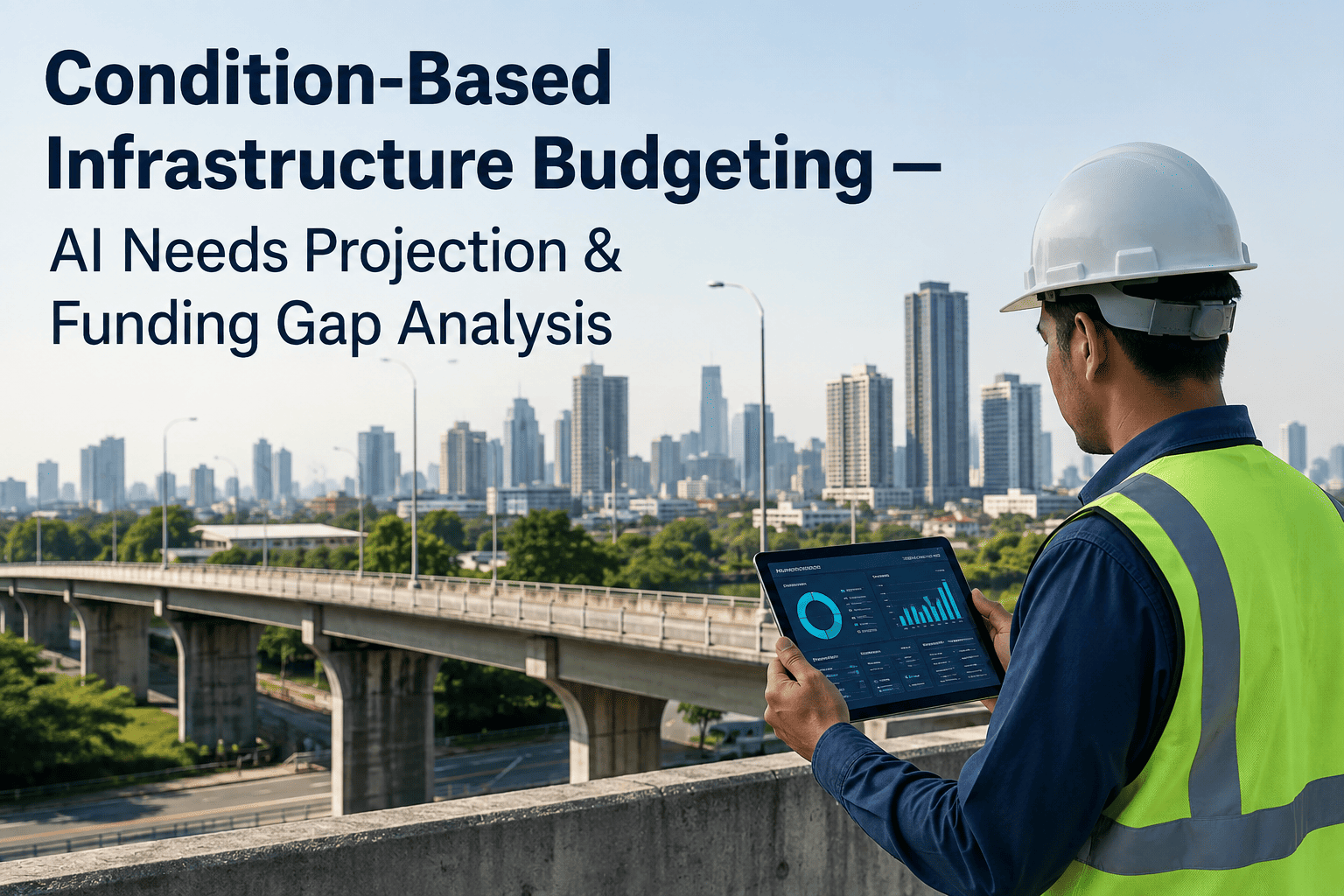
Condition-Based Infrastructure Budgeting: AI Needs Projection and Funding Gap Analysis
Replace historical spending patterns with budget requests supported by documented condition evidence, deterioration forecasts, and a funding gap finance can actually see.
National infrastructure research groups have tracked a widening gap between what agencies spend on maintenance and what their asset conditions actually require, and the pattern shows up in nearly identical form at the state and municipal level. A trend-based budget cannot see that gap forming until conditions have already degraded far enough to show up in a windshield survey or a citizen complaint, by which point the intervention that would have been routine maintenance has usually become an emergency repair at several times the cost. Asset managers are not the ones missing this pattern — most can point to specific bridges, pump stations, or roadway segments they have flagged internally for years. The disconnect happens further up the chain, where a budget request built on trend lines instead of condition evidence struggles to compete for limited capital against requests for new construction, which tend to arrive with more polished renderings and a clearer political story attached.
$3.7T
Estimated national infrastructure investment shortfall cited across recent public infrastructure grading reports
46%
Share of infrastructure assets nationally estimated to be more than 40 years past original construction
$86B+
Combined decade-long road and bridge funding gap projected across dozens of states in recent transportation funding analysis
1 Cycle
How long a single missed inspection window can take to surface in a trend-based budget model
The Core Difference
Trend-Based Budgeting vs. Condition-Based Budgeting
The two approaches can produce similar-looking budget totals in a stable year, but they diverge sharply the moment an asset class starts deteriorating faster or slower than its historical average — which is precisely the situation a trend line is worst equipped to catch. A trend-based model treats every asset class as if it ages at a constant, predictable rate, which is a reasonable simplification right up until a specific bridge deck, water main segment, or HVAC system starts failing faster than its peers due to usage load, material defects, or an environmental factor the original schedule never accounted for. Condition-based budgeting is built specifically to surface that divergence early, while there is still a meaningful range of intervention options and cost levels to choose from.
Trend-Based Budgeting
Starts from last year's spending, adjusted for inflation
Assumes deterioration continues at a flat, historical rate
Reprioritizes only after a failure or complaint
Defends requests with narrative and precedent
Funding gap is discovered, not projected
Condition-Based Budgeting
Starts from current, documented asset condition data
Models deterioration curves specific to each asset class
Reprioritizes continuously as new inspection data arrives
Defends requests with condition evidence and forecasts
Funding gap is quantified years before it becomes urgent
How It Works
From Inspection Data to a Defensible Budget Request
Most of the data a condition-based model needs already exists somewhere in the organization — the work is in connecting it, modeling it forward, and translating it into a format finance can act on. The five stages below are how that typically happens over a single budget cycle.
01
Consolidate Condition Data
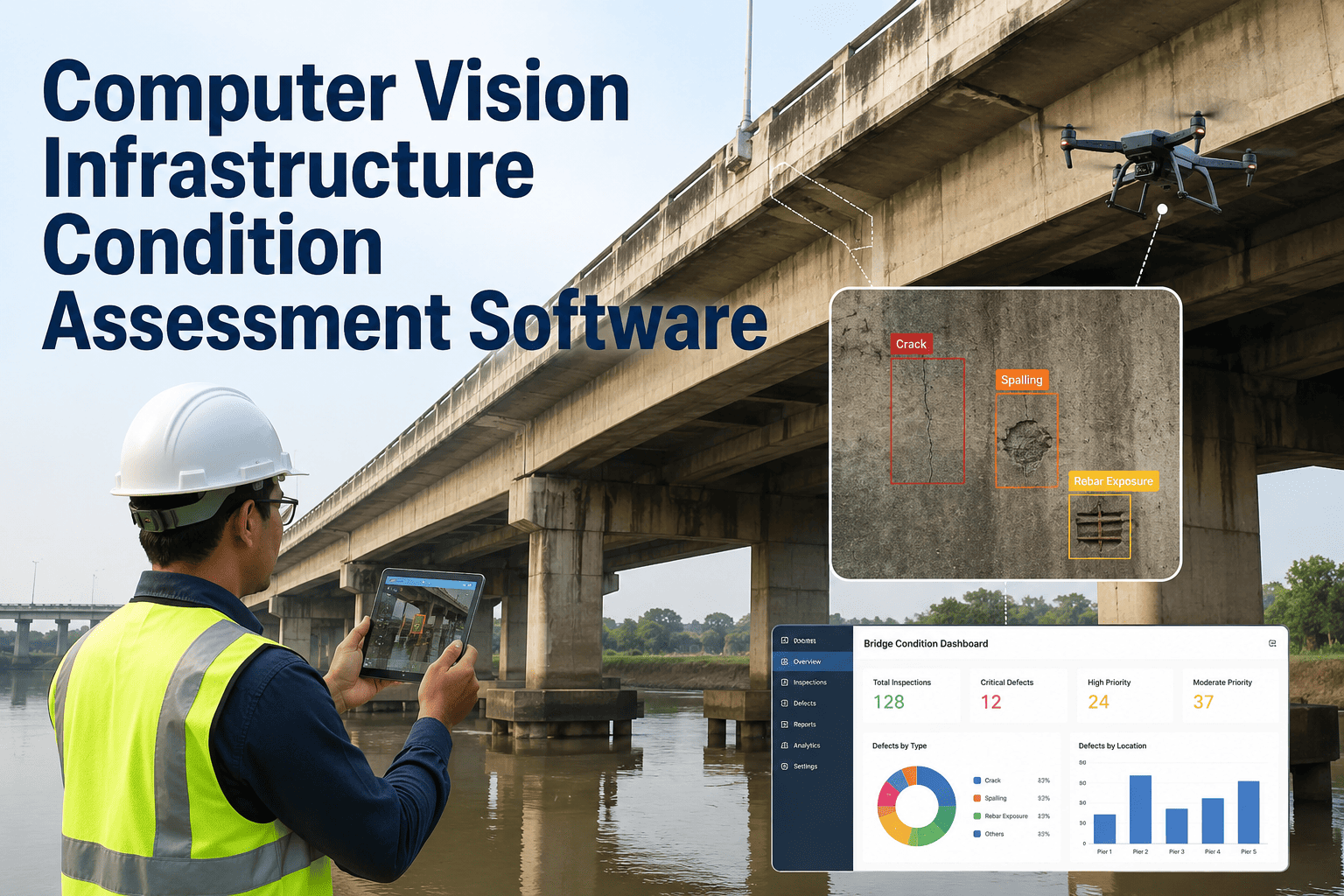
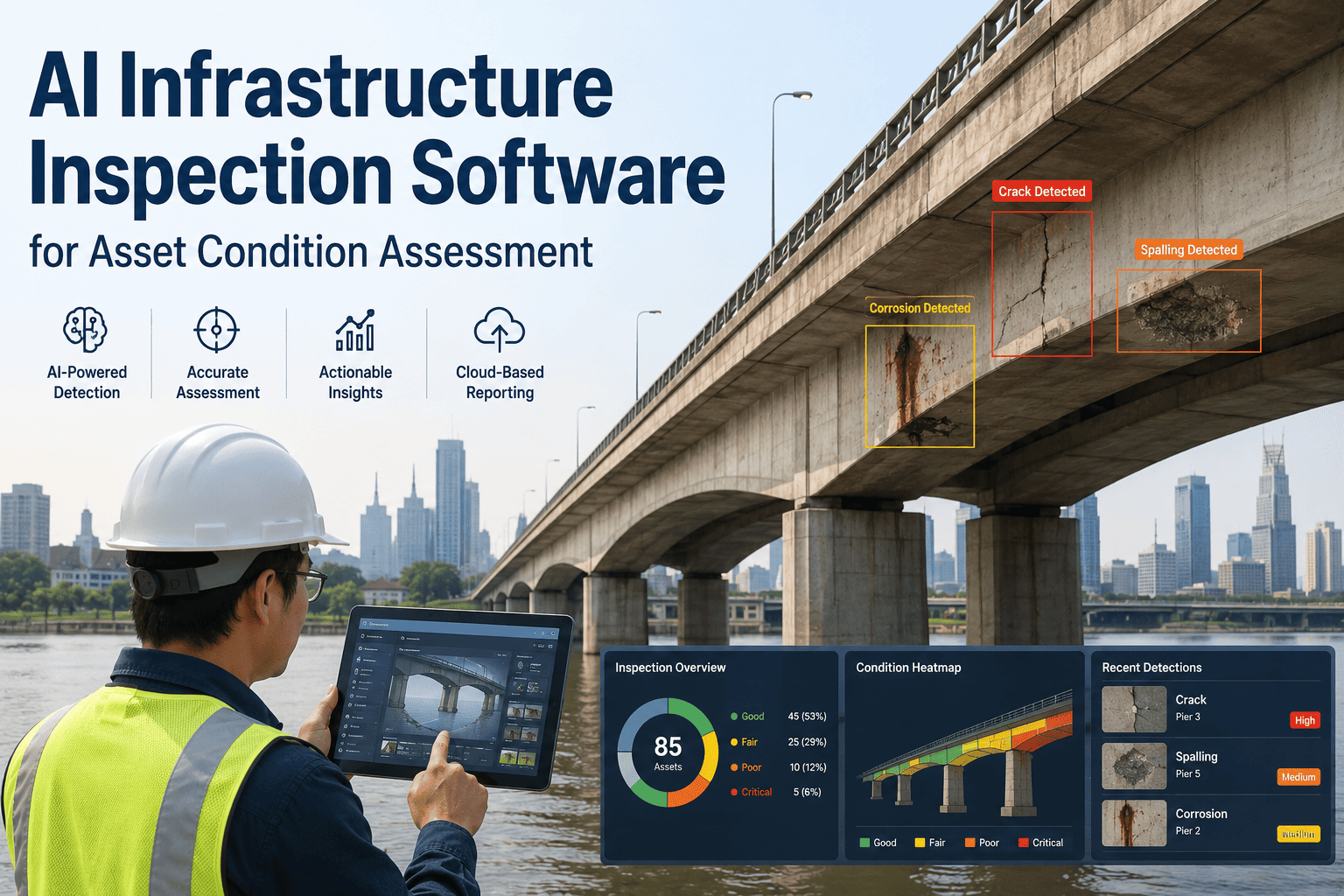
Inspection records, sensor feeds, and prior work orders are pulled into a single asset register so every asset has one current condition score instead of scattered notes across departments and spreadsheets.
02
Model Deterioration by Asset Class
The AI model applies deterioration curves specific to material type, usage load, and environmental exposure, projecting how each asset's condition score will move over the next one, five, and ten years if left at current funding levels.
03
Quantify the Funding Gap
Projected needs are compared against current and planned budget allocations, isolating exactly where and by how much funding falls short of what condition trajectories require, broken out by asset class and facility.
04
Rank Requests by Risk-Adjusted Return
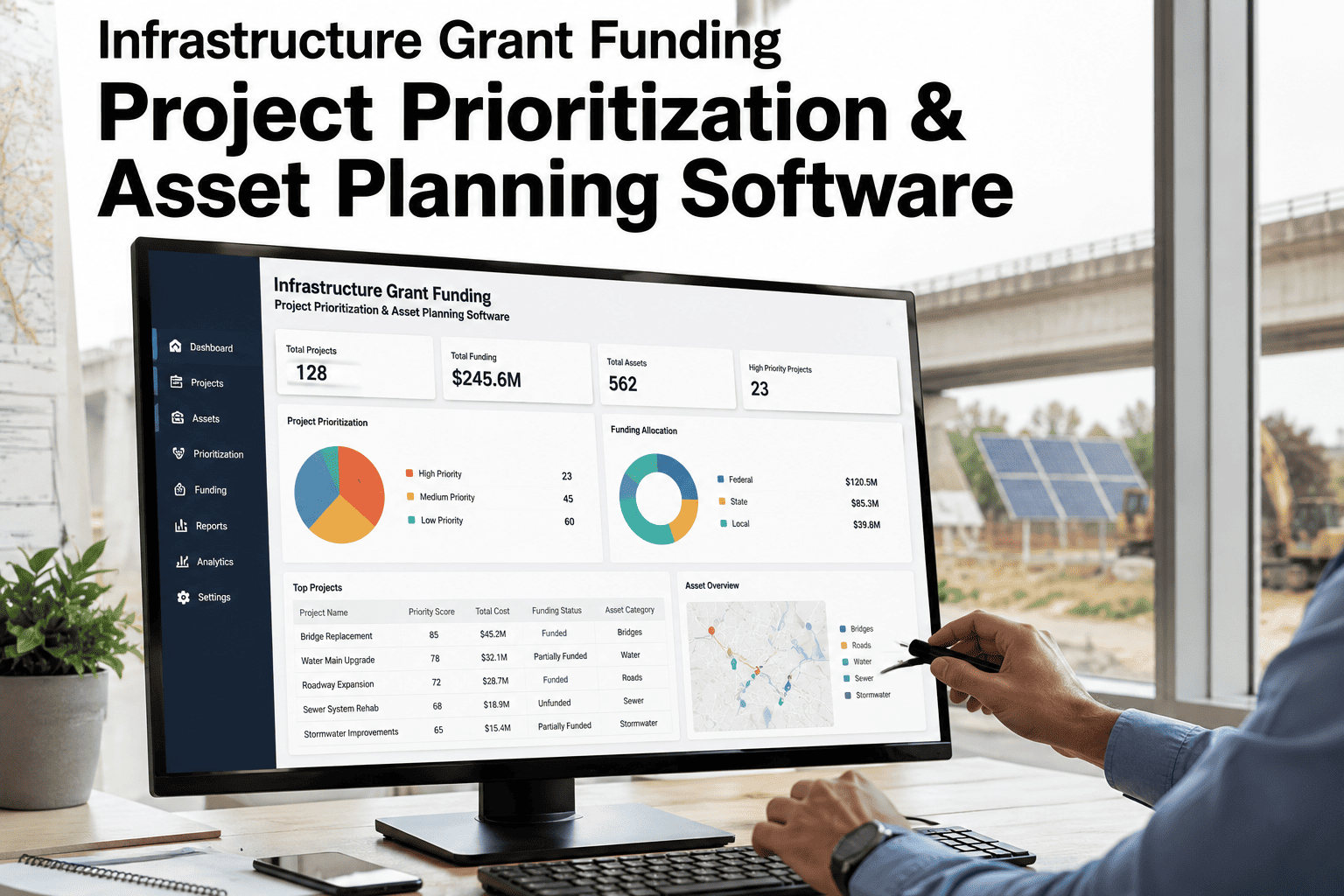
Each candidate project is scored on risk avoided per dollar spent, so limited capital is directed at the interventions that prevent the most costly failures rather than the projects that are simply next on a rotation schedule.
05
Generate the Budget Request Package
Condition evidence, deterioration forecasts, and gap figures are compiled into a documentation package built for the finance committee or grant reviewer, reducing the manual assembly work that usually consumes weeks before a submission deadline.
See Your Own Numbers First
Run a Funding Gap Analysis on Your Current Asset Portfolio
Before changing how a single budget request is written, most asset managers want to see what a condition-based model actually projects against their own inventory. We can walk through that analysis using data you already have on hand.
A gap analysis rarely shows an even shortfall across an entire portfolio — it concentrates in specific asset classes where deterioration has outpaced the budget those assets have historically received, while other classes may be adequately funded or even over-funded relative to their actual condition trajectory. Breaking the gap out this way, rather than presenting a single portfolio-wide shortfall figure, is usually what makes a request easy for a finance committee to act on, because it shows exactly which line items need to move and by how much. A representative breakdown for a mid-sized public works portfolio looks like this.
Asset Class
Avg. Condition Index
5-Year Projected Need
Current Allocation
Documented Gap
Bridges & Structures
Fair, declining
$18.4M
$11.2M
$7.2M
Roadway Pavement
Fair
$26.1M
$19.8M
$6.3M
Water & Sewer Mains
Poor, localized
$14.7M
$8.9M
$5.8M
Facilities & Buildings
Good to fair
$9.3M
$7.6M
$1.7M
Signal & Lighting
Fair
$4.1M
$3.4M
$0.7M
What Finance Committees Actually Ask For
Building a Budget Request Package That Survives Review
A condition-based request gets challenged far less often than a trend-based one, but only if the supporting package includes evidence a reviewer can independently verify rather than a narrative summary alone. Finance committees and grant reviewers increasingly expect this level of documentation as a baseline, not an enhancement — several federal and state infrastructure funding programs now score applications in part on whether condition evidence and forecasted need are clearly documented. A complete package generally includes the six elements below, assembled per project or per asset class rather than as a single portfolio-wide narrative.
Current Condition Score
A documented, date-stamped condition rating for every asset included in the request, sourced from inspection records rather than staff memory.
Deterioration Trajectory
A forward-looking projection showing what the condition score becomes under current funding versus the requested funding level.
Cost-of-Delay Comparison
The projected cost difference between addressing the asset now versus after further deterioration forces a more expensive intervention.
Risk-Adjusted Ranking
Where this project sits relative to every other candidate project competing for the same limited capital pool.
Funding Gap Figure
A clear dollar figure showing the shortfall between documented need and current allocation for the relevant asset class.
Grant Alignment Notes
Where applicable, how the project aligns with federal or state grant evaluation criteria that could offset the local funding gap.
Where Requests Get Rejected
Common Budgeting Mistakes Condition Evidence Fixes
None of these mistakes reflect a lack of effort on the part of asset management teams — they are structural consequences of budgeting off a trend line rather than off current condition data, and they tend to disappear once a documented gap analysis is in place.
Requesting by Rotation, Not Risk
Replacing assets on a fixed schedule regardless of actual condition wastes budget on assets that could safely wait and under-funds ones deteriorating faster than average.
No Cost-of-Delay Figure
Without a documented comparison of cost now versus cost later, a deferred request looks like a savings on paper even when it guarantees a larger expense down the line.
Condition Data That Is Months Stale
A request built on last year's inspection round loses credibility fast when a reviewer asks how current the underlying condition figures actually are.
One Portfolio-Wide Gap Number
A single aggregate funding gap figure hides where the shortfall actually concentrates, making it harder for a committee to see which asset class needs priority attention.
Timing the Shift
Signals It Is Time to Move Off Trend-Based Budgeting
Most departments do not switch models all at once — the shift usually starts in whichever asset class is causing the most budget friction, then expands once the first funding gap analysis proves out. A few recurring signals tend to prompt that first move.
Repeated Emergency Repairs
A growing share of the maintenance budget is going to unplanned, emergency-priced repairs rather than scheduled work, which is usually a lagging indicator that deterioration has outpaced the funding model tracking it.
Budget Requests Getting Trimmed
Finance is increasingly pushing back on requested increases without a specific reason to point to beyond inflation, a pattern that condition evidence tends to resolve quickly once introduced.
Grant Applications Falling Short
Applications for federal or state infrastructure funding are being submitted without the documented condition and needs data those programs increasingly weight in their scoring criteria.
Inspection Data Sitting Unused
Field teams are already collecting condition data through inspections and work orders, but it lives in disconnected systems rather than feeding directly into the budget planning process.
Applied Example
What a First Budget Cycle Under This Model Typically Looks Like
Consider a mid-sized public works department that has historically requested roughly the same maintenance budget each year, adjusted only for inflation, while its bridge and water main condition scores have quietly declined for several consecutive inspection cycles. Once condition data from recent inspections is consolidated into an asset register and run through a deterioration model, the projected five-year need for those two asset classes comes out well above what the trend-based request would have asked for — and the documentation shows exactly why, asset by asset, rather than as a single unexplained increase. The following budget cycle's request looks larger on the surface, but it is accompanied by a funding gap table, a cost-of-delay comparison for the highest-risk bridges, and a risk-adjusted ranking showing which projects would be funded first if the full request is not approved. Finance committees tend to respond very differently to that package than to a percentage increase with no supporting evidence, because every dollar in the request maps to a specific, verifiable condition finding. In departments that have made this shift, the second and third budget cycles tend to move faster than the first, since the asset register, deterioration models, and documentation format are already in place and only need to be refreshed with the latest inspection data rather than rebuilt from scratch each year.
"
I have sat in enough budget hearings to know what makes a committee lean in versus tune out. The agencies that get their full budget request approved almost never ask for more money in the abstract — they show up with a specific gap, tied to specific assets, backed by inspection data the committee can check for itself. That shift from narrative to evidence is what changes the conversation. Once a finance committee sees a documented funding gap broken down by asset class instead of a single percentage increase, the questions change from "why do you need this" to "which of these gets funded first."
Renata Achterberg-Solis
Capital Planning Advisor · 16 years in public infrastructure asset management and municipal budget strategy
Budgeting Questions
Condition-Based Budgeting — Frequently Asked
How is condition-based budgeting different from typical asset management software?
General asset management software tracks inventory and work orders, while condition-based budgeting specifically forecasts deterioration and quantifies the dollar gap between projected need and current funding for finance and capital planning use. Book a demo to see how the needs projection model applies to your existing asset register.
Do we need new inspection processes before this works?
Most departments already have enough inspection history to start — condition-based projection works with existing inspection records, work orders, and sensor data rather than requiring a new data collection program before any modeling can begin. Contact support to review what data your current process already provides.
Can this help with federal or state grant applications?
Yes — documented condition evidence and a quantified funding gap are exactly what most federal and state infrastructure grant programs evaluate applications against, so the same documentation package built for an internal budget request typically strengthens a grant submission as well. Book a session to align your gap analysis with an upcoming grant cycle.
How often should the funding gap analysis be updated?
Because deterioration is continuous, most departments update the underlying condition data and gap figures at least once per budget cycle, with some asset classes reviewed more frequently if recent inspections show faster-than-expected decline. Talk to our team about a review cadence that fits your reporting calendar.
Will this increase our total requested budget?
Not always — in some asset classes a condition-based analysis shows spending is already adequate, while in others it reveals an unfunded gap; the value is in knowing precisely where funding is under or over-allocated rather than assuming an across-the-board increase is needed. Book a call to see where your own portfolio stands.
Your Next Budget Cycle Starts With Condition Data
Turn Asset Condition Into a Budget Finance Committees Approve
iFactory consolidates your inspection data, projects deterioration by asset class, and generates a documented funding gap analysis ready for your next capital budget request.