Ground Penetrating Radar GPR Bridge Deck Evaluation Methods

By Grace on June 18, 2026

ground-penetrating-radar-bridge-deck-evaluation

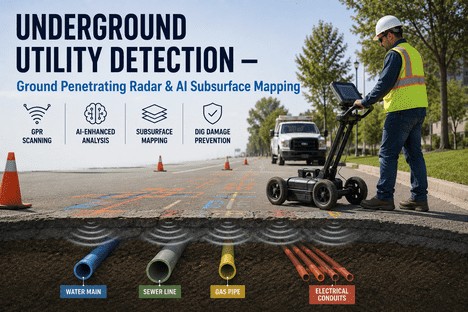
Ground penetrating radar (GPR) bridge deck evaluation has become the standard non-destructive method for assessing concrete bridge deck condition without coring or lane closures. When a bridge deck is surveyed using GPR, the electromagnetic signal penetrates the asphalt overlay and concrete to map rebar location, measure cover depth, and identify areas of deterioration and delamination before they appear as surface cracks or spalls. The ASTM D6087 standard governs this test method, providing consistent procedures for evaluating asphalt-covered concrete bridge decks using GPR. This guide covers everything a bridge engineer needs to know about GPR bridge deck inspection — antenna selection, survey planning, data processing, and condition mapping — so you can plan surveys that deliver actionable condition data on your first pass.

ASTM D6087 · Ground-Coupled GPR · Rebar Corrosion Mapping · Concrete Cover Depth
Ground Penetrating Radar Bridge Deck Evaluation: The Engineer's Guide to GPR Survey Planning, Antenna Selection, and ASTM D6087 Condition Mapping
Plan faster, more accurate bridge deck GPR surveys. Understand antenna frequency tradeoffs, data processing workflows, and how to interpret rebar amplitude maps for delamination detection — all aligned with ASTM D6087 protocols.
222,000+
US bridges requiring major repair or replacement according to ARTBA's 2025 Bridge Report — GPR is the primary screening tool for deck condition assessment
1.2–2.6
GHz antenna frequency range most commonly used for bridge deck evaluation — balancing penetration depth against spatial resolution of rebar and deterioration features
100%
Deck coverage achieved with multi-pass GPR survey grids versus point measurements from chain drag or hammer sounding — no gaps, no statistical sampling
42.4%
Of US bridges are over 50 years old (FHWA 2023). GPR enables condition-based maintenance planning rather than reactive repair on aging decks

Why GPR for Bridge Deck Evaluation?

Traditional bridge deck inspection methods — chain drag, hammer sounding, visual crack surveys, and core sampling — share a fundamental limitation: they detect deterioration only after it has progressed to a stage where physical evidence is visible at the surface or a core can be extracted. By that point, chloride-induced corrosion has already compromised the rebar-concrete bond, delamination has propagated across measurable areas, and the repair scope has shifted from preventive preservation to structural rehabilitation.

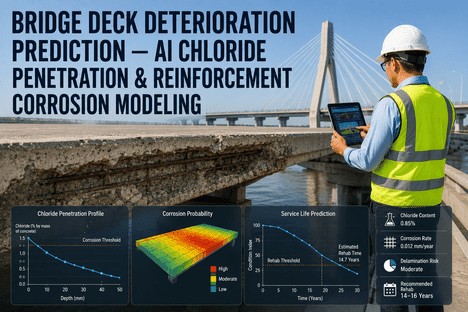
Ground penetrating radar changes this timeline. GPR detects changes in the dielectric properties of concrete that correlate with the early stages of corrosion and delamination — before surface cracking appears, before spalls form, and before the deck requires lane closures for emergency repair. The GPR signal reflection from the top mat of rebar loses amplitude when the surrounding concrete is compromised by chlorides, moisture, or micro-cracking. By mapping this amplitude variation across the full deck area, the engineer can identify deterioration zones with high confidence and plan targeted coring for verification, all without removing the asphalt overlay.

What GPR Reveals in a Bridge Deck Survey That Traditional Methods Miss
Hidden Deterioration
Delamination Under Asphalt Overlay
GPR is the only NDT method that can evaluate concrete deck condition through an asphalt overlay without removing it. Signal attenuation at the rebar level identifies areas where corrosion byproducts and micro-cracking have degraded the concrete-rebar bond — the precursor to delamination that chain drag cannot detect through overlay.
Rebar Mapping
Cover Depth and Spacing Variation
GPR produces a continuous profile of rebar cover depth across the entire deck surface, revealing areas where cover is below design specification and therefore more vulnerable to chloride ingress. Combined with half-cell potential or resistivity data, this identifies high-corrosion-risk zones before active corrosion begins.
Voids and Honeycombing
Subsurface Anomalies Within the Deck Section
Voids, honeycombing, and rock pockets within the concrete mass produce distinct GPR reflection signatures that are invisible to surface inspection. Early detection of these construction defects or service-induced voids allows targeted injection repair before water infiltration accelerates freeze-thaw damage.

How GPR Bridge Deck Evaluation Works

Ground penetrating radar operates on a straightforward physical principle: a transmitting antenna emits a high-frequency electromagnetic pulse into the deck structure. When this pulse encounters a boundary between materials with different dielectric properties — such as asphalt-to-concrete, concrete-to-rebar, or sound concrete-to-deteriorated concrete — a portion of the energy reflects back to the receiving antenna. The two-way travel time of the pulse is converted to depth using the dielectric constant of the material, and the amplitude of the reflected signal carries information about the condition of the reflecting interface.

For bridge deck evaluation, the primary reflector of interest is the top mat of reinforcing steel. Sound concrete produces a strong, consistent rebar reflection across the deck area. When the concrete surrounding the rebar becomes contaminated with chlorides, saturated with moisture, or micro-cracked due to corrosion expansion, the dielectric contrast between the steel and the concrete decreases, and the reflected amplitude drops. By mapping these amplitude variations across a dense grid of survey lines, the engineer creates a condition map that identifies areas of probable deterioration with metre-scale precision.

The GPR Bridge Deck Survey Workflow — Step by Step
Plan
Define survey grid, select antenna frequency, and establish calibration points based on deck dimensions and overlay condition
Acquire
Collect GPR scans along longitudinal and transverse lines at 0.3–0.6 m spacing using ground-coupled or air-coupled antenna
Process
Apply time-zero correction, gain adjustment, background removal, and depth conversion to raw radargram data
Analyze
Pick rebar reflection amplitudes, apply depth correction, and generate normalized amplitude condition maps
Report
Deliver condition map with deterioration zones, rebar cover statistics, and core verification recommendations

Choosing the Right GPR Antenna Frequency for Bridge Deck Surveys

Antenna frequency selection is the single most important equipment decision in GPR bridge deck evaluation. The choice directly controls the tradeoff between penetration depth and spatial resolution — and the wrong choice can render survey data uninterpretable for the specific deterioration type being investigated. The industry standard range for bridge deck evaluation is 1.0 GHz to 2.6 GHz, with specific frequencies preferred for different survey objectives.

Frequency
1.0–1.6 GHz Ground-Coupled
Best for: deep rebar, thick decks

Lower-frequency ground-coupled antennas in the 1.0–1.6 GHz range provide the best penetration through thick concrete sections and asphalt overlays. They are the most commonly specified antennas for routine bridge deck condition surveys under ASTM D6087, particularly for decks with overlay thickness exceeding 100 mm. The tradeoff is reduced spatial resolution — individual rebar reflections may overlap at close spacing, making cover depth measurement less precise. Manufacturers including GSSI (1.5 GHz), MALA (1.2 GHz), and Proceq (1.6 GHz) offer antennas in this band. Recommended scan spacing is 0.3 m for longitudinal lines with transverse tie lines at 0.6–1.0 m spacing.

ASTM D6087 compliant
Asphalt overlay penetration
FHWA protocol default
Frequency
2.0–2.6 GHz High-Frequency
Best for: shallow rebar, high resolution

Higher-frequency antennas between 2.0 GHz and 2.6 GHz deliver superior spatial resolution, making them ideal for detailed rebar mapping, cover depth measurement with high precision, and detection of thin delamination boundaries. The 2.6 GHz antenna is particularly valuable for bridge decks with minimal or no asphalt overlay, where the shallow penetration depth is not a limitation. These antennas resolve individual rebar at close spacing (down to 75–100 mm centres) and produce sharper amplitude contrast at deterioration boundaries. The tradeoff is significantly reduced penetration — signal attenuation limits useful depth to approximately 250–400 mm in sound concrete, and less in chloride-contaminated sections.

High-resolution rebar imaging
Thin overlay decks
Cover depth precision
Frequency
Air-Coupled Horn Antenna
Best for: high-speed network surveys

Air-coupled horn antennas (typically 1.0 GHz centre frequency) are mounted on survey vehicles and operated at traffic speed — up to 80 km/h with no lane closure required beyond a moving convoy. These systems trade depth resolution for survey speed. The air gap between antenna and deck surface introduces a strong surface reflection that must be filtered during processing, and the reduced coupling efficiency limits penetration. Air-coupled GPR is best suited for network-level bridge screening where the objective is to rank decks by deterioration severity rather than to produce detailed repair-level condition maps. Ground-coupled follow-up surveys are then deployed on decks identified as high-priority.

High-speed data collection
Network-level screening
Minimal traffic control

GPR Data Processing for Bridge Deck Condition Mapping

The raw GPR data collected in the field — a series of radargrams showing reflected signal amplitude as a function of two-way travel time and distance along each survey line — requires systematic processing before it can be interpreted as a bridge deck condition map. The processing workflow transforms raw signal data into a normalized, depth-corrected amplitude map that correlates with deck deterioration.

Raw Data Artifacts
Common Signal Issues That Must Be Corrected Before Analysis
Time-zero drift caused by temperature variation during long surveys produces misaligned surface reflections across scan lines.
Signal attenuation with depth must be compensated using time-varying gain functions to make deeper rebar reflections visible and comparable to shallow ones.
Background clutter from direct-wave coupling and asphalt surface roughness must be filtered using subtractive or high-pass filtering methods.
Geometric spreading and spherical divergence cause amplitude decay unrelated to material condition, requiring range-gain correction before amplitude comparison.
Corrected Data Output
What the Processed Condition Map Actually Shows
Normalized rebar amplitude map colour-coded from -3 dB (sound deck, strong reflection) to -12 dB (severe deterioration, weak reflection) with interpolated contours.
Cover depth map showing variations in rebar cover across the deck, identifying areas where cover is below design specification and corrosion risk is elevated.
Deterioration severity classification — sound, moderate deterioration, severe deterioration — calibrated against core verification at representative locations.
Depth-slice plan maps at multiple elevation ranges (surface, top rebar mat, bottom rebar mat, deck soffit) to isolate deterioration by structural layer.

ASTM D6087 Compliance and Survey Protocol

ASTM D6087-22 is the governing standard for evaluating asphalt-covered concrete bridge decks using ground penetrating radar. The standard specifies the test method scope, equipment requirements, calibration procedures, data collection parameters, and analysis methodology that define a compliant bridge deck GPR survey. Understanding the requirements of D6087 is essential for engineers procuring GPR services or conducting in-house surveys that will be used for bridge management system input or rehabilitation contract documentation.

The standard requires that the GPR system be calibrated on a known reference surface before each survey to establish consistent time-zero and gain settings. Survey lines must be spaced at intervals sufficient to characterize the deck condition — typically 0.3 m to 0.6 m for ground-coupled antennas — with the survey grid extending across the full deck width and between abutments or expansion joints. Data processing must include time-zero correction, depth calibration using known rebar depths or layer interfaces, and amplitude normalization relative to a reference sound zone on the deck. The final deliverables must include condition plan maps showing areas of probable deterioration at or above the top mat of reinforcement, with deterioration quantities reported as a percentage of total deck area.

"

Our first GPR survey on a 40-year-old bridge deck revealed that 23% of the deck area had active delamination that was completely invisible from the surface because of a 75 mm asphalt overlay. Chain drag and visual inspection had rated the deck in fair condition. The GPR-based rehabilitation plan allowed us to scope the repair accurately, budget the lane closures, and execute the concrete removal in a single season rather than discovering the full extent of deterioration during construction.

— Senior Bridge Engineer, State DOT — 12-Span Continuous Steel Girder Bridge, Mid-Atlantic Region

GPR Survey Planning: Practical Field Considerations

A successful bridge deck GPR survey depends as much on pre-survey planning as on the quality of the data processing. The following practical factors determine whether the survey produces usable condition data or requires a costly return visit.

Traffic Control
Lane closures dictate survey method

Available lane closure time determines whether ground-coupled or air-coupled GPR is feasible. Ground-coupled surveys require full lane closure at typical walking speed (0.3–0.6 m/s), covering one lane in approximately 30–60 minutes per 30 m span. Air-coupled systems survey at traffic speed but require a moving lane closure and produce lower-resolution data. Factor the closure duration into the cost comparison.

Deck Surface Condition
Overlay type and moisture content

Asphalt overlay thickness, density, and moisture content all affect GPR signal penetration. Freshly placed or rain-saturated overlays significantly attenuate the signal. Survey during dry conditions and note overlay age and type in the report. Concrete decks without overlay produce the highest-quality GPR data and allow use of higher-frequency antennas for superior resolution.

Calibration and Reference
Known sound zone for normalization

ASTM D6087 requires amplitude normalization against a known sound reference zone. Identifying this zone before the survey saves processing time. Ideally, select an area away from expansion joints and deck edges where the rebar reflection is strong and consistent. If no sound zone can be assumed, plan for a minimum of two verification cores to establish the reference amplitude baseline.

ASTM D6087 · Ground-Coupled GPR · Rebar Corrosion Mapping · Concrete Cover Depth
Plan Your Next GPR Bridge Deck Survey with Confidence. Get the Right Antenna, the Right Protocol, and the Right Interpretation.
Whether you are specifying a GPR survey for a single bridge or planning a network-level screening program, the engineering team at iFactory can help you select the right equipment configuration, survey protocol, and data analysis workflow for your deck condition assessment objectives.

Conclusion: GPR Is the Most Efficient Path to Reliable Bridge Deck Condition Data

Ground penetrating radar bridge deck evaluation has moved from a specialized research tool to a standard element of bridge management programs across transportation agencies worldwide. The method's ability to evaluate concrete deck condition through asphalt overlay, map deterioration across 100% of the deck area, and deliver quantitative condition data that can be compared across inspection cycles makes it the most efficient non-destructive method available for reinforced concrete bridge decks.

The key to a successful GPR bridge deck survey lies in three areas: selecting the correct antenna frequency for the deck configuration and overlay condition, following the ASTM D6087 protocol for data collection and calibration, and applying a rigorous data processing workflow that accounts for depth-dependent attenuation and cover depth variation. When these three elements are addressed, GPR delivers condition maps that correlate strongly with core verification and enable targeted, cost-effective rehabilitation planning.

For agencies managing an aging bridge inventory — where 42% of bridges are now over 50 years old and 222,000 require major repair — integrating GPR into the inspection workflow is not an additional cost. It is a cost-avoidance strategy that prevents emergency repairs, reduces lane closure frequency, and extends the service life of decks that would otherwise be replaced prematurely based on incomplete condition data. Book a demo to see how iFactory's GPR data analysis platform streamlines your bridge deck evaluation workflow, or talk to an expert about configuring a survey protocol for your specific bridge types and deterioration concerns.

Frequently Asked Questions

Ground-coupled antennas sit directly on the deck surface (or on the asphalt overlay) and provide maximum signal penetration and resolution because there is no air gap between the antenna and the deck. They must be pushed at walking speed and require a full lane closure. Air-coupled horn antennas are mounted on survey vehicles 1–2 feet above the deck surface and can collect data at traffic speed, but the air gap introduces a strong surface reflection that must be filtered out during processing, and the overall data resolution is lower. Ground-coupled is the preferred method for detailed condition assessment under ASTM D6087. Air-coupled is used for network-level screening where survey speed is prioritized over maximum resolution. Talk to an expert about selecting the right configuration for your survey objectives.

Yes, but through an indirect mechanism. GPR does not detect the delamination crack itself as a direct reflector in most cases. Instead, it detects the signal attenuation caused by the chloride contamination, moisture, and concrete degradation that accompany and precede delamination. The primary indicator is a reduction in the reflected amplitude from the top mat of rebar — sound concrete produces a strong rebar reflection, while concrete compromised by corrosion activity produces a weaker reflection. When this amplitude drop is mapped across the deck area, it correlates strongly with delamination confirmed by coring. GPR is most effective when combined with other NDT methods such as infrared thermography or half-cell potential for a complete condition assessment. Book a demo to see how multi-method data fusion improves delamination detection confidence.

GPR cover depth accuracy depends on the accuracy of the dielectric constant used for time-to-depth conversion. With proper calibration (using a known rebar depth from a core, or a dielectric constant measurement from a deck sample), GPR can measure cover depth to within approximately +/- 3–5 mm for depths up to 100 mm. Without site-specific calibration, the error can be 10–20% of the depth value because the dielectric constant of concrete varies with moisture content, mix design, and chloride level. For cover depth measurement applications, a 2.0–2.6 GHz antenna provides the best depth resolution. The cover depth data from GPR surveys also reveals spatial variation patterns — identifying areas where cover is consistently below specification — which is often more valuable for corrosion risk assessment than absolute depth at individual points. Talk to an expert about cover depth survey planning for corrosion risk mapping programs.

ASTM D6087 specifies that survey line spacing must be sufficient to characterize the deck condition, with the standard practice being longitudinal lines at 0.3 m to 0.6 m spacing with transverse tie lines at regular intervals (typically every 1.0–2.0 m). For detailed condition assessment on decks with known deterioration concerns, 0.3 m spacing is recommended to ensure that delaminated areas smaller than 0.5 m in diameter are not missed. For network-level screening where the objective is to estimate total deterioration percentage, 0.6 m spacing may be adequate. The survey grid must extend across the full deck width and the full length between abutments or expansion joints. Data should be collected in both directions where possible to check repeatability. Book a demo to discuss survey grid design for your specific bridge types.

Asphalt overlay attenuates the GPR signal before it reaches the concrete deck, reducing the signal-to-noise ratio at the rebar level — the critical interface for deterioration assessment. Overlays thicker than 100–150 mm significantly reduce confidence in amplitude-based deterioration mapping, particularly with higher-frequency antennas. The overlay itself also produces its own reflection that can mask shallow deck features. GPR remains the only NDT method that can evaluate deck condition through an intact asphalt overlay, but the overlay thickness must be measured (either from the GPR data itself or from construction records) and factored into the antenna selection decision. For overlays exceeding 150 mm, a 1.0–1.5 GHz ground-coupled antenna is recommended. Talk to an expert about survey feasibility assessment for decks with thick or multiple overlays.

Your Next Bridge Deck Condition Assessment Starts with the Right GPR Survey. iFactory Helps You Plan It.
From antenna selection and survey protocol design to data processing and condition mapping, iFactory provides the engineering support and analysis platform you need to get reliable, defensible bridge deck condition data from every GPR survey.

Share This Story, Choose Your Platform!