Bridge Deck Rehabilitation Overlay vs Full Replacement Methods
By Grace on June 18, 2026
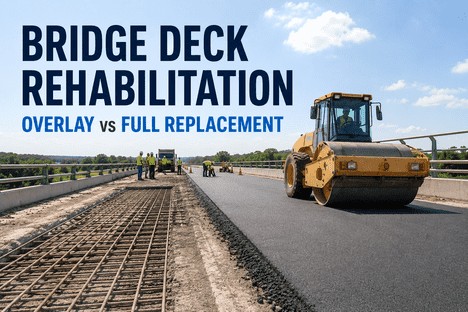
Every bridge owner managing a deteriorated concrete deck faces the same structural economic question: extend the deck's service life with an overlay, or replace it entirely. The decision is never purely technical. It is a life-cycle equation that must account for initial construction cost, user delay cost from lane closures, remaining structural capacity, and the risk that an overlay simply postpones the replacement at a higher cumulative cost. Overlay methods — latex-modified concrete, polyester polymer, silica fume, and ultra-high-performance concrete — each deliver 10 to 25 additional service years at 30 to 60 percent of replacement cost. Full deck replacement, accelerated through precast ABC methods, provides a new 40-to-75-year design life but at 2 to 3 times the upfront outlay and substantially higher traffic disruption. The choice depends on deck condition, structural reserve, traffic volume, and agency budget timing — and selecting incorrectly can cost millions in either premature failure or overcapitalised repair. This guide gives bridge engineers and asset managers the comparative data they need to make the right call.
Life-cycle cost comparison · Overlay service life · ABC replacement · GFRP rebar decks · Hydrodemolition preparation · NDE deck assessment
The Difference Between a 15-Year Fix and a 75-Year Solution Is Not Just Material Selection. It Is How You Model the Full Life-Cycle Cost.
iFactory's asset management platform gives bridge engineers a structured decision framework that compares overlay and replacement options on initial cost, service life, user delay impact, and discounted life-cycle expenditure — with NDE-informed deterioration modelling built into every scenario.
Deck overlay cost relative to full replacement — documented across LMC, silica fume, polyester polymer, and UHPC overlay programmes on NHS and non-NHS bridges
15-25
Additional service years achievable with a well-specified overlay on a deck with sound structural substrate and no active delamination extending below the top reinforcement mat
68%
FHWA national benchmark ratio of deck rehabilitation cost to full replacement cost — used by State DOTs for initial screening of overlay versus replacement alternatives
72
Hours of full closure needed for an accelerated precast deck replacement using ABC methods — versus 1 to 2 construction seasons for conventional staged CIP deck replacement
The Bridge Deck Rehabilitation Decision: Overlay or Replace?
The decision framework has three gates. Gate one is structural: is the deck deterioration confined to the top third of the deck cross-section, or does delamination, chloride contamination, or concrete distress extend to or below the top layer of reinforcement? If the deterioration is limited to the upper wearing surface and the top reinforcement is sound and adequately covered, an overlay is structurally viable. If the deterioration reaches the reinforcement or the deck has undergone significant section loss, full or partial-depth replacement is required. Gate two is economic: at what point in the remaining structural life does the cumulative cost of overlay maintenance and eventual replacement exceed the present value of replacing the deck now? Gate three is operational: can the agency absorb the longer closure duration of a full replacement, or must traffic be restored within a weekend window that only an overlay or ABC replacement can deliver? The paragraphs that follow give bridge engineers the overlay and replacement data needed to answer all three questions with confidence.
Four Bridge Deck Overlay Methods Compared — Material Properties, Cost, and Service Life
01
Latex-Modified Concrete (LMC) Overlay
LMC overlay consists of Portland cement concrete with a styrene-butadiene latex admixture replacing a portion of the mix water. The latex polymer particles form a continuous film within the hardened concrete matrix, substantially reducing permeability to moisture and chloride ions. LMC overlays achieve compressive strengths of 4,000 to 5,000 psi and bond strengths exceeding 300 psi to prepared concrete substrates. Service life under typical bridge deck conditions is 15 to 25 years, with VDOT studies documenting chloride permeability in the very low range (100 to 1,000 coulombs) after 5 years of field exposure. The primary disadvantage is logistical: 24.5 gallons of liquid latex must be transported to site per cubic yard of overlay material, requiring mobile batch equipment.
Typical cost range: $30–$50/SF installed. Curing time: 3–7 days before traffic.
02
Polyester Polymer Concrete (PPC) Overlay
PPC overlay uses a polyester-based resin binder in place of Portland cement, combined with graded silica or basalt aggregate. The material cures through a chemical cross-linking reaction — not hydration — reaching traffic-ready strength in 1 to 5 hours. Compressive strength is approximately 4,000 psi, with excellent chemical resistance to deicing salts, dilute acids, and petroleum products. Working life is temperature-dependent, ranging from 10 to 60 minutes, and application requires specialised mixing and placing equipment. PPC is not classified as a structural overlay; it restores ride quality and provides a waterproof wearing surface but does not contribute to deck flexural capacity. Service life is typically 10 to 15 years, with Caltrans and UDOT among the primary adopting agencies.
Silica fume overlay replaces 7 to 10 percent of the Portland cement with silica fume — a byproduct of silicon metal production with particle size approximately 100 times finer than cement grains. The micro-filler effect densifies the concrete matrix, producing extremely low chloride permeability (100 to 1,000 coulomb range) and bond strengths that VDOT studies found to exceed LMC overlay bond. Placement requires no specialised mixing equipment beyond bagged silica fume additions to the ready-mix truck, making it the most contractor-accessible structural overlay option. Achieving 3,000 psi compressive strength within 24 hours is standard. Service life is 15 to 25 years. Silica fume overlays are vulnerable to plastic shrinkage cracking, making immediate wet curing essential — typically a 3 to 7 day curing period.
Typical cost range: $25–$45/SF installed. Curing time: 1–3 days before traffic.
04
Ultra-High Performance Concrete (UHPC) Overlay
UHPC overlay is a thin bonded overlay using engineered cementitious composite with compressive strengths exceeding 18,000 psi, discontinuous fiber reinforcement, and a discontinuous pore structure that reduces chloride permeability by orders of magnitude compared to conventional concrete. FHWA life-cycle cost analysis demonstrates that UHPC overlay, despite a higher initial cost of $35 to $46 per square foot, provides the lowest 50-year present-value cost among all overlay types when combined with an intermediate surface treatment application at year 25. The service life projection for UHPC overlay on sound substrate is 30 to 50 years — comparable to a new deck at roughly half the cost. Application requires hydrodemolition surface preparation to a minimum 3/4-inch depth, staged construction, and specialised mixing and placing equipment. NJDOT is currently evaluating UHPC overlay for both rehabilitation and new construction applications.
Typical cost range: $35–$46/SF installed. Curing time: 2–7 days before traffic.
The Overlay Decision Is Not About Which Material Is Best. It Is About Which Material's Service Life and Cost Profile Matches the Remaining Structural Life of the Bridge.
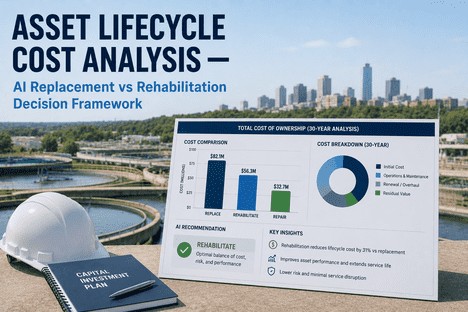
iFactory's life-cycle cost comparison tools embed FHWA LCCA methodology, allowing bridge engineers to compare overlay and replacement alternatives on present-value cost across any analysis period — with NDE-informed deterioration curves that make the comparison site-specific rather than generic.
Full Bridge Deck Replacement Methods — Conventional and Accelerated
When deck deterioration extends below the top reinforcement mat, the overlay window is closed and structural replacement is the only technically sound option. Two replacement approaches dominate: conventional cast-in-place concrete deck replacement using staged construction over one or two construction seasons, and accelerated bridge construction using full-depth precast concrete deck panels installed during a single extended weekend closure. The cost differential is narrower than most agencies assume when full life-cycle and user-delay costs are included.
Method 01
Conventional CIP Deck Replacement
Staged cast-in-place concrete over 1-2 construction seasons
A conventional staged CIP deck replacement removes half the existing deck at a time while traffic is maintained on the opposite half. The removed section is replaced with new cast-in-place concrete, and after curing, traffic is shifted to the new section and the remaining half is demolished and replaced. The process requires 1 to 2 full construction seasons for a typical bridge. National average cost for NHS bridge replacement is $429 per square foot (FHWA 2024 data), with deck-only replacement in the range of $100 to $150 per square foot. The extended duration generates significant user delay costs — typically 2 to 10 times the agency construction cost when traffic volumes exceed 50,000 ADT. New deck design life is 40 to 75 years depending on reinforcement type (epoxy-coated steel vs. GFRP) and exposure conditions.
$100-$150/SF deck-only
1-2 seasons duration
40-75 year design life
Method 02
ABC Precast Deck Replacement
Full-depth precast panels installed in a single weekend closure
ABC deck replacement uses full-depth precast concrete panels — typically 8 to 10 feet long, full deck width, weighing 20,000 to 30,000 pounds each — fabricated off-site in a controlled plant environment. Panels are transported to site, existing deck is demolished and removed, and panels are crane-set onto prepared girder bearings in a precisely coordinated sequence. UHPC or rapid-set closure pours connect adjacent panels and develop composite action with the supporting girders within hours. The Route 8 Bridge in New Hartford, NY was fully deck-replaced in 95 continuous hours. The I-190 bridges over Buffalo Avenue were replaced in 72 hours per bridge. Construction cost for ABC deck replacement typically runs 10 to 30 percent higher than conventional methods at bid, but when user delay costs are included, total project cost is 33 to 65 percent lower — the I-190 project saved $2.28 million in user delay costs alone.
72-120 hour closure
$112-$150/SF panels
65-75 year design life
Method 03
GFRP-Reinforced Deck Replacement
Corrosion-proof glass-fiber polymer reinforcement for extended service life
Glass fiber-reinforced polymer (GFRP) rebar offers corrosion-proof reinforcement for concrete bridge decks in aggressive chloride environments. GFRP has no yield point, tensile strength approximately 2.5 times that of steel (100 to 120 ksi), and one-quarter the weight. Initial material cost is higher than epoxy-coated steel, but MnDOT and LRRB life-cycle cost analyses demonstrate that GFRP-reinforced decks with a 65-year target service life are less costly overall than steel-reinforced decks at the same life — the gap widens as target life increases. GFRP can be specified for both conventional CIP and precast ABC decks. The primary consideration is that GFRP is linear-elastic to failure, meaning crack widths under service load are larger than steel-reinforced concrete, requiring attention to crack control specification. Minnesota's Dry Creek bridge and several Canadian highway bridges are documented GFRP deck reference installations.
15-25% higher initial cost
Zero corrosion maintenance
75-100 year service life target
Overlay vs. Replacement — The Decision Framework Bridge Engineers Need
The choice between overlay and replacement is determined by three interdependent factors: deck condition depth, structural reserve capacity, and the agency's tolerance for user delay costs. The table below maps each rehabilitation option to the deck condition and project constraints that make it the correct technical and economic choice. Life-cycle cost analysis should always be run on the specific bridge using FHWA RealCost or equivalent LCCA software with site-specific traffic data and unit costs — these comparisons are representative benchmarks, not project-level recommendations.
Method
Best For
Key Decision Criteria
LMC Overlay
Decks with surface deterioration only, no active delamination at rebar depth, remaining structural life of substructure of 15+ years, moderate traffic volume
Moderate cost, proven 20-year track record, requires mobile batch plant, 3-7 day curing
PPC Overlay
High-traffic urban decks where overnight curing is required, decks needing only waterproofing and skid resistance, low structural demand
Fastest return to traffic (1-5 hr), non-structural only, temperature-sensitive placement, 10-15 year life
Silica Fume Overlay
Agencies wanting structural overlay without specialised equipment, decks with good substrate and moderate traffic, moderate curing window
Lowest-cost structural overlay, no special equipment needed, vulnerable to plastic shrinkage cracking
UHPC Overlay
Bridges where overlay service life must approach new-deck duration, high-traffic or critical route, good substrate condition
Highest overlay cost but lowest 50-year LCC, requires hydrodemolition, 30-50 year life
CIP Deck Replacement
Low-traffic routes where extended lane closure is acceptable, decks with advanced deterioration, bridges nearing full superstructure replacement
Lowest first cost for replacement, long construction duration, high user delay costs
ABC Deck Replacement
High-traffic routes where weekend closure is the only viable construction window, multiple bridges in same corridor, aggressive schedule requirements
Higher first cost, 65-95% user cost savings, precast quality control, 72-120 hr closure
GFRP Deck Replacement
Coastal or heavy-deicing-route bridges where corrosion drives life-cycle cost, any deck replacement where design life target exceeds 50 years
Higher initial cost, zero corrosion, longer design life, compatible with both CIP and ABC
"
We had been overlaying decks with LMC every 12 to 14 years on a corridor with 80,000 ADT. The cumulative overlay cost over 40 years approached 85 percent of what a single ABC deck replacement with GFRP reinforcement would have cost — and the user delay cost from seven separate overlay operations was never factored into the decision. When we ran the full life-cycle cost analysis including user delay, the ABC replacement paid back its higher first cost within 18 years. The overlay approach was a legacy decision that had never been reexamined against current traffic volumes and construction costs.
— Bridge Asset Management Engineer, State DOT — Mid-Atlantic Region, 200,000+ SF Deck Area Under Management
Conclusion
The overlay versus replacement decision in bridge deck rehabilitation is not a binary technical choice — it is a life-cycle economic optimisation problem that demands simultaneous evaluation of deck condition depth, material service life, initial and recurring agency costs, and user delay impact. The four overlay methods profiled in this guide each occupy a distinct position in the cost-service-life matrix: PPC for overnight return to traffic on low-stress decks, silica fume for lowest-cost structural extension on moderate-traffic routes, LMC for proven 20-year performance with established contractor base, and UHPC for near-new-deck service life at half the replacement cost. On the replacement side, conventional CIP remains appropriate for low-traffic environments where extended closure is acceptable, but ABC precast deck methods — delivering complete deck replacement in 72 to 120 hours — shift the cost-benefit equation decisively for high-traffic corridors where user delay costs dominate total project economics.
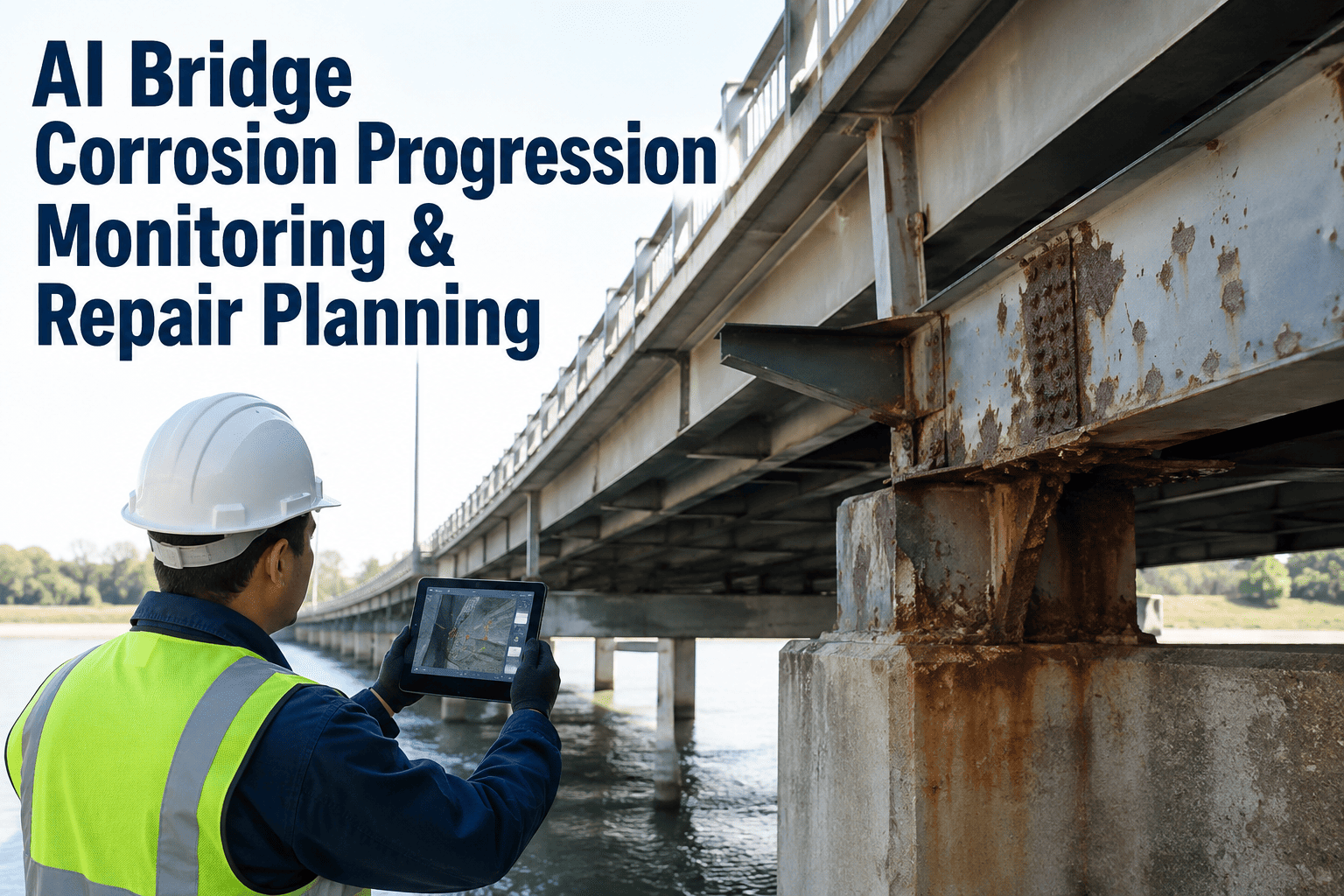
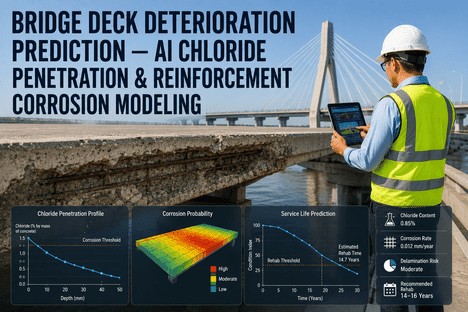
The FHWA national benchmark of 68 percent rehabilitation-to-replacement cost is a useful screening threshold, but it is not a substitute for bridge-specific LCCA using site deterioration curves and current traffic data. The more important structural insight is that an overlay applied to a deck with active delamination at rebar depth does not extend service life — it conceals deterioration and defers a more expensive replacement that the overlay cost has consumed budget for. NDE methods — ground-penetrating radar, impact echo, and infrared thermography — provide the condition-depth data that distinguish overlay-viable decks from decks that need structural replacement. The cost of NDE, at $0.40 to $2.00 per square foot, is negligible relative to the cost of making the wrong rehabilitation decision on a 10,000 to 50,000 square foot bridge deck.
iFactory's bridge deck asset management platform integrates NDE data ingestion with life-cycle cost modelling, overlay selection decision trees, and ABC-ready specification templates — all within a single interface that gives bridge engineers the structured comparison they need to recommend the correct rehabilitation method to agency decision-makers. Book a Demo to see the platform configured for your bridge inventory and deck condition data, or talk to an expert about a free life-cycle cost assessment of one overlay-eligible and one replacement-eligible deck in your network.
Frequently Asked Questions
Using the NBI condition rating scale (0 to 9), decks rated 5 (fair) or above — where delamination does not extend below the top reinforcement mat and less than 10 percent of the deck area is delaminated — are generally viable candidates for overlay. Decks rated 4 (poor) or below — where delamination or section loss has reached the reinforcement level, chloride content exceeds 2.0 pounds per cubic yard at rebar depth, or more than 10 percent of the deck area is actively delaminated — should be evaluated for full or partial-depth replacement. However, condition rating alone is insufficient. Ground-penetrating radar or impact echo survey data providing depth-wise deterioration mapping should always be obtained before making the final overlay-versus-replacement determination. A deck with an NBI rating of 5 on the surface but active delamination extending to 3 inches below the surface is not an overlay candidate regardless of the NBI number. Talk to an expert about NDE-informed deck assessment integration.
Hydrodemolition is the preferred surface preparation method for bonded concrete overlays on bridge decks. The high-pressure water jet (10,000 to 25,000 psi) selectively removes deteriorated concrete while leaving sound concrete intact, creating a rough surface texture with exposed aggregate that produces bond strengths 20 to 40 percent higher than milling or abrasive blasting. Oregon DOT studies found increased microcracking in deck substrates prepared by milling compared to hydrodemolition, with petrographic analysis showing that the fracture surface from milling extends deeper into the substrate than hydrodemolition. Most state specifications require hydrodemolition for bonded structural overlays, with a minimum removal depth of 1/2 to 3/4 inch for LMC and silica fume overlays and 3/4 to 1 inch for UHPC overlays. The cost of hydrodemolition is typically included in the overlay unit price and adds approximately $4 to $8 per square foot to the total installed cost. Book a Demo to see specification templates covering all overlay methods.
User delay costs are calculated using FHWA methodology that accounts for reduced speed through work zones, additional travel distance on detours, vehicle operating costs, and the value of traveller time. For a bridge with ADT of 80,000, a staged conventional deck replacement lasting one construction season (180 days) generates user delay costs of approximately $2 to $5 million — often more than the agency construction cost itself. An ABC precast deck replacement completed in a single weekend closure (72 to 96 hours) reduces user delay costs by 65 to 95 percent. An LMC overlay, requiring 7 to 14 days of lane closure per staged half, generates user delay costs in the range of $200,000 to $800,000 depending on ADT and detour length. The LCCA should present both agency and user costs in present value terms using the agency's discount rate (typically 2 to 4 percent for transportation infrastructure). When user delay costs are included, the breakeven between overlay and ABC replacement shifts dramatically in favour of ABC on high-traffic routes. Talk to an expert about configuring user cost parameters for your bridge network.
Yes. GFRP reinforcement is fully compatible with precast ABC deck panel construction and has been specified in multiple North American ABC projects. The critical consideration is the joint connection detail between adjacent panels. GFRP bars cannot be field-bent or welded, so longitudinal connection at panel joints typically uses lapped splice connections with UHPC or high-performance concrete closure pours. The UHPC closure provides the bond needed to develop composite action between adjacent panels without the hook or bend details that steel reinforcement connections rely on. Montana's Clark Fork River Bridge ABC project used 98 full-width precast concrete deck panels — each 34.33 feet wide and 9.5 feet long — connected with UHPC closure pours and no post-tensioning. The GFRP option is most cost-effective when the deck is in a severe chloride exposure environment and the agency is targeting a 75-to-100-year design life. Initial cost premium over epoxy-coated steel is 15 to 25 percent, but life-cycle cost parity is typically reached within 25 to 35 years due to zero corrosion maintenance. Book a Demo to see specification-ready ABC and GFRP deck templates.
Realistic service life ranges from field performance data are: PPC overlay 10 to 15 years, LMC and silica fume overlays 15 to 25 years, and UHPC overlay 30 to 50 years — all on condition that the deck substrate is structurally sound and properly prepared. VDOT Phase II studies found LMC, silica fume, and VELMC overlays averaging 20.9 years of service before reaching end-of-life condition. The factors that most significantly reduce overlay service life are: inadequate surface preparation (the number one cause of premature overlay failure), failure to seal construction joints between overlay stages, insufficient curing leading to plastic shrinkage cracking, application over active deck delamination (the overlay debonds as the substrate continues deteriorating), and chloride-laden water penetrating at unsealed parapet and expansion joint interfaces. Properly designed and installed overlays that address these factors typically meet or exceed their design service life. Overlays placed on decks with latent chloride contamination at the substrate interface will fail prematurely as chlorides migrate to the bond plane, regardless of the overlay material selected. Talk to an expert about overlay service life modelling tools.
Every Bridge Deck Has an Optimal Rehabilitation Strategy. The Question Is Whether Your LCCA Model Is Finding It. Get a Free Life-Cycle Cost Assessment for One Overlay-Eligible and One Replacement-Eligible Deck in Your Network.
iFactory's bridge deck asset management platform — structured decision trees for overlay versus replacement selection, NDE data ingestion with deterioration curve calibration, FHWA LCCA methodology with user delay cost integration, and specification-ready templates for every overlay and ABC replacement method discussed in this guide.