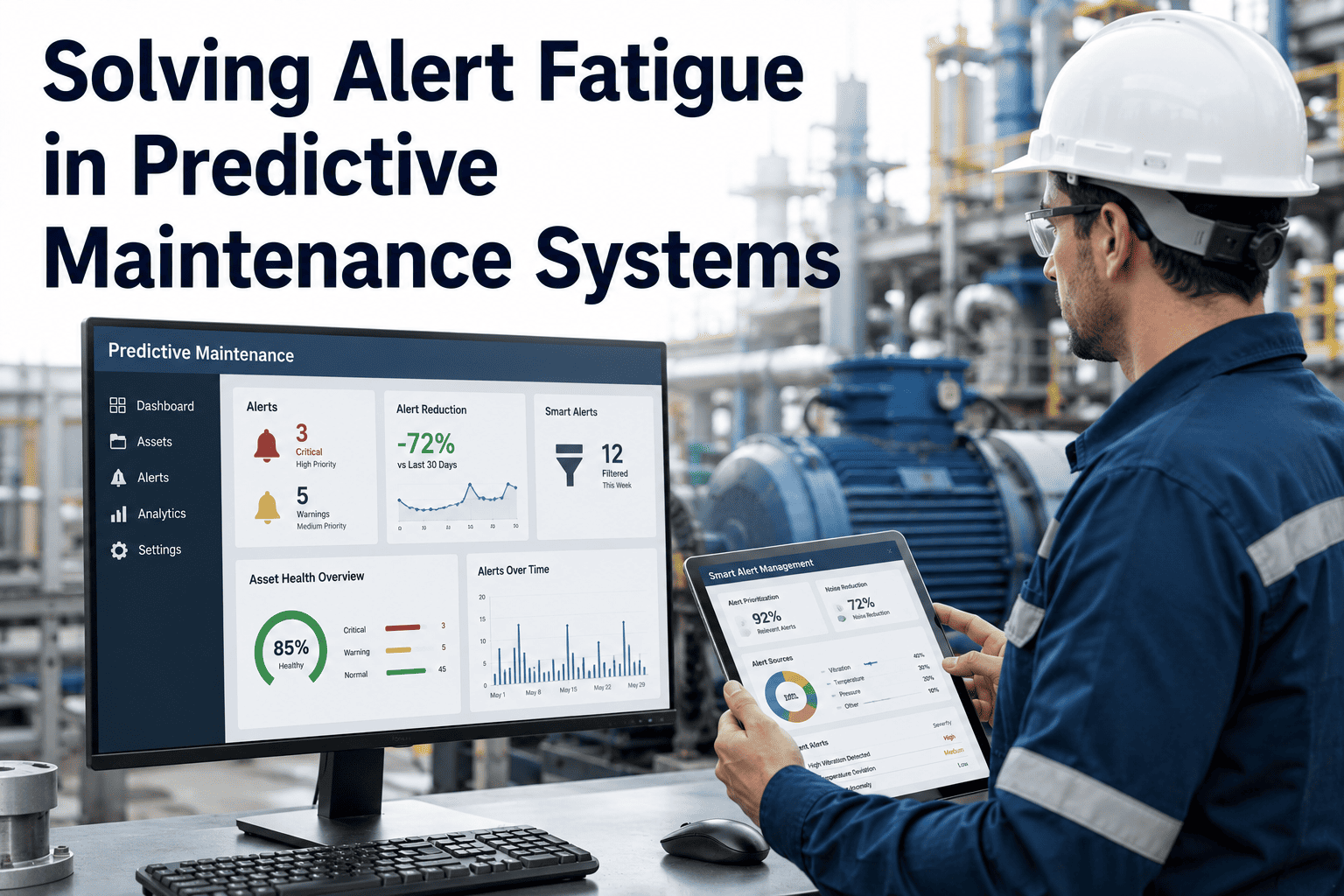
Somewhere on your plant floor, a maintenance technician just silenced another vibration alert without looking at it. Not because the machine is fine, but because the last nine alerts from that same sensor were false alarms, and the tenth one blends into the noise. This is alert fatigue, and it is quietly undoing the return on investment of every predictive maintenance system it touches. Operations managers who deployed PdM expecting fewer surprises are instead watching their teams tune out the very warnings meant to prevent them. Book a Demo with iFactory AI to see how alert design, not just alert detection, changes maintenance outcomes.
Your Predictive Maintenance System Is Only as Good as the Alerts People Trust.
iFactory AI reduces false positives and rebuilds alert credibility with precision-tuned models that maintenance teams actually respond to, not silence.
Alert Fatigue Is the Silent Killer of Predictive Maintenance ROI
Predictive maintenance programs are sold on a simple promise: catch the failure before it happens. But that promise depends entirely on one human behavior that vendors rarely account for — a technician has to believe the alert enough to act on it. When a PdM system generates dozens of alerts a week and only a handful correspond to a real developing fault, technicians learn, correctly, that most alerts are noise. This is not a training problem or a discipline problem. It is a rational response to a system that has not earned trust. Once that trust erodes, even a genuinely critical alert gets treated the same as the ninety false ones before it, and the entire investment in sensors, models, and dashboards collapses back into the exact reactive maintenance pattern the program was built to eliminate.
The scale of this problem is larger than most operations teams realize until they measure it directly. Reliability teams who audit their own alert logs typically discover that a large share of triggered alerts, often more than half, never correspond to an actual maintenance action. Every one of those alerts still consumed a technician's attention, interrupted a workflow, and quietly taught the team to trust the system a little less. The fix is not fewer sensors or less monitoring. It is a fundamentally different approach to how alerts are generated, scored, and delivered.
What Separates a Trustworthy Alert From Background Noise
Not all predictive maintenance alerts are created equal, even when they come from the same sensor and the same model. The difference between an alert that gets acted on and one that gets dismissed comes down to a handful of design choices that most off-the-shelf PdM tools get wrong. The breakdown below shows how these factors compound into either trust or fatigue.
Alert includes confidence score, contributing sensor trend, and comparable historical failure pattern. Technician sees why the model flagged it, not just that it flagged it.
Alert shows a threshold breach with no context. Technician has to manually cross-reference other systems to determine whether action is warranted.
Alert fires on a single data point crossing a static limit, with no pattern validation. Frequently correlates with sensor drift rather than actual asset degradation.
Why Most Predictive Maintenance Systems Generate Too Much Noise
Alert fatigue rarely comes from one single flaw. It builds up from several compounding design decisions made early in a PdM deployment, often for reasons that made sense at the time but stop making sense once the system is running at scale across hundreds of assets.
Static Thresholds Instead of Learned Baselines
Many systems still trigger alerts when a reading crosses a fixed number, regardless of that asset's normal operating variance. A pump that naturally runs hotter under seasonal load gets flagged constantly, while a subtler but more dangerous deviation on a different asset goes unnoticed because it never crosses the same fixed line.
No Confidence Scoring on Alerts
When every alert looks identical regardless of how strong the underlying evidence is, technicians cannot triage. A borderline anomaly and a near-certain bearing failure arrive in the same format, forcing the team to investigate both with equal urgency until they stop investigating either with much urgency at all.
Sensor Drift Mistaken for Asset Degradation
Sensors themselves degrade, lose calibration, or develop wiring issues over time. Without a model that distinguishes sensor-level anomalies from asset-level anomalies, a slowly drifting sensor can generate weeks of false alerts before anyone identifies the sensor, not the equipment, as the actual problem.
No Feedback Loop From Technician Outcomes
When a technician investigates an alert and finds nothing wrong, that outcome should retrain the model. In most deployments it simply disappears, so the system keeps making the same mistake indefinitely instead of learning which alert patterns actually correlate with real faults.
What Changes When Alert Precision Becomes the Design Priority
iFactory AI approaches predictive maintenance alerting as a precision problem first and a detection problem second. The goal is not simply to catch every possible anomaly, but to ensure that when an alert reaches a technician, it carries enough evidence and context to be worth acting on immediately.
| Alert Behavior | Typical PdM Deployment | iFactory AI Approach |
|---|---|---|
| Alert trigger logic | Static thresholds per sensor | Learned baselines per asset and operating condition |
| Alert context | Threshold breach only | Confidence score, trend, and comparable failure history |
| False positive handling | No structured feedback loop | Technician outcomes retrain the model continuously |
| Sensor drift detection | Not distinguished from asset faults | Modeled separately and flagged distinctly |
| Alert prioritization | All alerts treated equally | Ranked by confidence and business impact |
What Precision-Tuned Alerting Actually Delivers
Operations teams that move from threshold-based alerting to confidence-scored, feedback-trained alerting consistently report the same pattern: fewer total alerts, but a far higher share of those alerts leading to a real maintenance action. That shift is what restores technician trust, and trust is what makes a predictive maintenance program sustainable past its first year.
Reduction in total alert volume without missing real faults
Increase in the share of alerts leading to a technician action
Drop in unplanned downtime tied to missed early warnings
How iFactory AI Rebuilds Alert Trust in an Existing PdM Program
Fixing alert fatigue does not require ripping out an existing predictive maintenance investment. It requires layering precision and feedback on top of the sensors and infrastructure already in place. iFactory AI's approach starts by auditing the current alert log against actual maintenance outcomes, identifying exactly which alert types are producing noise. From there, learned baselines replace static thresholds for the highest-noise assets first, and every alert going forward carries a confidence score and supporting context rather than a bare threshold breach. Technician feedback on each alert, whether it led to a real finding or not, flows back into the model automatically, so the system gets more precise the longer it runs rather than staying static. Most operations teams see a measurable drop in alert volume within the first month of this process, well before the full model retraining cycle completes.
Why Technician Feedback Is the Missing Ingredient in Most PdM Programs
Every predictive maintenance vendor talks about machine learning models, but very few talk about the human loop that actually makes those models improve over time. When a technician closes out a work order triggered by an alert, that outcome, whether the alert was accurate, a false positive, or caught something the model did not even flag, is one of the highest-value pieces of training data a PdM system can receive. Most systems never capture it in a structured way. The technician's finding lives in a free-text CMMS comment field, if it is recorded at all, and never makes its way back into the model that generated the alert in the first place.
Closing this loop does not require new hardware or a lengthy re-implementation. It requires a structured, low-friction way for technicians to confirm or dispute an alert at the moment they investigate it, paired with a model architecture that can actually incorporate that feedback into future scoring. iFactory AI builds this confirmation step directly into the technician's existing workflow, so the two or three seconds it takes to tag an alert outcome becomes the fuel that continuously sharpens every future alert for that asset class. Over several months, this compounding feedback is what separates a system that stays noisy indefinitely from one that gets measurably quieter and more trustworthy every quarter.
Alert Fatigue and Predictive Maintenance — Common Questions
What causes alert fatigue in predictive maintenance systems?
Alert fatigue develops when a PdM system generates alerts faster than technicians can validate them, and a large share of those alerts turn out to be false positives. Over time, technicians rationally start giving every alert less attention, including the ones that matter. The root causes are usually static thresholds, missing confidence context, and no feedback loop from technician outcomes back into the model, all of which our team can help diagnose in an existing deployment.
How do you measure alert fatigue in an existing program?
The clearest measure is the ratio of alerts that led to a confirmed maintenance action against total alerts fired over a given period. Most unaudited systems show a ratio far lower than teams expect, often below one in three. Tracking this ratio by asset type and sensor also reveals which specific alert sources are driving the majority of the noise, which is usually a small number of chronic offenders rather than the whole system.
Does reducing alert volume risk missing a real failure?
No, when the reduction comes from precision improvements rather than simply raising thresholds. Confidence-scored alerting filters out low-evidence noise while preserving or improving detection of genuine developing faults, because the model is learning from actual outcomes rather than applying a blunt cutoff. The goal is a higher-quality alert stream, not a smaller one for its own sake.
How long does it take to retrain a noisy alerting system?
Initial noise reduction from baseline learning and context enrichment is typically visible within a few weeks, since it does not require waiting for new failure events to occur. Full precision gains from the technician feedback loop continue to compound over several months as the model accumulates more labeled outcomes across the asset base.
Can this integrate with our existing CMMS and sensor infrastructure?
Yes. iFactory AI's alerting layer is designed to sit on top of existing sensor networks and connect directly with common CMMS platforms, so technician outcomes captured during normal work order closeout feed the feedback loop automatically. Book a Demo to review your specific sensor and CMMS setup with our team.
Ready to Turn Down the Noise and Turn Up Technician Trust?
Let iFactory AI audit your current alert-to-action ratio and show you exactly where precision tuning would cut noise without cutting protection.