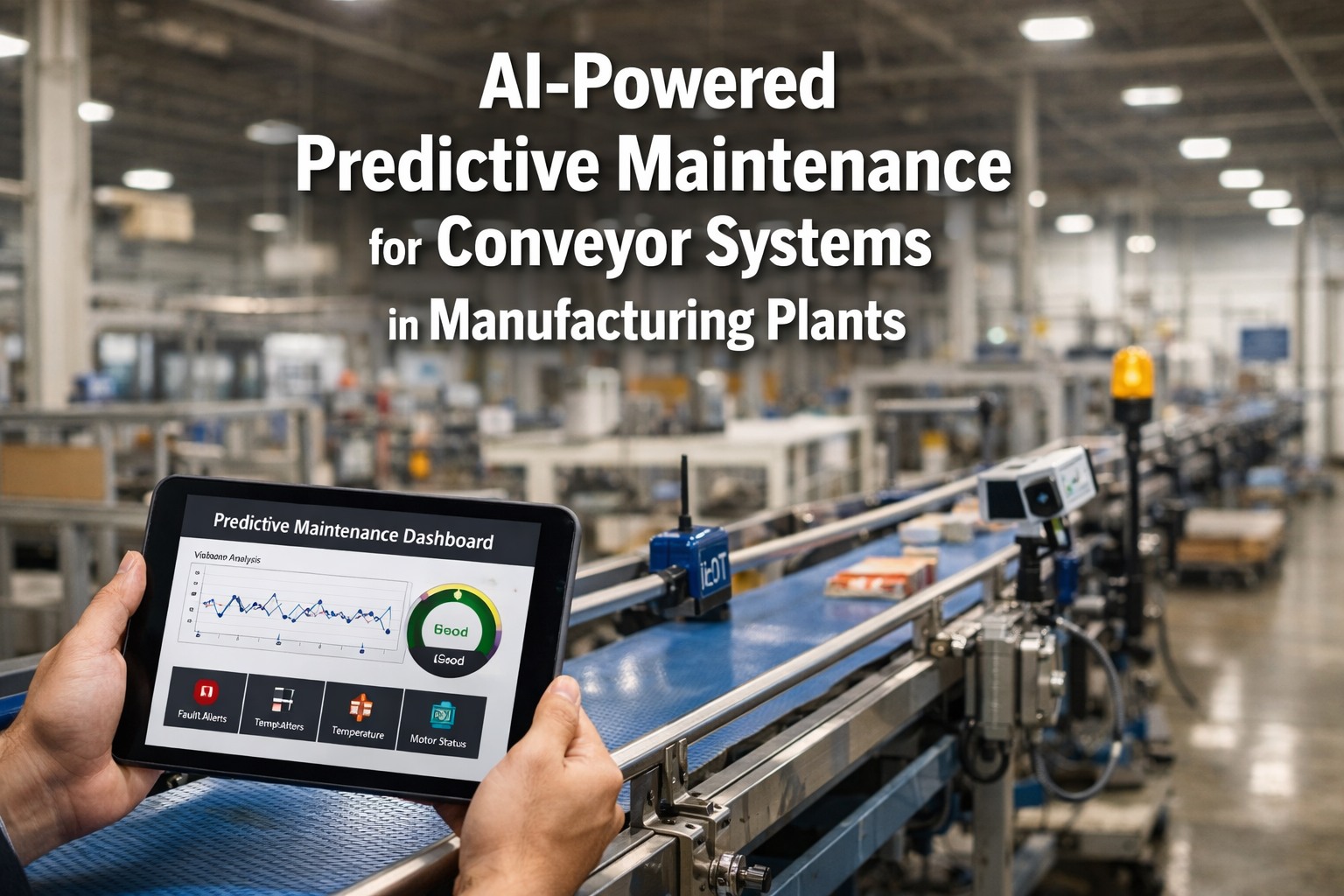
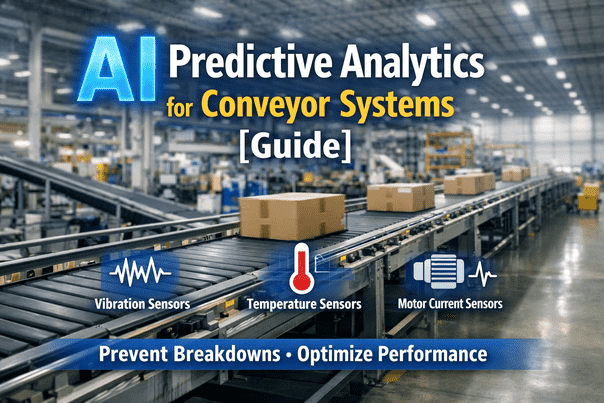
Your conveyor belt just stopped. Production halts. Workers stand idle. Every hour costs you $260,000. And here's the frustrating part: the warning signs were there for weeks — subtle vibrations in the motor, rising bearing temperatures, slight belt misalignment. AI-powered predictive maintenance catches these signals before they become catastrophic failures, reducing conveyor downtime by up to 70% and cutting maintenance costs by 25%.
Conveyor Downtime Reality
$260,000
Average cost per hour of unplanned downtime
— Aberdeen Research
82%
of companies experienced unplanned downtime in last 3 years
4 hrs
average duration of each downtime incident
3x
more downtime with low-cost conveyors vs. smart systems
The 5 Conveyor Failure Modes AI Detects Early
Every conveyor failure leaves a data signature weeks before breakdown. Here's what AI monitoring catches — and what it prevents:
01
Bearing Degradation
Worn bearings in rollers and drive components create distinctive vibration patterns and heat signatures. AI detects these changes 4-6 weeks before failure.
Vibration sensors
Temperature monitoring
02
Belt Misalignment
Misaligned belts cause edge damage, material spillage, and premature wear. Vision AI and tracking sensors catch drift before damage occurs.
03
Motor & Drive Issues
Electrical and mechanical faults in drive motors show up as current spikes, torque anomalies, and abnormal power draw patterns.
04
Gearbox Lubrication
Low lubricant levels increase friction and heat. ML models achieve 100% accuracy classifying gearbox lubricant conditions.
05
Splice Deterioration
Mechanical and vulcanized splices weaken over time. Tension monitoring and visual inspection detect failure risks early.
Worried about conveyor failures? Get a free conveyor health assessment from our predictive maintenance specialists.
How AI Predictive Maintenance Works
Sensor Data Collection
IIoT sensors on motors, rollers, and belts capture vibration, temperature, current, and acoustic signals in real-time.
AI Pattern Analysis
Machine learning algorithms compare current patterns against baseline health data to detect anomalies invisible to humans.
Predictive Alerts
System generates actionable alerts with failure probability, remaining useful life, and recommended maintenance actions.
Stop Reacting. Start Predicting.
iFactory's AI-powered CMMS monitors your conveyor systems 24/7, detecting failure patterns weeks in advance and automatically generating work orders before breakdowns occur.
The ROI of AI Predictive Maintenance
70%
Reduction in equipment breakdowns
U.S. Department of Energy
25-30%
Reduction in maintenance costs
35-45%
Reduction in downtime
10x
Average ROI on investment
40%
Extension of equipment lifespan
98%
Fault detection accuracy with AI
Reactive vs. Predictive: The Cost Comparison
Repair cost
5-10x higher
Downtime
Unplanned, 4+ hours
Parts inventory
Large safety stock
Labor
Emergency overtime
VS
Repair cost
Planned, optimized
Downtime
Scheduled, minimal
Parts inventory
Just-in-time ordering
Labor
Planned during shifts
Ready to calculate your savings? Request a custom ROI analysis for your conveyor systems.
The Sensor Stack for Conveyor Monitoring
Vibration Sensors
Accelerometers measure frequency and amplitude to detect bearing wear, imbalance, misalignment, and looseness.
Motors, rollers, gearboxes
Temperature Sensors
Track thermal signatures to identify friction, lubrication issues, and electrical problems before they escalate.
Bearings, motors, belts
Current Monitors
Analyze electrical current patterns to detect motor degradation, drive issues, and abnormal power consumption.
Drive motors, VFDs
Acoustic Sensors
Capture ultrasonic frequencies to identify lubrication deficiencies and early-stage bearing defects.
Idlers, pulleys, chains
Expert Perspective
"AI-powered predictive maintenance systems can detect potential equipment failures immediately, reducing unplanned downtime by up to 30%. IoT sensors track temperature, vibration, and belt alignment, enabling proactive interventions. The integration of AI and IoT transforms conveyors from passive transport systems into active decision-making infrastructure."
— Industrial Automation Market Analysis, 2026
Key Finding: Companies investing in high-end conveyor systems with predictive maintenance report uptime levels exceeding 98%, compared to 3x more unplanned downtime for those using low-cost systems without monitoring.
Want to achieve 98%+ uptime? Talk to our conveyor maintenance experts today.
Your Conveyors Are Talking. Start Listening.
iFactory's AI-powered predictive maintenance platform monitors vibration, temperature, and performance across your entire conveyor fleet — turning data into actionable insights that prevent costly failures.
Frequently Asked Questions
What is AI predictive maintenance for conveyor systems?
AI predictive maintenance uses IoT sensors and machine learning algorithms to continuously monitor conveyor components — motors, bearings, belts, and gearboxes — detecting anomalies that indicate developing failures. Unlike reactive maintenance (fix after failure) or preventive maintenance (fixed schedules), predictive maintenance intervenes only when data shows a component is degrading, typically 4-6 weeks before actual failure. This approach reduces breakdowns by 70% and maintenance costs by 25-30%.
What sensors are needed for conveyor predictive maintenance?
A comprehensive conveyor monitoring system uses multiple sensor types: vibration sensors (accelerometers) on motors, rollers, and gearboxes detect bearing wear and misalignment; temperature sensors identify friction and lubrication issues; current monitors analyze motor health and power anomalies; acoustic sensors capture ultrasonic frequencies indicating early-stage defects. Modern wireless sensors install in hours and connect via IIoT gateways to cloud-based AI analytics platforms.
How much does conveyor downtime really cost?
Aberdeen Research found that average unplanned downtime costs $260,000 per hour across industries, with incidents lasting 4 hours on average ($1M+ per event). For conveyor-dependent operations, a single belt failure can cost $50,000-$100,000 per day in lost production. In mining, major conveyor failures have cost $6-12 million. Beyond direct costs, there's overtime labor, emergency parts shipping, missed deliveries, and customer penalties.
What ROI can I expect from predictive maintenance?
The U.S. Department of Energy reports predictive maintenance delivers 10x ROI, with 25-30% reduction in maintenance costs, 70% fewer breakdowns, and 35-45% less downtime. According to Deloitte, companies achieve 10:1 to 30:1 ROI ratios within 12-18 months. For a mid-sized plant with 12 critical conveyor assets, savings of $50,000+ annually from avoided downtime and optimized maintenance scheduling are typical. Payback periods as short as 6 months are common.
How long does it take to implement conveyor predictive maintenance?
Modern AI-powered platforms deploy rapidly: wireless sensors install in 2-3 days with minimal operational disruption. Basic monitoring and alerting can be operational within 1-2 weeks. Full predictive capabilities require 3-6 months of baseline data collection to train ML models on your specific equipment behavior. Cloud-based solutions like iFactory eliminate on-premise infrastructure, accelerating deployment compared to traditional systems.