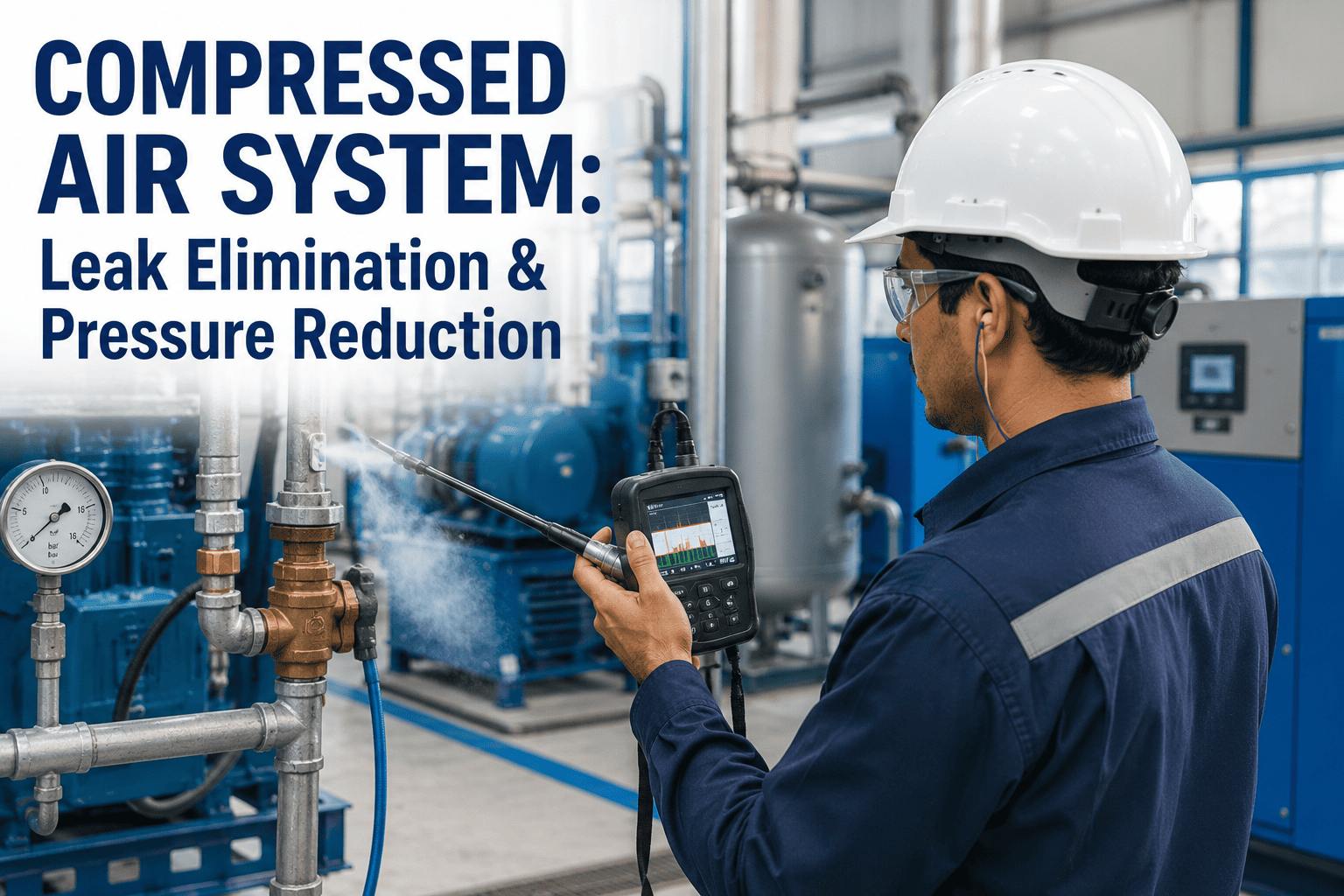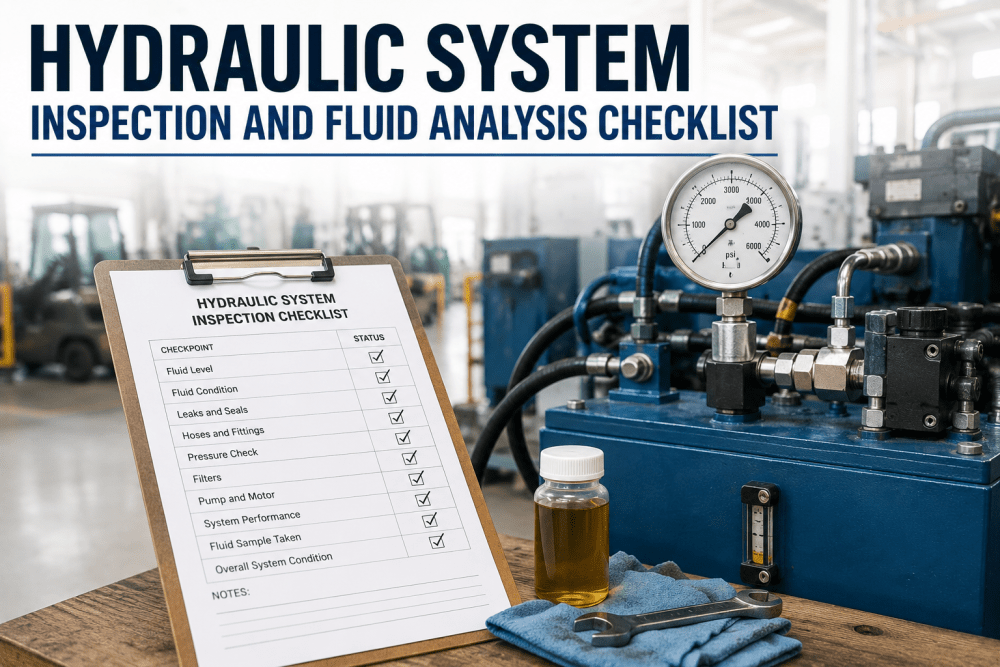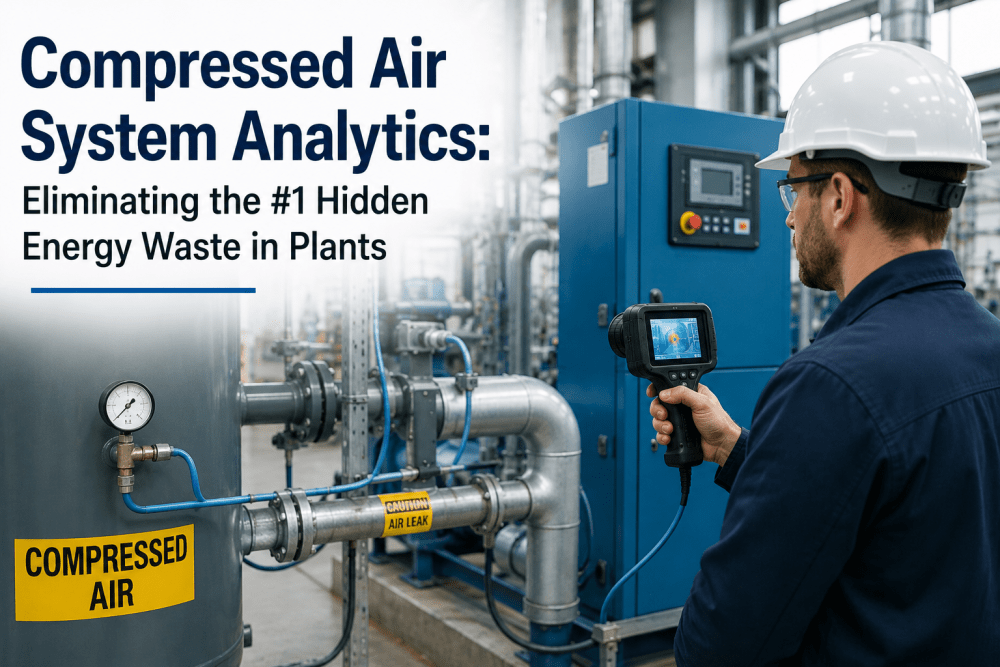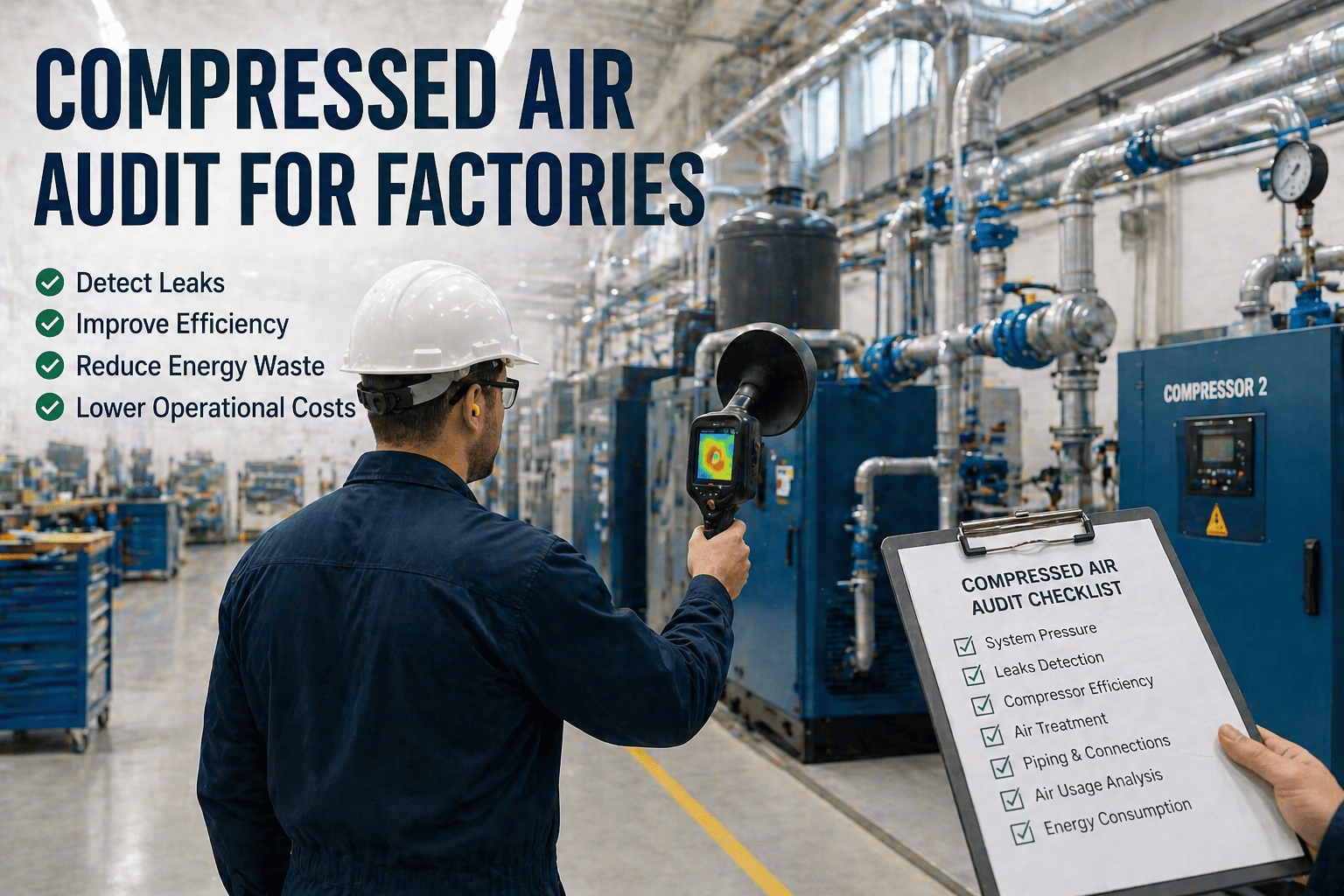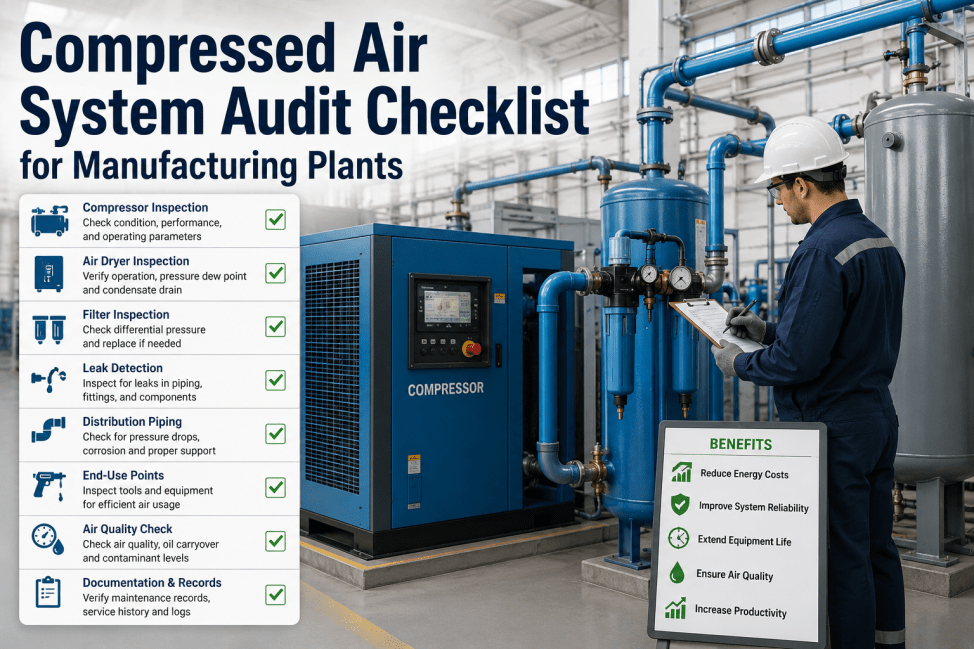
Compressed air is often called the "fourth utility" in manufacturing—yet it's also one of the most energy-intensive and leak-prone systems in any plant. Studies from the U.S. Department of Energy show that up to 30% of all compressed air produced in industrial facilities is lost to leaks, pressure drops, and inefficiencies. For a mid-sized plant spending $200,000/year on compressed air energy, that's $60,000 walking out the door annually.This audit checklist is built for U.S. manufacturing professionals who want to systematically evaluate every component of their compressed air system—from the compressor room to the end-use pneumatic tools—and drive measurable energy savings, uptime improvements, and compliance with OSHA and EPA air quality standards.
Stop Wasting 30% of Your Compressed Air.
Start With a Systematic Audit.
A complete, field-tested checklist covering compressors, dryers, filters, distribution piping, and end-use points—designed for U.S. manufacturing facilities aiming for energy efficiency and zero unplanned downtime.
Why Compressed Air Audits Are Non-Negotiable in 2026
Compressed air system inefficiencies aren't just an energy problem—they cascade into quality failures, equipment damage, production stoppages, and regulatory non-compliance. The U.S. DOE estimates that a single 1/8-inch leak at 100 psi costs roughly $1,700 per year in wasted electricity. Most plants have dozens of such leaks.
A rigorous audit addresses six core areas: the compressor unit itself, air treatment (dryers and filters), the distribution network, end-use equipment, controls and monitoring, and documentation & compliance. Each section below provides actionable checkpoints you can execute in the field.
Section 1: Compressor Unit Inspection
The compressor is the heart of your air system. Neglected maintenance here drives up energy consumption, shortens equipment life, and creates cascading failure risk. Complete this section during scheduled downtime or a planned maintenance window.
Section 2: Air Treatment — Dryers and Filters
Contaminated compressed air causes corrosion in piping, valve failures, product defects in food and pharma applications, and tool damage on the shop floor. Dryers and filters are your first line of defense—and the most commonly neglected components.
Section 3: Distribution Piping and Leak Detection
Leaks in distribution piping account for the single largest avoidable energy loss in most compressed air systems. A comprehensive leak detection survey using ultrasonic acoustic detectors should be performed at least annually—and after any new installation or major repair.
| Leak Orifice Diameter | Est. Air Loss (SCFM) | Est. Annual kWh Loss | Est. Annual Cost | Priority |
|---|---|---|---|---|
| 1/64" (0.016") | 0.13 SCFM | ~340 kWh | ~$34 | Low |
| 1/32" (0.031") | 0.52 SCFM | ~1,350 kWh | ~$135 | Medium |
| 1/16" (0.063") | 2.10 SCFM | ~5,460 kWh | ~$546 | Medium |
| 1/8" (0.125") | 8.38 SCFM | ~21,800 kWh | ~$1,780 | High |
| 3/16" (0.188") | 18.9 SCFM | ~49,100 kWh | ~$4,910 | Critical |
| 1/4" (0.250") | 33.4 SCFM | ~86,800 kWh | ~$8,680 | Critical |
Section 4: Pressure Management and Controls
Over-pressurization is a hidden cost driver in most plants. Every 2 psi increase in system pressure raises compressor energy consumption by approximately 1%. Plants routinely run 20–40 psi above what end-use equipment actually requires—a direct and correctable energy waste.
Section 5: End-Use Equipment and Point-of-Use Inspection
Pneumatic tools, cylinders, valves, and blow guns at the end-use points are often the most overlooked contributors to system inefficiency. Worn cylinder seals, leaking quick-connect fittings, and oversized nozzles individually seem minor—but at scale across a manufacturing floor, they represent significant waste.
Section 6: Documentation, Compliance, and CMMS Integration
An audit without documentation is just a walk-through. For U.S. manufacturers, compressed air system records support OSHA pressure vessel compliance, ISO 8573 air quality certifications, sustainability reporting under GHG Protocol Scope 2, and EPA energy benchmarking programs like ENERGY STAR for Industry.
Audit Findings Prioritization Workflow
Once you've completed the field inspection, use this prioritization framework to sequence corrective actions based on impact and effort. Not every finding needs to be addressed simultaneously—focus resources where the ROI is highest.
Classify All Findings
Tag each finding by category: Safety, Compliance, Energy Loss (Critical/High/Medium/Low), Reliability Risk, or Documentation Gap. Safety and compliance items go to the front of the queue regardless of cost.
Quantify Energy Losses
Estimate annual dollar value of each energy-related finding using the leak size reference table. Prioritize any leak costing more than $500/year for immediate repair scheduling.
Generate Work Orders in CMMS
Create corrective maintenance work orders for all findings in iFactory AI, linking each to the asset, location, estimated cost, and target completion date. Assign to the appropriate technician or contractor.
Execute and Verify Repairs
Complete repairs and document findings in CMMS. For energy-related repairs, re-measure to confirm leak is resolved. For pressure optimization, re-measure system pressure drop after changes.
Calculate Realized Savings
Compare post-repair energy consumption against baseline. Track cumulative savings by month. Report ROI against audit investment cost—most facilities recover audit costs within 60–90 days of repair completion.
Want iFactory AI to automate your audit-to-work-order workflow? Book a Demo and see how energy findings become tracked, closed-loop corrective actions in minutes.
Expert Review: What Certified Energy Auditors Look For
Expert Perspective: Compressed Air System Assessment
Based on DOE Compressed Air Challenge (CAC) Best Practices & Certified Energy Auditor (CEA) MethodologyCertified Energy Auditors (CEAs) and DOE-trained compressed air specialists consistently identify the same gap in most manufacturing plants: the supply side is maintained, but the demand side is ignored. Most facilities track compressor runtime and change filters on schedule—but have never conducted a systematic demand-side survey to identify inappropriate uses, artificial demand, and end-use inefficiencies.
According to the DOE Compressed Air Challenge, a properly conducted supply-demand analysis typically reveals 20–30% savings opportunity in facilities that have never undergone a formal audit. The highest-value interventions are usually: (1) leak repair programs with ultrasonic detection, (2) system pressure reduction via demand profiling, and (3) elimination of inappropriate uses such as open-pipe blow-offs and personnel cooling.
From a tools perspective, the minimum instrumentation required for a credible audit includes: a calibrated flow meter (or pressure/power-based indirect measurement), an ultrasonic leak detector, a dew point meter, a calibrated pressure gauge set with test points, and a data logger for 24–72 hour demand profiling. Spot checks alone miss the transient peaks and off-shift baseline losses that drive the largest savings opportunities.
Conclusion: Turn Your Audit Into a Continuous Improvement Loop
A compressed air system audit is one of the highest-ROI activities available to a manufacturing plant maintenance or energy team. The combination of leak detection, pressure optimization, and demand-side rationalization consistently delivers payback periods under 12 months—often under 90 days for leak repair programs alone.
But the real power comes when you move from a one-time event to a continuous monitoring program. With iFactory AI's Energy & Sustainability Tracking, every compressor, dryer, and critical valve becomes a tracked asset with automated PM schedules, sensor-triggered alerts, and closed-loop work order management. Audit findings don't sit in a spreadsheet—they become actionable work orders assigned to the right technician, tracked to closure, and measured for verified savings.
The manufacturers who are winning on energy efficiency in 2026 aren't doing annual manual audits and hoping for the best. They're running continuous compressed air monitoring, catching leaks within days of formation, and using data to justify capital investments in VSD compressors, system redesigns, and demand-side upgrades. Book a Demo with iFactory AI to see how your plant can get there.
Frequently Asked Questions
Ready to Automate Your Compressed Air Audits?
iFactory AI's Energy & Sustainability Tracking turns your compressed air checklist into a continuous digital monitoring program—with automated PM scheduling, real-time energy dashboards, and closed-loop work order management for every finding.