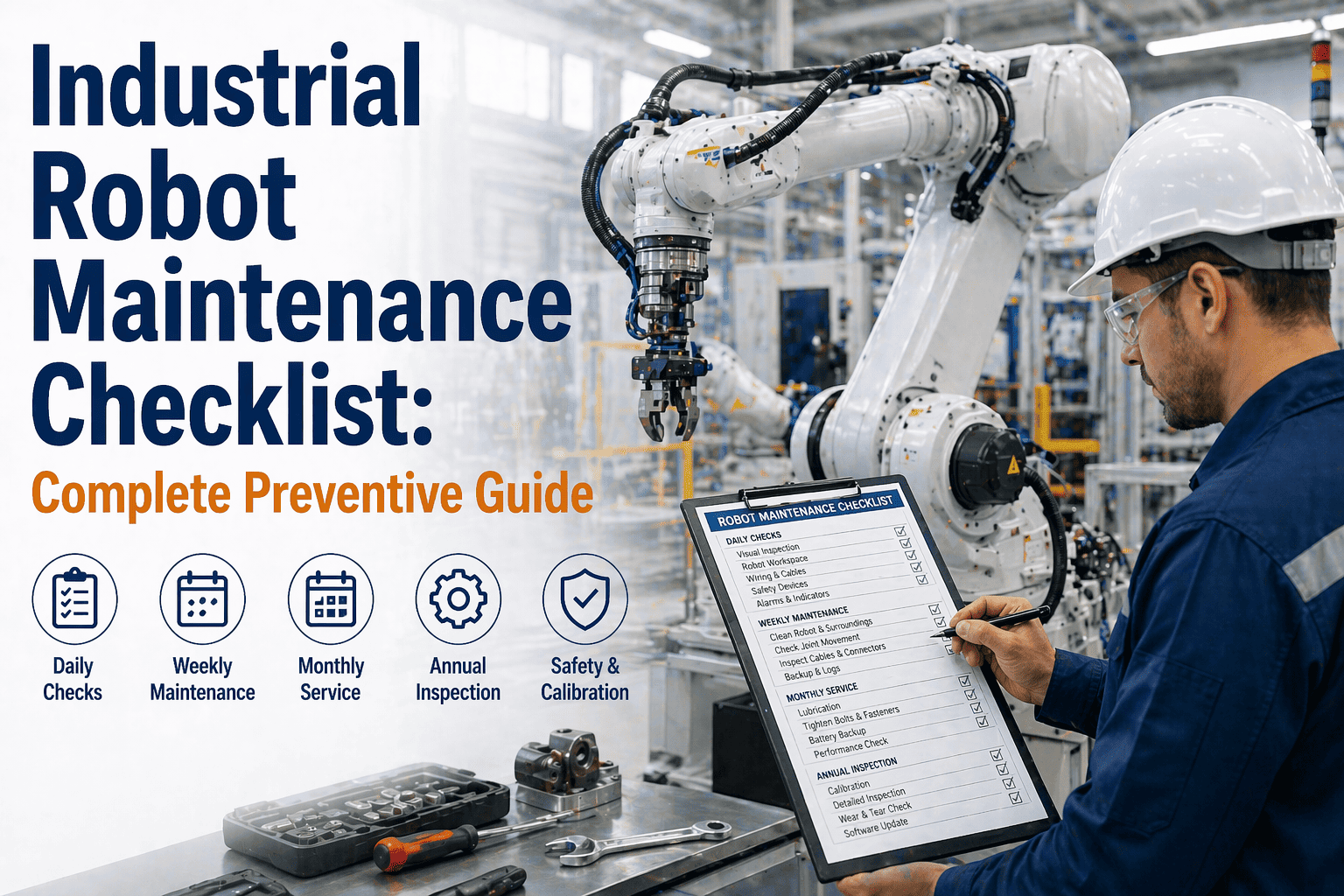
A fully automated robotic cell doesn't fail overnight. It degrades — joint by joint, sensor by sensor, firmware version by skipped firmware version — until the first missed cycle becomes a production stop that takes your entire shift with it. The plants running cobots and industrial arms at peak throughput in 2026 aren't doing anything exotic. They're closing a structured PM checklist every service interval, and they're doing it before the degradation curve reaches the threshold that triggers an unplanned event. This checklist covers every layer of robotic system health: mechanical joints, servo drives, grippers, safety systems, sensors, software, and cobot-specific collaboration zones. Walk it with your automation technician before every scheduled PM window. Every open box is a risk you're carrying into the next production cycle. Book a demo to see how iFactory automates this checklist inside a live robotic cell environment.
Why Robotic PM Fails Without a Structured Checklist
Most robotic PM programs fail not because technicians don't know what to check — they fail because the scope of "what to check" expands every time a new axis, end-effector, or sensor is added to the cell. Without a master checklist, each technician inspects based on experience and memory. Critical items get missed not from negligence but from the absence of a system. The result is inconsistent PM depth across shifts, cells, and plants. The checklist below standardizes what "done" looks like across every robotic asset in your facility — from a six-axis welding arm to a collaborative screwdriving cobot on a final assembly line.
How to Use This Checklist
This checklist is organized into seven phases, each mapped to a distinct system layer of a robotic cell. Run Phase 01 through Phase 04 at every scheduled PM interval. Run Phase 05 (Software & Firmware) at every controller update or quarterly, whichever comes first. Run Phase 06 (Cobot-Specific) for every collaborative application in your facility — skip it only if your robots are fully caged industrial arms with no human interaction zones. Phase 07 (Analytics & CMMS Readiness) should be completed after every PM cycle to close the loop in your maintenance management system.
Phase 01 — Joint & Mechanical Inspection (Steps 1–15)
Mechanical wear is silent until it isn't. Joint backlash, bearing preload drift, and lubrication starvation are the leading root causes of positional repeatability loss in industrial robots. These 15 checkpoints should be your first stop at every PM window.
Phase 02 — Servo & Drive System Calibration (Steps 16–30)
Servo degradation is the most common cause of positional drift and path deviation in six-axis robots. Calibration drift goes undetected until part quality suffers or cycle time increases. These checks prevent that.
Phase 03 — Gripper & End-Effector Inspection (Steps 31–45)
End-effectors are the highest-wear components in most robotic cells — and the most overlooked in PM programs. Gripper wear directly translates to part drop events, positional error at pick, and cycle time creep. These checks catch degradation before it becomes a quality escape.
Phase 04 — Safety System Verification (Steps 46–60)
Safety system failures in robotic cells are not just regulatory liabilities — they're the difference between a recoverable near-miss and a recordable incident. OSHA 1910.217 and ISO 10218 require documented verification at defined intervals. These steps satisfy that requirement and protect your workforce.
Phase 05 — Software, Firmware & Controller Health (Steps 61–75)
Controller software is the nervous system of your robotic cell. Firmware mismatches, unvalidated program edits, and backup gaps are the silent risks that turn a routine change into a multi-day outage. These steps protect your controller environment.
Want iFactory to auto-generate work orders for Steps 61–75 every time a firmware update is pushed to your robots? Book a 30-minute robot CMMS demo with our automation team.
Phase 06 — Cobot-Specific Collaboration Zone Checks (Steps 76–90)
Collaborative robots introduce a category of PM requirements that don't exist in fully caged cells. Force-torque sensor drift, collaboration zone boundary creep, and skin/surface wear on the cobot arm itself require dedicated verification. These steps are mandatory for any ISO/TS 15066-governed application.
Phase 07 — Predictive Analytics & CMMS Closure (Steps 91–105)
Completing the physical checklist is only half the value. The plants that get compounding ROI from robotic PM are the ones that close the data loop — logging results in CMMS, trending sensor outputs against failure thresholds, and feeding PM findings into predictive maintenance models. This phase is where inspection becomes intelligence.
PM Frequency Reference: What to Check and When
Not all 105 steps run at the same interval. The table below maps each phase to its recommended PM frequency based on industry practice for industrial robots operating single-shift, double-shift, and continuous production environments.
| Phase | Single Shift | Double Shift | Continuous (24/7) | Trigger-Based |
|---|---|---|---|---|
| Phase 01 — Joint & Mechanical | Every 2,000 hrs | Every 1,500 hrs | Every 1,000 hrs | Vibration anomaly alert |
| Phase 02 — Servo & Drive | Quarterly | Every 8 weeks | Monthly | Positional drift detected |
| Phase 03 — Gripper & End-Effector | Monthly | Every 2 weeks | Weekly | Part drop or pick failure |
| Phase 04 — Safety Systems | Quarterly | Quarterly | Monthly | Any safety event or near-miss |
| Phase 05 — Software & Firmware | Quarterly | Quarterly | Quarterly | Controller update or alarm pattern |
| Phase 06 — Cobot Zones | Every 6 months | Quarterly | Quarterly | Layout or task change |
| Phase 07 — Analytics & CMMS | After every PM | After every PM | After every PM | Threshold breach in historian |
Expert Perspective
15066
Conclusion: Close All 105 Before the Robot Tells You Something Is Wrong
A robotic cell running on reactive maintenance isn't an automation asset — it's a scheduled interruption waiting for its next appointment. The 105 checkpoints in this guide represent the minimum viable PM scope for any industrial robot or cobot operating in a production environment. They cover every layer where degradation begins: mechanical joints, servo drives, end-effectors, safety systems, software environments, collaboration zones, and the analytics infrastructure that converts inspection data into predictive intelligence. The plants achieving 85%+ OEE from their robotic cells in 2026 aren't doing anything the industry doesn't already know. They're simply doing it systematically, documenting it in CMMS, and acting on the trends before the thresholds are breached. Walk this checklist at every PM interval. Close every box. Feed every result into your CMMS. That's the discipline that separates a robotic cell that performs from one that surprises you.