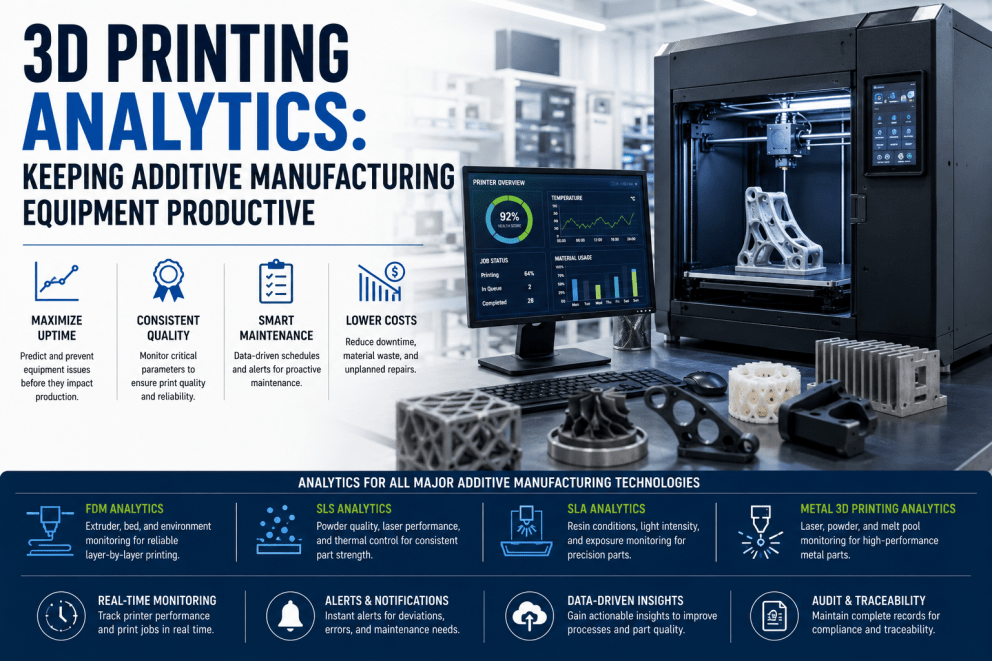
At 2:47 AM on a Tuesday, an FDM production printer running a 72-hour PEEK job for an aerospace supplier begins to layer-shift. The operator, half-asleep at the monitoring station, misses the first warning — a 0.3°C deviation in the chamber temperature. By 3:14 AM, the print head drags through a warped layer, ruining 14 hours of work and $4,200 in material. The part is scrapped, the delivery deadline is missed, and the root cause — a failing heater cartridge — won't be found until the next scheduled maintenance window three weeks later. For every additive manufacturing manager, this scenario is not a question of if, but when. The gap between a print failing and knowing why it failed is where margins disappear, throughput evaporates, and quality promises break.
Stop Guessing When Your 3D Printers Will Fail — Know It Before the First Layer Goes Bad
iFactory's on-premise analytics engine ingests live sensor data from every FDM, SLS, SLA, and metal printer in your fleet, predicts failures 6 to 12 hours in advance, and automatically adjusts print parameters to keep production running. No cloud dependency. No data leaving your plant. A working pilot in 6–12 weeks.
Additive Manufacturing's Hidden Failure Cascade
Every 3D printer generates hundreds of data points per second — nozzle temperature, bed adhesion force, chamber humidity, extrusion pressure, laser power, powder bed density. Most plants capture none of it in real time, and the few that do have no system to correlate those signals with print outcomes. The result is a predictable cycle of waste, rework, and machine downtime that erodes the economics of additive at scale.
Undetected Process Drift Destroys Batches
A 0.5% drift in extrusion multiplier or a 1°C fluctuation in the build chamber goes unnoticed for hours. By the time the operator sees a failed layer, 60–80% of the print is already compromised. In metal binder jetting, a single undetected humidity spike can ruin an entire job worth $15,000 in powder and machine time.
Reactive Maintenance Kills Utilization
When a heated build platform thermistor fails mid-print, the machine sits idle for 8–12 hours waiting for a technician to diagnose and replace it. For a fleet of 20 printers running 24/7, each unplanned event costs $4,000–$7,000 in lost production capacity. Scheduled maintenance catches only 30% of failure modes.
Quality Variability Stops Scaling
You can't scale additive production if every print run has a different yield. Plants running 5+ printer technologies — FDM for prototypes, SLS for end-use parts, metal for tooling — see yield variance of 15–25% between machines of the same model. Without cross-fleet analytics, you can't identify which machine, operator shift, or material lot is the outlier.
Post-Mortem Analysis Is Too Late
After a failed print, teams spend 4–6 hours reviewing logs, checking camera footage, and running test coupons. The root cause — a clogged nozzle that took 90 minutes to develop, or a Z-axis binding that started 20 layers earlier — is buried in data the plant never captured. Every post-mortem is a lost opportunity to prevent the next failure.
Regulatory Traceability Gaps in Medical & Aerospace
For FDA-cleared medical implants or AS9100 aerospace parts, you must prove every print parameter stayed within validated bounds. Without continuous, timestamped analytics from every sensor, you're relying on periodic log exports that miss the critical 30-second window when the laser power spiked. A single audit finding can halt production for weeks.
Your printers are already generating the data you need to predict failures. You just can't see it yet. Book a 30-min walkthrough and we'll show you how iFactory turns that raw sensor stream into a 12-hour advance warning system.
From Sensor Noise to Scheduled Certainty in Four Steps
iFactory's on-premise analytics appliance connects directly to your printer controllers, material handling systems, and environmental sensors — no cloud relay, no data egress. Within weeks, it learns the normal operating envelope for every machine in your fleet and starts predicting failures before they start.
Connect & Ingest
iFactory connects to any printer with a digital interface — FDM, SLS, SLA, DMLS, binder jet — ingesting nozzle temp, bed level, chamber humidity, extrusion pressure, laser power, powder spreader force, and 200+ other signals at 1-second resolution.
Learn Normal Behavior
Over 14 days of continuous operation, iFactory builds a baseline for each machine — not just averages, but the acceptable variance for every sensor at every stage of a print. It accounts for material type, part geometry, and ambient conditions.
Predict & Alert
When a sensor drifts outside its learned envelope — a nozzle temperature trending 0.2°C per minute, or a bed adhesion sensor showing intermittent contact loss — iFactory issues a predictive alert 6–12 hours before the failure would occur, with the specific component and failure mode.
Automate & Schedule
iFactory's Preventive Analytics Scheduling engine automatically adjusts print parameters to compensate for early-stage drift, or schedules a maintenance window at the natural end of the current print job — no emergency stops, no scrapped parts, no lost production.
What iFactory Monitors, Predicts, and Prevents
Every printer technology has its own failure physics. iFactory's models are purpose-built for each process, not a generic anomaly detector that catches everything but predicts nothing.
Nozzle Clog & Extrusion Failure
iFactory detects the telltale pressure spike pattern that precedes a clog by 8–12 hours. It correlates extrusion rate, filament diameter variance, and nozzle temperature to predict when the filament path will obstruct. You get a maintenance alert before the next print starts, not after the current one fails.
Powder Bed Density & Sintering Uniformity
By monitoring recoater arm force, powder bed temperature gradients, and IR camera data, iFactory predicts regions of incomplete sintering or density variation. Alerts flag the exact layer and XY location where a defect will form, enabling parameter adjustment mid-print.
Resin Cure & Platform Adhesion
iFactory tracks peel force, UV LED output decay, and resin temperature across the vat. It predicts delamination or incomplete curing 4–6 hours before visible failure, and can auto-adjust exposure time or layer height to maintain adhesion.
Recoater Blade Crash & Thermal Distortion
The most expensive failure in metal printing — a recoater blade striking a raised part edge — is predicted by iFactory's analysis of powder spreader load cells and melt pool thermal cameras. Alerts come 2–4 hours before the crash, with a recommendation to pause and inspect a specific layer.
Humidity & Binder Saturation
iFactory correlates ambient dew point, powder bed moisture sensors, and binder jetting pressure to predict green part strength variation. A 3% increase in relative humidity triggers a preventive pause and bed drying cycle, saving an entire job from crumbling in the furnace.
Component Health & End-of-Life Prediction
iFactory tracks cumulative wear on every serviceable component — heaters, thermistors, motors, belts, lasers, galvos, and filters. It predicts remaining useful life and schedules replacement during planned downtime, eliminating emergency part runs and overnight technician calls.
What iFactory Delivers in the First Quarter
These results are from actual iFactory deployments across 12 additive manufacturing plants running mixed fleets of 8–45 printers. Your numbers will vary by fleet size, technology mix, and current baseline — but the direction is consistent.
Complete Predictive Analytics for Your Additive Fleet — Turnkey, On-Premise, Delivered in 6–12 Weeks
No cloud subscription. No data leaving your network. No months-long integration project. iFactory arrives as an NVIDIA appliance, connects to your printers and plant network, and starts delivering predictive alerts within two weeks of data ingestion.
End-to-End Turnkey Deployment
You provide data-source access to your printer controllers and environmental sensors. iFactory handles all integration, model training, and alert configuration. Working pilot in 6–12 weeks.
On-Premise NVIDIA Appliance — Zero Cloud Dependency
All data stays on your plant network. No internet connection required for operation. No data egress fees. No third-party cloud provider accessing your print parameters or part geometries.
Pilot-to-ROI in One Quarter
Most customers see measurable improvement in print success rates and reduced downtime within 90 days of go-live. We don't ask for a multi-year commitment — prove the value first.
24×7 Managed Service Included
iFactory's operations team monitors your fleet's predictive alerts around the clock. You get phone, email, and Slack support with a 30-minute response SLA for critical alerts.
Multi-Technology, Multi-Vendor Support
iFactory works across FDM, SLS, SLA, DMLS, EBM, and binder jetting from any manufacturer — Stratasys, 3D Systems, EOS, HP, Desktop Metal, Markforged, and 40+ others. One pane of glass for your entire fleet.
Preventive Analytics Scheduling Engine
iFactory doesn't just predict failures — it schedules the right intervention at the right time. Automatically adjusts print parameters to compensate for early drift, or queues a maintenance task for the next natural break in production.
What Additive Manufacturing Managers Want to Know
Stop Losing Prints to Failures You Could Have Predicted
Your additive manufacturing fleet is generating the data you need to eliminate unplanned downtime, reduce scrap, and scale production with confidence. iFactory turns that data into a 12-hour advance warning system — delivered on your network, in your plant, within one quarter. Book a 30-minute demo and we'll show you live predictions on a real printer fleet.




.png)