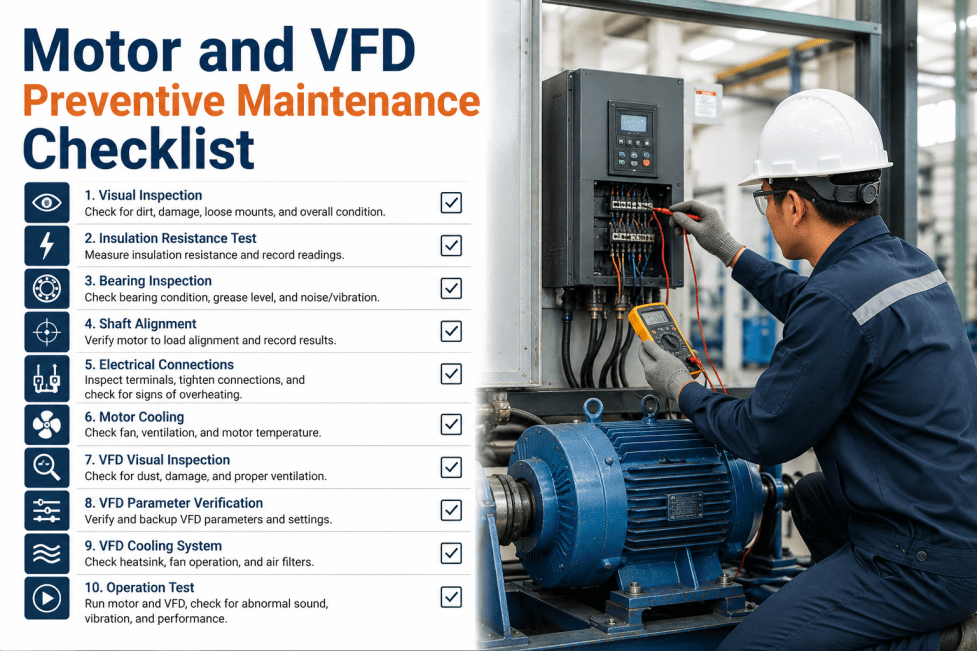
Industrial motors and variable frequency drives (VFDs) are the workhorses of your plant floor—and when one goes down unexpectedly, the ripple effect hits production, quality, and your bottom line. A structured preventive maintenance checklist is the difference between a scheduled two-hour swap and an unplanned eight-hour shutdown. This guide gives U.S. manufacturing maintenance teams a complete, field-tested Motor and VFD PM checklist—covering insulation resistance testing, bearing condition, alignment, VFD parameter verification and cooling system checks—organized by frequency so your technicians know exactly what to do and when.
A Complete Field-Ready Inspection Framework for Industrial Motors and Variable Frequency Drives
Why Motor and VFD PM Checklists Matter
Electric motors consume roughly 70% of industrial electrical energy in a typical U.S. manufacturing facility. VFDs, which control motor speed and torque, introduce additional failure modes—harmonic distortion, capacitor degradation, and parameter drift—that many PM programs still overlook. The combination of aging motors and under-maintained drives is one of the leading causes of unplanned production downtime in discrete and process manufacturing.
A single unplanned motor failure on a critical line can idle an entire shift. PM prevents this.
Bearing wear, insulation degradation, and misalignment are all detectable before catastrophic failure.
Well-maintained drives operate within design specs, cutting kWh per unit produced and reducing heat stress.
Optimal-condition operation extends motor and drive lifespan, deferring $50K–$500K replacement costs.
Daily Motor Inspection Checklist
Daily checks take under 10 minutes per motor and catch the leading indicators of imminent failure—abnormal heat, vibration, and noise—before they escalate. Assign these to the shift technician responsible for the line.
Weekly Motor and VFD Checklist
Weekly tasks go deeper into VFD status, lubrication, and environmental conditions. These checks are typically performed by the maintenance technician assigned to the asset zone.
Monthly Motor Inspection Checklist
Monthly tasks require more time and instruments but are where you catch the slow-developing failures—insulation degradation, misalignment drift, and bearing wear progression—before they reach the critical zone.
Quarterly and Annual Motor & VFD Checklist
Quarterly and annual inspections require planned downtime, specialized instruments, and often a certified electrician. These tasks address the slow-burn failure modes that daily and weekly checks cannot detect—winding condition, bearing end-of-life, and full VFD component assessment.
VFD Parameter Verification Reference Table
When verifying VFD parameter settings during PM, use this reference table to cross-check critical parameters against motor nameplate data and process requirements. Deviations from approved settings should be corrected and documented in the CMMS work order before the drive is returned to service.
| Parameter | Verify Against | Acceptable Tolerance | Failure Risk if Wrong |
|---|---|---|---|
| Motor Rated Voltage | Motor nameplate voltage | ±0 V (exact match) | High — Overheating |
| Motor Rated Current (FLA) | Motor nameplate FLA | ±2% | High — OL Trip or Winding Damage |
| Motor Rated Frequency | Motor nameplate Hz (50 or 60) | Exact match | Medium — Speed Error |
| Motor Rated Speed (RPM) | Nameplate full-load RPM | ±5 RPM | Medium — Process Deviation |
| Acceleration Ramp Time | Approved parameter file | Per process spec | Medium — Mechanical Stress |
| Deceleration Ramp Time | Approved parameter file | Per process spec | Medium — Overvoltage Fault |
| Overload Protection Level | ≤115% of motor FLA | ±2% | High — Motor Burnout |
| Carrier Frequency | Cable length / motor type spec | Per manufacturer guidance | Low-Med — Bearing Current |
| Minimum / Maximum Speed Limits | Process engineering spec | Exact match | Medium — Process Overspeed |
iFactory AI's Preventive Maintenance module stores approved parameter files and flags deviations automatically. Book a Demo to see how VFD parameter tracking works in practice.
How iFactory AI Powers Motor and VFD PM
Executing this checklist on paper or in spreadsheets creates audit gaps, missed escalations, and no trending visibility. iFactory AI's Preventive Maintenance Scheduling platform digitizes every task, connects it to asset history, and surfaces trends before they become failures.
Predictive Maintenance
AI-driven anomaly detection on motor vibration, temperature, and current draw auto-generates work orders before failures occur — cutting unplanned downtime 35–45%.
Preventive Maintenance Scheduling
Auto-generates motor and VFD PM work orders by frequency (daily/weekly/monthly/annual), assigns technicians, and sends completion alerts to supervisors.
Enterprise Asset Management
Complete motor and VFD asset records — nameplate data, parameter backups, maintenance history, and failure codes — in one searchable system your whole team can access.
OEE Analytics
Track how motor and VFD downtime events impact availability and performance scores. Connects PM compliance rates to OEE outcomes so the business case for PM is always visible.
Smart Document Management
Store VFD parameter backup files, motor test reports, and alignment records directly in the asset record. Technicians access the correct documentation from any mobile device on the floor.
Automated Analytics Reporting
PM compliance rate, overdue work order count, and mean time between motor failures — automatically compiled into management-ready reports without manual data gathering.
Expert Review: What Separates Reliable Motor Programs From Reactive Ones
The plants with the lowest motor failure rates share one discipline: they treat insulation resistance trending as seriously as vibration trending. A motor with a falling IR trend over three consecutive monthly readings—even if still above 1 MΩ—is telling you it will fail within 90 to 180 days. Plants that act on the trend avoid the failure entirely. Plants that only act when the megger reads below 1 MΩ are already in crisis mode. The same principle applies to VFD fault logs. One OV fault in six months is noise. Three in one month is a pattern — and it almost always traces back to either a deceleration ramp that is too aggressive for the load inertia or a failing brake resistor. The checklist frequency matters, but the discipline to trend and act on the data is what separates 12-hour outages from zero-downtime quarters.
Conclusion: A Structured PM Checklist Is Your First Line of Defense
Motors and VFDs do not fail without warning — they fail without monitoring. The daily checks in this guide take 10 minutes and catch thermal and vibration anomalies before they cascade. The monthly insulation resistance tests give you a 60- to 90-day warning window on winding failures. The quarterly VFD parameter audits prevent the silent parameter drift that causes process quality issues and nuisance trips. And the annual teardowns and capacitor replacements eliminate the sudden, costly failures that reactive maintenance teams spend their careers responding to.
The difference between a 35% reduction in unplanned motor downtime and the status quo is not better equipment — it is consistent execution of this checklist, combined with a CMMS that tracks compliance, trends measurements, and escalates anomalies automatically. iFactory AI's Preventive Maintenance Scheduling module was built specifically to make that execution repeatable, auditable, and connected to your OEE and asset reliability outcomes. Book a Demo to see how plants using iFactory AI are transforming their motor PM programs.
Frequently Asked Questions
Digitize Your Motor and VFD PM Program
iFactory AI gives your team the scheduling engine, asset history, and predictive analytics to execute this checklist consistently — and prove the reliability outcomes to management.