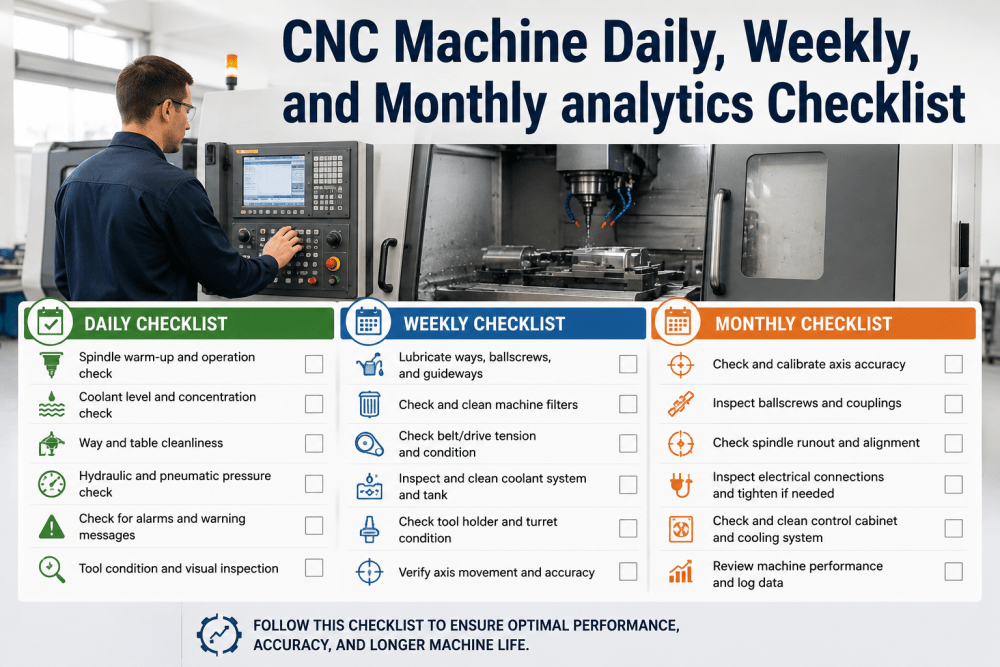
CNC Machine Daily, Weekly, and Monthly analytics Checklist
By Daniel Brooks on May 30, 2026
CNC machine tool failures rarely announce themselves — they accumulate. A missed spindle warm-up on Monday becomes a runout issue by Wednesday. Skipped coolant concentration checks quietly corrode aluminum fixtures. Way lubrication intervals stretched by two weeks double linear guide wear. The most expensive CNC repairs in American manufacturing plants trace back to maintenance tasks that were known, documented, and simply not done consistently. This checklist organizes every critical CNC preventive maintenance task by frequency — daily, weekly, and monthly — so your operators and technicians can execute precision machine PM without guesswork. Use it alongside iFactory AI's Preventive Maintenance Scheduling to automate task dispatch, capture digital sign-offs and generate compliance-ready audit trails from a single platform.
A structured, frequency-organized checklist for spindle warm-up, coolant management, axis calibration, way lubrication, and tooling inspection — built for U.S. manufacturing teams running precision CNC equipment.
CNC machining centers operate within tolerances measured in microns. Degradation that would be invisible on general industrial equipment is catastrophic on precision machine tools. The table below illustrates how skipped maintenance tasks translate into measurable production losses.
Skipped Task
Time to Failure
Typical Repair Cost
Production Impact
Spindle warm-up skipped
2–4 weeks
$8,000–$40,000
Dimensional drift, part rejection
Coolant concentration unchecked
1–3 months
$1,500–$6,000
Tool life reduction 30–50%
Way lube interval missed (2 weeks)
3–6 months
$12,000–$35,000
Linear guide replacement, geometry error
Chip conveyor not cleaned
1–2 weeks
$400–$2,000
Coolant contamination, re-cutting
Axis backlash not verified monthly
6–12 months
$5,000–$20,000
Out-of-tolerance parts, scrap
DAILY CHECKLIST
CNC Machine Daily Maintenance Checks
Daily tasks must be completed at shift start before the first part runs. Many items take under 10 minutes total. Skipping them — even once — creates cumulative risk across a week of production.
FREQUENCY: DAILY
Complete at shift start — before first part
Spindle & Warm-Up
Coolant System
Machine Surfaces & Chip Management
Air & Hydraulic Systems
Tooling & Work Holding
Alarms & Operator Log
WEEKLY CHECKLIST
CNC Machine Weekly Maintenance Checks
Weekly tasks require 45–90 minutes and should be scheduled during planned downtime or shift transition windows. Many require trained maintenance technicians rather than operators.
FREQUENCY: WEEKLY
Schedule during planned downtime — 45–90 minutes required
Way Lubrication System
Coolant System Deep Check
Electrical & Control Cabinet
Tool Management
Machine Geometry Spot Checks
Guarding & Safety
MONTHLY CHECKLIST
CNC Machine Monthly Inspection Tasks
Monthly tasks are the foundation of long-term precision retention. They require qualified maintenance technicians, calibrated measurement instruments, and documented results. These tasks directly protect machine geometry and spindle performance over a multi-year asset life.
FREQUENCY: MONTHLY
Requires calibrated instruments and qualified technician — 2–4 hours
Axis Calibration & Geometry
Spindle Performance Measurement
Hydraulic & Pneumatic Systems
Coolant System Full Service
Electrical System Monthly Checks
Structural & Mechanical
Every task in this checklist can be digitized, scheduled, and tracked automatically in iFactory AI's Preventive Maintenance module. Operators receive task notifications on mobile devices, sign off with timestamped records, and management sees real-time completion dashboards — no paper, no spreadsheets. Book a Demo to see how CNC maintenance scheduling works in iFactory.
DIGITAL PM SCHEDULING
How iFactory AI Automates CNC Preventive Maintenance
Paper-based and spreadsheet-driven PM programs fail for a predictable reason: there is no enforcement mechanism. A digital PM platform converts this checklist from a document into a workflow — with dispatch, accountability, and traceability built in.
1
Schedule
Configure task frequencies (daily, weekly, monthly) in iFactory. Tasks auto-generate work orders at the correct interval with no manual scheduling.
2
Dispatch
Technicians and operators receive task notifications on mobile devices with full checklist details, reference documents, and prior readings attached.
3
Execute
Technicians check off each item, record readings (coolant concentration, spindle runout values), and flag abnormal findings directly in the mobile interface.
4
Verify
Supervisors review completed tasks in real time. Overdue or failed items escalate automatically. All records are timestamped and audit-ready.
Without Digital PM
Paper checklists with no completion enforcement
No historical trending of measured values (spindle runout, backlash)
Missed tasks discovered only after failure
Manual reporting for compliance audits
No correlation between PM gaps and quality escapes
Tribal knowledge — PM quality depends on which technician is present
With iFactory AI
Auto-dispatched tasks with mobile sign-off and photo capture
Trended measurement history with alert thresholds per parameter
Overdue task escalation before failure occurs
One-click audit reports with full task history and timestamps
Correlation dashboard linking PM gaps to production quality events
Standardized procedure delivery — every technician follows the same steps
Automate Your CNC PM Program with iFactory AI
Replace paper checklists with digital workflows that dispatch, track, and report every CNC maintenance task — daily, weekly, and monthly — from a single platform deployed inside your plant.
Most CNC maintenance failures in U.S. job shops and production facilities stem from two root causes: calendar-based scheduling that ignores actual machine utilization, and checklist designs that bundle all tasks into a single "monthly PM" event. Both approaches create dangerous gaps.
A high-production CNC running three shifts needs daily coolant and chip management at the utilization rate of a machine running 120 hours per week — not 40. Conversely, a low-utilization machine running 20 hours per week can stretch some weekly tasks to bi-weekly without risk. The correct approach is frequency-based scheduling tied to spindle hours or production cycles, not wall-calendar dates.
The three-tier structure used in this checklist — daily operator tasks, weekly technician tasks, and monthly calibration tasks — reflects industry best practice for precision machining centers. Daily tasks protect consumables (coolant, chips, air). Weekly tasks protect wear items (way lube, tooling, filters). Monthly tasks protect geometry and precision. Each tier requires a different skill level and time commitment, which is why separating them is operationally critical.
Plants that implement digital PM scheduling in tools like iFactory AI — where daily tasks auto-generate every shift and are visible to supervisors in real time — consistently report 40–60% reductions in unplanned downtime within the first year of structured PM execution. The checklist itself is not the hard part. Consistent execution is the hard part, and that requires digital enforcement.
KEY METRICS
What Structured CNC PM Delivers in Practice
Spindle Life Extension
2–4x
Plants running disciplined warm-up and lubrication programs report spindle bearing life 2–4x longer than facilities with informal PM practices.
Tool Life Improvement
20–35%
Maintaining coolant concentration within spec reduces tool wear by 20–35% and virtually eliminates thermal shock-related insert failures.
Unplanned Downtime Reduction
40–60%
Digital PM programs with task enforcement reduce unplanned CNC downtime by 40–60% in the first year of structured implementation.
Geometric Accuracy Retention
3–5 yrs
Monthly calibration and way lubrication programs extend the period before major geometric correction is required from 1–2 years to 3–5 years.
CONCLUSION
Consistent Execution Is the Only CNC Maintenance Strategy That Works
A CNC machine tool is a precision instrument that tolerates inconsistency poorly. Every item in this checklist has a documented failure mode behind it — a bearing that failed because warm-up was skipped, a way surface that corroded because coolant concentration drifted, a ball screw that seized because the lube reservoir ran dry. These are not theoretical risks. They are the routine failure catalog of every machine shop that runs informal PM programs.
The checklist above gives you the complete task structure across daily, weekly, and monthly frequencies. But a checklist is only as effective as its execution discipline. The production facilities that achieve the best CNC reliability outcomes in U.S. manufacturing are not the ones with the most detailed checklists — they are the ones that have built systems to ensure every task gets done, every time, with a record.
iFactory AI's Preventive Maintenance Scheduling module converts this checklist into a living, enforced workflow. Tasks auto-dispatch. Operators and technicians receive mobile notifications. Measurements are recorded and trended. Supervisors see real-time completion status. Overdue tasks escalate before they become failures. Book a demo to see how it works in a real manufacturing environment.
How long does a CNC daily maintenance check actually take?
A complete daily checklist — spindle warm-up, coolant check, chip management, air/hydraulic pressure verification, and tooling inspection — takes a trained operator 15–25 minutes, not counting spindle warm-up run time. The warm-up program itself typically runs 15–30 minutes unattended while the operator prepares the first setup. Plants that object to daily checks on time grounds are usually underestimating the cost of the failures those checks prevent.
What is the correct coolant concentration range for CNC machining?
For most semi-synthetic metalworking fluids used in CNC machining aluminum, steel, and titanium, the working concentration range is 5–10% by refractometer reading. The specific target depends on the fluid formulation and the material being cut — consult your coolant supplier's technical data sheet for the exact range. General-purpose aluminum machining typically runs 5–7%; ferrous and titanium work often runs 7–10%. Concentrations below minimum reduce lubricity and biocide protection; concentrations above maximum increase residue buildup and operator skin irritation risk.
How often should CNC axis calibration be performed?
Monthly calibration checks — measuring positioning accuracy, backlash, and squareness — are appropriate for production CNC machines running one to three shifts. High-precision aerospace or medical machining centers operating at tolerances below ±0.0005" benefit from bi-weekly checks. Machines that have experienced a crash, thermal event, or unusual alarm history should be re-calibrated immediately regardless of the scheduled interval. All calibration results should be documented and compared against a baseline to detect drift trends before they affect part quality.
Can CNC operators perform all of these tasks, or do some require a maintenance technician?
Daily tasks — spindle warm-up, coolant concentration checks, chip cleaning, pressure gauges, and basic visual inspections — are appropriate for trained operators with documented procedures. Weekly tasks like way lube system inspection, ATC maintenance, and coolant sump cleaning require a maintenance technician with knowledge of the machine's lubrication and tooling systems. Monthly calibration tasks — axis positioning measurement, spindle runout, drawbar pull force, and hydraulic oil sampling — require a maintenance technician or metrology-trained individual with calibrated measurement instruments. Assigning tasks to unqualified personnel is a common PM program failure mode.
How does iFactory AI help enforce CNC PM compliance in multi-machine environments?
iFactory AI's Preventive Maintenance Scheduling module allows maintenance managers to configure unique task lists for each individual CNC machine — by make, model, age, and production load — and assign them to specific operators or technician teams. Tasks auto-generate on schedule, appear on the assigned person's mobile dashboard, and require digital sign-off with timestamps. Overdue tasks trigger automated escalation to supervisors. The platform produces completion rate reports by machine, by technician, and by task category — giving managers the visibility they need to identify PM gaps before they produce failures. All records are searchable and exportable for ISO or customer audit requirements.
Ready to Digitize Your CNC PM Program?
iFactory AI deploys on your plant network in 6–12 weeks. See daily, weekly, and monthly CNC tasks auto-scheduled, dispatched, and tracked — with full audit trails and real-time completion dashboards.