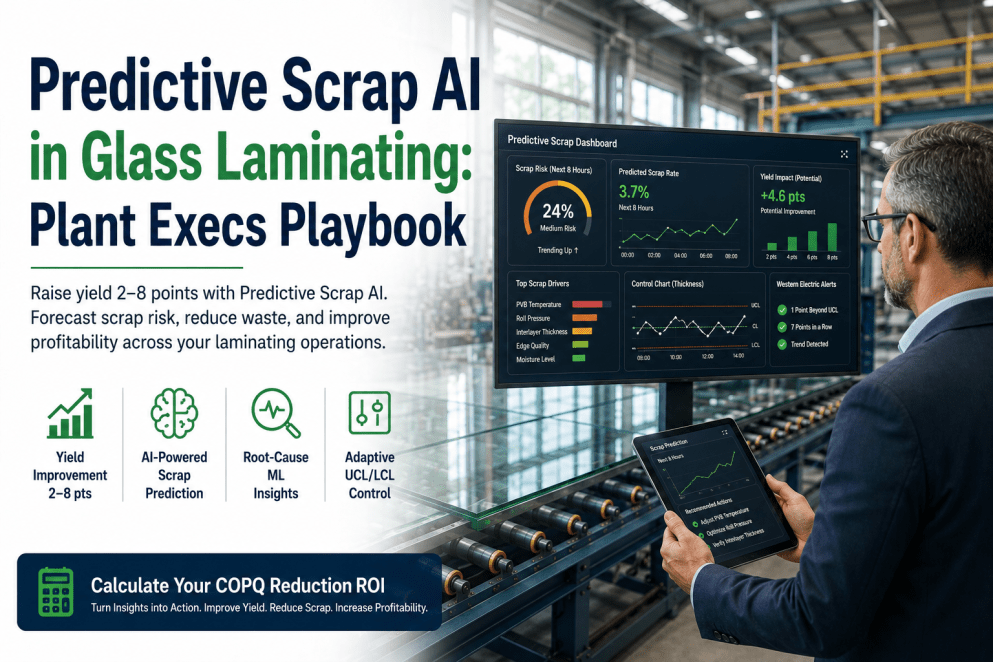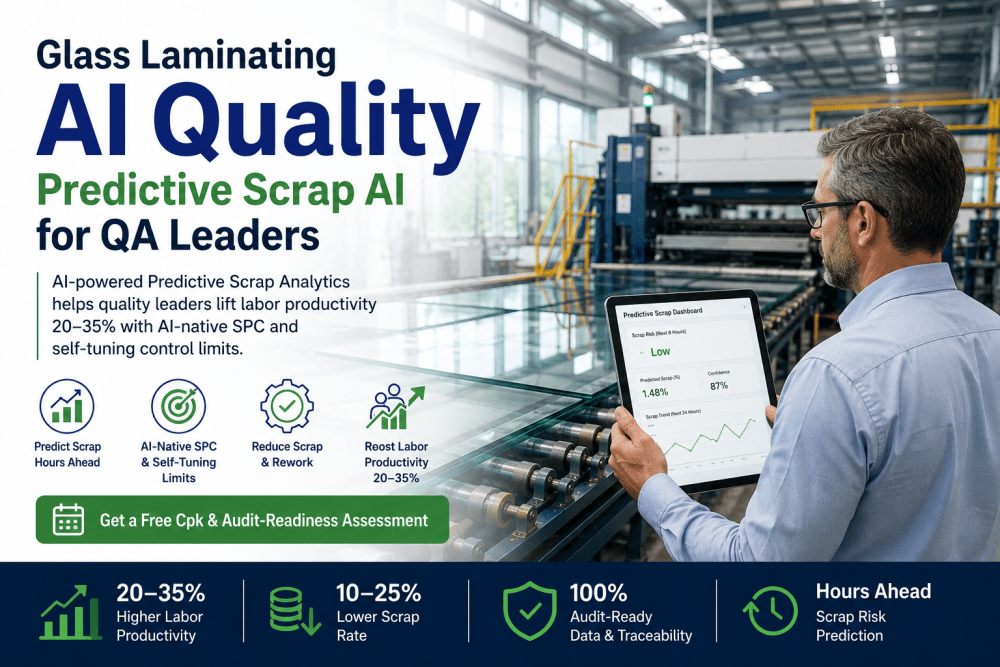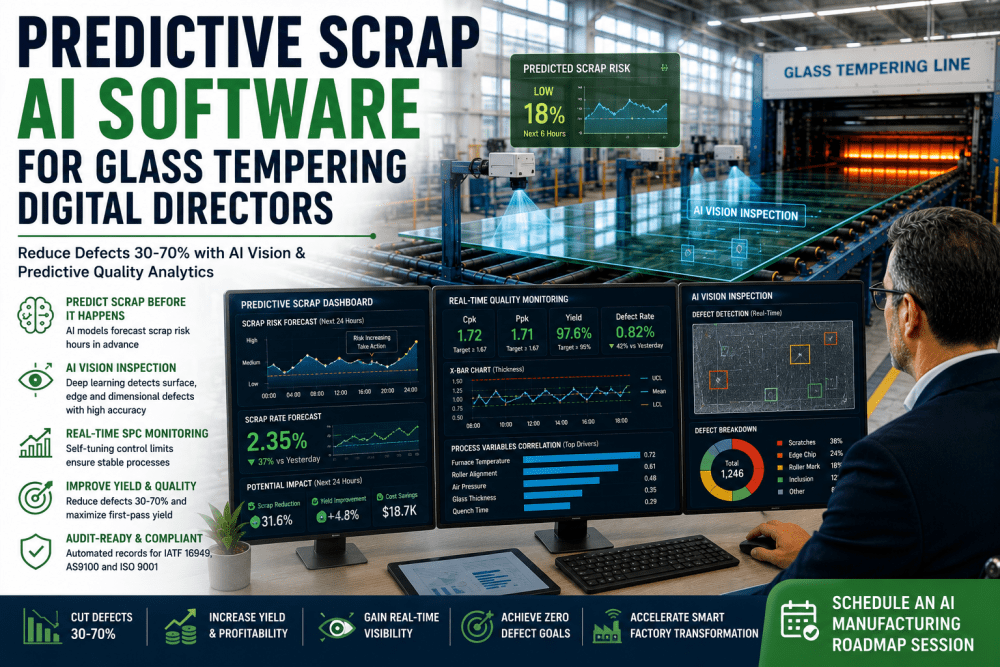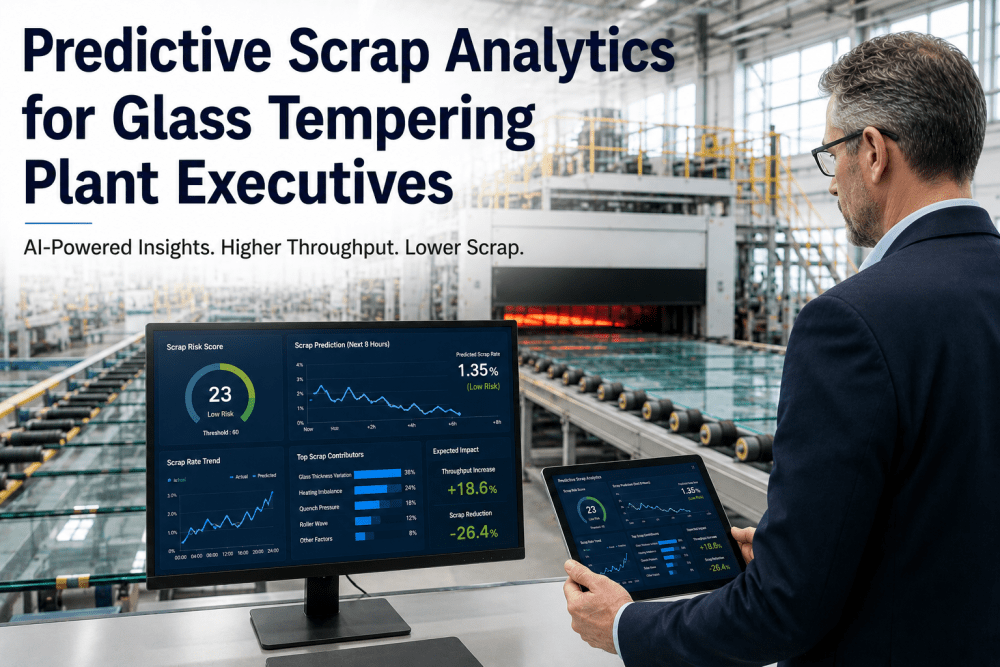
A Tier-1 architectural glass fabricator producing 14,000 tempered panels per day deployed iFactory's Predictive Scrap AI platform across five tempering lines — combining machine learning scrap forecasting, self-tuning SPC, and real-time yield dashboards — to reduce scrap rates from 8.2% to 3.1% over a 16-week deployment. The platform ingests 110+ process variables from furnace zone controllers, quench pressure transducers, conveyor drives, and inspection stations, modeling scrap risk for every panel before it enters the tempering furnace. By predicting which panels are likely to fail quality inspection, the system enables quality leaders to adjust process parameters in flight — raising furnace temperature, modifying quench pressure, or slowing conveyor speed — preventing scrap before it occurs rather than detecting defects after the fact. The deployment delivered a 5.1 percentage point yield improvement worth $1.8 million annually in reduced scrap and rework costs. Quality managers evaluating predictive scrap analytics for glass tempering operations.
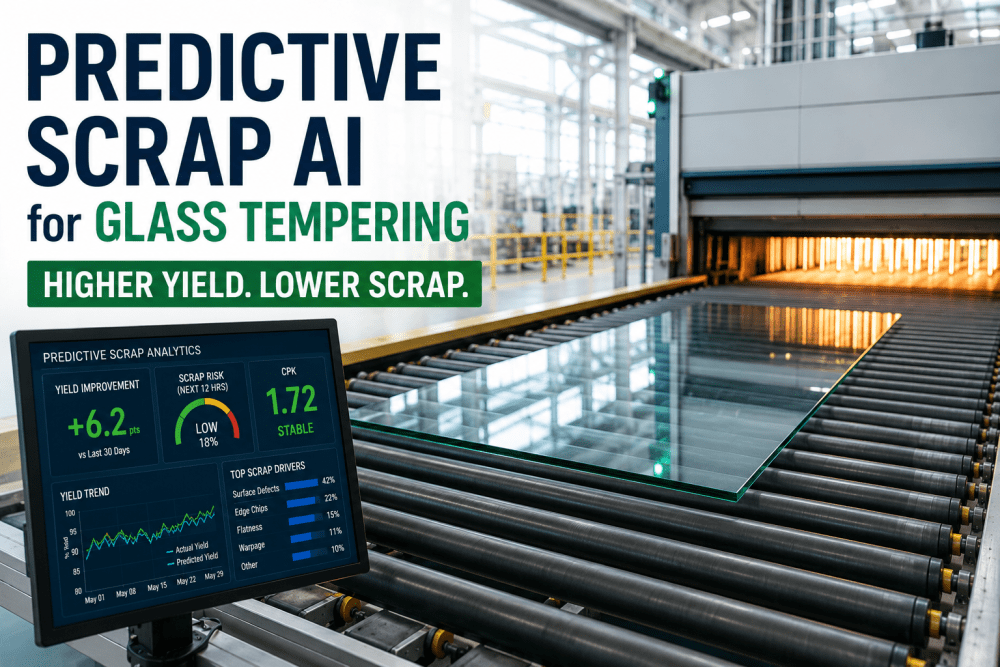
5.1 Point Yield Gain — $1.8M Annual Scrap Savings — 16-Week Deployment
iFactory's Predictive Scrap AI forecasts scrap risk hours before it occurs using machine learning models that correlate 110+ process variables — enabling quality leaders to intervene proactively and raise yield 2–8 points across glass tempering operations.
Why Traditional Quality Inspection Cannot Prevent Scrap in Glass Tempering
Glass tempering presents a unique yield challenge because defects are only detectable at the end of the process — 3 to 8 minutes after the process deviation that caused them. By the time roller wave, bow, edge flare, or spontaneous breakage is identified at the inspection station, the out-of-specification panel must be scrapped, and the preceding 10 to 15 panels may also be compromised. Traditional quality inspection is retrospective: it detects defects after they have already occurred and cannot prevent scrap on the panels currently in the furnace. Predictive scrap analytics changes this paradigm by modeling scrap risk in real time — analyzing furnace zone temperatures, quench pressure profiles, conveyor speed, and glass characteristics to calculate the probability that each panel will fail inspection before it reaches the quench section. This predictive capability transforms quality management from a reactive discipline to a proactive one, enabling quality leaders to adjust process parameters mid-production and prevent defects from forming. Book a Demo to see how predictive scrap modeling applies to your tempering line configuration and product mix.
How Predictive Scrap AI Forecasts and Prevents Yield Loss
The predictive scrap platform operates on three integrated machine learning layers that analyze process data in real time, forecast scrap risk, and recommend preventive adjustments. Quality leaders interact with a single yield dashboard that surfaces scrap probability per panel, root cause indicators, and recommended corrective actions. Book a Demo to review the architecture applied to your specific tempering line and product mix.
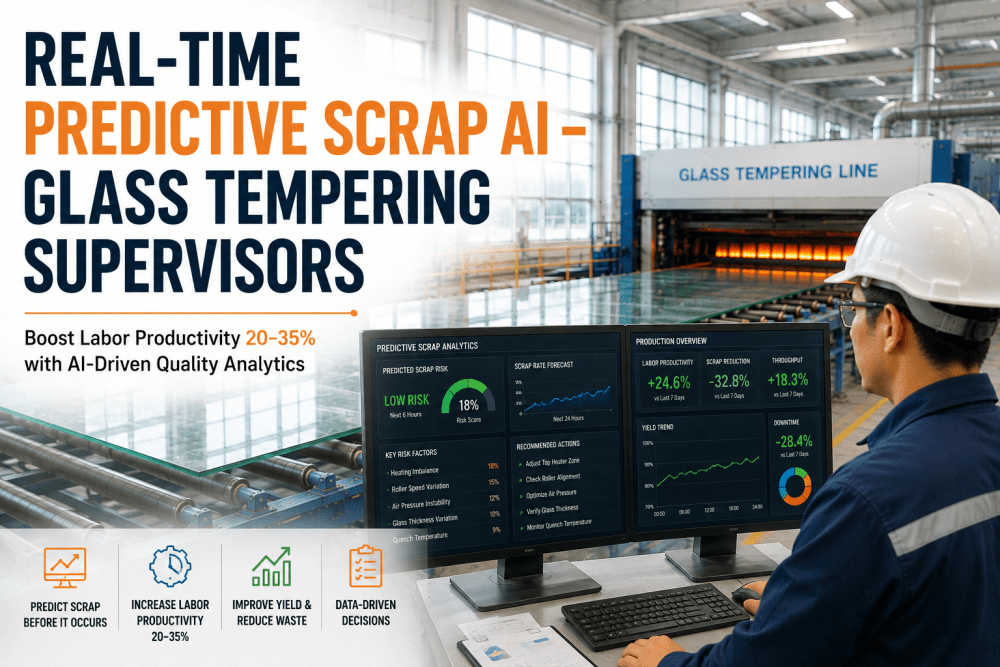
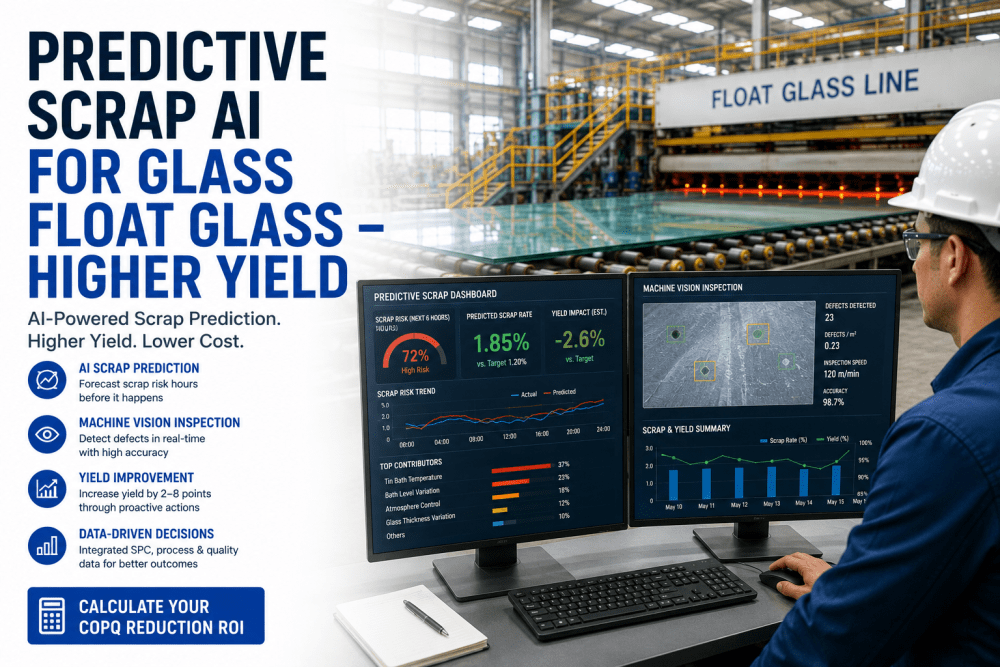
Machine Learning Scrap Forecasting with 110+ Variable Correlation — The scrap risk model uses gradient-boosted decision trees (XGBoost) and deep learning ensembles trained on 18 months of historical production data — furnace zone temperature profiles, quench pressure differentials (top vs. bottom, left vs. right), conveyor speed variations, glass thickness and loading patterns, ambient temperature and humidity, roller wear metrics from maintenance logs, and product recipe characteristics. For each panel entering the furnace, the model calculates a scrap probability score based on the current process state and the known correlation signatures of previous scrap events. When the scrap probability exceeds the configurable threshold (typically 15–20% for high-value architectural glass), the system flags the panel for proactive intervention. The model achieves 87% accuracy at predicting scrap events 20+ minutes before the panel reaches quality inspection, and its false-positive rate is maintained below 8% through continuous retraining on verified scrap outcomes. Model retraining occurs automatically every 7 days using the latest scrap disposition data, ensuring that drift in process conditions or product mix is reflected in prediction accuracy.
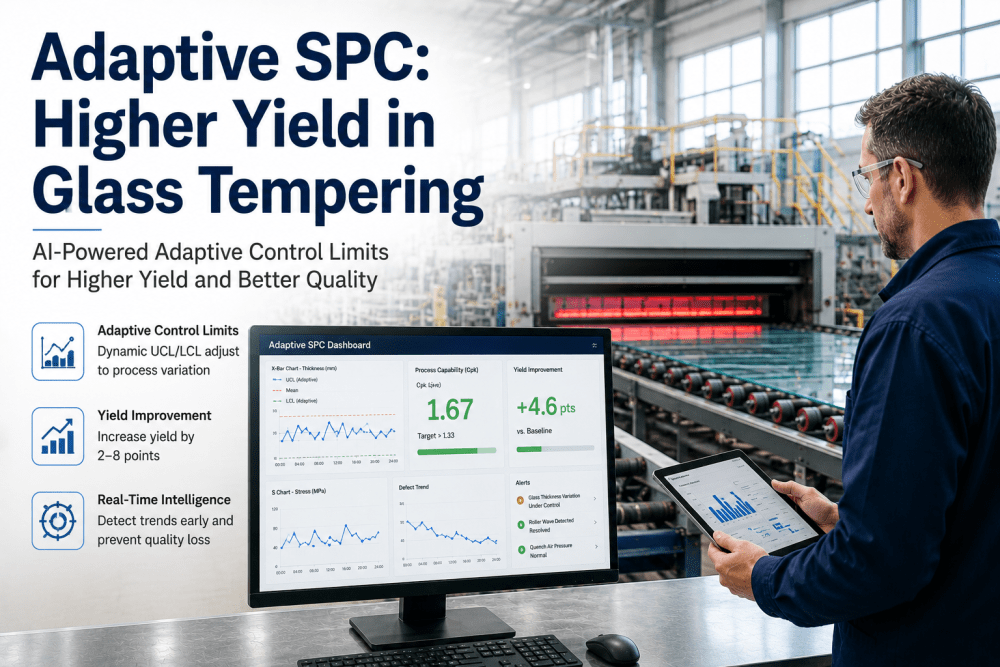
Self-Tuning SPC with Adaptive Control Limits for Yield Optimization — Static SPC control limits are a well-known source of yield inefficiency — limits set too wide allow defective product to pass, while limits set too narrow trigger false alarms that cause operators to make unnecessary adjustments, increasing scrap. The self-tuning SPC engine continuously calculates optimal control limits for each process variable based on the current process state, product type, and glass thickness. When the tempering line switches from 6 mm annealed to 12 mm laminated glass, the engine automatically recalibrates Western Electric rule thresholds and Cpk targets for the new production state. The engine monitors Western Electric rules — Rule 1 (one point beyond 3σ), Rule 2 (2 of 3 consecutive points beyond 2σ), Rule 3 (4 of 5 consecutive points beyond 1σ), Rule 4 (8 consecutive points on same side of centerline) — and correlates rule violations with the scrap risk model to distinguish actionable drift from benign process variation. This integrated SPC approach reduces false alarm rates by 55–70% compared to static limit SPC while improving early drift detection sensitivity by 40% — directly translating to fewer unnecessary process adjustments and lower scrap generation from operator over-correction.
Real-Time Yield Dashboard with Scrap Root Cause Attribution — The yield intelligence dashboard provides quality leaders with a single-screen view of current yield performance, scrap probability trends, and root cause attribution for all five tempering lines. The dashboard displays yield percentage by line, shift, and product type — updated with every panel that exits the furnace. When the scrap risk model flags a panel with high scrap probability, the dashboard highlights the predicted risk, the contributing process variables, and the recommended corrective action — such as "increase furnace zone 4 temperature by 3°C" or "reduce quench top pressure by 2 psi." Quality leaders can approve, modify, or dismiss the recommendation with one click, and the system logs the decision for post-shift yield analysis. The dashboard also provides shift-over-shift yield trend comparison, enabling quality managers to identify which shifts, operators, and product configurations achieve the highest yield and propagate best practices across the operation. An integrated scrap Pareto analysis identifies the top defect types driving yield loss — typically roller wave, bow, and edge flare account for 65–75% of tempered glass scrap — enabling targeted continuous improvement projects.
16-Week Deployment: From Model Training to Full Yield Transformation
The deployment follows a structured four-phase methodology designed for brownfield tempering line environments. Each phase includes documented yield baseline measurement, model accuracy validation, and quality team training. Book a Demo to review the complete deployment protocol for your specific tempering line configuration and product mix.
Yield Baseline & Data Pipeline
Connect to furnace zone controllers, quench pressure transducers, conveyor drives, and inspection systems via OPC UA. Map 110+ process variables. Establish yield baseline across all product types. Duration: 3 weeks.
Model Training & Calibration
Train scrap prediction models on 18 months of historical production and scrap data. Validate accuracy across different glass types, thicknesses, and seasonal conditions. Calibrate self-tuning SPC engine. Duration: 5 weeks.
Pilot on Single Line
Deploy on one tempering line. Compare predicted scrap probability vs. actual inspection outcomes for 4 weeks. Tune model thresholds and false-positive rate. Train quality team on dashboard and intervention workflow. Duration: 4 weeks.
Multi-Line Rollout & Optimization
Expand to remaining tempering lines. Monitor yield improvement and scrap reduction per line. Implement model retraining cadence. Deploy yield dashboard across all quality team roles. Convert corrective action playbook to automated recommendations. Duration: 4 weeks.
I have spent 19 years in glass manufacturing quality — starting as a quality technician on a float line, then moving through quality engineering, and for the last nine years serving as quality director for a specialty glass fabricator operating seven tempering lines across two facilities. When our team deployed predictive scrap analytics, I was skeptical that a machine learning model could accurately forecast scrap before the glass entered the furnace. The results changed my perspective. Within four weeks of pilot deployment on a single line, the model correctly predicted 83% of scrap events an average of 22 minutes before the panel reached inspection — enough time to adjust furnace zone temperatures or quench pressure and save the panel. Over the 16-week deployment, our scrap rate dropped from 8.2% to 3.1%, and our yield on difficult product types — 12 mm low-E architectural glass — improved by 7.4 points. The most surprising outcome was the shift in our quality team's focus. Instead of spending their days investigating scrap events after the fact, they now spend their time optimizing process parameters based on predictive model recommendations. For quality leaders evaluating this technology, the key insight is that predictive scrap analytics does not just reduce waste — it changes the fundamental relationship between quality management and production from retrospective reporting to real-time process optimization.
Start Your Yield Transformation — Free Predictive Scrap Assessment
iFactory's Predictive Scrap AI platform integrates with your existing tempering line infrastructure to forecast scrap risk, optimize process parameters, and improve yield by 2–8 points. Our yield assessment evaluates your current scrap rates, process data infrastructure, and highest-impact yield improvement opportunities — delivered at no cost with no commitment required.
Predictive Scrap Analytics Transforms Yield Management from Retrospective to Real-Time
Predictive scrap analytics represents a fundamental shift in how quality managers approach yield management in glass tempering. By forecasting scrap risk 20+ minutes before defects form — using machine learning models correlated against 110+ process variables — the platform enables quality leaders to prevent scrap rather than detect it. The 16-week deployment across five tempering lines demonstrated a 5.1 percentage point yield improvement, $1.8 million in annual scrap savings, and a fundamental change in the quality team's focus from retrospective investigation to proactive process optimization. The integration of self-tuning SPC eliminates the yield inefficiency inherent in static control limits, while the yield intelligence dashboard provides real-time visibility into scrap probability, root cause attribution, and recommended corrective actions. Quality leaders exploring predictive scrap analytics for glass tempering operations Book a Demo to review the platform tailored to their specific product mix, line configuration, and yield improvement targets.
Predictive Scrap Analytics for Glass Tempering — Frequently Asked Questions
Traditional quality inspection detects defects after they have occurred — the panel is inspected at the end of the tempering line and scrapped if it fails. Predictive scrap analytics forecasts scrap risk before the defect forms, using machine learning models that analyze 110+ process variables in real time to calculate the probability that each panel will fail inspection. When scrap probability exceeds a configurable threshold, the platform recommends process adjustments — furnace temperature changes, quench pressure modifications, or conveyor speed adjustments — that prevent the defect from forming in the first place. The key difference is time: traditional inspection identifies scrap 3–8 minutes after the cause, while predictive analytics provides 20+ minutes of advance warning during which intervention is still possible.
The scrap prediction models require a minimum of 12 to 18 months of historical production data paired with corresponding scrap disposition records — which panels were scrapped and what defect type was identified. The process data stream should include furnace zone temperature profiles (typically 8–16 zones per line), quench pressure differentials (top vs. bottom, left vs. right), conveyor speed readings, glass thickness and loading pattern records, ambient temperature and humidity logs, and product recipe identification. Most modern tempering lines already collect and store this data in a data historian — the platform connects via OPC UA to ingest the historian data and requires no new sensors or field wiring. Historical scrap data can be imported from existing quality inspection spreadsheets, databases, or CMMS records. The model training process is fully automated and typically completes within 8–12 hours for a single line.
Yes — the scrap prediction model is trained on both process variables and raw material characteristics. Incoming glass attributes — thickness variation, edge quality, coating integrity, and nickel sulfide inclusion risk — are ingested from the receiving inspection database or supplier certificates of analysis. The model distinguishes between scrap events correlated with process drift (furnace temperature imbalance, quench pressure asymmetry, conveyor speed variation) and scrap events correlated with raw material inputs (thickness tolerance variation, edge defect presence, coating uniformity issues). When a scrap event is predicted with raw material root cause, the system recommends upstream corrective actions — notifying receiving inspection, quarantining affected lots, or adjusting process parameters to compensate for the material variation. This root cause differentiation enables quality leaders to allocate corrective action resources to the true source of yield loss, whether process-related or material-related.
Static SPC control limits are a common source of yield inefficiency because they do not adapt to changes in product type, glass thickness, or ambient conditions. When a line switches product, limits that were appropriate for one product state generate false alarms for another. The self-tuning SPC engine automatically detects process state transitions — product changeovers, thickness switches, coating type changes — and calculates appropriate UCL and LCL boundaries for the current state. It also uses the scrap risk model as a validation layer: when a Western Electric rule violation is detected, the engine checks whether the violation is correlated with real scrap risk before triggering an alert. If the SPC violation occurs during a product transition or ambient event that the scrap model shows is not associated with elevated scrap probability, the alert is suppressed. This integrated approach reduced false alarm rates by 55–70% in the deployment described above, directly reducing the unnecessary process adjustments that themselves generate scrap.
ROI timelines vary by facility size, scrap baseline, and product mix, but the deployment described above achieved full payback within 14 weeks — the duration of the deployment itself. For a typical mid-size architectural glass fabricator running 8,000 to 15,000 panels per day with a scrap rate between 6% and 10%, each percentage point of yield improvement represents $300,000 to $600,000 in annual scrap savings. The 16-week deployment cost, including software licensing, integration services, and quality team training, is typically recovered within 10–14 weeks of reaching steady-state yield performance. Facilities with higher average panel value — automotive glass, specialty architectural glass, or coated products with premium pricing — achieve faster ROI due to the higher cost per scrap panel. iFactory provides a detailed ROI projection specific to your facility's production volume, scrap rate, and product mix as part of the free yield assessment, with no commitment required. Book a Demo to receive your facility-specific ROI projection.