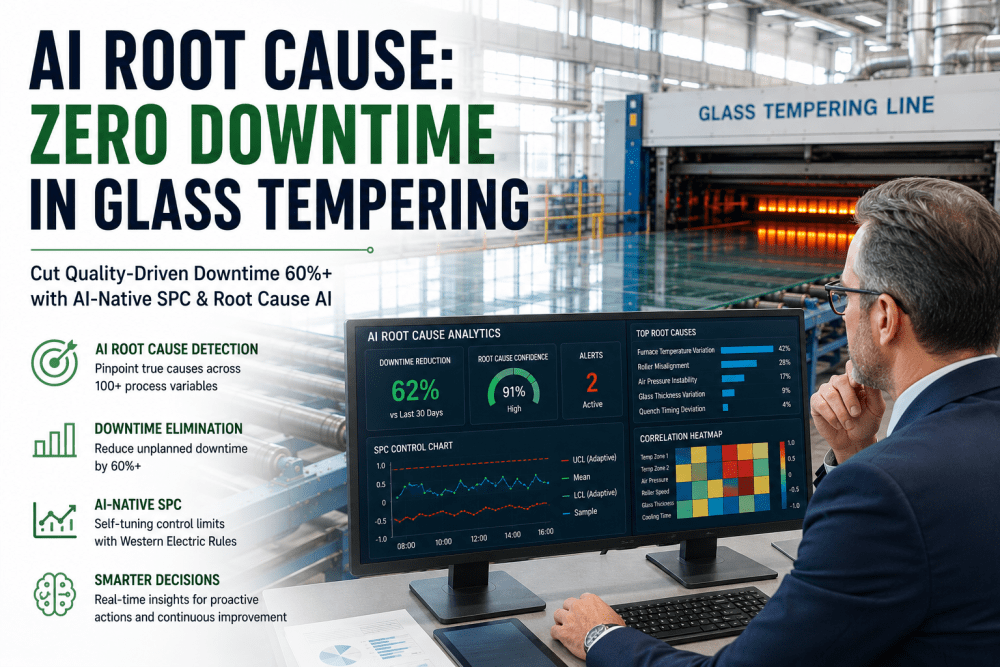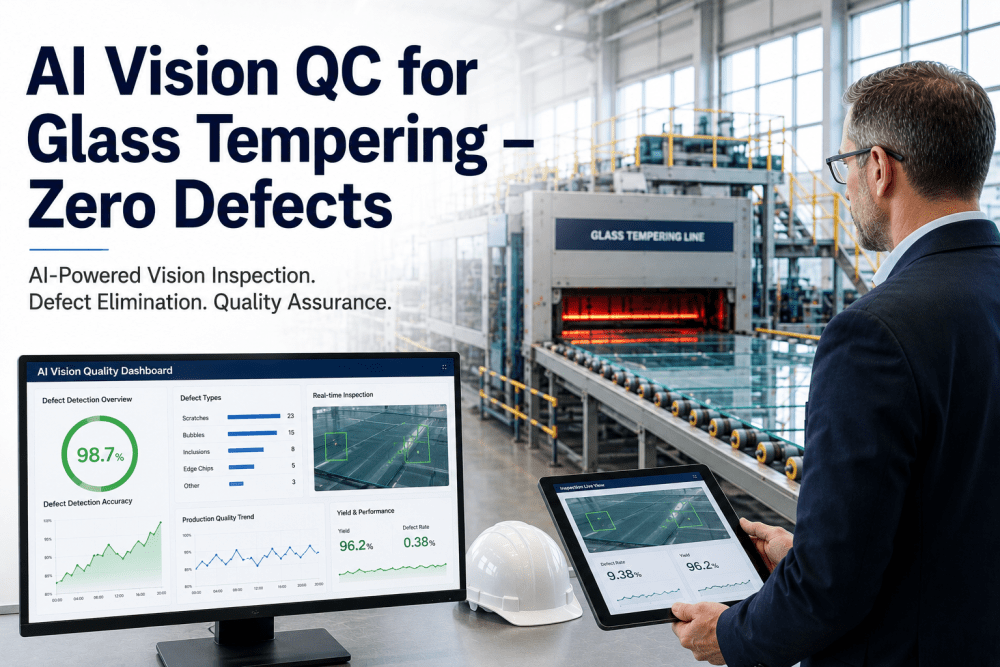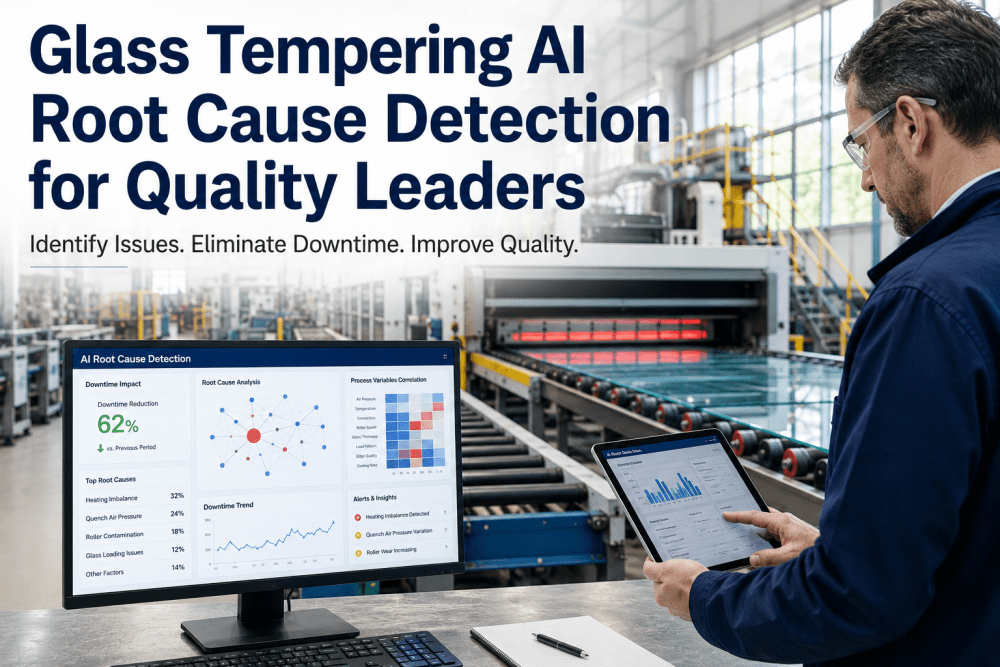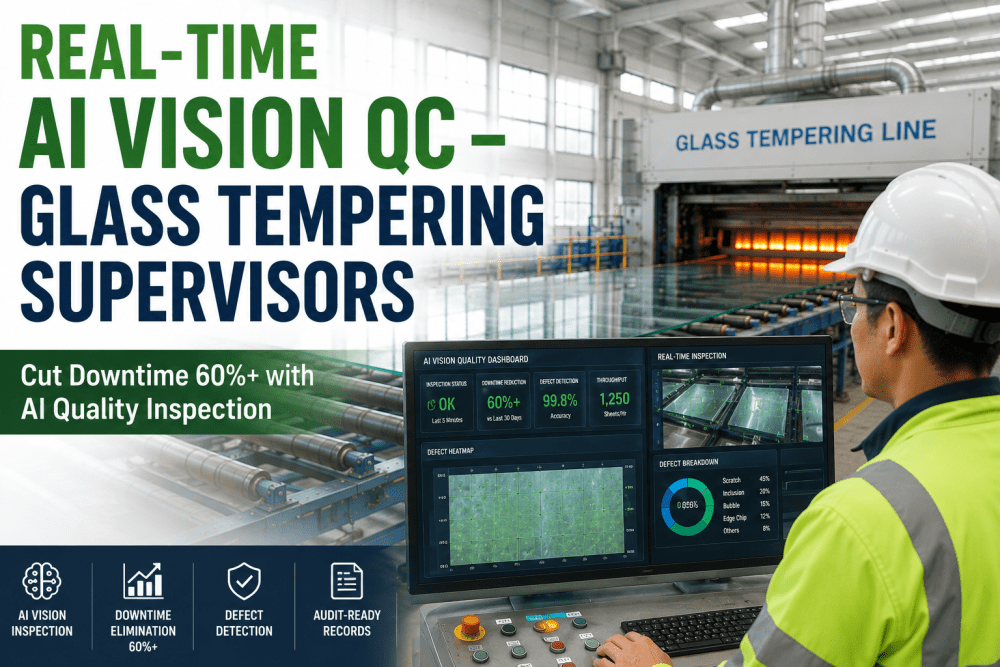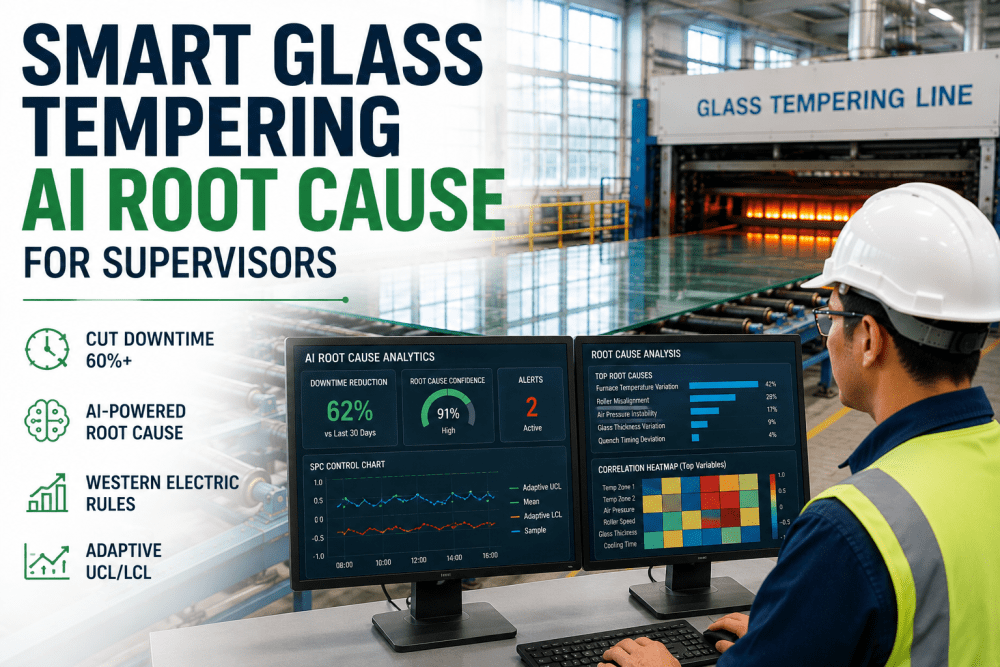
Glass tempering is a precision thermal process where glass panels are heated to approximately 620°C and then rapidly quenched to create surface compression. In this cycle, small deviations in furnace zone temperature, conveyor speed, quench pressure, or edge heating profiles can produce quality defects — bow, roller wave, edge flare, spontaneous breakage — that are only detected at the inspection station minutes later, at which point out-of-specification product must be scrapped. For shift supervisors managing tempering production lines, identifying the true root cause of these defects has traditionally required hours of manual data review across dozens of process parameters. AI root cause detection changes this paradigm by automatically correlating more than 100 process variables — furnace temperature zones, quench pressure differentials, conveyor speed profiles, glass thickness inputs, ambient conditions, and roller wear metrics — to pinpoint defect sources in minutes rather than shifts. This capability enables supervisors to eliminate quality-driven downtime by over 60%, reduce troubleshooting effort, and maintain consistent production efficiency across all shifts. Book a Demo to see how iFactory's AI root cause detection applies to your glass tempering operation.
The Quality Challenge — Why Root Cause Detection Matters in Glass Tempering
Glass tempering is an "unforgiving" manufacturing process — once a lite is tempered, you cannot re-cut, rework, or change an edge without causing breakage. Quality deviations that develop during the thermal cycle — roller wave from furnace imbalance, bow from uneven quench pressure, edge flare from improper heating profiles, or spontaneous breakage from nickel sulfide inclusion — are only detectable at the end of the line. When a defect is found, the supervisor faces a forensic challenge: the process deviation occurred 3 to 8 minutes upstream, and dozens of variables could be responsible. Traditional root cause analysis requires manually reviewing temperature charts, pressure logs, conveyor speed records, and shift notes — a process that consumes 45 to 90 minutes per incident and often produces inconclusive results. During that time, the line may continue producing out-of-specification product, compounding scrap losses. AI root cause detection eliminates this forensic bottleneck by automatically correlating every process variable against defect occurrence data and delivering a ranked list of probable causes to the supervisor within seconds.
| Capability Dimension | Traditional Root Cause Analysis | AI Root Cause Detection | Improvement Factor |
|---|---|---|---|
| Time to Identify Root Cause | 45–90 minutes of manual data review across control charts, shift logs, and inspection records | Under 5 minutes — automated multivariate correlation analysis delivers ranked probable causes | 10–18x faster root cause identification |
| Variables Analyzed | 8–15 variables reviewed manually; limited to what one supervisor can cross-reference in real time | 100+ process variables correlated simultaneously — furnace zones, quench pressures, speed, thickness, ambient conditions | 7–12x more variables analyzed per event |
| Detection Timing | Reactive — defect discovered at inspection station 3–8 minutes after process deviation occurred | Proactive — Western Electric rule violations and adaptive UCL/LCL drift alerts during the process window | Shift from reactive to real-time intervention |
| Shift Consistency | Highly variable — depends on individual supervisor experience, shift staffing levels, and institutional knowledge | Consistent — same ML model applies identical correlation logic across every shift, operator, and product changeover | Consistent RCA quality across all shifts |
| Documentation & Learning | Manual shift log entries; root cause findings rarely captured in searchable, structured format for future reference | Automated RCA documentation with tagged process variables, time-stamped events, and corrective action tracking | Searchable institutional knowledge base built automatically |
How AI Root Cause Detection Works — Three Core Capabilities for Supervisors
iFactory's AI root cause detection platform for glass tempering combines three integrated capabilities that work together to eliminate quality-driven downtime. Shift supervisors interact with a single dashboard that surfaces root cause findings, process drift alerts, and corrective action recommendations without requiring data science expertise. Each capability is designed to reduce the time between process deviation and corrective action, keeping tempering lines running at target quality levels across all shifts.
Multivariate Correlation Analysis Across 100+ Process Variables — Glass tempering defects rarely have a single cause. Roller wave may result from a combination of furnace zone 3 temperature drift, conveyor speed variation, and roller wear on position 7. Traditional univariate SPC monitoring would miss this multivariate interaction because no single variable crosses its threshold. iFactory's AI engine uses multivariate machine learning models that correlate every process variable simultaneously — furnace heating zone temperatures (typically 8–16 zones), quench pressure differentials (top vs. bottom, left vs. right), conveyor speed profiles, glass thickness and loading patterns, ambient temperature and humidity, roller condition metrics, and heating cycle duration. When a defect event occurs at inspection, the engine traces backward through the process timeline, identifies which variable combinations are statistically correlated with the defect signature, and presents the supervisor with a ranked list of probable root causes — typically reducing the investigation space from dozens of variables to 2–3 likely contributors. This capability alone eliminates 70–80% of the manual investigation time per defect event.
Adaptive UCL/LCL with Western Electric Rule Monitoring — Static control limits are a persistent source of frustration for supervisors. When the tempering line switches from 6 mm annealed to 10 mm laminated glass, the process mean shifts naturally — but static control charts either generate false alarms or miss real drift because the limits were calculated for the previous product state. iFactory's adaptive UCL/LCL engine automatically detects process state changes (product changeover, thickness switch, loading pattern shift) and recalculates upper and lower control limits appropriate for the current production conditions. The engine then monitors Western Electric rules continuously — Rule 1 (one point beyond 3σ), Rule 2 (2 of 3 consecutive points beyond 2σ), Rule 3 (4 of 5 consecutive points beyond 1σ), and Rule 4 (8 consecutive points on same side of centerline) — and alerts the supervisor only when actionable drift is detected. The adaptive algorithm distinguishes between intentional process variation (scheduled changeovers, ambient temperature effects) and actionable drift signals (furnace zone degradation, burner imbalance, quench nozzle blockage), reducing false alarms by 60–80% compared to static SPC while improving drift detection sensitivity during steady-state production.
Automated Root Cause Analysis with Corrective Action Recommendations — When a defect is detected at the inspection station, the automated RCA engine immediately executes a structured investigation workflow. The engine ingests the defect type, location, and severity from the inspection system, then queries the multivariate correlation model to identify the most probable contributing variables. Next, it cross-references the current process state against a curated playbook of proven corrective adjustments — for example, "furnace zone 5 temperature 8°C above target with quench pressure differential exceeding 15% suggests burner imbalance; recommended action: trim zone 5 burner by 3% and verify quench pressure differential returns to under 10% within 6 production cycles." The supervisor receives the RCA report with ranked probable causes, recommended corrective actions, expected impact, and guardrails — all within 30 seconds of the defect being flagged at inspection. The supervisor can approve the action with one click, modify it with recorded rationale, or decline it — and every decision is logged to build institutional knowledge for future root cause recognition across all shifts.
Implementation Roadmap — Deploying AI Root Cause Detection on Your Tempering Line
Deploying AI root cause detection follows a structured five-phase methodology that minimizes operational disruption while delivering measurable downtime reduction from the first pilot week. The roadmap is designed to build supervisor confidence progressively, starting with a single production line before expanding across the entire tempering operation.
Expert Perspective — AI Root Cause Detection on the Glass Tempering Floor
I have spent 14 years in glass manufacturing — starting as a tempering line operator, then moving through quality control, and for the last five years serving as production shift supervisor at a facility running three tempering lines 24 hours a day. Before AI root cause detection, every defect event triggered the same time-consuming investigation: pull temperature charts, check pressure logs, review conveyor speed records, talk to the previous shift operator, and try to piece together what happened during the 3-to-8-minute window between the process deviation and when the defect appeared at inspection. Some investigations took over an hour, and even then we were guessing based on incomplete data. The AI root cause detection system changed our approach fundamentally. Now when a defect is flagged at inspection, I have a root cause analysis on my dashboard within 30 seconds — ranked by probability, with specific variables identified and corrective actions recommended. Our quality-driven downtime dropped by 65% in the first eight weeks, and our troubleshooting time per defect event went from 75 minutes to under 8 minutes. The most valuable outcome has been shift-to-shift consistency — the AI system applies the same rigorous analysis every time, regardless of which supervisor is on duty or how much experience they have. For supervisors evaluating this technology, the key insight is that AI root cause detection does not replace your expertise — it gives you the analytical horsepower of a full quality engineering team at your fingertips on every shift.
— Production Shift Supervisor, Glass Tempering Facility — 14 Years in Glass Manufacturing OperationsKey Benefits — What Supervisors Gain with AI Root Cause Detection
Deploying AI root cause detection transforms how supervisors manage quality on glass tempering lines. The benefits extend beyond downtime reduction to include process stability improvements, data quality enhancements, and organizational knowledge retention that compound over time as the ML model learns from every defect event and corrective action across all shifts.
Conclusion
AI root cause detection for glass tempering represents a step-change improvement in how shift supervisors manage quality and downtime on the production floor. By combining multivariate ML correlation across 100+ process variables, adaptive UCL/LCL with Western Electric rule monitoring, and automated RCA with corrective action recommendations, the platform gives supervisors the analytical capability of a full quality engineering team on every shift — without requiring data science expertise or expanding headcount. The structured five-phase deployment methodology ensures that supervisors build confidence progressively, starting with a single production line pilot and expanding to full operation based on validated downtime reduction, false alarm rate, and root cause precision metrics.
iFactory's AI root cause detection platform integrates directly with your existing tempering line controllers, quench pressure transducers, conveyor drives, inspection systems, and data historian — delivering real-time root cause analysis and adaptive SPC monitoring without replacing existing control infrastructure. The platform is designed for the shift-floor environment with large-format dashboards, color-coded alerts, and one-click corrective action approval that supervisors can operate effectively after minimal training. The next step for production supervisors and plant managers is a free AI root cause assessment that evaluates your tempering line's current defect investigation workflow, data infrastructure readiness, and highest-impact automation opportunities. Book a Demo to start your assessment and discover how AI root cause detection can eliminate quality-driven downtime on your glass tempering lines.
Frequently Asked Questions
The AI root cause detection engine typically delivers a ranked list of probable causes with recommended corrective actions within 30 seconds of a defect being flagged at the inspection station. This represents a 90–95% reduction in investigation time compared to traditional manual root cause analysis, which typically requires 45 to 90 minutes of cross-referencing temperature charts, pressure logs, conveyor speed records, and shift notes. The engine correlates 100+ process variables — furnace zone temperatures, quench pressure differentials, conveyor speed profiles, glass thickness inputs, ambient conditions, and roller condition metrics — simultaneously, tracing backward through the 3-to-8-minute process window between the process deviation and the defect's appearance at the inspection station. The supervisor receives a comprehensive RCA report with ranked probable causes, specific variable contributions, recommended corrective actions with expected impact, and guardrails — enabling informed decision-making within the same production cycle.
No — iFactory's AI root cause detection platform is designed as an overlay layer that integrates with your existing tempering line infrastructure without replacing PLCs, furnace controllers, quench pressure regulators, conveyor drives, or inspection systems. The platform reads process data from your existing data historian, SCADA system, or directly from controller outputs using standard industrial protocols (OPC UA, Modbus TCP, MQTT). It receives defect detection data from your existing inspection system through API or database integration. The ML analysis and dashboard layers run on a separate edge or cloud server, processing data from the existing infrastructure and delivering root cause findings, drift alerts, and corrective action recommendations to the supervisor dashboard. This integration approach means the platform can typically be deployed and operational within 2–4 weeks without modifying any existing control system logic, PLC code, or inspection system configuration. The platform also integrates with iFactory's CMMS, MES, and quality management modules for facilities already using the iFactory ecosystem, but the AI root cause detection engine functions as a standalone solution with any tempering line infrastructure.
AI root cause detection is applicable to the full spectrum of glass tempering defects, including roller wave (from furnace zone temperature imbalance and roller wear), bow and warp (from uneven quench pressure distribution between top and bottom nozzles), edge flare and edge damage (from improper heating profiles or edge heating element degradation), spontaneous breakage (from nickel sulfide inclusion or edge micro-cracks amplified by thermal stress), optical distortion and anisotropy (from uneven cooling rates across the glass surface), surface pitting and haze (from roller residuals or quench medium contamination), and dimensional drift (from conveyor speed calibration drift or thickness measurement sensor error). The ML model learns the correlation signatures between specific defect types and process variable patterns during the training phase, and continues to improve its accuracy as it processes more defect events and corrective action outcomes across all shifts and product types. For new defect types not previously encountered, the system flags the event as an anomaly and captures the process variable snapshot for supervised learning during the next model update cycle.
The adaptive UCL/LCL engine automatically detects process state transitions — including product changeovers, glass thickness switches, loading pattern shifts, and ambient temperature changes — and recalculates upper and lower control limits appropriate for the current production state. When the tempering line switches from 6 mm annealed glass to 10 mm laminated glass, the engine identifies the process state change through a combination of categorical signals (product recipe ID, thickness setpoint) and continuous variable shifts (furnace temperature ramps, conveyor speed changes, quench pressure adjustments). It then loads or calculates the appropriate UCL and LCL boundaries for the new state and begins monitoring Western Electric rules against the new limits — without requiring operator intervention or manual limit adjustment. The adaptive algorithm maintains separate baseline profiles for each product type and glass thickness combination the line runs, and continuously refines these profiles as new production data accumulates. During steady-state production within a single product run, the engine applies tighter detection sensitivity because the process is expected to be stable, while at transition points it applies wider allowable bands that accommodate the natural process variation of changeovers.
The supervisor dashboard is designed for the shift-floor environment and requires less than 15 minutes of training for supervisors to operate effectively. The interface uses large-format text, color-coded alert severity indicators (green for normal, yellow for watch, red for action required), and one-click corrective action approval workflow — eliminating the need for data science expertise, SPC certification, or ML knowledge. Supervisors interact with three primary views: the process health dashboard showing real-time status of all monitored variables with drift alerts and Western Electric rule violations; the root cause analysis view presenting ranked probable causes, variable contributions, and recommended corrective actions for each defect event; and the trend analysis view showing process stability trends, defect frequency by type, and corrective action effectiveness over time. iFactory provides on-floor training sessions during the pilot deployment phase, typically two 30-minute sessions per shift, covering dashboard navigation, alert response workflow, corrective action approval process, and system configuration. All training materials include quick-reference guides posted at the dashboard workstation for ongoing reference.


.png)