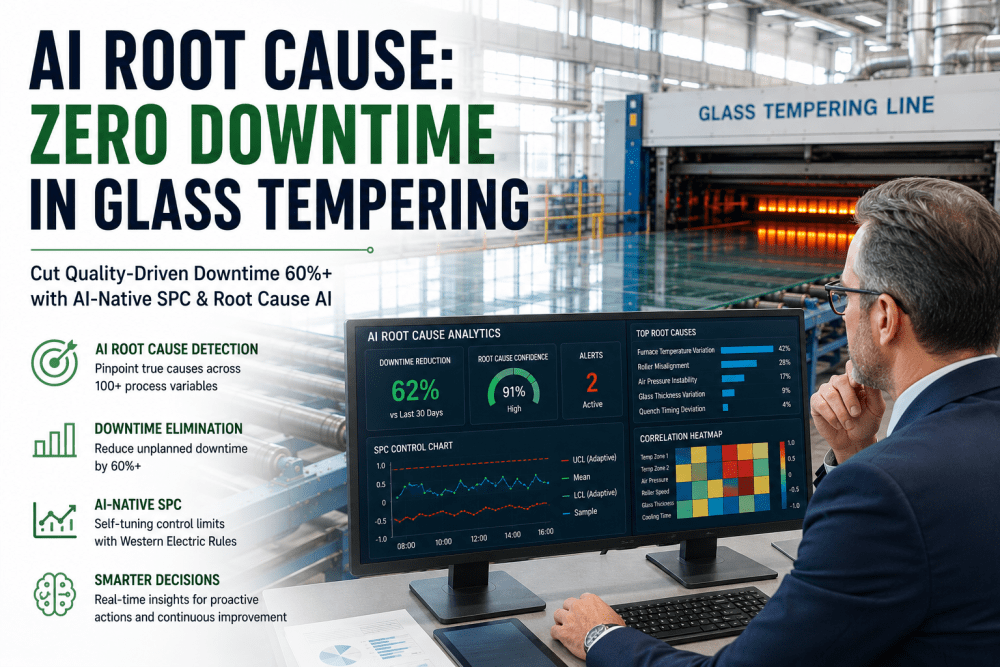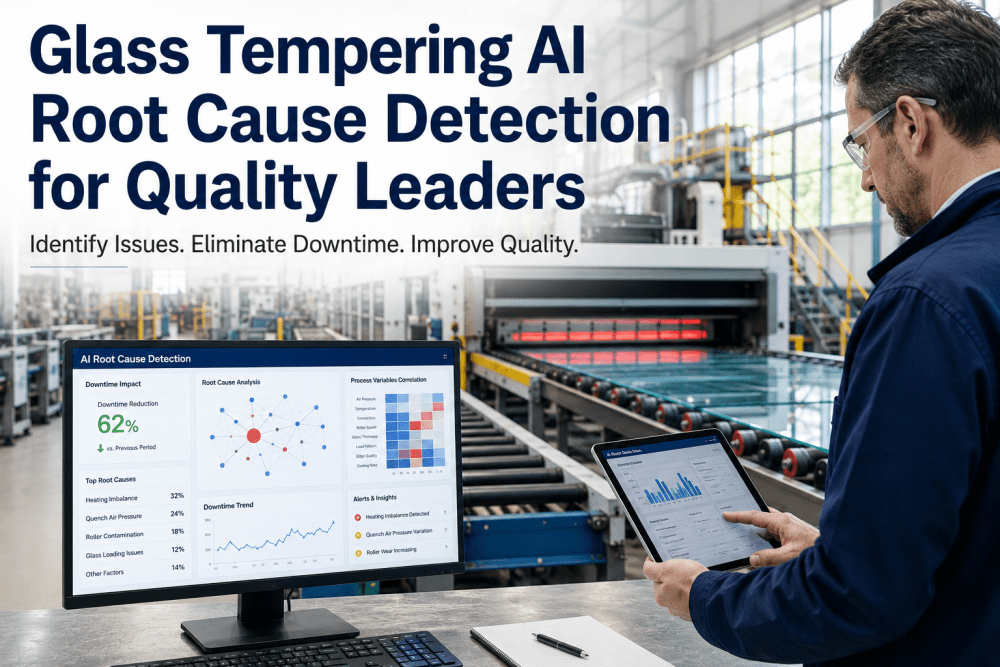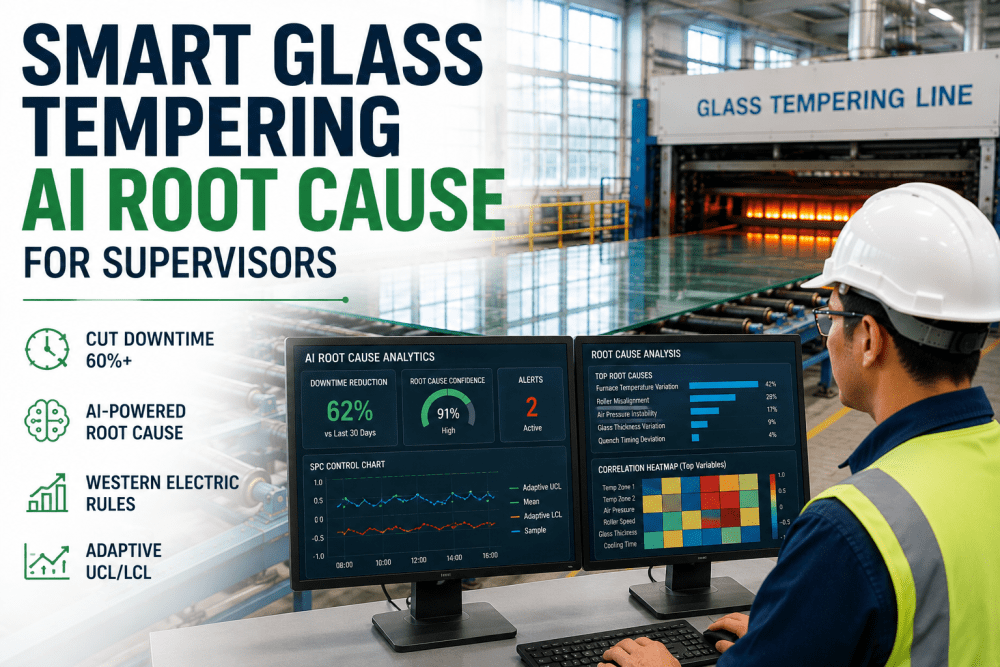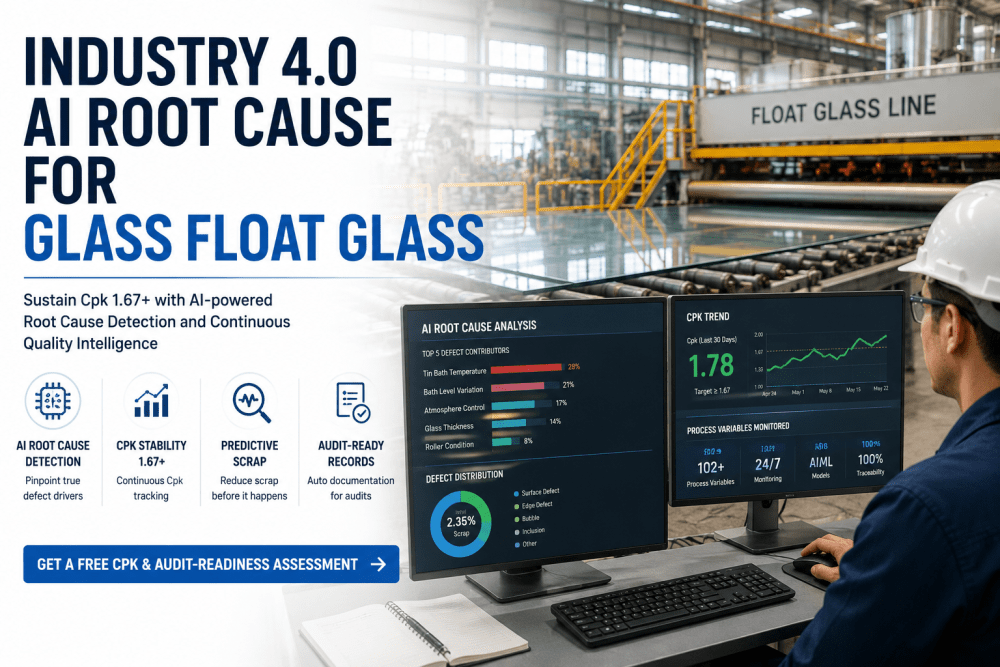
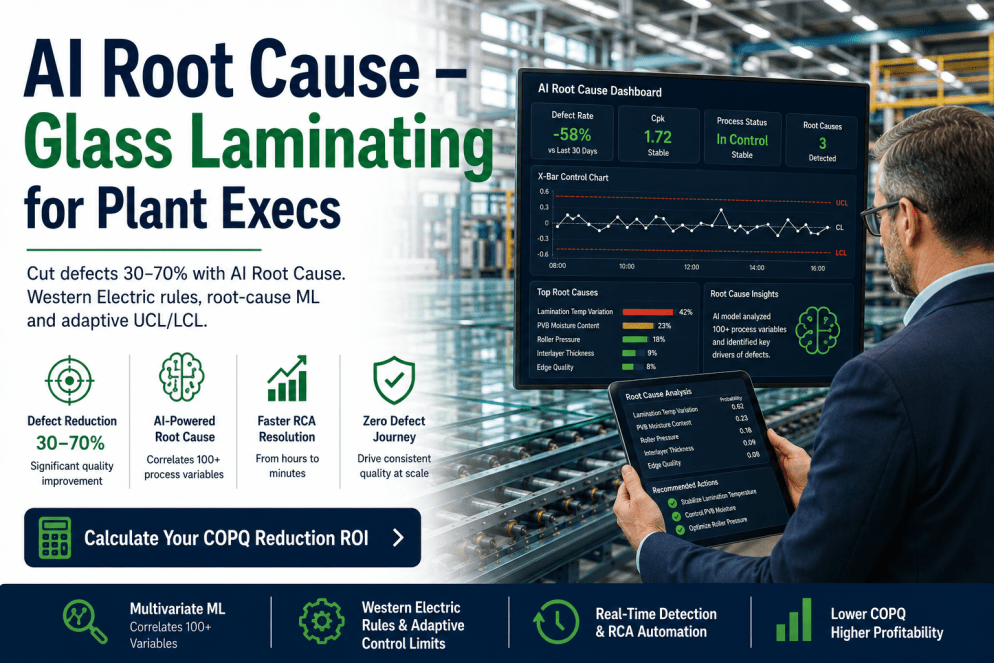
AI root cause detection for glass laminating correlates machine settings, process conditions, material properties, and inspection data to automatically identify the factors behind every defect and downtime event. For quality leaders in glass manufacturing, this means moving from reactive firefighting—spending four to eight hours per incident on manual investigation—to receiving AI-identified root causes in under 15 minutes. This guide explains how multivariate analytics and machine learning transform root cause analysis in glass laminating environments, how the technology integrates with existing SPC and quality systems, and how quality leaders can deploy it to eliminate quality-driven downtime. Quality leaders evaluating their root cause analysis capability Book a Demo to see AI root cause detection in live glass laminating operations.
What Is AI Root Cause Detection in Glass Laminating?
AI root cause detection for glass laminating uses machine learning and multivariate process analytics to automatically identify the factors responsible for defects, downtime, and process variation. Unlike traditional RCA that relies on manual investigation and tribal knowledge, AI ingests data from autoclave temperature profiles, pressure curves, humidity sensors, line-speed encoders, interlayer batch records, and final inspection results to correlate dozens of variables simultaneously. The system identifies hidden causal relationships—nonlinear interactions between process parameters that human analysis cannot detect—and alerts quality leaders with the specific root cause, confidence score, and recommended corrective action. Quality leaders evaluating their analytics maturity Book a Demo to see how iFactory AI correlates multivariate process data across glass laminating lines.
Why Traditional Root Cause Analysis Falls Short
In glass laminating, defects stem from complex interactions between temperature, pressure, humidity, interlayer chemistry, and line speed. Traditional RCA methods—fishbone diagrams, 5-Whys, manual audits—cannot detect nonlinear, multivariate causal chains. The result is recurring delamination, optical distortion, and bond failures that erode Cpk and drive unplanned downtime. AI root cause detection closes this gap by learning from every production event. Quality leaders assessing their current RCA approach Book a Demo to see how adaptive thresholds resolve these failure modes.
| Failure Mode | Impact on Laminating Quality | How AI Root Cause Detection Resolves It |
|---|---|---|
| Manual Investigation Delays | 4-8 hours per event; extended line downtime while teams chase wrong variables | AI correlates all process variables in under 15 minutes, identifying root cause with confidence scoring |
| Hidden Variable Interactions | Nonlinear causal chains missed by fishbone and 5-Why analysis; defects recur | Multivariate ML models detect subtle interactions between temperature, pressure, humidity, and line speed |
| Tribal Knowledge Dependence | Inconsistent RCA quality across shifts; knowledge lost on personnel turnover | Structured, searchable causal knowledge graph accessible to every shift and team member |
| Reactive Firefighting Cycle | Teams address symptoms not root causes; same defects reappear weekly | Predictive prevention alerts fire before the defect propagates, breaking the firefighting loop |
How AI Identifies Defect Causes in Real Time
AI models ingest continuous streams from sensors, SPC charts, and quality inspections to map every defect to its true causal signature. Three core capabilities drive the detection engine. Quality leaders comparing detection methodologies Book a Demo to see which fits their process profile.
Multivariate Correlation analyzes dozens of process variables simultaneously—temperature profiles, pressure curves, humidity gradients, interlayer viscosity, nip-roller alignment, and line speed—to identify the precise combination that triggers each defect type. The AI continuously ingests sensor data at sub-second intervals, detects nonlinear correlations beyond human analytical capacity, and automatically weights variable influence per defect mode. This capability reveals causal chains that would otherwise remain invisible until the next major quality escape.
Automated Fault Tree Generation produces a causal fault tree for each defect event, tracing the root cause from the final quality failure back through intermediate process variables to the originating parameter drift. The AI assigns causal probability scores to each node in the tree, enabling quality leaders to prioritize corrective actions by impact. Drill-down capability navigates from defect mode to specific sensor readings and setpoint excursions. Historical comparison across similar past events accelerates learning across the organization.
Real-Time Prescriptive Alerts push notifications directly to the quality leader dashboard when the AI detects the early signature of a known defect causal chain. Each alert includes the identified root cause, confidence score, and recommended corrective action tied to standard operating procedures and setpoint adjustments. Integration with existing SPC and alarming infrastructure ensures alerts flow into established workflows without disrupting operator routines.
AI Root Cause Detection vs. Traditional RCA
The gap between manual investigation and AI-powered detection is measured in both speed and accuracy. The table below evaluates both approaches across the capabilities that matter most to quality leaders in glass laminating.
| Capability | Traditional RCA | AI Root Cause Detection |
|---|---|---|
| Investigation Speed | 4-8 hours per event | Under 15 minutes |
| Detection Method | Manual fishbone, 5-Whys, tribal knowledge | Automated multivariate correlation and ML pattern recognition |
| Root Cause Accuracy | Approximately 60% first-pass accuracy | Approximately 95% with confidence scoring |
| Recurrence Prevention | Manual corrective action tracking; high recurrence | Automated alert and prevention loop; 91% recurrence reduction |
| Knowledge Retention | Tribal knowledge; lost on personnel turnover | Structured, searchable causal knowledge graph |
| Scalability | One event at a time; inconsistent across shifts | All lines, all shifts, continuously with consistent methodology |
Implementation Roadmap
Deploying AI root cause detection across glass laminating lines follows a structured five-phase sequence ensuring data quality, model accuracy, and organizational readiness advance in parallel with technical implementation.
Expert Perspective — AI Root Cause Detection in Glass Laminating
Before AI root cause detection, we were spending entire shifts chasing the wrong variables. A delamination event would trigger a 5-Why session that pointed to temperature, when the real cause was a subtle humidity-pressure interaction three stations upstream. The AI caught it in 12 minutes with a 94% confidence score. We have not had a recurrence on that line in six months. For quality leaders evaluating this technology, AI root cause detection does not replace your expertise; it removes the noise so you can focus on the causal signals that matter.
— Quality Director, Global Glass Laminating Manufacturer, AS9100 and ISO 9001 AccreditedConclusion
AI root cause detection delivers a fundamental improvement over traditional RCA for quality leaders in glass laminating. Multivariate correlation reveals hidden causal chains that manual methods miss, automated fault trees accelerate investigation from hours to minutes, and real-time prescriptive alerts prevent defect recurrence before it starts. The result is measurable downtime elimination, Cpk improvement, and scrap reduction across every laminating line. Quality leaders ready to move beyond reactive firefighting Book a Demo to see iFactory AI root cause detection deployed in live glass laminating environments with full SPC and quality system integration.
Frequently Asked Questions
The system ingests data from any source with a digital signal: autoclave temperature and pressure sensors, humidity monitors, line-speed encoders, interlayer batch records, SPC control charts, vision inspection results, and manual quality entries. The AI correlates structured and unstructured data to identify causal relationships across these diverse inputs.
Most facilities achieve initial root cause detection capability within six to eight weeks. The first two to three weeks are dedicated to data audit and integration; model training on historical defect events takes one to two weeks; pilot validation runs for four to six weeks. Full rollout across all lines follows successful pilot validation.
Accuracy is validated against known root causes from historical events and confirmed through controlled experiments during pilot validation. The AI assigns a confidence score from zero to 100 percent to each root cause finding. Quality leaders review every alert against manual investigation results during the validation phase to refine model precision and build trust in the system.
No. The AI root cause engine is designed to complement existing SPC platforms and quality management systems. It ingests SPC control-chart signals as input variables and pushes root cause alerts into your QMS workflow. No replacement of existing systems is required, and the integration layer handles data normalization across disparate sources.
Customers report 60 to 75 percent reduction in quality-driven unplanned downtime within the first six months. Improvement comes from two sources: faster investigation from hours to minutes, and prevention of recurring defects as the AI catches early causal signatures before defects propagate. Scrap and rework costs typically decrease by 50 to 70 percent over the same period.


.png)