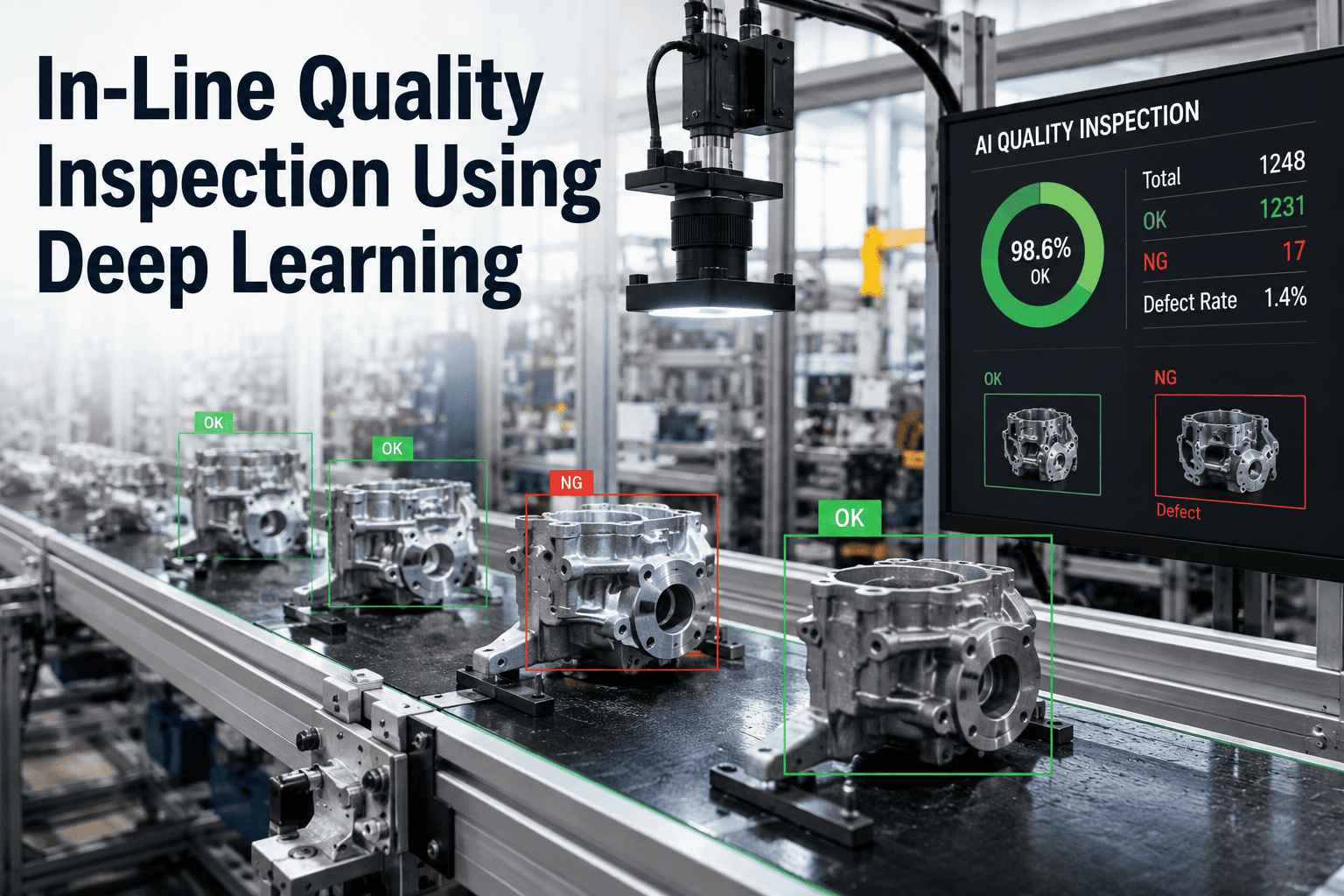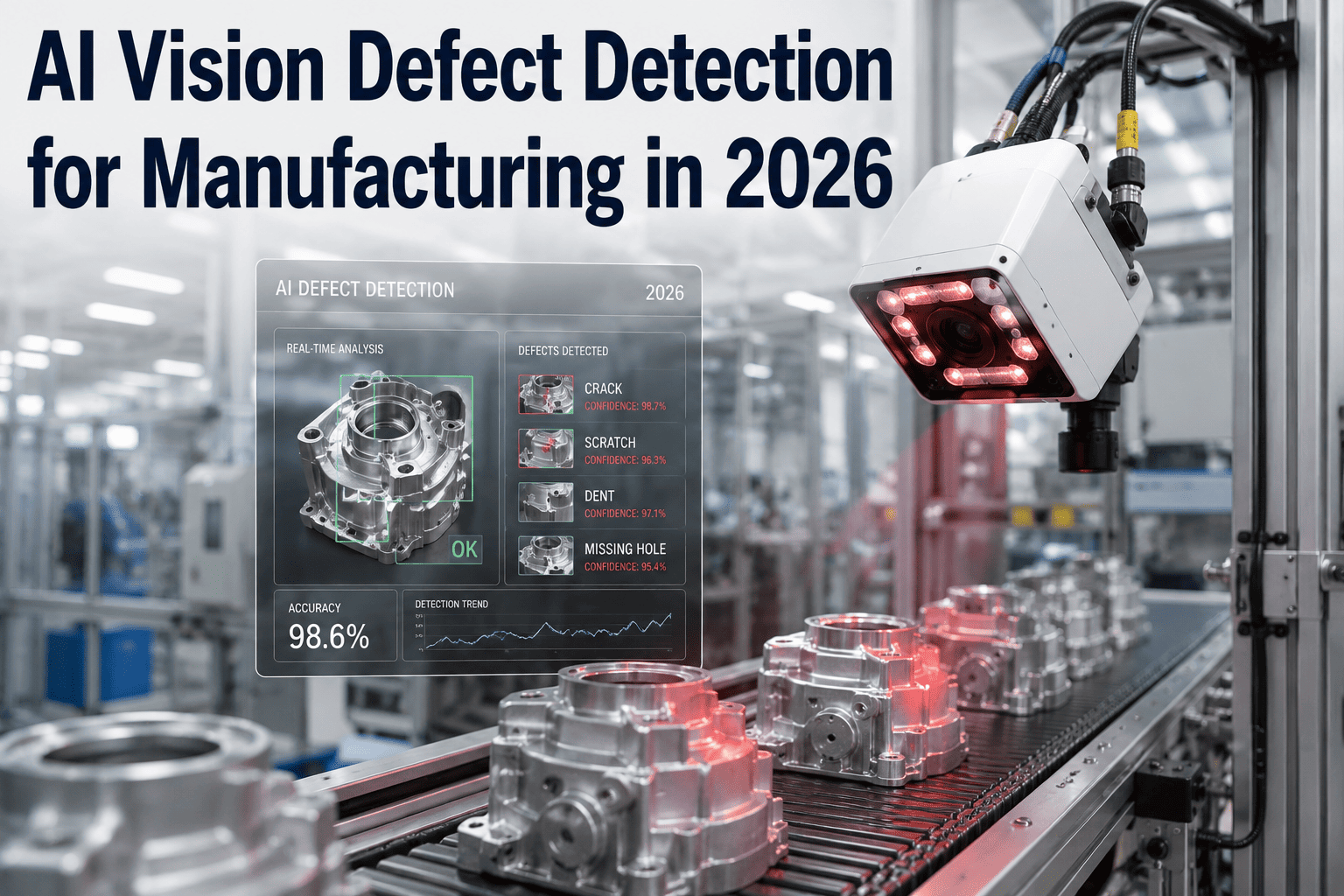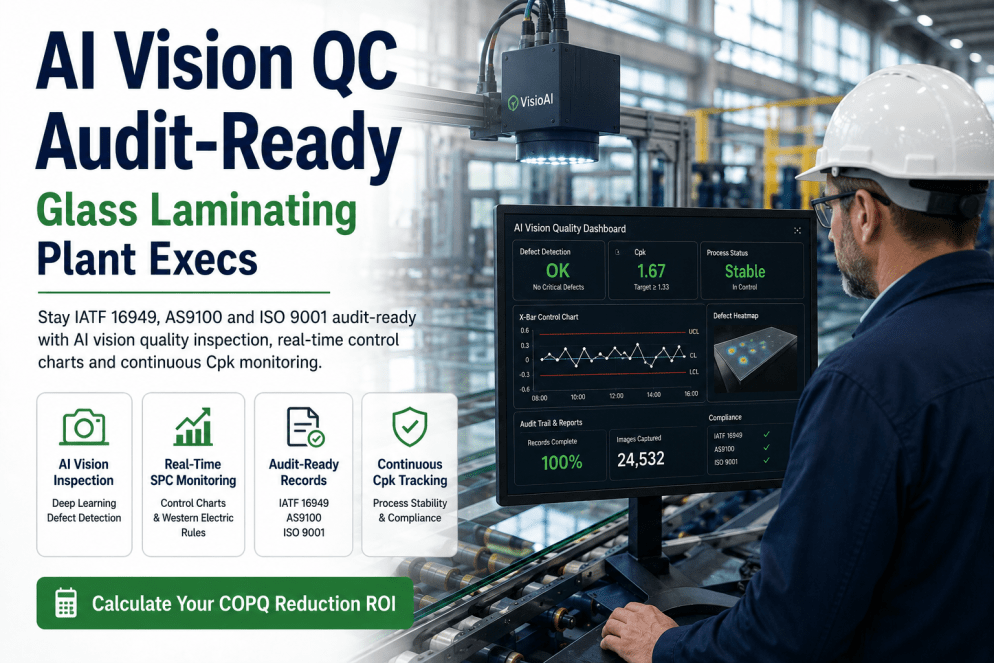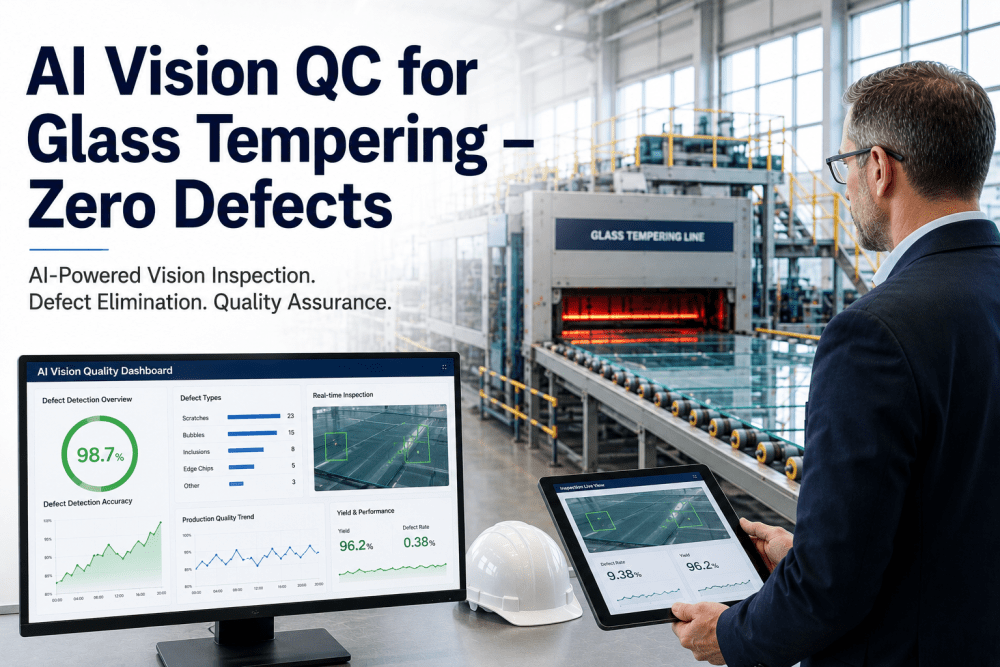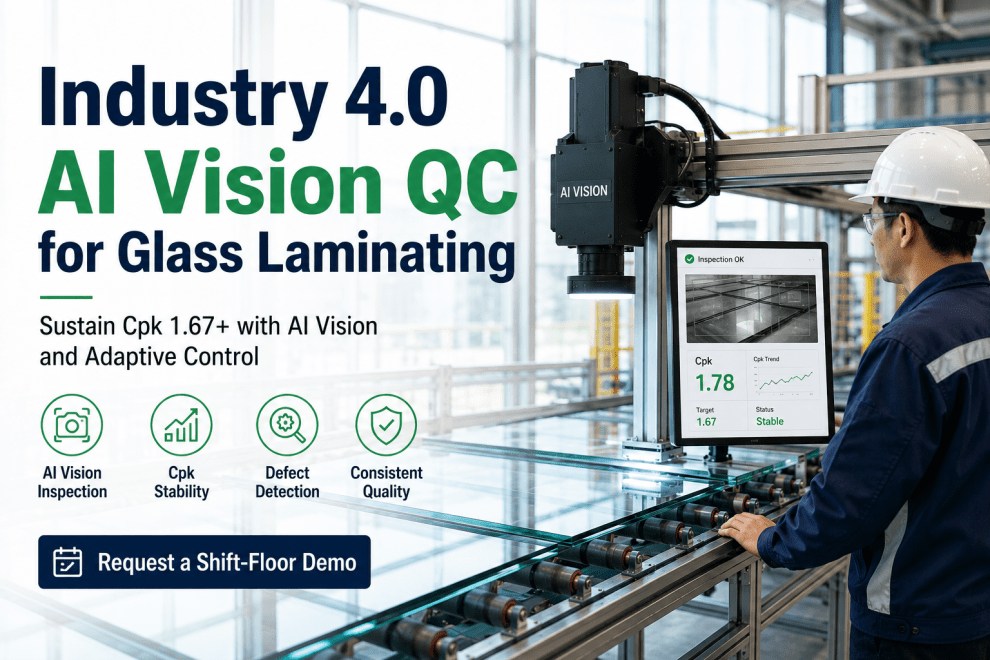
A shift supervisor managing four glass laminating lines producing architectural and automotive laminated glass knows that Cpk stability depends on detecting defects before they compound across downstream processes. Every bubble, edge chip, interlayer contamination, and alignment shift that escapes the laminating station becomes a quality incident at final inspection — reducing Cpk, increasing scrap, and requiring rework that disrupts production schedules. Traditional vision inspection systems capture surface images at fixed thresholds, generating excessive false rejects that slow production while missing subtle defects that degrade process capability. AI vision quality for glass laminating changes this by combining deep learning defect detection with real-time Cpk monitoring, enabling supervisors to maintain process capability above 1.67 while reducing false rejects and scrap. Supervisors evaluating next-generation quality platforms regularly Book a Demo to see how AI vision transforms quality control on the laminating floor.
Cpk Stability Challenges in Glass Laminating Quality Control
Glass laminating presents unique quality inspection challenges. Multiple product types — architectural, automotive, and specialty — each with distinct defect tolerances, run on shared lines with frequent changeovers. PVB interlayer properties, glass thickness variations, and autoclave conditions all influence final lamination quality. Supervisors responsible for maintaining Cpk above customer thresholds must detect and classify defects across this variable production environment while minimizing false rejects that reduce throughput.
Manual Inspection Cannot Keep Pace
Visual inspection by trained operators produces inconsistent defect detection rates — estimated at 70 to 80% on the best shifts — and slows to match available staffing. Fatigue, lighting conditions, and line speed variations cause detection rates to fluctuate, directly impacting Cpk stability across shifts.
Traditional Vision Generates False Rejects
Rule-based vision systems apply fixed thresholds that cannot distinguish between cosmetic anomalies and genuine defects. False reject rates of 8 to 12% force supervisors to re-inspect rejected parts, consuming time that should be spent on process optimization and reducing effective line throughput.
Subtle Defects Escape Detection
Early-stage bubbles smaller than 0.5mm, edge micro-chips, and partial interlayer contamination are invisible to threshold-based vision systems but accumulate over production runs, degrading Cpk from 1.67 to below 1.33 before the trend is identified through periodic quality sampling.
Quality Data Arrives Too Late
Batch-based quality sampling means defect trend data reaches supervisors hours after production. By the time Cpk degradation is detected, dozens of non-conforming laminates have been produced, requiring quarantine, inspection, and potential rework that disrupts downstream schedules.
How AI Vision Quality Transforms Glass Laminating Inspection
iFactory's AI vision platform replaces rule-based inspection thresholds with deep learning models trained on millions of glass laminating defect images. The system continuously learns from production data, improving defect classification accuracy while adapting to product type changes, material variations, and line speed adjustments. Supervisors view real-time quality dashboards showing defect maps, Cpk trends, and inspection results for every laminate produced. Quality and production leaders evaluating AI vision for glass laminating regularly Book a Demo to review the platform architecture and defect detection model library.
Multi-Class Defect Classification — Deep learning models classify defects across 12 categories — bubbles, edge chips, interlayer contamination, delamination, glass cracks, thickness variation, alignment shift, roller debris, pitting, scratch, haze, and foreign inclusion — with per-class confidence scores. Models are trained on facility-specific defect libraries and continuously improved through active learning that incorporates supervisor feedback on classification accuracy. Each inspection result is logged with the defect image, classification confidence, and production context for full quality traceability.
Continuous Capability Tracking — The platform calculates Cp, Cpk, Pp, and Ppk in real time based on AI vision inspection results for every laminate produced. Supervisors view capability dashboards filtered by product type, production line, and shift — updated with each inspection cycle. Cpk trends are displayed alongside defect frequency charts, enabling supervisors to identify emerging capability issues before they breach customer thresholds. Automated alerts notify supervisors when Cpk approaches the 1.67 minimum threshold for any product type or parameter.
Early Warning for Process Degradation — Predictive quality models analyze defect trend data alongside process parameters — autoclave temperature profiles, nip roll pressure, PVB interlayer lot — to forecast Cpk trajectory over the next production shift. When the model predicts Cpk will fall below threshold within the next 50 cycles, the platform recommends corrective actions such as parameter adjustment, maintenance intervention, or material lot change. This shifts quality management from reactive batch sampling to predictive process control.
Deployment Process — From Line Assessment to AI Vision Operations
Deploying AI vision quality for glass laminating follows a structured methodology designed for production continuity while building toward autonomous defect detection and Cpk monitoring.
Line Assessment & Camera Configuration
Quality and production teams identify inspection points, defect categories, and Cpk targets for each product type. Camera positions, lighting configurations, and line speed synchronization are mapped to capture optimal defect images across all laminating line configurations.
Model Training & Threshold Calibration
Deep learning models are trained on facility-specific defect image libraries representing each product type and defect category. Classification thresholds are calibrated against supervisor-reviewed validation sets to balance detection sensitivity and false reject rates per customer requirements.
System Integration & Cpk Dashboard
iFactory edge connectors link inspection results to existing MES and quality systems. Real-time Cpk dashboards are configured per product type and production line, with automated alerts for threshold breaches and capability trends visible to supervisors on the production floor.
Live Deployment & Supervisor Validation
AI vision inspection goes live with parallel manual validation. Supervisors review AI classifications, provide feedback on edge cases, and adjust confidence thresholds. The active learning pipeline captures this feedback to continuously improve model accuracy without requiring retraining cycles.
Continuous Improvement & Scaling
Defect detection models improve continuously as the platform accumulates inspection data across product types and production conditions. New defect patterns are automatically flagged for supervisor review, enabling the system to adapt to process changes, material supplier variations, and evolving quality requirements.
Measured Impact on Cpk Stability and Quality Performance
Within eight weeks of deploying AI vision quality across glass laminating lines, facilities documented measurable improvements across every quality metric, validated through production data and capability analysis.
| Quality Metric | Traditional Vision QC | AI Vision Quality | Improvement |
|---|---|---|---|
| Defect Detection Rate | 82% | 99.7% | +17.7 pp |
| Inspection Speed | 12 parts/min | 60 parts/min | 5X faster |
| Cpk Stability Range | ±0.4 | ±0.08 | 5X tighter |
| False Reject Rate | 8.5% | 1.2% | 86% reduction |
| Scrap Rate per Line | 4.8% | 2.3% | 52% reduction |
| Quality Data Availability | Batch (4 hr delay) | Real-time | Immediate |
"Our previous vision system was detecting defects, but it was also rejecting 8% of good laminates — parts that passed manual inspection but triggered false alarms on the vision system. Supervisors were spending hours every shift re-inspecting rejected parts and adjusting thresholds that never seemed to work across all product types. The AI vision platform changed this completely. Our detection rate went from 82% to over 99%, false rejects dropped to near zero, and for the first time we have continuous Cpk visibility across every laminate we produce. Our architectural glass customers now receive Cpk reports with each shipment — generated directly from the inspection data — and our automotive customers have reduced their incoming inspection sampling because our quality data is more reliable than their own." — Director of Quality, Glass Laminating Division
Building Sustainable Cpk Stability with AI Vision Quality
This deployment demonstrates that AI vision quality offers glass laminating supervisors a practical path from manual inspection variability to continuous, data-driven quality control. By combining deep learning defect detection with real-time Cpk monitoring and predictive analytics, the iFactory platform enables supervisors to maintain process capability above 1.67 while reducing scrap, false rejects, and quality data latency. The technology connects to existing laminating line infrastructure and begins generating defect classification results and capability metrics from the first production cycle. Quality and operations leaders evaluating their glass laminating quality strategy are encouraged to Book a Demo to explore how iFactory's AI vision platform can transform their quality management and Cpk stability.
Frequently Asked Questions
AI vision quality for glass laminating replaces rule-based inspection thresholds with deep learning models trained on millions of defect images. The system classifies defects across 12 categories — bubbles, edge chips, delamination, contamination, and more — with per-class confidence scores, while continuously learning from production data to improve accuracy. Real-time Cpk monitoring and predictive quality analytics give supervisors continuous visibility into process capability.
The platform detects bubbles and air pockets, edge chips and cracks, PVB interlayer contamination, delamination at glass-interlayer interfaces, glass thickness variation, alignment shifts between glass layers, roller debris marks, surface pitting and scratches, haze, and foreign inclusions. Models are trained on facility-specific defect libraries and can be extended to additional defect categories as new quality requirements emerge.
AI vision improves Cpk stability by detecting subtle defects — early-stage bubbles, micro-cracks, partial contamination — that traditional systems miss but accumulate over production runs to degrade process capability. The platform calculates Cp, Cpk, Pp, and Ppk in real time for every laminate produced, enabling supervisors to identify and correct capability issues before they breach customer thresholds. Predictive quality models forecast Cpk trajectory up to 50 cycles ahead, recommending corrective actions proactively.
Initial deployment covering line assessment, camera configuration, model training, and supervisor validation requires approximately 6 weeks. First defect classification results and Cpk metrics are available within the first week of live operation. Full calibration for all product types and defect categories is achieved within the deployment window, with continuous model improvement ongoing through active learning.
Yes. The iFactory platform connects inspection results directly to existing MES, quality management, and reporting systems. Supervisors access real-time defect maps, Cpk dashboards, and quality trend charts on production floor displays. Automated alerts notify supervisors of Cpk threshold breaches and emerging defect patterns. Inspection data is structured for ISO 9001 and IATF 16949 quality documentation requirements, eliminating manual report preparation.