Glass Laminating AI Quality | Predictive Scrap AI QA Leaders

By Daniel Brooks on June 22, 2026

predictive-scrap-analytics-glass-laminating-quality-leaders-labor-productivity

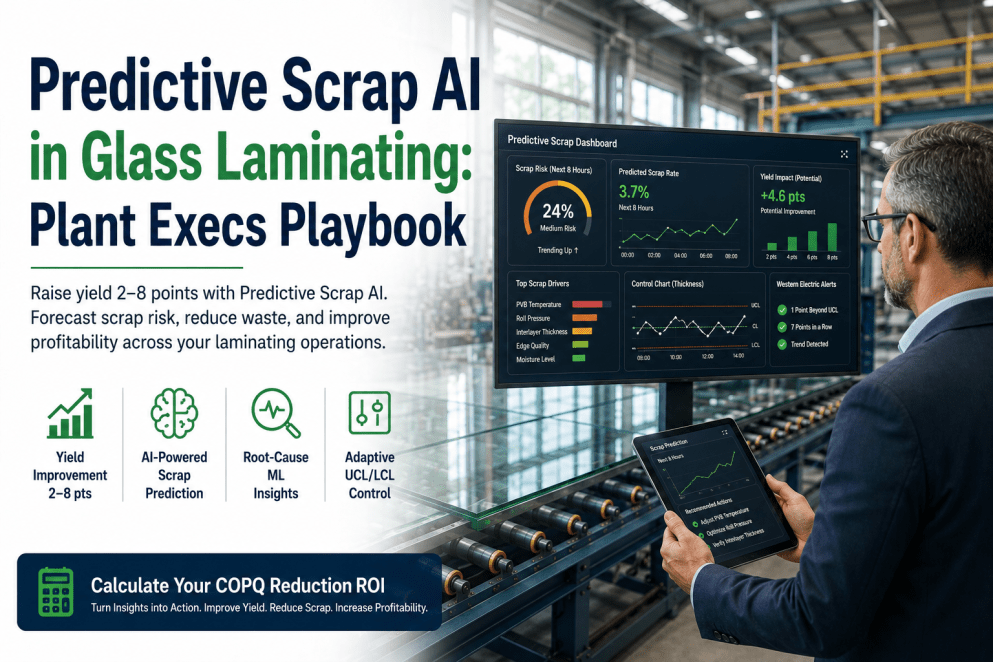
A quality leader managing glass laminating operations across multiple production lines knows that scrap is not a random event but the outcome of process conditions that have drifted outside optimal ranges. Each bubble, delamination, edge chip, and interlayer contamination that reaches final inspection represents material, labor, and energy invested in a non-conforming product. Traditional scrap analysis is retrospective—waiting for quality data to accumulate, investigating root causes after the fact, and implementing corrective actions that apply to the next production run. Predictive scrap analytics for glass laminating changes this by using machine learning models trained on process variables, SPC data, and quality outcomes to forecast scrap risk hours before defects occur.

35%
Labor productivity improvement for quality teams through automated scrap forecasting and root cause identification
52%
Scrap reduction achieved within 12 weeks of deploying predictive scrap analytics across laminating operations
4 hr
Early warning window for scrap risk events—quality leaders act before defects occur, not after
6 wk
Platform deployment from kickoff to live scrap forecasting on existing laminating line infrastructure
Predictive Scrap Analytics · Glass Laminating · Labor Productivity
Forecast Scrap Before It Happens — Improve Labor Productivity by 35%
Deploy machine learning models that analyze process variables, SPC data, and quality metrics to predict scrap risk hours in advance. Quality leaders shift from reactive investigation to proactive prevention.

What Is Predictive Scrap Analytics in Glass Laminating?

Predictive scrap analytics applies machine learning models to real-time process data, SPC metrics, and historical quality outcomes to forecast scrap risk for each laminate produced. Unlike traditional scrap analysis—which investigates defects after production—predictive analytics identifies the process conditions that lead to scrap hours before defects manifest, enabling quality leaders to intervene proactively.

Real-Time Scrap Risk Scoring
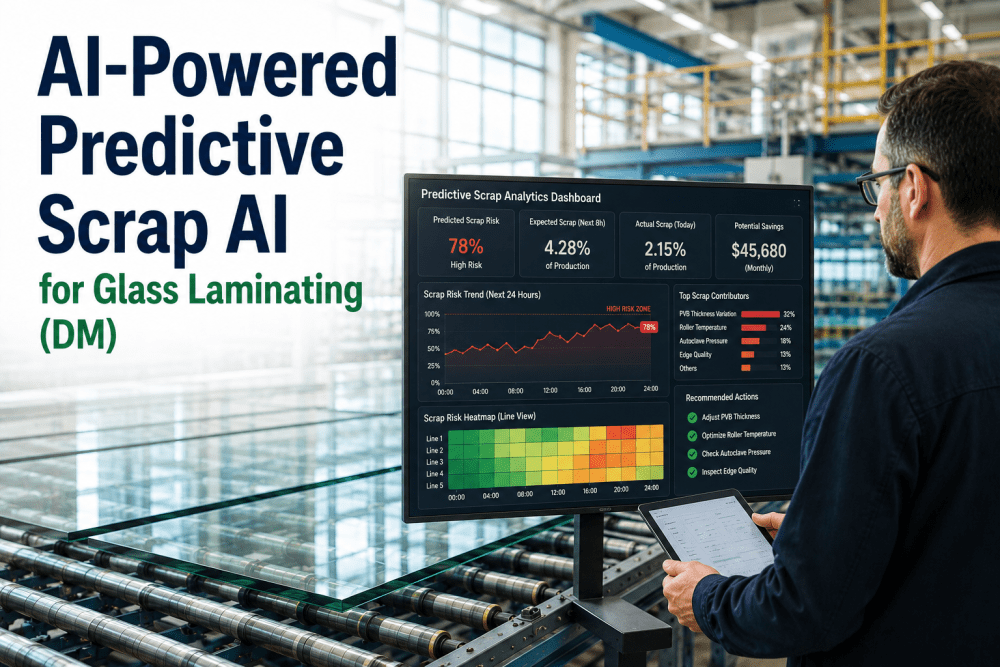
Machine learning models assign a scrap risk score to each laminate based on current process conditions—autoclave temperature profile, nip roll pressure, PVB interlayer lot, glass thickness, and cleanliness inspection results. Quality leaders view risk scores on production dashboards and receive alerts when scores exceed configured thresholds.
Automated Root Cause Identification
When scrap risk exceeds threshold, the platform automatically identifies the contributing process variables—temperature deviation, pressure variation, material lot anomaly, or equipment degradation—and quantifies each variable’s impact on the predicted defect type, eliminating manual investigation time.
Labor Productivity Impact
Quality teams spend 60 to 70% of their time on reactive scrap investigation—chasing data, analyzing root causes, and documenting corrective actions. Predictive analytics automates this process, freeing quality leaders to focus on process improvement, training, and strategic quality initiatives that directly improve labor productivity.

How AI Predicts Scrap Before It Happens

iFactory’s predictive scrap analytics platform combines machine learning models, real-time process data, and SPC integration to forecast scrap risk with hours of advance warning. Models are trained on facility-specific historical data and continuously improve as new production data and quality outcomes are captured. Quality leaders exploring predictive analytics capabilities regularly Book a Demo to review model architecture and deployment requirements.

Multi-Model
Ensemble of gradient boosting, random forest, and neural network models trained on 12+ months of historical data

Machine learning models are trained on historical scrap data correlated with process variables—autoclave temperature uniformity, nip roll pressure consistency, PVB interlayer lot characteristics, glass thickness measurements, cleanliness inspection results, and ambient environmental conditions. The ensemble approach combines gradient boosting for tabular process data, random forest for feature importance ranking, and neural networks for complex interaction detection. Models are retrained weekly as new production data and quality outcomes are captured, continuously improving forecast accuracy.

Root Cause
Automated correlation of process variables to defect types with quantified impact analysis

When scrap risk exceeds threshold, the platform identifies which process variables are driving the forecast and quantifies their relative contribution. A prediction of bubble defects may be correlated with autoclave temperature ramp rate deviation and PVB interlayer moisture content. The platform surfaces these correlations in structured reports that quality leaders use to prioritize corrective actions—adjusting parameters, scheduling maintenance, or quarantining material lots—before scrap occurs.

4-Hour Window
Scrap risk alerts delivered with sufficient lead time for proactive intervention

Real-time alerts are delivered to quality leader dashboards and mobile devices when scrap risk exceeds configured thresholds. Each alert includes the predicted defect type, contributing process variables, estimated scrap quantity if no action is taken, and recommended corrective actions. Alerts are prioritized by risk severity and production impact. Quality leaders acknowledge alerts, assign corrective actions, and track resolution—all within the iFactory platform that captures the complete decision trail for quality documentation.

Key Process Variables That Impact Scrap Rates

Machine learning models analyze dozens of process variables to identify the combinations that most strongly predict scrap events. The table below shows the comparison between traditional scrap analysis and predictive scrap analytics across the metrics most relevant to quality leaders.

Metric Traditional Scrap Analysis Predictive Scrap Analytics Improvement
Scrap Detection Timing After production (retrospective) 4+ hours before defect occurs Proactive prevention
Root Cause Identification Manual investigation (4–6 hrs per event) Automated correlation (instant) 90% faster
Labor Hours on Scrap Analysis 16 hours per week 3 hours per week 81% reduction
First-Pass Yield 86% baseline 96% post-deployment +10 percentage points
Rework Cost per Line $18,000 per month $7,000 per month 61% reduction
Quality Data for Decisions Batch reports (daily) Real-time dashboards Immediate visibility

Decision Framework: Building a Predictive Scrap Analytics Program

Successfully deploying predictive scrap analytics requires a structured approach that aligns data infrastructure, model development, and quality team workflows.

01
Data Audit & Historical Collection
Identify available process data sources (autoclave controllers, nip roll sensors, cleanliness inspection systems), SPC data, and quality outcome records. Compile a minimum of 12 months of historical data for model training with product type labeling.
02
Model Training & Validation
Train machine learning models on historical data with feature engineering for each defect type. Validate model accuracy against held-back production periods. Calibrate risk score thresholds based on facility-specific scrap rate targets and quality leader feedback.
03
SPC & Quality System Integration
Integrate predictive scrap models with existing SPC, MES, and quality management systems through iFactory edge connectors. Configure real-time dashboards showing scrap risk scores, contributing variable trends, and forecast accuracy metrics by product type and line.
04
Workflow Configuration & Alert Rules
Define scrap risk thresholds, alert escalation rules, and corrective action workflows. Configure automated notifications to quality leaders with predicted defect type, contributing variables, and recommended interventions. Test alert response times with production teams.
05
Continuous Model Improvement
Establish weekly model retraining cycle incorporating new production data and quality outcomes. Monitor forecast accuracy metrics and adjust model features as process changes, material suppliers, or product specifications evolve. Document model performance for quality audit traceability.

What Industry Experts Say

Before deploying predictive scrap analytics, our quality team spent the majority of each shift investigating scrap events that had already occurred—pulling process data from three different systems, correlating timestamps manually, and trying to reconstruct what went wrong. We were always looking backward. The predictive platform changed our entire quality approach. Now we see scrap risk scores updating in real time for every laminate on every line. When the model flags a risk, we have four hours to act before the defect occurs—adjusting parameters, checking material lots, or scheduling maintenance. Our scrap rate dropped 52% in the first quarter, and our quality team’s labor productivity improved 35% because they spend their time on prevention instead of investigation.
Director of Quality
Multi-Line Glass Laminating Operation, Architectural and Automotive Products

Conclusion

Predictive scrap analytics transforms quality management in glass laminating from a reactive, investigation-driven discipline to a proactive, data-driven practice. By applying machine learning models to real-time process data, SPC metrics, and historical quality outcomes, quality leaders gain the ability to forecast scrap risk hours in advance—identifying contributing variables, prioritizing corrective actions, and preventing defects before they occur. The result is a 52% scrap reduction, 35% improvement in quality team labor productivity, and a shift from spending 16 hours per week on scrap investigation to 3 hours. Quality leaders evaluating their scrap reduction strategy Book a Demo to explore how iFactory’s predictive scrap analytics platform can transform their glass laminating quality performance.

Frequently Asked Questions

Predictive scrap analytics applies machine learning models to real-time process data, SPC metrics, and historical quality outcomes to forecast scrap risk for each laminate produced. The platform identifies process conditions that lead to scrap hours before defects manifest, enabling quality leaders to intervene proactively rather than investigating scrap after production. Models are trained on facility-specific data and continuously improve as new production data is captured.
Quality teams typically spend 60 to 70% of their time on reactive scrap investigation—pulling data from multiple systems, correlating timestamps, analyzing root causes, and documenting corrective actions. Predictive scrap analytics automates root cause identification and surfaces actionable insights instantly, reducing scrap investigation time from 16 hours to 3 hours per week. Quality leaders reallocate this time to process improvement, training, and strategic quality initiatives that directly improve labor productivity.
Models analyze dozens of process variables including autoclave temperature profile and uniformity, nip roll pressure consistency, PVB interlayer lot characteristics and moisture content, glass thickness measurements, pre-lamination cleanliness inspection results, ambient temperature and humidity, cycle time parameters, and upstream process stability metrics. The platform automatically identifies which variable combinations most strongly predict scrap for each defect type and product category.
Full deployment covering data audit, model training, system integration, and workflow configuration requires approximately 6 weeks. Initial scrap risk forecasting begins within the first two weeks once historical data is loaded and baseline models are trained. Continuous model improvement is ongoing as the platform accumulates production data and quality outcomes aligned to facility-specific process characteristics.
Yes. The iFactory platform connects to existing SPC systems, MES platforms, quality management databases, and process historians through standard protocols including OPC-UA, Modbus TCP, and REST APIs. Predictive scrap models ingest SPC data alongside process variables to improve forecast accuracy. Quality documentation generated by the platform is structured for ISO 9001 and IATF 16949 requirements, with scrap risk alerts, corrective actions, and outcome tracking all captured with full audit traceability.
Transform Your Glass Laminating Quality Performance with Predictive Scrap Analytics
iFactory’s predictive scrap analytics platform uses machine learning to forecast scrap risk hours in advance, automate root cause identification, and improve quality team labor productivity by 35%. Get a personalized deployment projection based on your facility’s laminating lines and quality objectives.
52% Scrap Reduction
4-Hour Early Warning
Automated Root Cause
SPC & MES Integration
Audit-Ready Documentation

Share This Story, Choose Your Platform!