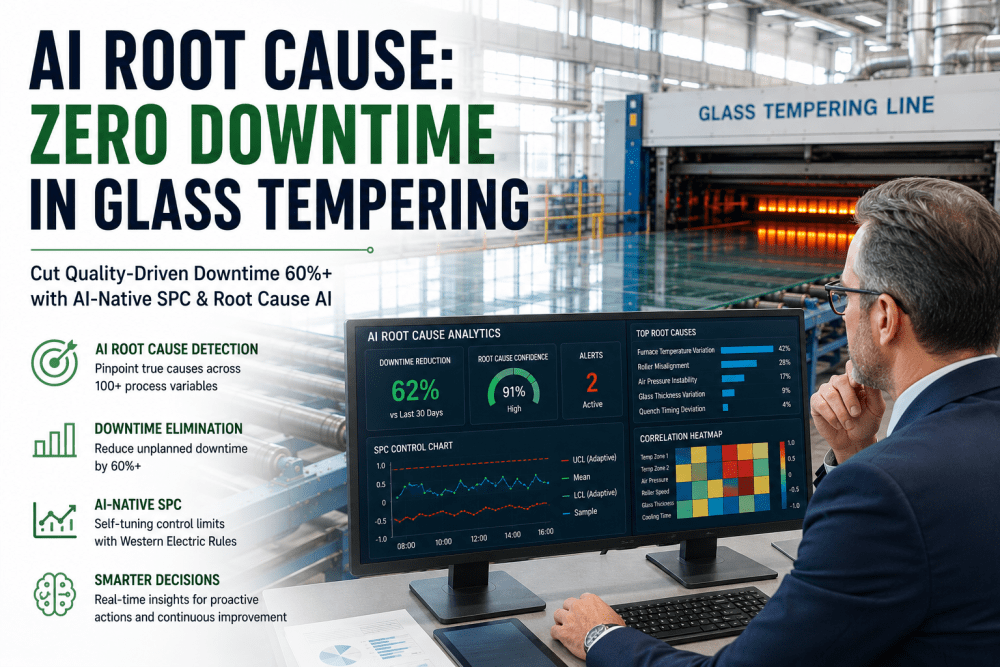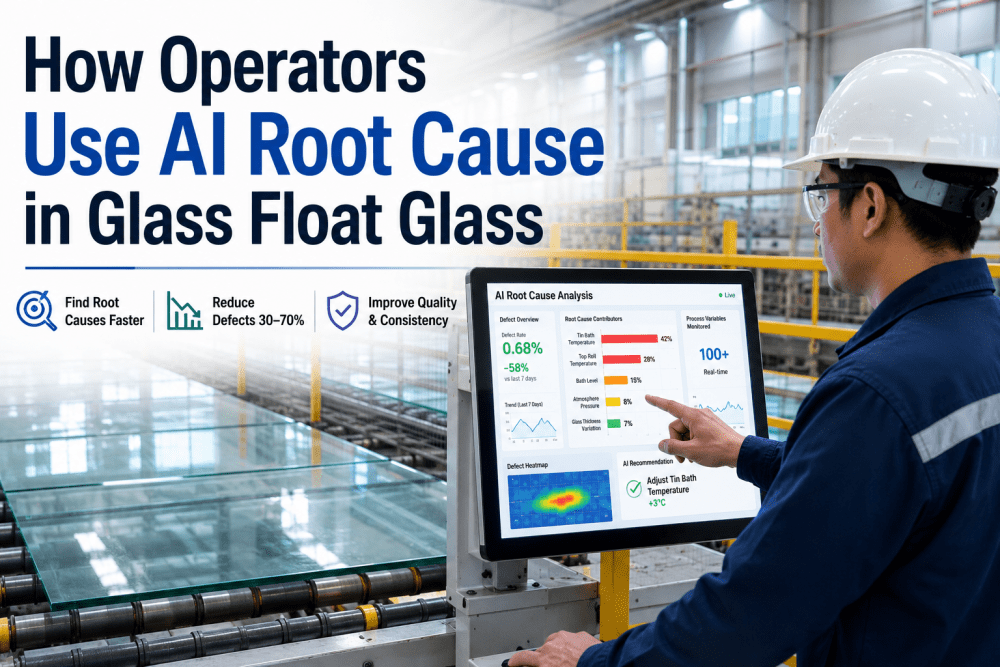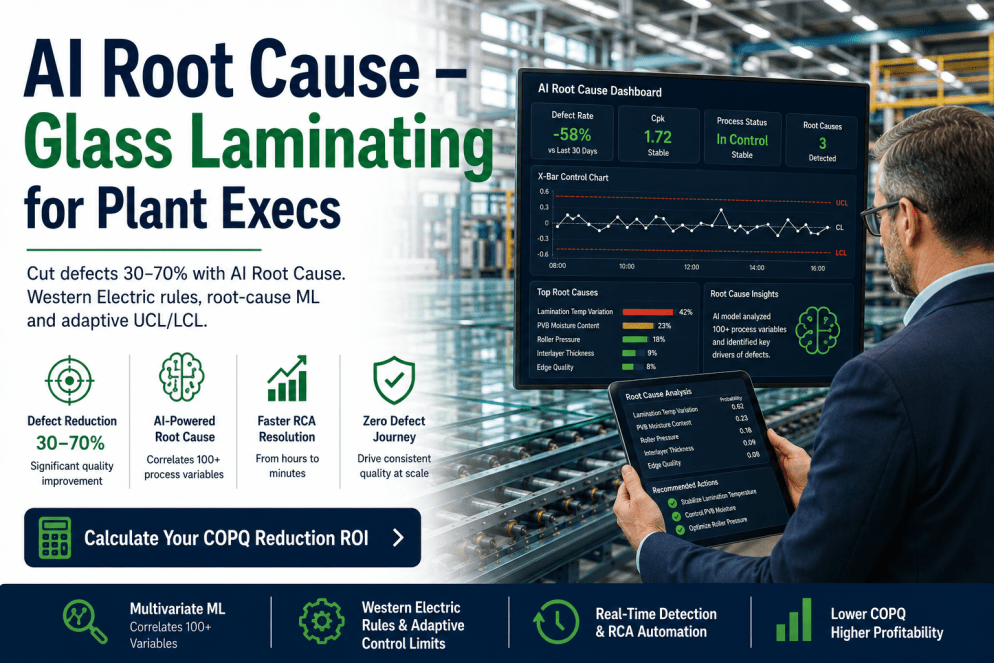
Plant executives in glass laminating face a persistent quality challenge: recurring defects that erode product quality, inflate scrap costs, and undermine Cpk performance. Traditional root cause analysis relies on manual investigation methods—fishbone diagrams, 5-Whys, and tribal knowledge—that take 4–8 hours per event and miss the nonlinear, multivariate causal chains that drive today's most costly defect modes. AI root cause detection for glass laminating changes this paradigm by using machine learning and multivariate analytics to automatically identify the true causes of defects in under 15 minutes, enabling plant executives to eliminate recurring quality issues at the source rather than treating symptoms. This playbook explains how AI-powered root cause analysis reduces defect rates by 30–70%, improves Cpk performance, and supports zero-defect manufacturing initiatives.
What Is AI Root Cause Detection in Glass Laminating?
AI root cause detection for glass laminating uses machine learning models and multivariate process analytics to automatically identify the factors responsible for defects, quality excursions, and process variation across laminating lines. Unlike traditional RCA that depends on manual investigation and institutional knowledge, AI ingests data from autoclave temperature profiles, pressure curves, humidity sensors, line-speed encoders, interlayer batch records, and final inspection results to correlate dozens of variables simultaneously. The system identifies hidden causal relationships—nonlinear interactions between process parameters that human analysis cannot detect—and alerts plant executives with the specific root cause, confidence score, and recommended corrective action. By automating the detection-to-correction cycle, AI root cause analysis compresses investigation time from hours to minutes and prevents defect recurrence through systematic causal knowledge capture. Plant executives assessing their analytics maturity Book a Demo to see how iFactory AI correlates multivariate process data across glass laminating lines.
Three AI Methodologies That Detect Defect Causes in Real Time
AI root cause detection for glass laminating combines three machine learning methodologies that together create a comprehensive defect analysis system. Each methodology addresses a different causal detection challenge. Plant executives comparing detection approaches Book a Demo to see which fits their process complexity and data maturity.
Multivariate Correlation analyzes dozens of process variables simultaneously—autoclave temperature profiles, pressure curves, humidity gradients, interlayer viscosity, nip-roller alignment, line speed—to identify the precise variable combination that triggers each defect type. The AI continuously ingests sensor data at sub-second intervals, detects nonlinear correlations beyond human analytical capacity, and automatically weights variable influence per defect mode. This capability reveals causal chains that remain invisible to traditional RCA until the next major quality escape occurs.
Automated Fault Tree Generation produces a causal fault tree for each defect event, tracing the root cause from the final quality failure back through intermediate process variables to the originating parameter drift. The AI assigns causal probability scores to each node in the tree, enabling plant executives to prioritize corrective actions by impact. Drill-down capability navigates from defect mode to specific sensor readings and setpoint excursions. Historical comparison across similar past events accelerates learning and prevents recurrence across the organization.
Real-Time Prescriptive Alerts push notifications directly to the plant executive dashboard when the AI detects the early signature of a known defect causal chain. Each alert includes the identified root cause, confidence score, and recommended corrective action tied to standard operating procedures and setpoint adjustments. Integration with existing SPC and alarming infrastructure ensures alerts flow into established workflows without disrupting operator routines.
AI Root Cause Detection vs. Traditional RCA
The gap between manual investigation and AI-powered root cause detection is measured in both speed and accuracy. The table below evaluates both approaches across capabilities that matter most to plant executives in glass laminating.
| Capability | Traditional RCA | AI Root Cause Detection |
|---|---|---|
| Investigation Speed | 4–8 hours per defect event | Under 15 minutes |
| Detection Method | Manual fishbone, 5-Whys, tribal knowledge | Automated multivariate correlation and ML pattern recognition |
| Root Cause Accuracy | Approximately 60% first-pass accuracy | Approximately 95% with confidence scoring |
| Recurrence Prevention | Manual corrective action tracking; high recurrence | Automated alert and prevention loop; 91% recurrence reduction |
| Knowledge Retention | Tribal knowledge; lost on personnel turnover | Structured, searchable causal knowledge graph |
| Scalability | One event at a time; inconsistent across shifts | All lines, all shifts, continuously with consistent methodology |
Measured Outcomes—Defect Elimination and Cpk Improvement
Glass laminating facilities deploying iFactory's AI root cause detection platform consistently document measurable improvement in defect rates, process capability, and quality costs. The following results represent average performance across iFactory's glass sector deployments.
Beyond the headline metrics, AI root cause detection produces structural improvements that compound over time. Investigation labor for quality events drops from 1,200 hours per quarter to under 200 hours as AI replaces manual RCA. Recurring defect events decrease by 91% as the causal knowledge graph captures every root cause finding and prevents re-investigation of the same failure mode. The platform's machine learning models continue improving with each production cycle, projecting an additional 15–20% defect reduction in year two. Plant executives reviewing their quality analytics infrastructure Book a Demo to see the full ROI model for their laminating operations.
Expert Analysis—Why AI Root Cause Detection Transforms Defect Elimination
Conclusion
AI root cause detection delivers a fundamental improvement over traditional RCA for plant executives in glass laminating. Multivariate correlation reveals hidden causal chains that manual methods miss, automated fault trees accelerate investigation from hours to minutes, and real-time prescriptive alerts prevent defect recurrence before it starts. The result is measurable defect elimination, Cpk improvement, and scrap reduction across every laminating line. Plant executives ready to move beyond reactive defect management Book a Demo to review the AI root cause detection deployment plan for your glass laminating facility.
Frequently Asked Questions—AI Root Cause Detection for Glass Laminating
What is AI root cause detection and how does it differ from traditional RCA in glass laminating?
AI root cause detection uses machine learning and multivariate analytics to automatically identify the factors responsible for defects by correlating dozens of process variables simultaneously. Traditional RCA relies on manual methods like fishbone diagrams and 5-Whys that take 4–8 hours per event and miss nonlinear causal chains. AI root cause detection compresses investigation to under 15 minutes with 95% accuracy while building a structured causal knowledge graph that prevents recurrence.
How does AI root cause detection improve defect elimination in glass laminating operations?
AI root cause detection improves defect elimination through two primary mechanisms. First, it identifies the true root cause of each defect event with confidence scoring, eliminating misdirected corrective actions that result from incomplete manual analysis. Second, it builds a structured causal knowledge graph that prevents recurrence by capturing and sharing learnings across shifts and lines. Facilities report 30–70% defect reduction within six months of deployment.
What data sources does AI root cause detection require for glass laminating?
The platform ingests data from any source with a digital signal: autoclave temperature and pressure sensors, humidity monitors, line-speed encoders, interlayer batch records, SPC control charts, vision inspection results, and manual quality entries. The AI correlates structured and unstructured data across these diverse inputs to identify causal relationships. iFactory handles data normalization through standard OPC-UA, Modbus TCP, and REST API connectors.
Can AI root cause detection integrate with our existing SPC and quality management systems?
Yes. The AI root cause engine is designed to complement existing SPC platforms and quality management systems. It ingests SPC control-chart signals as input variables and pushes root cause alerts into your QMS workflow. Root cause findings are logged with full traceability for audit compliance. No replacement of existing systems is required, and the integration layer handles data normalization across disparate sources.
What is the typical payback period for AI root cause detection deployment in glass laminating?
Most facilities recover platform investment within 4–8 months. Primary ROI drivers include reduced quality-driven downtime saving 68% of unplanned stoppage costs, decreased scrap and rework from prevented defect recurrence, lower investigation labor costs as AI replaces manual RCA, and improved Cpk reducing variation-related losses. A personalized ROI analysis is provided during the Book a Demo consultation.


.png)