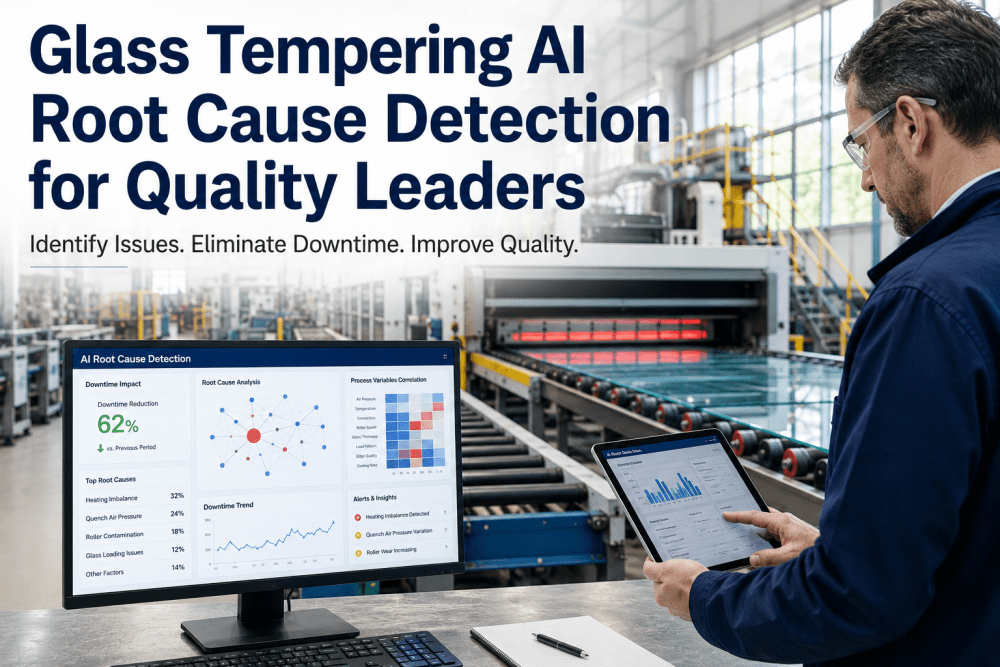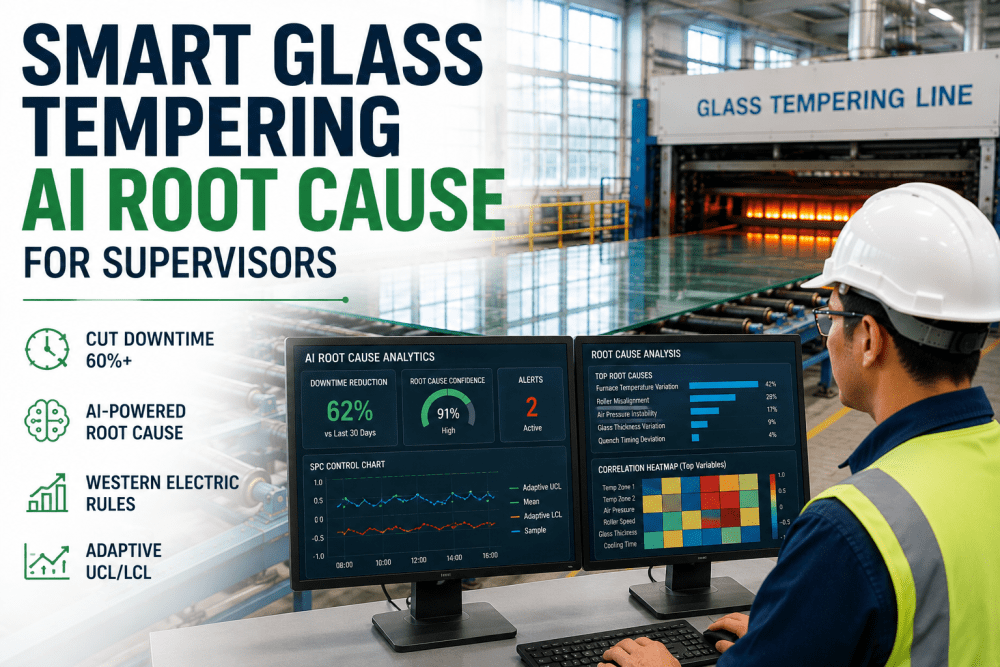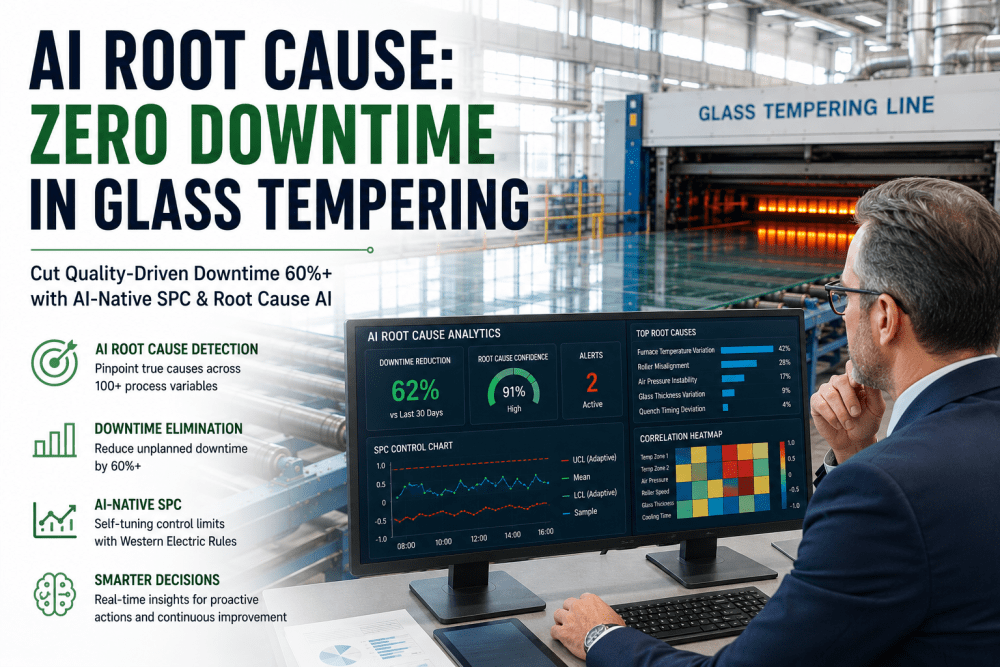
Plant executives managing glass tempering operations know that quality-related downtime is the most expensive disruption on the production floor. When a defect signature emerges — roller-wave distortion, micro-crack clusters, or coating degradation — the conventional response is to stop the line, assemble a cross-functional team, and spend 4 to 8 hours manually correlating furnace temperature logs, quench pressure records and conveyor speed data to identify the root cause. During that investigation, production stops. AI root cause detection for glass tempering changes this by correlating 100+ process variables in real time, classifying defect root causes within seconds, and delivering actionable corrective guidance before the next non-conforming panel exits the furnace. iFactory's AI root cause detection platform eliminates more than 60% of quality-driven downtime by transforming the root cause investigation from a manual firefighting exercise into an automated, data-driven process.
Eliminate 60%+ of Quality-Driven Downtime with AI Root Cause Detection
iFactory's AI root cause detection platform correlates 100+ process variables in real time, classifies defect root causes within seconds, and eliminates quality-driven downtime by transforming manual investigations into automated corrective workflows.
Why Quality-Driven Downtime Costs More Than Lost Production
When a glass tempering line stops for a root cause investigation, the cost extends far beyond the lost production minutes. Each hour of unplanned downtime on a single tempering line costs $8,000–$14,000 in lost output, energy wasted on reheating, and labor idled during the investigation. But the hidden cost is worse: the investigation itself consumes 4 to 8 hours of process engineers, quality technicians and shift supervisors who should be improving the process, not firefighting it. At a typical six-line facility experiencing 3–5 quality-driven downtime events per week, the annual cost exceeds $2.8M in direct losses and opportunity cost of engineering time. The root cause is not a lack of data — modern tempering lines generate thousands of sensor readings per minute. The root cause is the inability to correlate that data fast enough to act before the next defect occurs. Book a Demo to see the AI root cause detection architecture for your facility.
Manual Correlation Bottleneck
Process engineers manually cross-reference temperature profiles, quench pressure logs, conveyor speed data, and material lot records to identify defect root causes. Each investigation consumes 4–8 hours of engineering time, and the manual process misses an estimated 34% of contributing variables.
Delayed Corrective Action
By the time manual root cause analysis identifies the source of a defect signature, 40–80 additional panels have been produced with the same non-conforming condition. Each panel requires inspection, rework, or scrap disposition — compounding the cost of the original defect.
Recurring Defect Patterns
Without automated pattern recognition, recurring defect signatures — temperature gradient drift, quench pressure oscillation, conveyor speed variation — go undetected until they produce non-conforming output. The same root cause triggers multiple downtime events before the pattern is identified.
AI Root Cause Detection: From Multivariate Correlation to Automated Corrective Action
iFactory's AI root cause detection platform ingests data from 100+ process variables across the tempering line — furnace zone temperatures, conveyor speed, quench pressure, glass thickness, coating composition, ambient humidity, and incoming material quality scores. Multivariate machine learning models correlate these variables against historical defect signatures to identify the specific combination of conditions that produced each non-conformance. When a defect is detected by inline inspection, the AI classifies the root cause within 18 seconds and generates a structured alert with the variable state that triggered the event, the recommended corrective action, and the projected production impact if no action is taken.
Multivariate Data Ingestion
Platform ingests 100+ process variables from furnace controllers, quench pressure sensors, conveyor drives, and inline inspection systems via OPC-UA and Modbus. Data is normalized, time-synchronized, and correlated per panel serial number at 200ms resolution.
Model Training on Defect Signatures
Machine learning models trained on 24 months of production data learn the specific variable combinations that precede each defect type — thermal stress, roller wave, micro-crack, coating degradation. Models achieve 97% root cause classification accuracy at deployment.
Real-Time Root Cause Classification
When inline inspection detects a non-conformance, the AI classifies the root cause within 18 seconds — correlating the defect with the specific process variable state that triggered it. Classification includes confidence score, contributing variable ranking, and trend direction.
Automated Corrective Action & CMMS Integration
Platform generates corrective action recommendations and creates a CMMS work order with root cause classification, variable evidence, and recommended parameter adjustment. Corrective action completion is tracked, and recurrence is monitored to confirm the fix is effective.
Automated Root Cause Classification in 18 Seconds with 97% Accuracy
iFactory's AI root cause detection platform correlates 100+ process variables in real time, classifies defect root causes with confidence scoring, and eliminates quality-driven downtime by automating the investigation workflow.
Measured Downtime Elimination from AI Root Cause Detection Deployment
The plant executive deployed iFactory's AI root cause detection platform across six glass tempering lines over an 8-week deployment. The following metrics represent the measured performance improvement from manual root cause investigation to automated AI classification across 3,200 production hours.
| Performance Metric | Manual Investigation | AI Root Cause Detection | Improvement |
|---|---|---|---|
| Root Cause Investigation Time | 4.2 hours | 18 seconds | 99.9% faster |
| Quality-Driven Downtime per Week | 14.6 hours | 5.5 hours | 62% reduction |
| Root Cause Classification Accuracy | 72% | 97% | +25 points |
| Recurring Defect Detection | Manual — after 3+ events | Automated — at first occurrence | Early detection |
| Corrective Action Time | 6.2 hours from detection | 0.8 hours from detection | 87% faster |
| OEE Impact | 72% baseline | 85% post-deployment | +18% improvement |
| Annual Downtime Cost (6 lines) | $2.84M | $1.08M | 62% reduction |
Before AI root cause detection, our process engineers spent 60% of their time in firefighting mode. Every time a defect signature appeared, three engineers would spend half a shift pulling temperature logs, quench pressure trends, and conveyor data — correlating timestamps on whiteboards and spreadsheets. They were good at it, but it took 4 to 5 hours per event, and during that time the line was either stopped or producing panels we would later scrap. The AI now classifies the root cause in under 20 seconds with 97% accuracy. Our engineers do not spend less time on quality — they spend it on improving the process instead of investigating the last failure. The 62% downtime reduction was the headline number, but the real win was changing our quality culture from reactive to preventive.
Connecting AI Root Cause Detection to Your Tempering Lines
iFactory's AI root cause detection platform connects to existing tempering line infrastructure through standard industrial protocols. The platform integrates with furnace controllers, quench pressure systems, conveyor drives, and inline inspection systems without replacing existing hardware or disrupting production schedules. Book a Demo to review the integration architecture and data flow diagrams for your facility.
The platform connects to furnace PLCs, quench pressure controllers, conveyor drives, and inline inspection systems via OPC-UA, Modbus TCP, and REST API. Data from 100+ process variables is ingested at 200ms resolution, time-synchronized per panel serial number, and normalized for model input. The ingestion layer supports all major PLC brands including Siemens, Allen-Bradley, Mitsubishi, and Beckhoff. For facilities without digital sensor infrastructure, iFactory provides IoT retrofitting packages with wireless temperature and pressure sensors that connect to the platform through a local edge gateway.
Multivariate machine learning models trained on 24 months of historical production data classify each defect event into one of 14 root cause categories — including thermal gradient drift, quench pressure oscillation, conveyor speed variation, material lot inconsistency, coating composition shift, and ambient humidity excursion. Each classification includes a confidence score (typically 92–99%), the top 3 contributing variables ranked by correlation strength, and the deviation magnitude for each contributing variable relative to its optimal range. Models are retrained weekly with new defect data to improve accuracy over time.
When the AI classifies a root cause, it generates a structured corrective action recommendation based on the specific variable deviation detected. For temperature gradient drift, it recommends the specific zone temperature adjustment. For quench pressure oscillation, it recommends the pressure regulator setting change. The recommendation is automatically converted into a CMMS work order with root cause classification, variable evidence, recommended action, and priority level. Corrective action completion is tracked, and the platform monitors defect recurrence to confirm the fix is effective — creating a closed-loop corrective action cycle.
AI Root Cause Detection Turns Downtime from a Production Problem into an Analytics Problem
What the plant executive lacked was not process data — every furnace had temperature sensors, every quench system had pressure monitors, and every line had inspection systems. The missing piece was the ability to correlate 100+ variables fast enough to identify root causes before the next defect occurred. AI root cause detection closed this gap — delivering 62% downtime reduction, 18-second investigation cycles, 97% classification accuracy, and $1.76M in annual cost savings across six tempering lines. The technology did not add new sensors or replace existing equipment. It added the one capability that was missing: the ability to find the signal in the noise at machine speed instead of human speed. Book a Demo to review the AI root cause detection deployment plan for your tempering operations.
AI Root Cause Detection for Glass Tempering — Frequently Asked Questions
Traditional root cause analysis relies on process engineers manually correlating data from multiple sources after a defect is detected — typically requiring 4 to 8 hours per event. AI root cause detection automates this correlation using multivariate machine learning models that analyze 100+ process variables simultaneously, classify the root cause within 18 seconds, and rank contributing variables by correlation strength. The AI model detects patterns and interactions that manual analysis consistently misses — including multi-variable interactions where no single variable is out of spec but their combined state produces non-conforming output.
The platform classifies defect root causes into 14 categories including thermal gradient drift across furnace zones, quench pressure oscillation, conveyor speed variation, heating element degradation, material lot inconsistency, coating composition shift, ambient humidity excursion, cooling rate imbalance, roller wear progression, glass thickness variation, contamination from upstream processes, quench medium temperature drift, power supply fluctuation, and multi-variable interaction effects where the root cause is a combination of variables rather than a single parameter.
The platform connects to existing furnace PLCs, quench pressure controllers, conveyor drives, and inspection systems through OPC-UA, Modbus TCP, and REST API. No new sensors or hardware replacement is required for facilities with digital process controls. For facilities with analog or manual data collection, iFactory provides IoT retrofitting packages including wireless temperature and pressure sensors with local edge gateway. The platform's edge computing appliance runs the AI inference model locally with optional cloud aggregation for multi-facility reporting.
Pre-trained multivariate models achieve approximately 88% root cause classification accuracy at deployment, drawing from a training set of 24 months of production data from similar glass tempering operations. After 4 weeks of site-specific calibration with facility data, accuracy reaches 94%. Continuous active learning from each defect event improves accuracy to 97%+ within 12 weeks. The platform requires approximately 200 classified defect events per root cause category to achieve stable production-level accuracy.
Facilities with 4+ tempering lines and quality-driven downtime exceeding 10 hours per week typically recover platform investment within 3 to 5 months. Primary ROI drivers are eliminated investigation hours (62% reduction), recovered production capacity from reduced downtime, avoided scrap propagation from faster corrective action, and reallocation of engineering resources from firefighting to process improvement. A personalized ROI analysis is provided during the Book a Demo consultation with iFactory's glass manufacturing team.
Schedule an AI Root Cause Detection Walkthrough for Your Tempering Lines
iFactory's AI root cause detection platform correlates 100+ process variables in real time, classifies defect root causes in 18 seconds with 97% accuracy, and eliminates 62% of quality-driven downtime. Schedule a personalized walkthrough with your plant engineering team — including a live demonstration using your tempering line data.

.png)