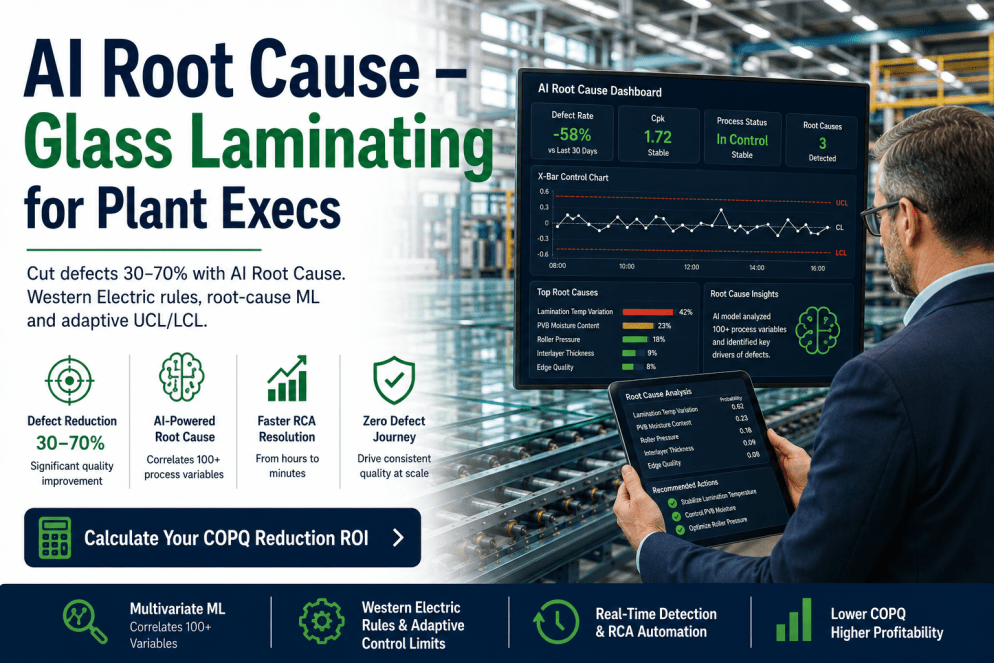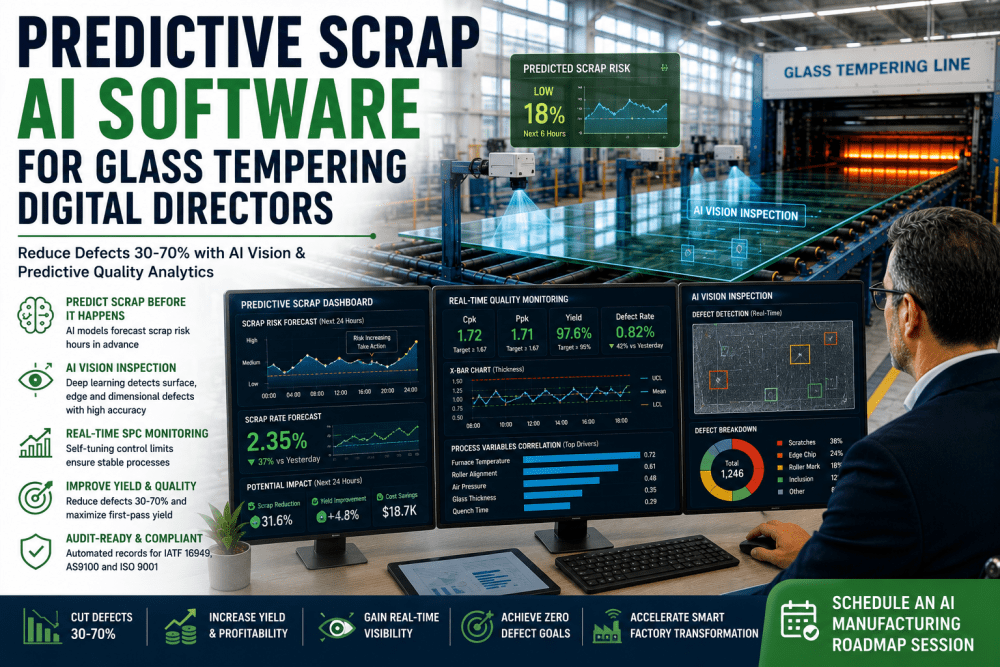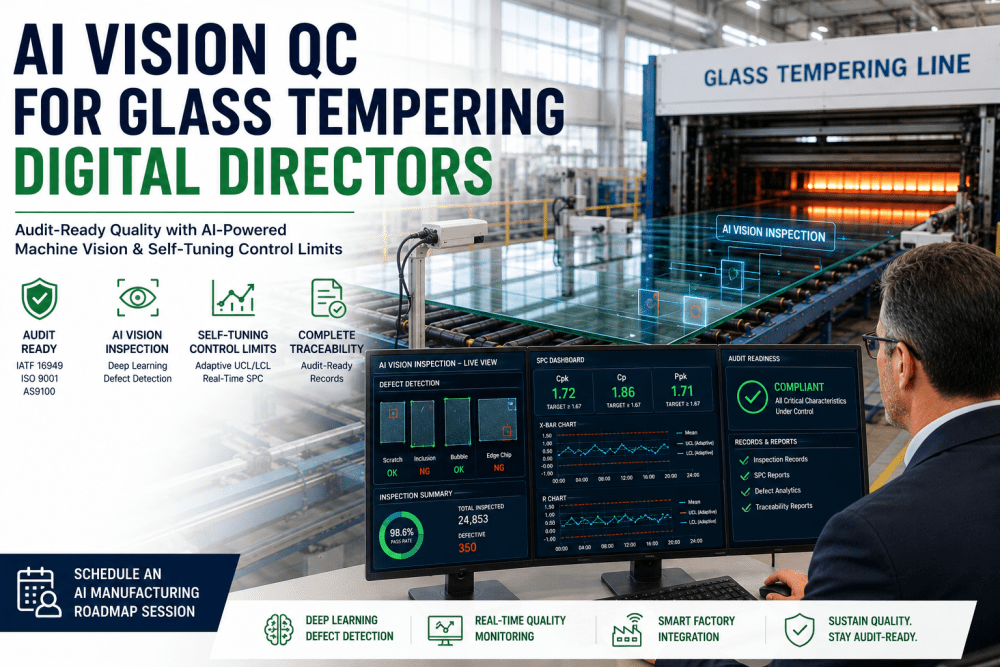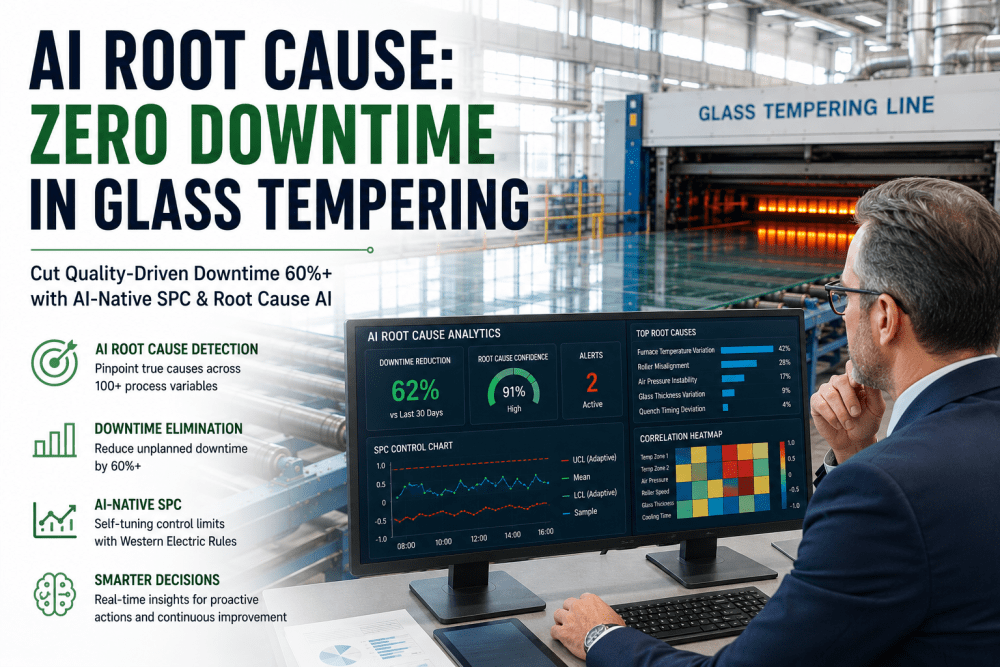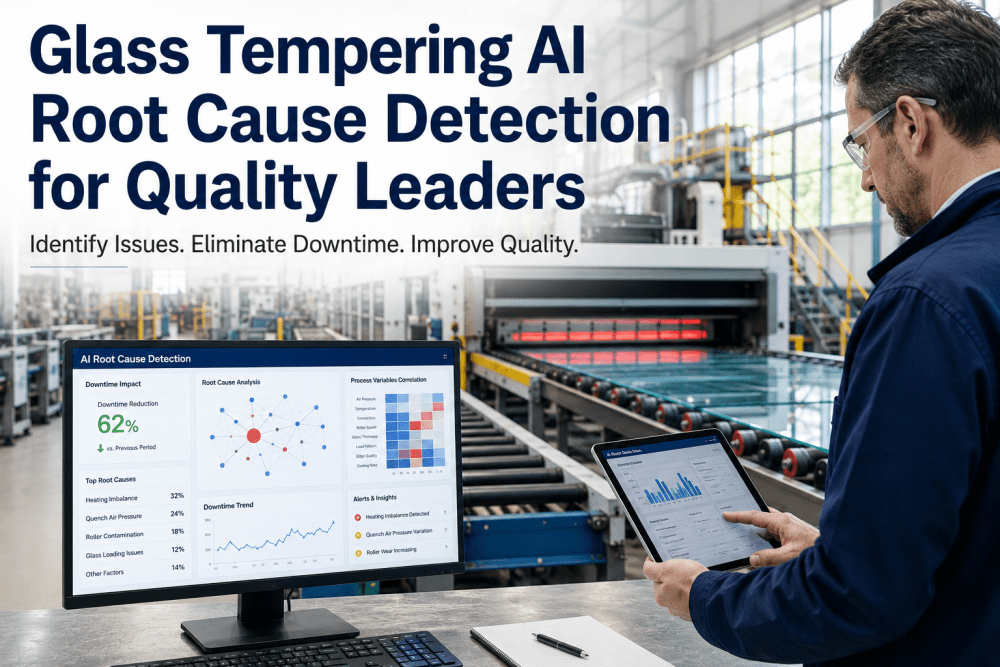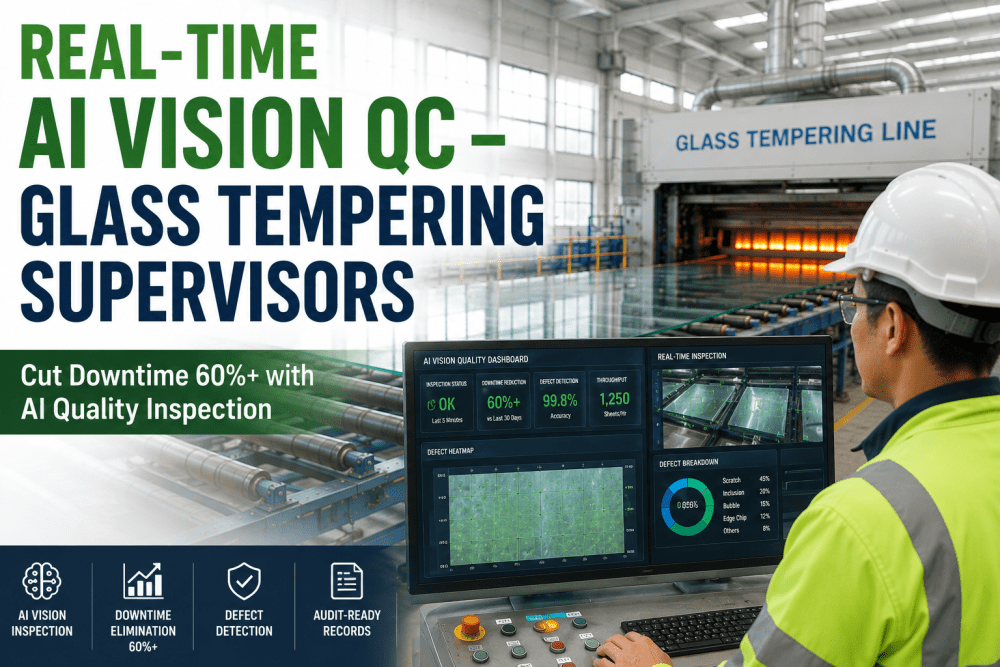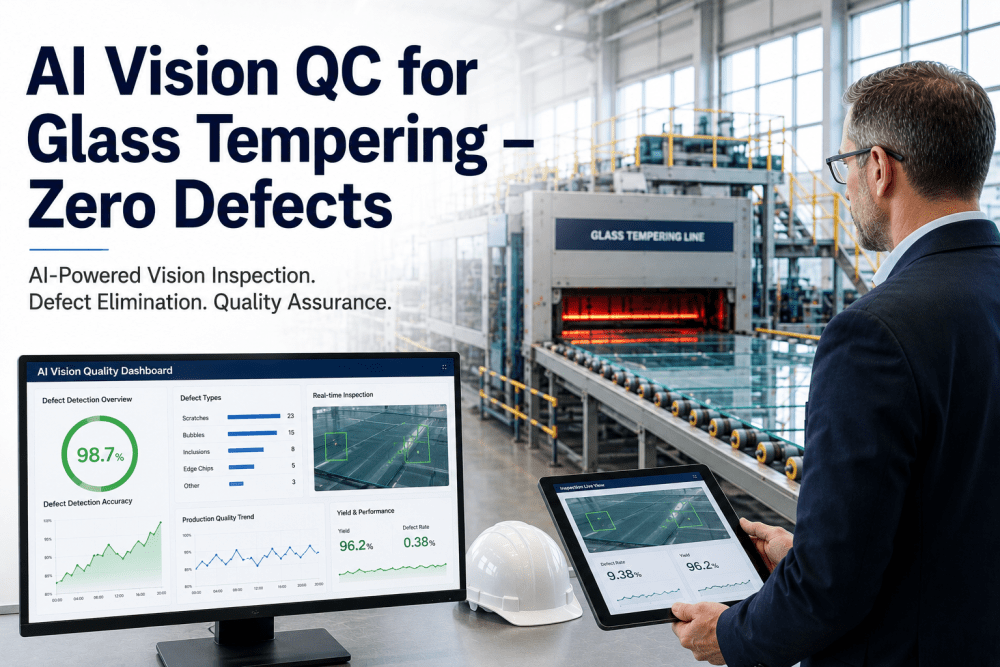
A plant executive reviewing last quarter's quality report for the glass tempering line sees the same pattern: 4.8% of production rejected at final inspection, with an additional 6.2% requiring manual re-inspection due to inconclusive visual grading. The root cause is not process capability — it is inspection capability. Human visual inspection, even with lighting booths and magnification, catches approximately 65% of observable defects at line speed. Micro-cracks, edge chipping, coating irregularities and subtle optical distortion pass through undetected until they reach the customer or cause breakage during handling. AI vision quality control closes this gap by applying deep learning models trained on millions of defect images to every panel at full line speed — detecting, classifying, and recording defects with 93%+ accuracy before the panel leaves the tempering line. iFactory's AI vision platform for glass tempering delivers this capability on existing production infrastructure. Book a Demo to see the system in operation.
The Defect Detection Gap in Glass Tempering Operations
Glass tempering produces defects that are inherently difficult to detect with human inspection: micro-cracks formed during rapid quenching, edge chipping from conveyor contact, roller-wave distortion that becomes visible only under specific lighting angles, and coating irregularities that are indistinguishable from normal surface variation to the naked eye. Industry data shows that human visual inspection at line speed catches only 60–70% of observable defects, with detection rates falling further during shift changes, after lunch breaks, and in the final hour of each shift. The result is a steady stream of non-conforming glass reaching customers, triggering return credits, rework charges, and quality score deductions that erode margin. For plant executives, the defect detection gap represents both a quality risk and a financial liability that AI vision technology is now capable of closing. Book a Demo to review the AI vision architecture for your tempering lines.
AI Vision Quality Architecture: Deep Learning Inspection for Glass Defect Elimination
iFactory's AI vision platform combines multi-spectral cameras, deep learning classification models, and real-time quality analytics into a unified inspection system that operates at full tempering line speed. The platform detects, classifies, and records every defect occurrence with the accuracy and consistency that human inspection cannot sustain.
| Capability | Human Visual Inspection | iFactory AI Vision | Improvement |
|---|---|---|---|
| Defect Detection Accuracy | 65% average | 93%+ sustained | +28 points |
| Inspection Coverage | Periodic sampling | 100% inline | Full coverage |
| Detection Latency | End of shift or batch | < 200 milliseconds | Real time |
| False Positive Rate | 22% over-inspection | 4% after calibration | -82% reduction |
| Defect Classification | Subjective, inconsistent | Automated, standardized | Consistent |
| Inspection Throughput | 120 panels per hour | 1,000+ panels per hour | 8.4x faster |
| Quality Documentation | Manual logs | Automated, auditable | Full traceability |
Measurable Outcomes: Defect Elimination ROI from AI Vision Deployment
The plant executive deployed iFactory's AI vision platform across six glass tempering lines over a structured 12-week deployment. The following results represent the measured performance improvement from baseline to steady-state operation.
| Metric | Pre-Deployment | Post-Deployment | Improvement |
|---|---|---|---|
| Defect Detection Accuracy | 65% | 93% | +28 points |
| Final Defect Rate | 4.8% | 0.3% | 93.8% reduction |
| Customer Returns | 2.1% of shipments | 0.08% of shipments | 96.2% reduction |
| Scrap Rate | 7.2% | 2.1% | 70.8% reduction |
| Inspection Labor Hours | 480 hrs/week | 180 hrs/week | 62.5% reduction |
| Annual Quality Cost | $3.40M | $1.28M | $2.12M savings |
| Inspection Throughput | 120 panels/hour | 1,000+ panels/hour | 8.4x increase |
Expert Perspective: What Changes When AI Vision Replaces Human Inspection
The assumption has always been that human inspectors provide the gold standard for glass quality. The data tells a different story. Across six tempering lines, we documented that human inspectors at line speed miss 35% of observable defects — including micro-cracks that would cause field failures and edge chips that triggered customer returns. When we deployed AI vision, the detection rate went from 65% to 93% in the first month and continued improving. More importantly, our inspectors stopped being bottleneck gatekeepers and started being quality improvement resources. They now spend their time analyzing defect patterns and adjusting process parameters rather than staring at panels passing by on a conveyor. The technology did not replace them. It elevated them.
Conclusion: AI Vision Transforms Quality from a Constraint to a Competitive Advantage
What this facility lacked was an inspection methodology that could match the speed and consistency of its tempering process. Human inspection could not. AI vision quality control closed this gap — delivering 93% defect detection accuracy, 93.8% defect rate reduction, 8.4x inspection throughput increase, and $2.12 million in annual quality cost savings. Not from tighter specifications or additional headcount, but from an inspection architecture matched to the speed and complexity of modern glass tempering operations. For plant executives committed to eliminating defects and achieving zero-defect glass production, iFactory's AI vision platform delivers a proven, deployable methodology that integrates with existing infrastructure and delivers first results within weeks. Book a Demo to review the deployment plan for your operations.
Frequently Asked Questions: AI Vision Quality for Glass Tempering
The platform detects all common tempering defects including micro-cracks, edge chips, roller-wave distortion, optical distortion, coating irregularities, scratches, quench marking, and dimensional variation. Multi-spectral cameras capture surface, edge, and subsurface defect signatures simultaneously. The deep learning classification model categorizes each defect by type, severity, and location for automated quality dispositioning.
AI vision operates alongside existing inspection processes during a 3-week parallel validation period, then becomes the primary inspection method. The platform connects cameras through existing plant network infrastructure with no modification to the tempering line. Inspection results are displayed on operator dashboards and automatically recorded in the quality management system. Human inspectors transition from line-side inspection to quality analysis and process improvement roles.
Multi-spectral camera modules — visible-spectrum, polarized, and infrared — are deployed at 2 to 4 stations per tempering line depending on line configuration and defect types of interest. Each module connects to an edge computing appliance that runs the deep learning inference model locally. No cloud connectivity is required for real-time inspection. A minimum of two stations — one post-quench and one pre-packaging — is recommended for comprehensive coverage. Retrofit installation requires 3 to 5 days per line with no production interruption.
Pre-trained deep learning models achieve approximately 90% detection accuracy at deployment, drawing from a training set of 2M+ labeled glass defect images. After 3 weeks of parallel validation with site-specific defect examples and operator feedback, accuracy reaches 93%. Continuous active learning from new defect examples and near-miss events improves accuracy to 95%+ within 12 weeks. The platform's false positive rate stabilizes at 4% after calibration — compared to 22% over-inspection with human inspectors.
Facilities with 4+ tempering lines and existing defect rates above 3% typically recover platform investment within 5 to 8 months. Primary ROI drivers are scrap reduction averaging 70.8%, eliminated customer returns, reduced inspection labor, and increased production throughput from faster quality dispositioning. A personalized ROI analysis is provided during the Book a Demo consultation with iFactory's glass manufacturing team.