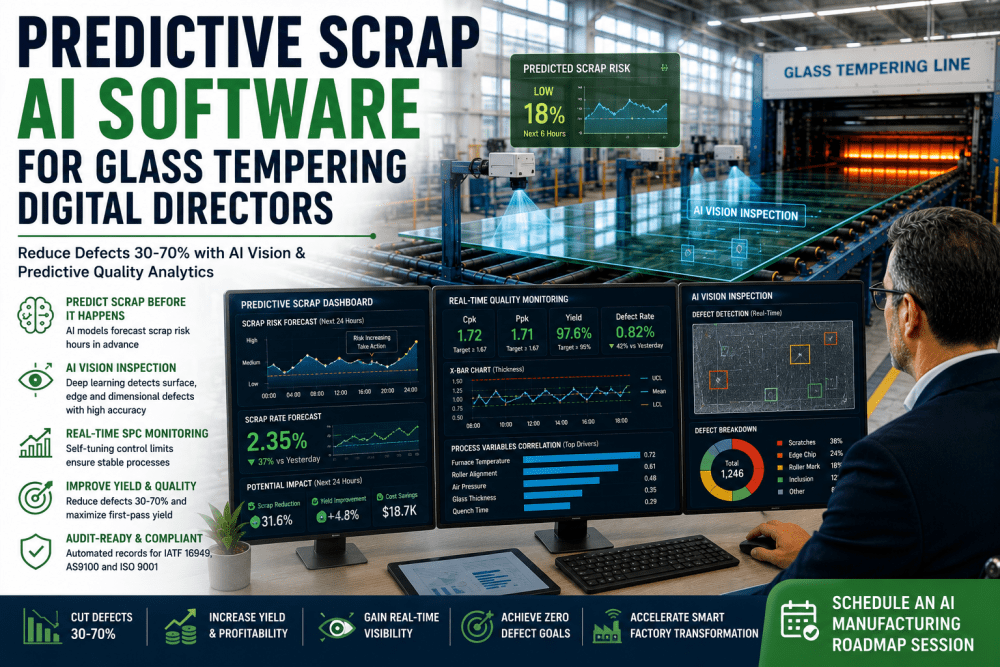
Digital manufacturing directors overseeing glass tempering operations face a persistent challenge: scrap and rework costs that erode margins while defect rates remain stubbornly above zero-defect targets. When a tier-one architectural glass manufacturer operating five tempering lines across two facilities needed to reduce defect rates from 4.8% to below 1.5%, traditional reactive quality methods — inspecting finished glass and sorting nonconforming units — proved insufficient to achieve the required improvement. The digital manufacturing team deployed iFactory's Predictive Scrap Analytics platform — combining AI yield prediction, real-time SPC monitoring, and machine vision inspection with automated intervention workflows — to reduce defect rates by 58% within five months while increasing first-pass yield by 22 percentage points. Manufacturing leaders evaluating predictive quality strategies regularly Book a Demo to explore how AI-driven scrap analytics transforms glass tempering quality performance.
Why Traditional Quality Methods Fall Short in Glass Tempering
Traditional quality control in glass tempering relies on after-the-fact inspection — detecting defects after glass has been processed, cooled, and prepared for shipment. This reactive approach creates systematic gaps that prevent digital manufacturing directors from achieving zero-defect targets. Quality leaders evaluating their scrap reduction strategy Book a Demo to see how predictive scrap analytics closes these gaps.
| Failure Mode | Impact on Glass Tempering Quality | How Predictive Scrap Analytics Resolves It |
|---|---|---|
| Reactive Defect Detection | Defects found after tempering — scrap cost already incurred, no opportunity for preventive action | ML models forecast scrap risks 90+ minutes before defect occurrence, enabling preemptive process adjustment |
| Hidden Process Interactions | Univariate SPC misses interaction effects between furnace temperature, quench pressure, and glass thickness that drive scrap | Multivariate ML captures parameter interactions, detecting scrap risk patterns invisible to individual control charts |
| Delayed Corrective Action | Quality engineers discover scrap trends hours or shifts after onset, extending nonconforming production runs | Real-time scrap risk alerts trigger automated CMMS work orders, reducing response time from hours to minutes |
| Incomplete Quality Visibility | Manual inspection sampling covers 5–10% of production, leaving 90%+ of glass units unmonitored for quality | 100% inline AI vision inspection combined with predictive models provides complete quality coverage for every glass unit |
Predictive Scrap Analytics Methodologies for Glass Tempering
Predictive scrap analytics applies three complementary methodologies to forecast defect risks and enable proactive quality intervention in glass tempering operations. Digital manufacturing directors comparing approaches Book a Demo to determine which methodology aligns with their facility's data maturity and quality objectives.
AI Yield Prediction uses ensemble ML models trained on historical scrap data, furnace zone temperatures, quench pressure profiles, glass thickness measurements, and material batch properties to forecast defect probability for each glass unit hours before tempering begins. Models generate per-unit risk scores that enable quality engineers to adjust process parameters — modify furnace temperature profiles, reduce line speed, or change quench pressure — before the glass enters the furnace, preventing defects rather than detecting them after the fact.
Real-Time SPC with Scrap Correlation extends traditional control charting by linking out-of-control conditions to historical scrap outcomes. When a control limit violation occurs, the platform calculates the probability of scrap based on the specific parameter deviation, current furnace state, and glass type. Alerts are prioritized by scrap risk severity — a temperature deviation with 85% predicted scrap probability generates an immediate automated work order, while a 15% risk flags for operator awareness. This correlation-based approach eliminates the signal-to-noise problem that causes quality teams to ignore SPC alerts.
Machine Vision with Predictive Feedback connects inline AI vision inspection results to the predictive scrap model, creating a closed-loop learning system. When the vision system detects a defect, the platform back-tracks to identify the process conditions at time of manufacture and updates the prediction model to recognize similar risk patterns earlier. Over time, the model learns to predict defect types — edge chips vs. optical distortion vs. surface scratches — based on specific process signatures, enabling targeted preventive actions for each defect category.
Traditional vs. Predictive Scrap Analytics Comparison
The table below evaluates traditional reactive quality methods against predictive scrap analytics across the metrics that matter most to digital manufacturing directors responsible for defect elimination in glass tempering operations.
| Capability | Traditional Reactive Quality | Predictive Scrap Analytics |
|---|---|---|
| Defect Detection Timing | After tempering and cooling; scrap cost already incurred | 90+ minutes before defect occurrence; preventive action possible |
| Inspection Coverage | Sampling-based; 5–10% of production inspected | 100% inline inspection with AI vision for every glass unit |
| Process Visibility | Univariate SPC; limited parameter interaction awareness | Multivariate ML; full parameter interaction modeling |
| Response Time | Hours to shifts; scrap accumulates during gap | Minutes; automated work orders on high-risk predictions |
| First-Pass Yield | Baseline; improvement through retrospective analysis | +22 percentage points through proactive intervention |
| Scrap Cost Reduction | Limited; reactive sorting cannot prevent scrap | 30–70% reduction through prevention and early intervention |
Implementation Roadmap for Glass Tempering Facilities
Deploying predictive scrap analytics across glass tempering operations follows a structured five-phase sequence ensuring data integration, model accuracy, and organizational readiness advance in parallel with technical implementation.
Expert Perspective — Predictive Scrap Analytics in Glass Tempering
We had been running SPC on our tempering lines for years, but our scrap rate had plateaued at around 4.5%. The problem was not a lack of data — we had years of furnace temperatures, pressure readings, and quality records. The problem was that our quality systems were retrospective. We were analyzing scrap after it happened and trying to prevent the same defect from recurring. Predictive scrap analytics changed the paradigm completely. The AI model started forecasting scrap events 90 minutes before they occurred, giving our process engineers time to adjust furnace parameters and prevent the defect entirely. In the first three months, we reduced scrap by 38%, and by month five we had cut the defect rate by 58%. For digital manufacturing directors managing multiple lines, this capability transforms quality from a cost center into a competitive advantage.
— Director of Digital Manufacturing, Tier-One Architectural Glass Manufacturer, Multi-Facility OperationsConclusion
Predictive scrap analytics delivers a fundamental improvement over reactive quality methods for glass tempering digital manufacturing directors. AI yield prediction, real-time SPC with scrap correlation, and machine vision with predictive feedback enable defect rate reductions of 30–70% while increasing first-pass yield by 22 percentage points. The five-phase implementation roadmap ensures that data integration, model accuracy, and organizational readiness advance together, delivering measurable scrap reduction within the first quarter of deployment. Digital manufacturing directors ready to move beyond reactive quality management Book a Demo to explore how iFactory's Predictive Scrap Analytics platform can accelerate their zero-defect manufacturing journey.
Frequently Asked Questions
Predictive scrap analytics models can forecast surface defects including chips and scratches, edge cracks, optical distortion, roller wave, tin drop, and dimensional nonconformances. Models are trained on facility-specific defect libraries and can distinguish between different defect types based on the process parameter signatures that precede each category, enabling targeted preventive actions.
Minimum data requirements include furnace zone temperature readings, quench pressure measurements, conveyor speed data, glass thickness specifications, and quality inspection results with scrap disposition. iFactory's platform handles data normalization, missing value imputation, and integration with existing furnace controllers and quality databases through standard protocols including OPC-UA and Modbus TCP.
A full deployment across a glass tempering facility typically requires 10 to 14 weeks. This includes three weeks for data audit and pipeline setup, three weeks for model training and validation, two weeks for SPC and vision system integration, two weeks for pilot operation and accuracy validation, and two to four weeks for full rollout across all production lines with operator training.
Glass tempering facilities deploying predictive scrap analytics typically achieve defect rate reductions of 30–70% within three to six months, with first-pass yield improvements of 15–25 percentage points. The tier-one architectural glass manufacturer in this case study reduced defect rates from 4.8% to 2.0% (58% reduction) and increased first-pass yield by 22 percentage points within five months of deployment.
Yes. iFactory's Predictive Scrap Analytics platform connects to existing SPC systems and CMMS platforms through standard protocols including OPC-UA, Modbus TCP, and REST APIs. Scrap risk predictions are automatically linked to SPC control charts for real-time process monitoring, and high-risk alerts generate prioritized work orders in the CMMS with asset IDs, predicted defect type, and recommended corrective actions. Integration is typically completed within two to four weeks.