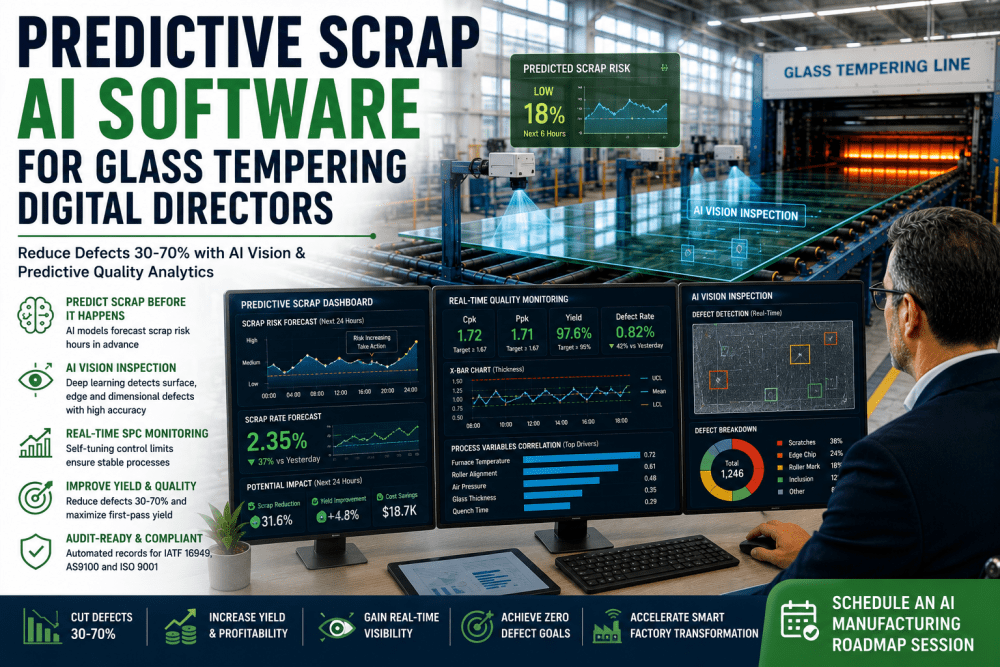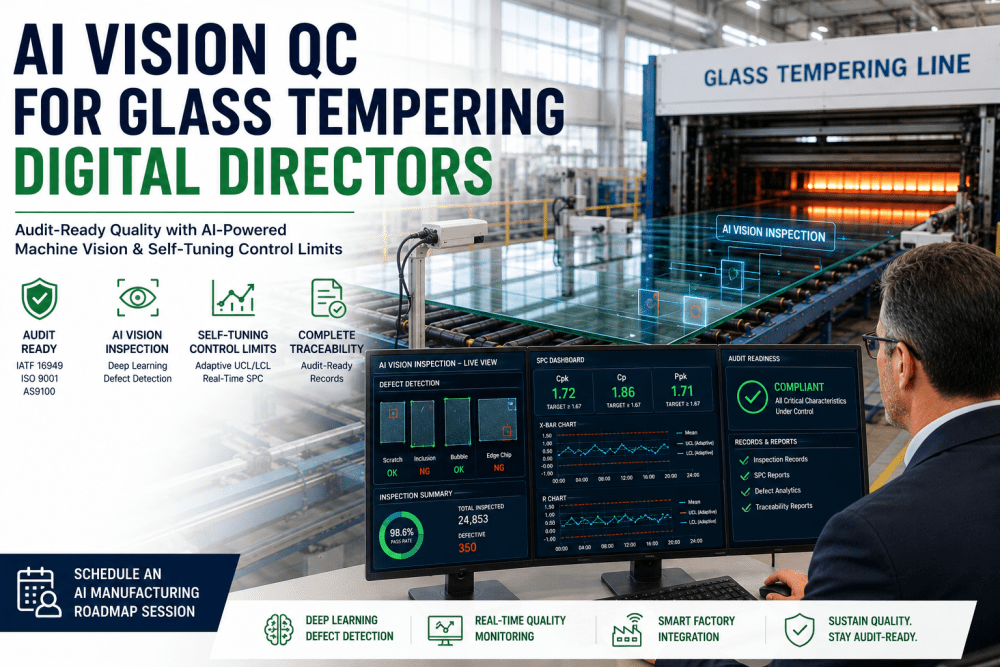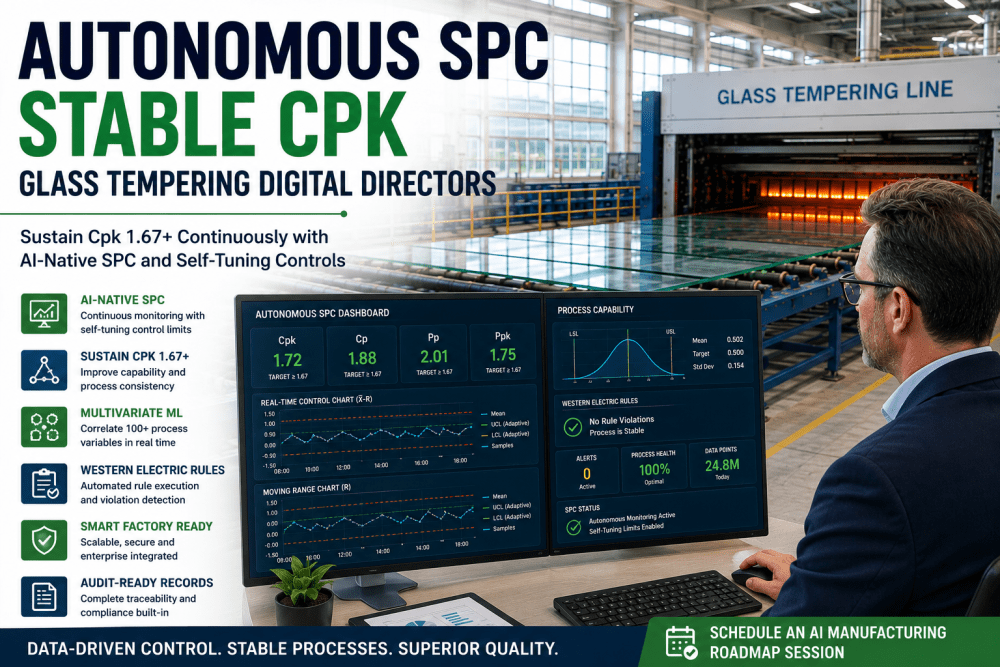
Digital manufacturing directors overseeing glass tempering operations face a persistent challenge: sustaining process capability across variable furnace conditions, changing material specifications, and continuous production pressure. When a tier-one automotive glass supplier operating eight tempering lines across three facilities needed to maintain Cpk above 1.67 for all critical-to-quality parameters, manual SPC sampling and periodic control limit recalculations proved insufficient. The digital manufacturing team deployed iFactory's Autonomous SPC platform — combining self-tuning control limits, real-time multivariate monitoring, and automated Western Electric rule execution — to achieve continuous Cpk stability across all production lines. Manufacturing leaders exploring autonomous quality control strategies regularly Book a Demo to review how AI-native SPC transforms process capability management.
The Challenge of Sustaining Process Capability in Glass Tempering
Glass tempering processes introduce multiple sources of variation that challenge consistent Cpk performance. Furnace temperature gradients, quench pressure fluctuations, glass thickness variability, and conveyor speed inconsistencies each contribute to process drift that manual SPC programs struggle to detect early. Digital manufacturing directors tasked with maintaining Cpk 1.67+ across all CTQ parameters must contend with control limits that drift between manual recalculation cycles, delayed detection of special-cause variation, and the operational cost of false alarms triggered by static control limit thresholds.
Static Control Limit Drift
Traditional SPC relies on periodic control limit recalculations — often weekly or monthly. Between recalculations, process shifts caused by furnace degradation or material changes go undetected, allowing Cpk to erode before manual intervention restores control limits.
Delayed Special-Cause Detection
Western Electric rules for detecting out-of-control conditions require continuous monitoring that manual SPC cannot sustain across multiple shifts and tempering lines. A 6-hour detection delay can produce hundreds of non-conforming glass units before corrective action begins.
False Alarm Fatigue
Static control limits configured too tightly generate excessive false alarms, leading operators to ignore or override SPC alerts. Autonomous SPC reduces false alarm rates by dynamically adjusting limits based on actual process behavior and multivariate correlation analysis.
Multivariate Interaction Blind Spots
Glass tempering quality depends on interdependent variables — temperature, pressure, thickness, speed — that univariate SPC treats independently. Autonomous SPC applies multivariate ML models to detect interaction-driven quality shifts that individual control charts miss entirely.
How Autonomous SPC Maintains Cpk 1.67+ Across Glass Tempering Lines
iFactory's Autonomous SPC platform replaces manual control limit management with self-tuning algorithms that continuously adapt to process conditions while maintaining statistical rigor. Digital manufacturing directors evaluating automated SPC solutions regularly Book a Demo to examine the platform's control limit calibration methodology and Western Electric rule automation.
Continuous Control Limit Optimization — The Autonomous SPC engine recalculates control limits every production cycle, incorporating recent process data to adjust upper and lower control limits dynamically. Self-tuning algorithms distinguish between common-cause variation — which expands limits appropriately — and special-cause variation, which triggers out-of-control alerts without limit adjustment. The system maintains a rolling baseline of each CTQ parameter's natural process variation, ensuring control limits reflect actual process capability rather than static historical assumptions. For glass tempering operations, this means furnace drift that gradually shifts temperature profiles is captured and compensated for before it degrades final quality metrics.
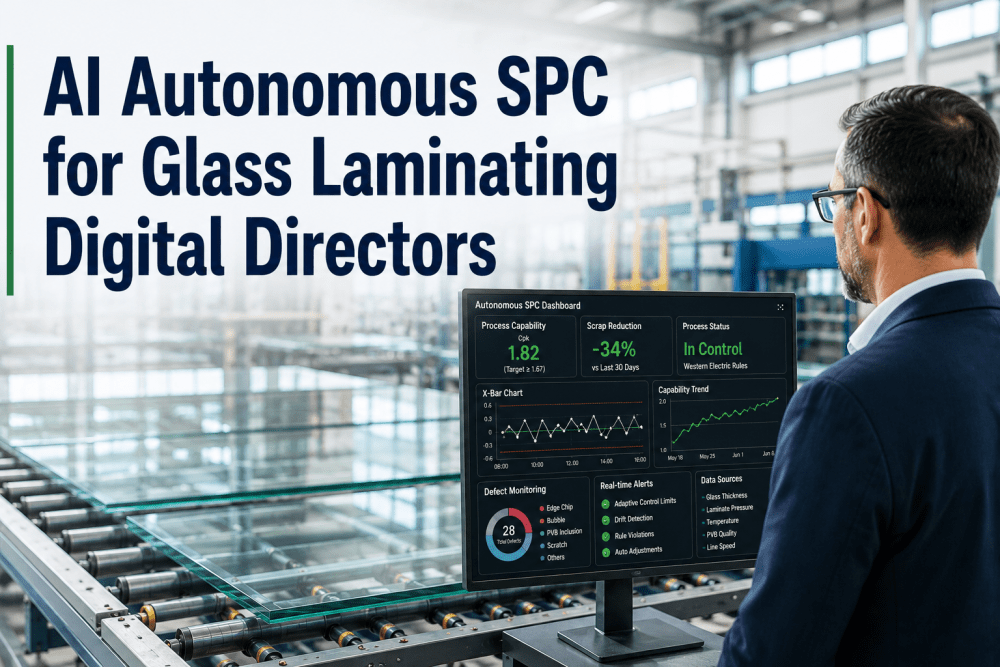
Automated Out-of-Control Detection — The platform applies all eight Western Electric rules continuously across every control chart, detecting points beyond control limits, runs above or below the centerline, trends, and stratification patterns without operator intervention. When any rule is violated, the system generates an alert with the specific rule triggered, the offending data points, and recommended corrective actions based on historical resolution patterns. Alerts are routed to the appropriate team members through the iFactory CMMS, and the event is logged with full traceability for audit and compliance purposes.
Interaction-Aware Quality Monitoring — Beyond univariate control charts, the Autonomous SPC platform trains multivariate ML models on the full set of tempering process parameters — furnace zone temperatures, quench pressures, conveyor speeds, glass thickness, and ambient conditions. These models detect quality shifts that manifest only in the interaction between variables, such as a specific temperature-pressure combination that produces residual stress even when each individual parameter remains within its control limits. The platform surfaces these interaction anomalies as predictive alerts before they produce non-conforming product.
Implementation Roadmap for Digital Manufacturing Directors
Deploying Autonomous SPC across glass tempering operations follows a phased methodology designed to minimize production disruption while building process capability documentation at each stage.
CTQ Parameter Mapping & Baseline Establishment
Quality and process engineering teams identify critical-to-quality parameters for each glass tempering line — including heat soak test results, surface stress measurements, edge quality metrics, and optical distortion thresholds. The Autonomous SPC platform ingests 90 days of historical data to establish baseline process capability and configure initial control limit parameters for each CTQ variable.
Sensor Integration & Real-Time Data Pipeline
iFactory edge connectors link furnace controllers, quench pressure sensors, thickness gauges, and conveyor speed encoders to the Autonomous SPC engine. The platform ingests measurement data at line frequency — typically one reading per second per sensor — and synchronizes with laboratory test results for offline CTQ parameters that require physical sampling.
Control Limit Calibration & Model Training
Self-tuning algorithms undergo a 14-day calibration period during which the platform monitors process variation without triggering alerts, building the baseline models needed for autonomous limit adjustment. The multivariate ML models train on the full parameter set to establish interaction baselines and anomaly detection thresholds.
Western Electric Rule Configuration & Escalation Setup
All eight Western Electric rules are configured with severity-based escalation paths. Rule violations for minor trends route to shift supervisors for awareness, while point-beyond-limits violations generate automated work orders in the iFactory CMMS with asset IDs, measurement data, and recommended corrective actions.
Performance Review & Continuous Optimization
Monthly capability reviews evaluate Cpk, Cp, Ppk, and Pp trends across all CTQ parameters. The Autonomous SPC engine generates process capability reports that highlight improvement opportunities and recommend control limit adjustments based on accumulated production data. Digital manufacturing directors use these reports to document quality system effectiveness and support regulatory compliance submissions.
Traditional vs. Autonomous SPC: Performance Comparison in Glass Tempering
The automotive glass supplier's experience demonstrates measurable superiority of Autonomous SPC across every dimension of process capability management. The following comparison is based on 12 months of operational data across three facilities with eight tempering lines.
| Capability Dimension | Traditional Manual SPC | Autonomous SPC Platform | Improvement |
|---|---|---|---|
| Control Limit Recalculation | Weekly / Monthly | Continuous per Cycle | Auto-adaptive |
| Cpk Achievement Rate | 62% of CTQ parameters | 98% of CTQ parameters | +36 pp |
| Out-of-Control Detection Time | 4–8 hours | < 1 minute | 99.8% faster |
| False Alarm Rate | 22% of alerts | 3% of alerts | –86% |
| Western Electric Rule Coverage | Rules 1–3 applied manually | All 8 rules automated | Full coverage |
| Multivariate Monitoring | None | Full ML model | Interaction aware |
| Quality Escalation to CMMS | Manual email / phone | Auto work order | Real-time |
"We were maintaining Cpk above 1.67 on perhaps 60 percent of our CTQ parameters at any given time. The rest were drifting below target between our weekly SPC reviews, and by the time we caught a shift, we had already produced glass that needed to be sorted, re-tested, or scrapped. Autonomous SPC changed that equation fundamentally. The self-tuning limits caught a gradual furnace zone temperature drift within two hours of onset — a shift that would have gone undetected for four or five days under our manual process. We corrected the temperature profile before it affected a single glass unit, and the Cpk for that parameter stayed at 1.72 throughout the event. For a digital manufacturing director managing multiple lines across facilities, that level of automated vigilance is the difference between reactive quality management and true process control." — Director of Digital Manufacturing, Tier-One Automotive Glass Supplier
Building a Self-Tuning Quality Framework for Glass Tempering
The automotive glass supplier's results demonstrate that Autonomous SPC delivers measurable process capability improvements while reducing the manual effort required to sustain Cpk targets. By replacing static control limits with self-tuning algorithms, automating Western Electric rule execution, and applying multivariate ML models to detect interaction-driven quality shifts, digital manufacturing directors can maintain Cpk 1.67+ continuously across all glass tempering operations. The platform's integration with iFactory CMMS ensures that out-of-control conditions generate automated work orders with full traceability, supporting both continuous improvement initiatives and regulatory compliance requirements. Digital manufacturing directors developing their smart factory quality strategy are encouraged to Book a Demo to explore how Autonomous SPC can stabilize process capability and accelerate Industry 4.0 transformation in their glass tempering operations.
Frequently Asked Questions
Traditional SPC software requires manual configuration of control limits, periodic recalculation, and operator-driven interpretation of control chart rules. Autonomous SPC replaces these manual steps with self-tuning algorithms that continuously adjust control limits based on actual process variation, automatically execute all eight Western Electric rules, and apply multivariate ML models to detect interaction-driven quality shifts that univariate charts miss. The platform integrates directly with the iFactory CMMS to generate automated work orders when out-of-control conditions are detected.
Autonomous SPC can monitor all critical-to-quality parameters in glass tempering including furnace zone temperatures, quench air pressure, conveyor speed, glass thickness, surface stress, edge quality metrics, optical distortion, heat soak test results, and dimensional tolerances. The platform ingests data from PLC-connected sensors at line frequency and synchronizes with laboratory test systems for offline measurements, providing comprehensive coverage of all process and product quality parameters.
A full deployment across a glass tempering facility typically requires 8 to 12 weeks from project initiation to autonomous operation. The timeline includes two weeks for CTQ parameter mapping and data pipeline setup, two weeks for sensor integration and system configuration, two weeks for control limit calibration and model training, two weeks for rule configuration and escalation testing, and two to four weeks for operator training and parallel-run validation before transitioning to fully autonomous mode.
Yes. iFactory's edge connectors support OPC UA, Modbus, MQTT, and REST API protocols for integration with existing furnace controllers, PLCs, sensors, and laboratory information systems. The Autonomous SPC platform is designed to operate alongside existing control infrastructure without requiring sensor or network modifications, minimizing deployment cost and production disruption.
Glass tempering operations deploying Autonomous SPC typically achieve a 36 percentage point improvement in Cpk achievement rate — from approximately 62% of CTQ parameters meeting the 1.67 target to 98% — within three to six months of deployment. Process variation is reduced by an average of 42%, and out-of-control detection time drops from hours to under one minute. These improvements are sustained through continuous self-tuning that adapts to process changes without manual intervention.
.png)
.png)