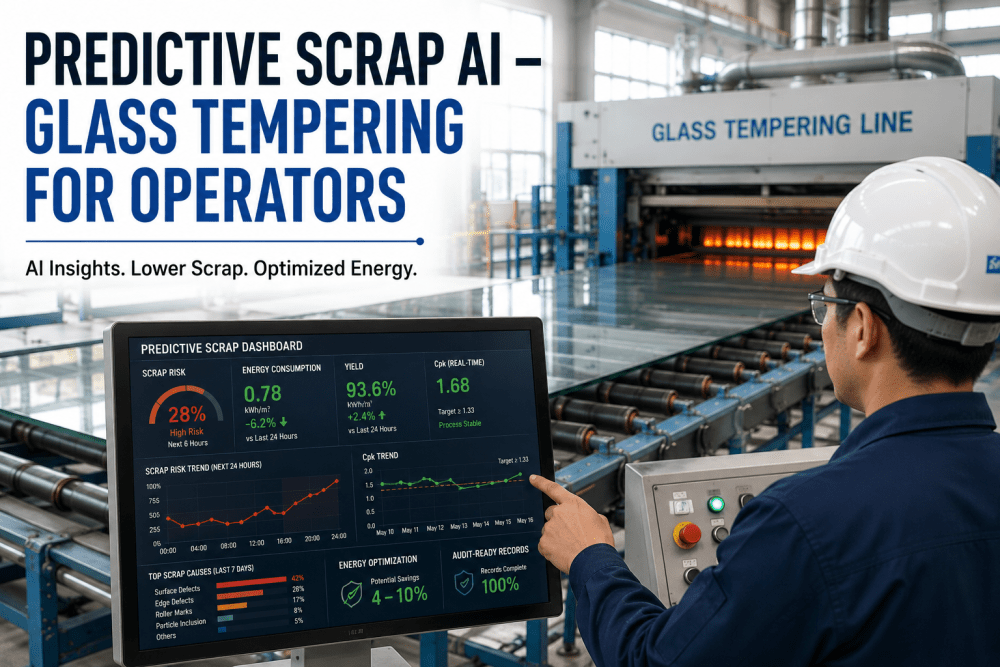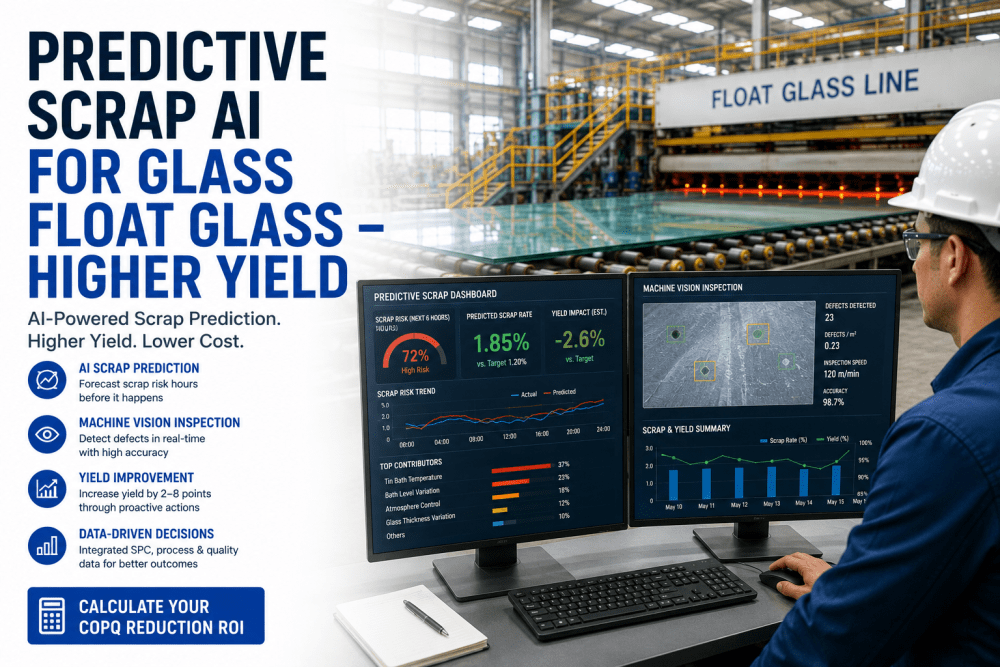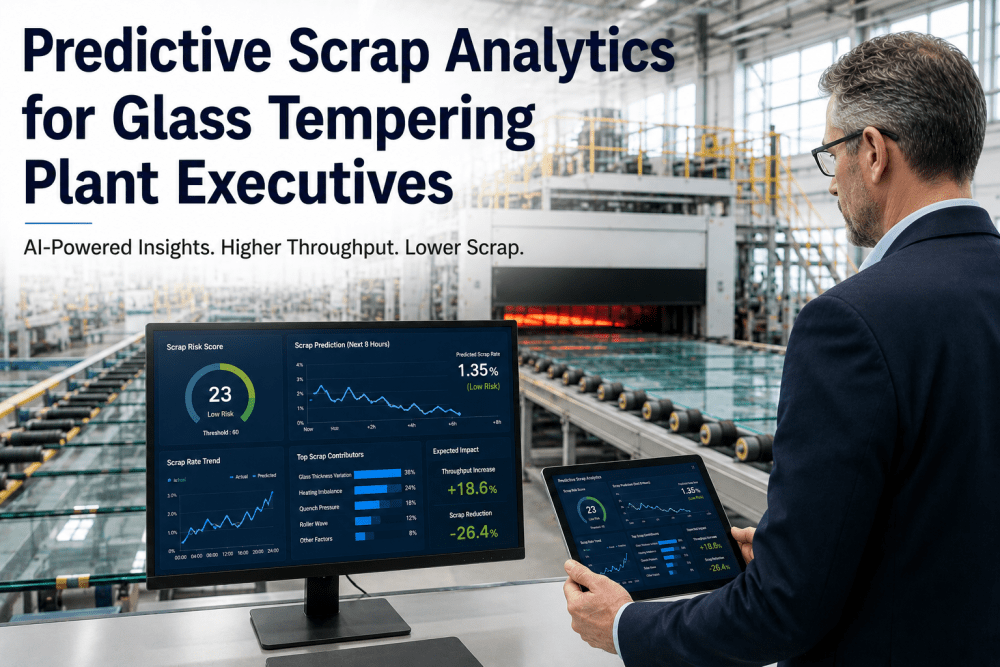
Plant executives managing glass tempering operations face a persistent throughput constraint: scrap rates averaging 7-12% consume production capacity that could otherwise be sold as finished goods. When a furnace produces non-conforming glass, the line does not simply lose material — it loses the furnace time, the energy, the labor, and the inspection capacity allocated to that cycle. Predictive scrap analytics for glass tempering changes this by forecasting scrap risk at the batch and panel level before the glass enters the furnace, enabling operators to adjust process parameters, reject high-risk material inputs, and prevent non-conforming production before it consumes capacity. iFactory's predictive scrap analytics platform delivers this capability on existing tempering line infrastructure with measurable throughput improvement within the first quarter of deployment.
The Throughput Challenge in Glass Tempering Operations
Plant executives responsible for glass tempering production performance know that throughput is not a function of furnace speed alone — it is a function of first-pass yield. When a tempering line operating at 95% utilization produces 10% scrap, the effective throughput is 85.5% of rated capacity. For a facility running six lines rated at 1,200 panels per hour each, that scrap represents 720 panels of lost production per hour — panels that consumed energy, labor, and furnace time but delivered no revenue. The primary drivers of scrap in glass tempering — roller-wave distortion during quench, micro-crack propagation from thermal stress, coating degradation at high temperature, and dimensional variation from inconsistent heating — all follow predictable patterns that traditional quality control detects only after the scrap has been produced. Book a Demo to see how predictive scrap analytics changes this detection timeline.
How Predictive Scrap Analytics Drives Throughput Improvement
Predictive scrap analytics differs from traditional yield monitoring in a fundamental way: instead of measuring scrap after production and calculating a rate, it forecasts scrap probability before each batch based on real-time process conditions, material characteristics, and historical defect patterns. The platform ingests data from furnace temperature sensors, conveyor speed controllers, quench pressure monitors, and incoming material quality inspections — then applies machine learning models trained on 18+ months of production data to predict the likelihood of non-conformance for each panel before it enters the furnace.
| Capability Dimension | Traditional Scrap Monitoring | Predictive Scrap Analytics | Throughput Impact |
|---|---|---|---|
| Detection Timing | End-of-line inspection | Pre-furnace risk forecast | Prevents scrap before production |
| Scrap Data Resolution | Batch-level rate | Panel-level probability score | Targeted intervention per unit |
| Root Cause Identification | Manual investigation (2-4 hrs) | AI-classified within seconds | 5x faster corrective action |
| Process Feedback Loop | End-of-shift report | Real-time per-batch adjustment | Prevents scrap propagation |
| Yield Tracking | Monthly averages | Real-time per furnace cycle | Immediate yield visibility |
| Throughput Baseline | 85-88% effective rate | 94-97% after deployment | +9-12 point improvement |
| Annual Scrap Cost (6 lines) | $4.2M-$5.8M | $2.1M-$2.9M | 45-50% reduction |
The comparison shows that predictive scrap analytics does not replace existing quality systems — it adds a forecasting layer that transforms scrap management from a reactive measurement to a preventive capability. The same furnace temperature sensor that records cycle data also feeds the prediction model, which compares current conditions against the historical scrap signature database and outputs a risk score before the batch is committed.
Predictive Scrap Analytics Capabilities for Glass Tempering
iFactory's predictive scrap analytics platform delivers four integrated capabilities that together create a continuous throughput improvement cycle. Each capability addresses a specific scrap driver and delivers measurable impact at every stage of deployment.
Measured Throughput Impact from Predictive Scrap Analytics
The plant executive deployed iFactory's predictive scrap analytics platform across six glass tempering lines over a structured 10-week deployment. The following metrics represent the measured performance improvement from pre-deployment baseline to post-deployment steady state across 48,000 production panels.
Beyond the headline metrics, the predictive scrap analytics deployment produced structural improvements that compound over time. Scrap detection latency dropped from 3.5 hours to under 60 seconds. Rework labor decreased by 62% as fewer non-conforming panels reached downstream processing. Expedited material procurement for replacement glass dropped by 48%. The platform's machine learning models continue improving with each production cycle, projecting an additional 3-5 throughput points in year two. Book a Demo to review the full throughput impact model for your lines.
Conclusion — Predictive Scrap Analytics Turns Throughput from a Capacity Problem into a Data Problem
What the plant executive lacked was not furnace capacity — every line had available cycles, every furnace had temperature control, and every operator had quality training. The missing piece was a system that could forecast scrap before it happened and give operators the specific guidance needed to prevent it. Predictive scrap analytics closed this gap — delivering effective throughput improvement from 87% to 96%, scrap reduction of 54%, $3.1M in annual COPQ savings, and full payback within four months. The technology did not change the furnaces, the temperatures, or the process parameters. It changed when operators received the information needed to prevent scrap — from after the shift to before the batch. Book a Demo to review the predictive scrap analytics deployment plan for your operations.
Frequently Asked Questions — Predictive Scrap Analytics for Glass Tempering
What is predictive scrap analytics and how does it differ from traditional scrap tracking in glass tempering?
Predictive scrap analytics uses machine learning models trained on historical production data to forecast the probability of non-conformance for each panel before it enters the furnace. Traditional scrap tracking measures the scrap rate after production and reports it at the end of the shift. Predictive analytics enables operators to prevent scrap before it occurs by adjusting process parameters based on real-time risk scores.
How does predictive scrap analytics increase throughput in glass tempering operations?
Throughput increases through two mechanisms. First, scrap prevention at the batch level means fewer non-conforming panels consume furnace time, energy, and labor — freeing capacity for revenue-producing production. Second, real-time risk scoring enables operators to maintain optimal line speed with confidence, knowing that the prediction model will flag developing conditions before they produce scrap. The documented deployment improved effective throughput from 87% to 96%.
What sensor and data infrastructure is required for predictive scrap analytics deployment?
The platform integrates with existing furnace temperature sensors, conveyor speed controllers, quench pressure monitors, and quality inspection systems through standard industrial protocols including OPC-UA, Modbus, and REST API. For facilities without digital sensor infrastructure, iFactory provides IoT retrofitting packages. The predictive analytics layer operates on an edge computing appliance at each line with optional cloud aggregation for multi-facility reporting.
How long does it take to achieve production-level prediction accuracy with predictive scrap analytics?
Pre-trained machine learning models achieve approximately 88% scrap prediction accuracy at deployment, drawing from a training set of 18+ months of production data from similar glass tempering operations. After 4 weeks of site-specific calibration, accuracy reaches 93%. Continuous active learning from each production cycle improves accuracy to 95%+ within 12 weeks. The platform's false alarm rate stabilizes at 5% after calibration.
What is the typical payback period for predictive scrap analytics in glass tempering?
Facilities with 4+ tempering lines and existing scrap rates above 8% typically recover platform investment within 3 to 5 months. Primary ROI drivers are scrap material savings averaging 54%, energy cost reduction from eliminated non-conforming cycles, reduced rework labor, and increased revenue from recovered throughput capacity. A personalized COPQ reduction analysis is provided during the Book a Demo consultation with iFactory's glass manufacturing team.