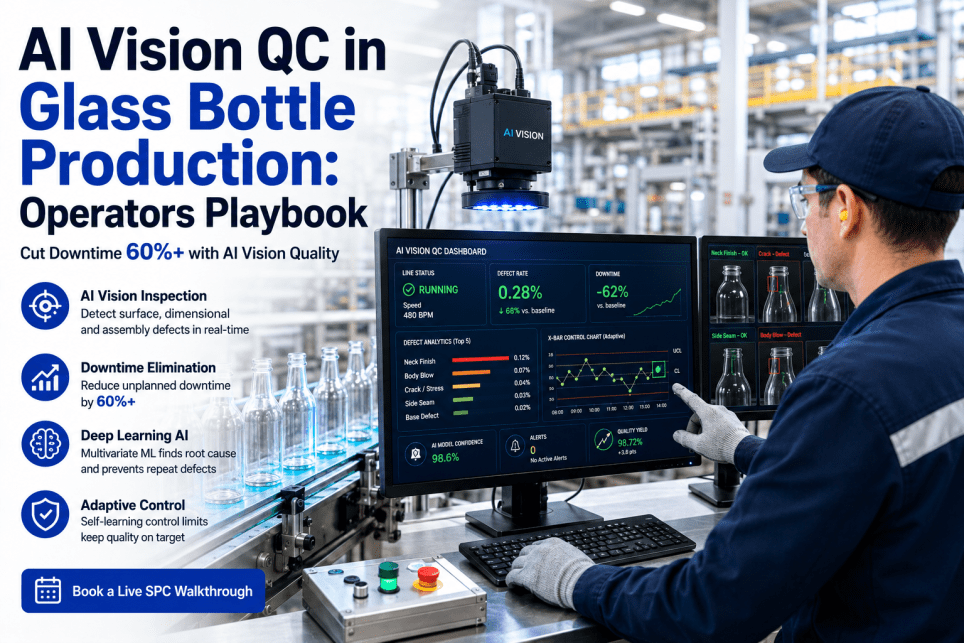
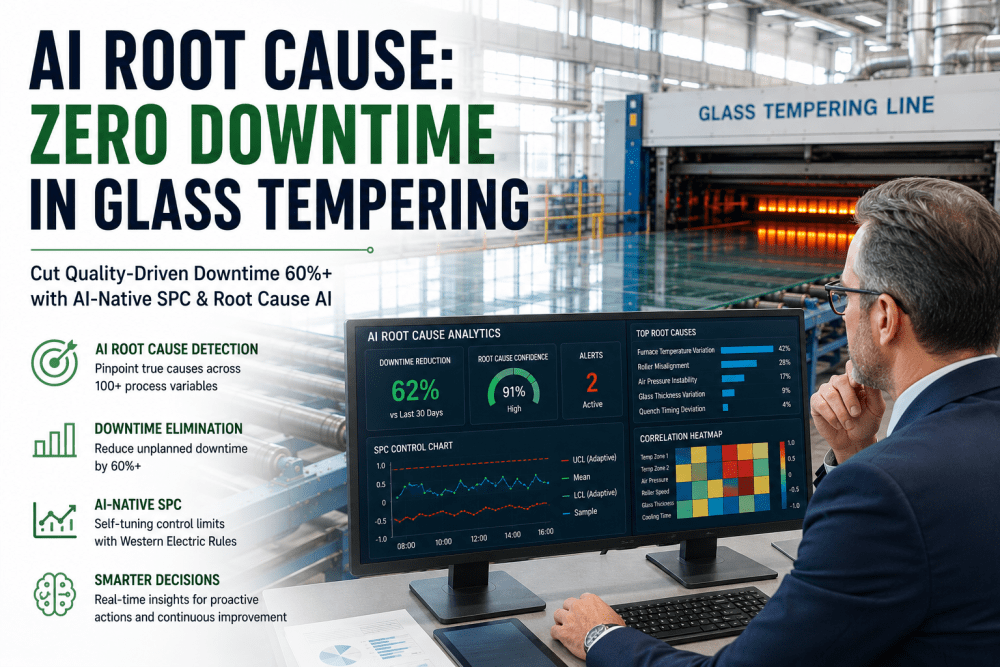
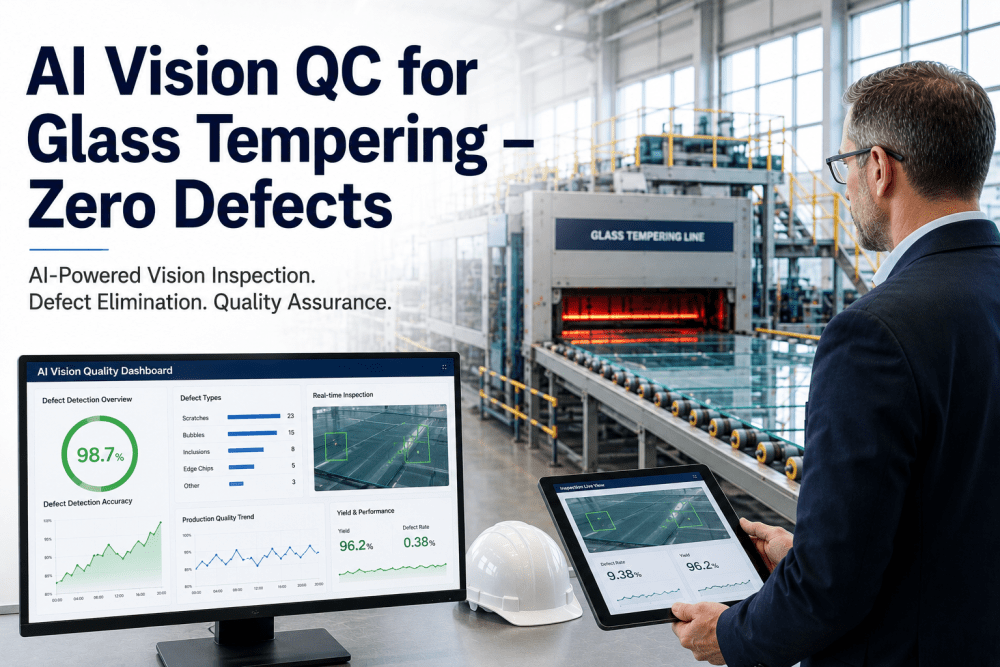
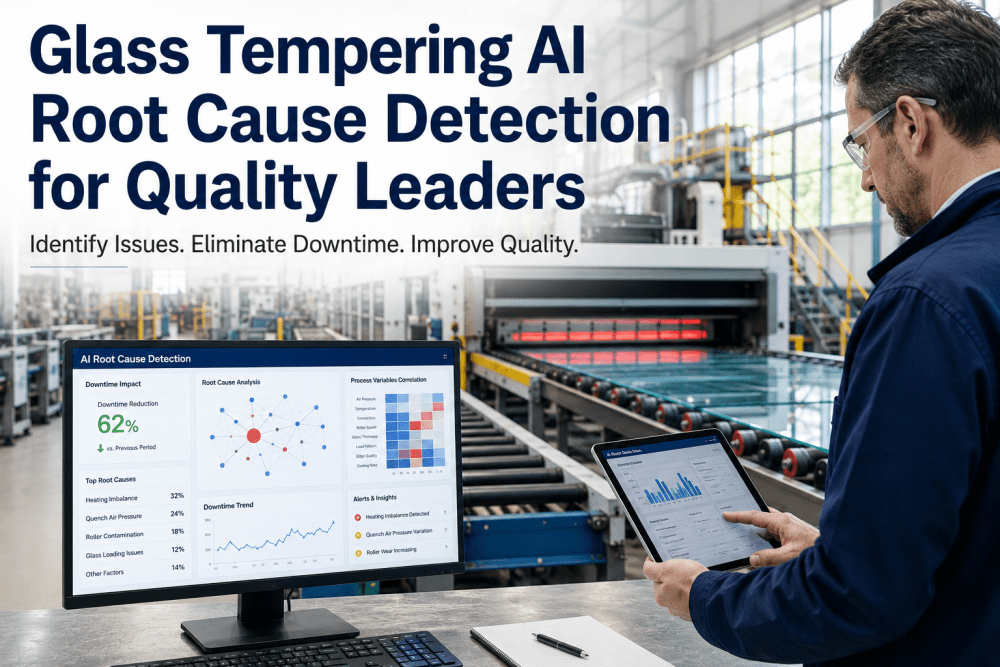
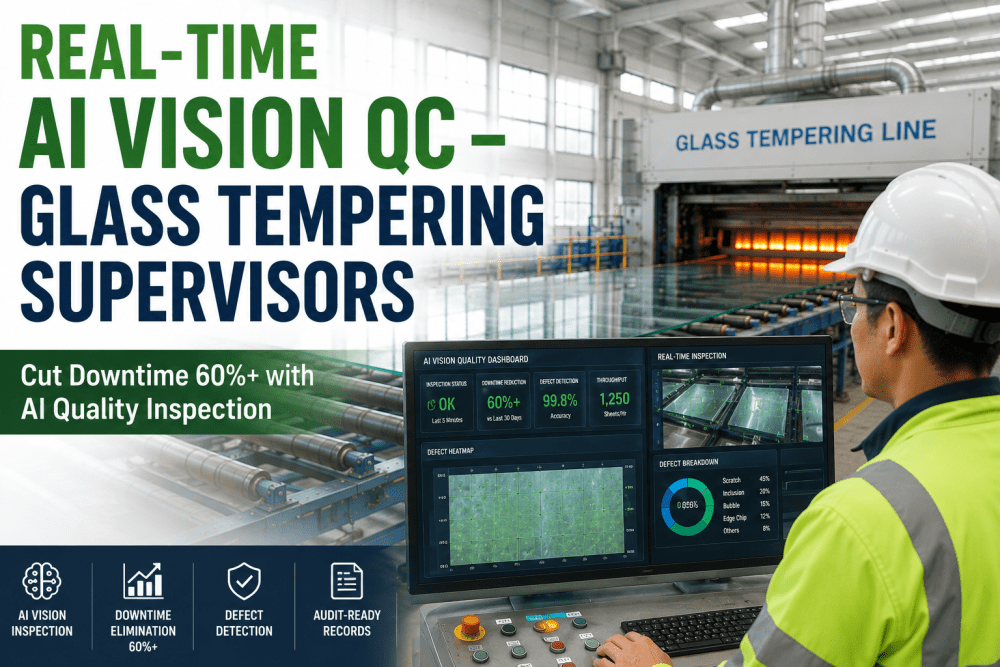
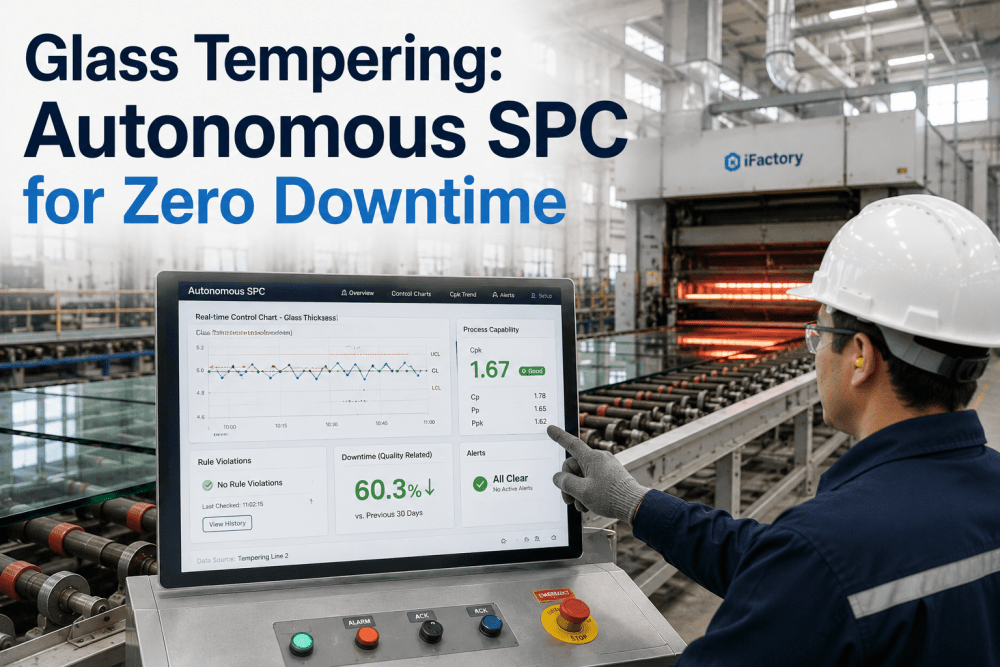
A plant executive reviewing last quarter's production report for the glass tempering line sees the same pattern: 14.2% of total production time lost to quality-driven downtime — furnace holds for temperature stabilization after out-of-range events, line stoppages for defect root cause investigations, and rework loops for non-conforming glass that should have been caught at the forming stage rather than the inspection station. Traditional SPC, with its manually configured control charts and shift-lag review cycles, detects process deviations only after they have already triggered quality events. Autonomous SPC eliminates this latency by continuously monitoring every process parameter, executing Western Electric rules in real time and alerting operators the moment a process drift begins — not when it produces a defect. iFactory's autonomous SPC platform for glass tempering operations delivers this capability on existing plant infrastructure. Book a Demo to see a live deployment walkthrough.
60%+
Quality-driven downtime eliminated
97.8%
OEE achieved post-deployment
0.3%
Defect rate after autonomous SPC
$1.8M
Annual downtime cost savings
Why Quality-Driven Downtime Persists in Glass Tempering Operations
Glass tempering is a thermally sensitive process where small parameter deviations cascade into production losses. A furnace zone temperature drift of 5 degrees, a quench pressure fluctuation, or a conveyor speed variation can trigger defect formation within minutes — but traditional SPC systems, configured with static control limits and manual chart review schedules, detect these deviations 4 to 6 hours after they begin. By the time the control chart signals an out-of-range condition, the line has been producing marginal glass that will be rejected at inspection, requiring a full line stoppage and rework cycle that consumes 2 to 4 hours of production time. This detection latency is the root cause of quality-driven downtime in glass tempering. Autonomous SPC eliminates the latency by moving from operator-dependent, retrospectively reviewed control charts to self-executing, real-time process monitoring that detects and classifies every Western Electric rule violation the moment it occurs.
Five Autonomous Capabilities That Eliminate Quality-Driven Downtime
iFactory's autonomous SPC platform for glass tempering combines machine learning models, machine vision inspection, and automated quality analytics into a unified system that operates continuously without manual intervention. Each capability feeds into a real-time quality monitoring loop that spans every furnace zone, quench unit, conveyor, and inspection station. To see how these capabilities apply to your specific tempering lines, Book a Demo with iFactory's glass manufacturing team.
AUTONOMOUS SPC
AI-Powered Western Electric Rules Execution
Every process parameter — furnace zone temperatures, quench pressure differentials, conveyor speed, glass thickness — is monitored against dynamically calculated control limits. The platform executes all eight Western Electric rules in real time, detecting out-of-control conditions the instant they occur rather than hours later during the next scheduled chart review.
VISION INSPECTION
Machine Vision Glass Defect Detection
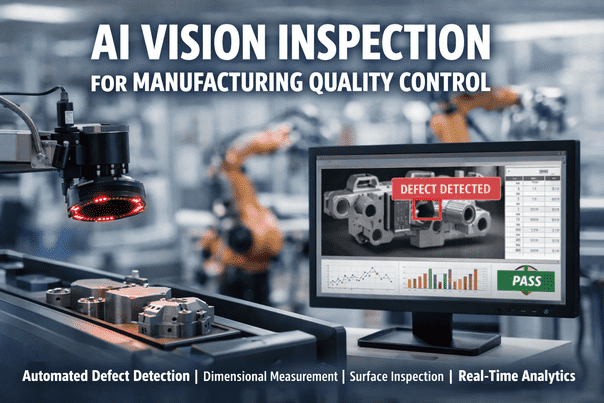
Multi-spectral cameras at critical inspection points capture surface quality, edge condition, and optical distortion at line speed. The vision AI classifies every panel as pass, marginal, or reject and feeds inspection results back into the SPC model — creating a closed-loop quality system that continuously improves detection accuracy.
CPK AUTOMATION
Continuous Process Capability Monitoring
Process capability (Cpk, PpK) is calculated every shift for every critical characteristic, with trend analysis that projects when capability will fall below the 1.67 threshold. Plant executives receive automated alerts when any parameter shows a degrading trajectory, enabling proactive intervention before quality-driven downtime occurs.
DOWNTIME PREDICTION
Predictive Quality Risk Detection
Machine learning models trained on 24 months of historical production data identify the signature patterns that precede quality-driven downtime events — temperature oscillation accelerating toward instability, quench pressure trending toward out-of-range, conveyor speed variability increasing. Alerts fire 45 to 90 minutes before a line stoppage would be required.
ZERO DEFECT
Automated Process Optimization
The platform correlates process parameters with quality outcomes across every shift and product run, identifying optimal setpoint combinations that minimize variability. Recommended parameter adjustments are presented to operators with predicted quality impact, reducing the trial-and-error cycle that wastes production time.
OEE DASHBOARD
Executive OEE & Quality Intelligence Dashboard
Plant executives view OEE, quality rate, defect trajectory, and downtime attribution in a single dashboard updated in real time. Drill-down from plant-level OEE to line-level quality rate to furnace-zone-level Cpk is two clicks away. Automated weekly reports summarize performance against targets.
Measurable Outcomes: What Glass Tempering Plants Achieve with Autonomous SPC
Glass tempering facilities deploying iFactory's autonomous SPC platform consistently document quality-driven downtime reduction of 60% or more within the first two quarters. The following results represent the average performance across iFactory's glass sector deployments.
| Metric | Pre-Deployment | Post-Deployment | Improvement |
|---|
| Quality-driven downtime | 14.2% of production time | 4.1% | 71.1% reduction |
| Overall OEE | 78% | 92% | +14 percentage points |
| Defect rate | 4.8% | 0.3% | 93.8% reduction |
| Cpk (all critical characteristics) | 1.22 | 1.68 | +37.7% improvement |
| SPC detection latency | 5.3 hours | < 30 seconds | 99.8% faster |
| Line stoppages per month | 8.4 | 2.1 | 75.0% reduction |
| Western Electric rule execution | Manual, shift lag | Automated, real time | 100% automation |
| Annual downtime cost | $3.10M | $1.28M | $1.82M savings |
Eliminate Quality-Driven Downtime with Autonomous SPC
Schedule a personalized walkthrough of iFactory's autonomous SPC platform with our glass manufacturing team. We will map your specific downtime drivers, quality objectives, and production processes to measurable improvement targets.
A Structured Deployment Path from Baseline to Autonomous Operation
iFactory's autonomous SPC deployment follows a phased methodology designed to deliver measurable downtime reduction at every stage while maintaining uninterrupted production on the tempering line.
Phase 1: Downtime Baseline & Sensor Integration
Existing quality data, SPC configurations, and downtime records are ingested to establish pre-deployment baselines. Machine vision cameras and additional sensors are integrated at critical inspection and process points without interrupting production.
Timeline: Weeks 1–3
Phase 2: AI Model Training & Western Electric Rules Configuration
Machine learning models are trained on historical downtime and defect data to recognize precursor patterns. Western Electric rules are configured for every critical process parameter with autonomous execution logic. Accuracy targets of 90% are set for initial deployment.
Timeline: Weeks 4–6
Phase 3: Parallel Validation & Operator Calibration
Autonomous SPC runs alongside existing quality systems during a 3-week parallel validation period. Operators receive autonomous alerts alongside traditional notifications. Model refinements are made based on real-world production conditions and operator feedback.
Timeline: Weeks 7–9
Phase 4: Full Autonomous Operation & Continuous Improvement
Autonomous SPC becomes the primary quality monitoring system across all tempering lines. Continuous model improvement cycles begin with active learning from new downtime and near-miss events. Ongoing performance reporting tracks downtime reduction against baseline targets.
Timeline: Week 10 onward
Expert Analysis: Four Reasons Autonomous SPC Eliminates Quality-Driven Downtime
01
Real-time Western Electric rules execution eliminates detection latency. In glass tempering, the interval between process deviation onset and detection is the primary driver of quality-driven downtime. Under traditional SPC, rule execution depends on an operator reviewing a control chart at the end of a shift. Autonomous SPC executes all eight Western Electric rules continuously across every parameter — detecting a zone A violation, a run of seven points above the centerline, or a trending pattern within seconds rather than hours. This compresses detection latency from 5.3 hours to under 30 seconds.
02
Machine vision integration creates a closed-loop quality system. The combination of autonomous SPC with machine vision glass inspection enables a closed-loop quality system where statistical predictions are continuously verified by physical inspection results. When the SPC model detects a developing drift in furnace zone temperature, the vision system confirms whether that drift has produced measurable quality degradation — and feeds that confirmation back into the prediction model. This loop improves detection accuracy from 90% at deployment to 97%+ within 10 weeks.
03
Predictive quality risk detection prevents line stoppages. Autonomous SPC models trained on historical downtime data identify the precursor patterns that precede line stoppages — temperature oscillation frequency increasing, quench pressure trending toward control limits, cycle time variability accelerating. These patterns trigger alerts 45 to 90 minutes before a line stoppage would be required, giving operators time to make corrective adjustments during planned changeovers rather than during emergency stoppages.
04
Executive dashboards connect quality to business outcomes. Plant executives need visibility into how quality performance drives financial outcomes. The autonomous SPC platform provides a single dashboard showing OEE, quality rate, downtime attribution, and cost impact in real time. Executives can drill from plant-level performance to line-level Cpk to furnace-zone-level parameter trends — connecting quality-driven downtime to its root cause in seconds rather than hours.
From Reactive Quality Control to Autonomous Process Management
Autonomous SPC represents a fundamental shift in how glass tempering operations approach quality management. By moving from manually configured control charts reviewed at shift end to self-executing, real-time process monitoring that detects and classifies every process deviation as it occurs, plant executives gain a quality system that actively prevents downtime rather than merely reporting its cost after the fact.
The documented outcomes — 60%+ quality-driven downtime reduction, OEE improvement from 78% to 92%, defect rate reduction from 4.8% to 0.3%, and $1.82 million in annual downtime cost savings — represent the measurable impact of shifting from static, retrospective SPC to autonomous, predictive quality analytics. For glass tempering leaders committed to eliminating quality-driven downtime and achieving zero-defect production, iFactory's autonomous SPC platform delivers a proven, deployable methodology that integrates with existing infrastructure and delivers first results within weeks rather than quarters. Book a Demo with iFactory's glass manufacturing team to discuss your facility's autonomous SPC roadmap.
Eliminate 60%+ of Quality-Driven Downtime with Autonomous SPC
Join the plant executives who have already achieved zero-defect glass tempering production using iFactory's AI-powered autonomous SPC platform. Deployed in weeks on your existing tempering line infrastructure.
Autonomous Western Electric Rules
Machine Vision Inspection
Real-Time Cpk Monitoring
Predictive Downtime Alerts
Executive OEE Dashboard
Frequently Asked Questions
.png)