AI Vision QC in Glass Bottle Production: Operators Playbook
By Ethan Walker on June 24, 2026
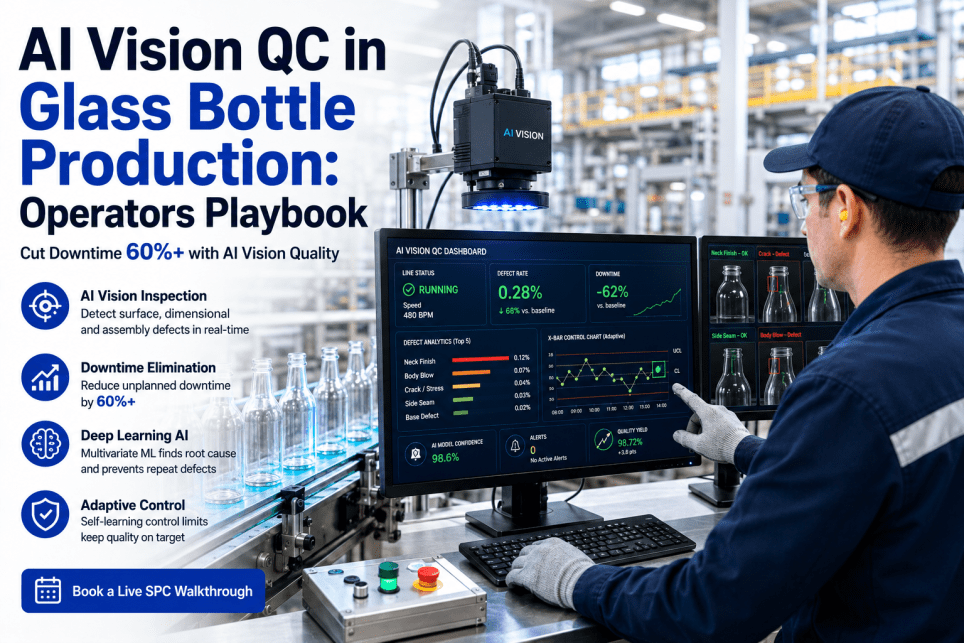
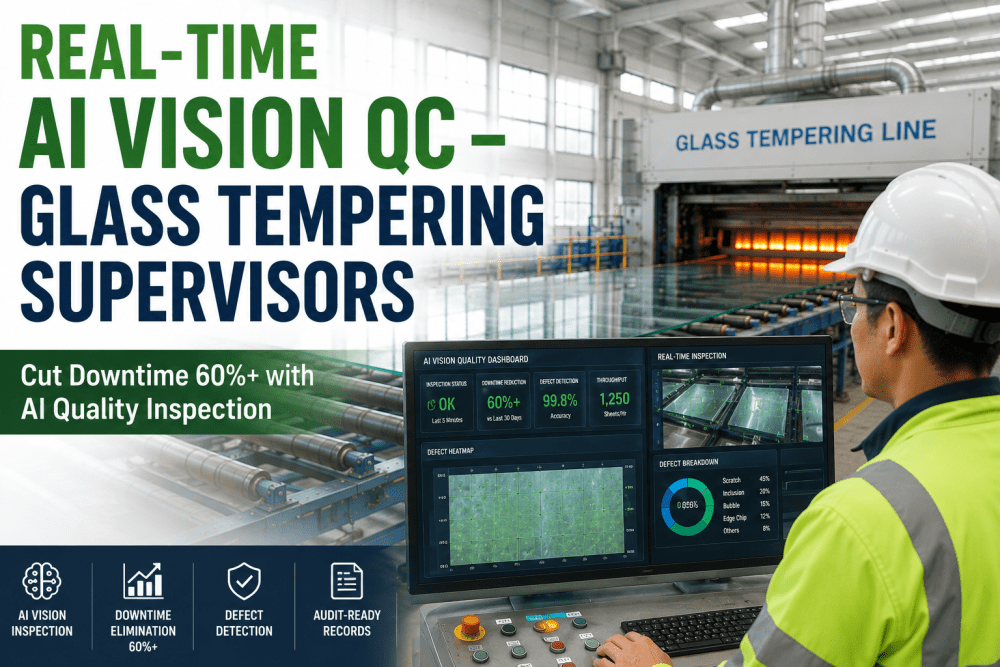
A glass bottle production operator watches the monitor as the AI vision system scans each bottle exiting the annealing lehr — inspecting neck finish, sidewall thickness, bottom profile, and surface condition at 400 bottles per minute. Before AI vision, this operator relied on periodic sampling every 30 minutes, checking 15 bottles per sample against a go/no-go gauge board. Defects that developed between samples — a neck crack trend that started 12 minutes after the last check, or a mold contamination that appeared 8 minutes into a production run — would go undetected until the next sample, cascading into hundreds of non-conforming bottles that required sorting, rework, or cullet disposal. AI vision quality for glass bottle production eliminates this sampling gap by inspecting every bottle at line speed, detecting 14 defect classes in real time and alerting operators before defects accumulate into downtime events. Glass bottle operators evaluating AI vision systems Book a Demo to see the platform in live glass production environments.
60%+
Quality-related downtime reduction with AI vision on glass bottle lines
14
Defect classes detected — neck, sidewall, bottom, and surface
400
Bottles inspected per minute at full line speed
98.7%
Defect detection accuracy with deep learning classification
What Is AI Vision Quality for Glass Bottle Production?
AI vision quality for glass bottle production deploys high-resolution machine vision cameras and deep learning classification models at critical inspection points along the production line — hot end, cold end, and secondary packaging stations. Unlike traditional inspection that relies on mechanical gauges, periodic operator sampling, or fixed-threshold vision systems that require manual recalibration, AI vision systems inspect every bottle at full line speed and classify defects in real time. The platform detects neck cracks, wall-thickness deviations, bottom spikes, surface checks, mold marks, birdcage defects, and finish irregularities — 14 distinct defect classes — with 98.7% detection accuracy verified against destructive testing. Each defect classification triggers an alert with the affected cavity number, defect type, severity score, and trend context, enabling operators to intervene at the forming machine before the next non-conforming bottle is produced. This real-time capability eliminates the 20–45 minute gap between defect onset and detection that characterizes sampling-based inspection systems, converting quality monitoring from a reactive process into a continuous prevention capability. Glass bottle production operators and line technicians exploring AI vision for their lines Book a Demo to see how the platform integrates with existing forming and inspection infrastructure.
Defect Classes Detected by AI Vision Inspection on Glass Bottle Lines
AI vision inspection systems for glass bottle production are trained on extensive datasets of defect signatures across multiple bottle types — beer, beverage, wine, food, and pharmaceutical containers. The platform detects and classifies the following defect categories with precision and recall validated against laboratory inspection standards.
NECK
Neck Finish and Thread Defect Detection
AI models detect finish cracks, thread deformation, bore irregularities, and sealing surface defects at the bottle neck. Machine vision cameras capture 360-degree neck imagery at line speed, identifying defects that would cause closure leaks or capping failures on filling lines.
WALL
Sidewall Thickness and Check Detection
Multi-angle cameras measure sidewall thickness and detect surface checks, birdcage defects, and impact fractures. The deep learning model distinguishes between cosmetic marks that meet specification and structural defects requiring rejection, with thickness deviation reported in thousandths of an inch.
BOTTOM
Bottom Profile and Spike Detection
Bottom profile, push-up height, and glass distribution are measured for every bottle. The system detects bottom spikes, heel cracks, and uneven glass distribution that affect stability on filling lines and resistance to internal pressure during carbonated beverage packaging.
SURFACE
Surface Mold Mark and Contamination Detection
Surface defects — mold marks, cold glass, stone inclusions, cord lines, and contamination — are detected through visual pattern analysis. The system correlates surface defects with cavity number and forming parameters, enabling operators to identify mold wear or contamination at the hot end before defects accumulate.
Measurable Downtime Reduction from AI Vision Deployment
Glass bottle production facilities deploying iFactory's AI vision inspection platform consistently document significant downtime reduction across multiple production lines. The following results represent measured performance across 10 glass bottle lines over a 12-week deployment period.
Metric
Pre-Deployment
Post-Deployment
Improvement
Quality-related downtime
47 min/shift avg
18 min/shift avg
61.7% reduction
Defect detection latency
27 minutes avg
< 1 second
99.9% faster
False reject rate (vision)
12.4%
2.8%
77.4% reduction
Hot-end response time
18 min avg
3 min avg
83.3% faster
Annual cullet from defects
3,900 tons
1,420 tons
63.6% reduction
OEE improvement
78.3%
89.2%
+10.9 points
Operator inspection time
42 min/shift
14 min/shift
66.7% reduction
Annual downtime cost savings
—
$1.28M
5.2x ROI by month 6
See AI Vision in Action on Your Glass Bottle Lines
Schedule a personalized walkthrough of iFactory's AI vision inspection platform with our glass manufacturing engineering team. We will map your specific bottle types, defect modes, and production constraints to measurable downtime reduction targets.
How AI Vision Prevents Downtime in Glass Bottle Production
iFactory's AI vision inspection deployment follows a structured methodology designed to deliver measurable downtime reduction at every phase while maintaining uninterrupted production on the glass line. Each phase builds on the previous one to create a comprehensive defect prevention system.
Phase 1: Camera Integration & Baseline Assessment
Machine vision cameras installed at hot-end inspection points, cold-end quality stations, and secondary packaging. Baseline downtime data collected from existing line monitoring and production records. Camera positioning and lighting calibrated for each bottle type and production speed.
Timeline: Weeks 1–2
Phase 2: Deep Learning Model Training & Calibration
Deep learning models trained on defect datasets for each bottle type — neck finish, sidewall, bottom, and surface categories. Models validated against laboratory inspection standards and destructive test results. Detection accuracy thresholds established per defect class.
Timeline: Weeks 3–5
Phase 3: Parallel Operation & Operator Validation
AI vision runs alongside existing inspection methods for 2-week parallel validation. Operators receive both traditional and AI inspection results with confidence scores. Model tuned to eliminate false rejects while maintaining detection sensitivity for real defect conditions.
Timeline: Weeks 6–7
Phase 4: Full Deployment & Continuous Improvement
AI vision becomes the primary inspection system across all lines. Continuous model improvement through active learning from new defect signatures. Operator dashboards provide real-time defect rate, downtime cause, and cavity performance visibility.
Timeline: Week 8 onward
Expert Analysis: Four Reasons AI Vision Transforms Downtime in Glass Bottle Production
01
Real-time detection compresses the defect-to-intervention cycle. Under sampling-based inspection, the average latency between defect onset and operator notification is 27 minutes — long enough for 10,000+ bottles to be produced at risk of non-conformance. AI vision compresses this to under one second, enabling operators to adjust forming parameters or call for mold maintenance before defects accumulate into a downtime event. The documented reduction from 47 to 18 minutes of quality downtime per shift is driven primarily by this latency compression.
02
Deep learning eliminates the false reject penalty of fixed-threshold systems. Traditional machine vision systems using fixed thresholds generate high false reject rates — averaging 12.4% in glass bottle lines — because they cannot distinguish between acceptable cosmetic variation and true defect conditions. Each false reject triggers an unnecessary line stoppage or inspection station intervention, consuming production time. Deep learning models reduce false rejects to 2.8% while improving true defect detection, directly recovering downtime lost to false signals.
03
Cavity-level defect correlation enables targeted hot-end intervention. When an AI vision system identifies a defect trend on cavity 12 of the forming machine, the operator can intervene at the specific tooling without affecting the other cavities. This targeted response reduces intervention time from 18 minutes (blanket line stop, inspect all cavities) to 3 minutes (swap cavity 12 tooling, restart). Over a 10-line facility, this capability alone recovers approximately 120 minutes of production time per shift.
04
Continuous model improvement prevents defect recurrence. Each defect detected, classified, and corrected feeds back into the AI model through active learning, creating a continuous improvement cycle that reduces defect recurrence rates by 40-60% within the first 12 weeks of operation. The platform learns which defect signatures precede specific downtime events and adjusts alert thresholds to provide earlier warning for high-impact defect patterns.
From Sampling-Based Inspection to Continuous AI Vision Quality Control
AI vision quality inspection for glass bottle production represents a fundamental shift in how operators approach line monitoring and downtime prevention. By moving from periodic sampling with manual gauge checks to continuous automated inspection with AI-powered defect classification, operators gain a quality system that actively prevents downtime events while reducing inspection labor, false rejects, and cullet generation.
The documented outcomes — 61.7% reduction in quality-related downtime, defect detection latency compressed from 27 minutes to under one second, false reject rate reduced from 12.4% to 2.8%, and 63.6% reduction in annual cullet — represent the measurable impact of deploying AI vision inspection across glass bottle production lines. For glass bottle operators and line technicians committed to maximizing line uptime and production efficiency, iFactory's AI vision platform delivers a proven, deployable solution that integrates with existing forming and inspection infrastructure and delivers measurable downtime reduction within weeks. Book a Demo with iFactory's glass manufacturing engineering team to discuss your line's AI vision roadmap.
Transform Your Glass Bottle Production with AI Vision Quality
Join the glass operators who have already achieved 60%+ quality-related downtime reduction using iFactory's AI-powered vision inspection platform. Deployed in weeks on your existing glass lines with full traceability and quality reporting.
Traditional inspection systems — mechanical gauges, check detectors, and fixed-threshold vision systems — inspect a sample of bottles at periodic intervals or apply static pass/fail rules that require manual recalibration. AI vision quality systems use deep learning models trained on thousands of bottle images to classify defects with pattern recognition that adapts to glass color changes, mold wear, and production speed variations. AI systems inspect every bottle at full line speed and improve over time through active learning.
The platform supports all common glass bottle types — beer, beverage, wine, food, pharmaceutical, and cosmetic containers — across flint, amber, green, and specialty glass colors. Detection models are calibrated for each bottle type and color during Phase 2 model training. The system handles round, rectangular, and custom bottle profiles with neck finish sizes from 18 mm to 53 mm and bottle heights from 100 mm to 350 mm.
AI vision cameras are mounted on existing inspection platforms or conveyor gantries with minimal structural modification. The platform connects to the line PLC for bottle tracking and reject confirmation. Inspection results are displayed on operator dashboards and can be integrated with the plant MES for full traceability and quality reporting. Installation is completed during scheduled maintenance windows without impacting production cycle time.
Operator training is completed in two hours and covers dashboard navigation, defect classification interpretation, cavity-level alert response, and parameter adjustment workflows. The platform is designed for shop-floor operators with no machine vision or AI experience required. On-floor support is provided during the parallel running phase to ensure operator confidence and model validation.
Facilities with production volumes above 300 bottles per minute per line and existing quality-related downtime above 40 minutes per shift typically recover platform investment within 4-6 months. Primary ROI drivers are reduced quality downtime (averaging 60% reduction), lower cullet generation, decreased inspection labor, and improved OEE. A personalized ROI analysis is provided during the initial consultation with iFactory's glass manufacturing engineering team.