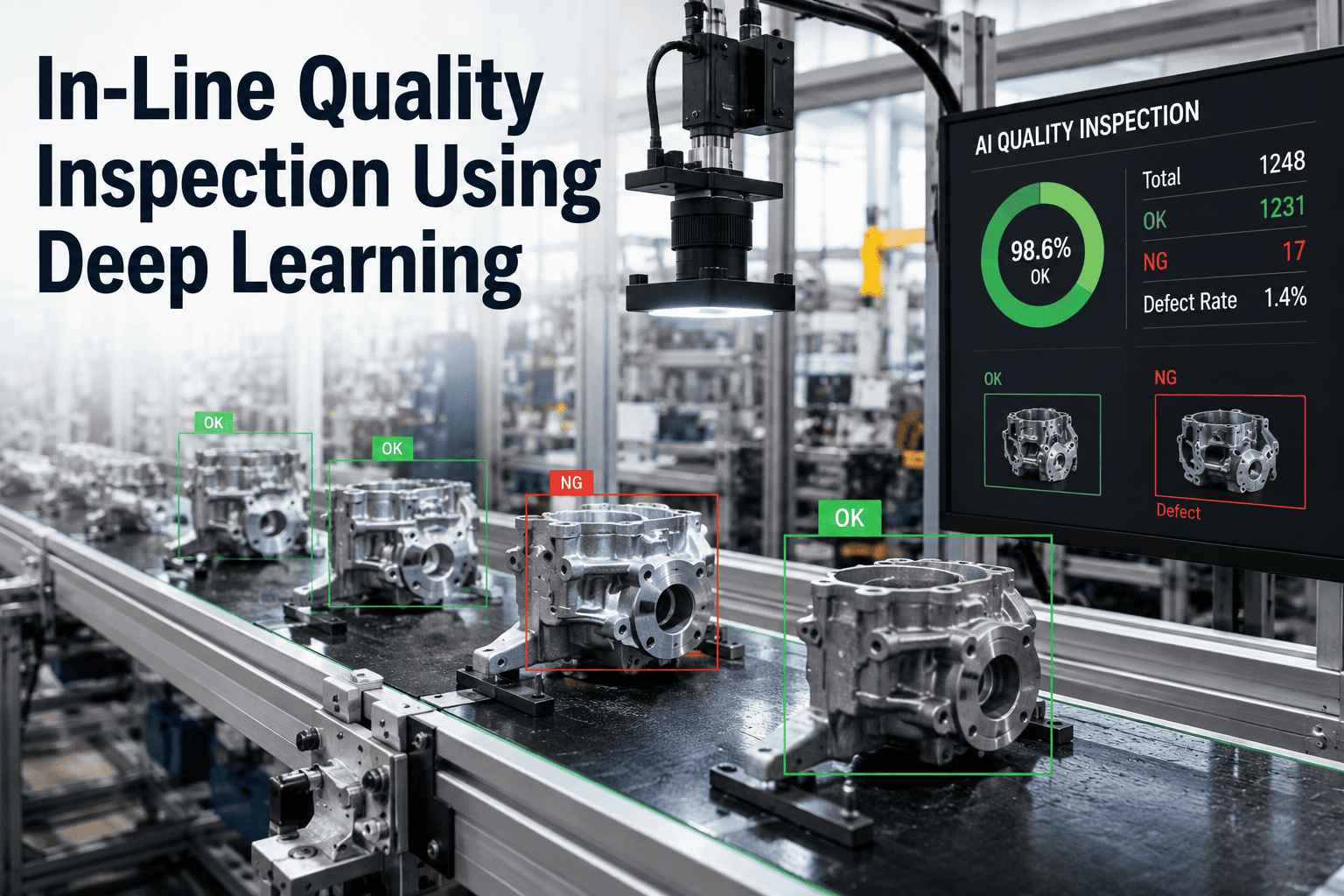
Traditional quality inspection methods in manufacturing rely on statistical sampling, human visual checks, or rule-based machine vision systems that are brittle and slow to adapt. As production lines accelerate and product complexity increases, these approaches leave critical gaps—allowing defective parts to reach customers and wasting resources on false rejects. Deep learning-based in-line inspection systems offer a paradigm shift: the ability to inspect 100% of parts at full line speed, with accuracy that improves over time. Unlike conventional machine vision, deep learning models can learn nuanced defect patterns, adapt to new product variations without reprogramming, and operate consistently across shifts. This guide provides a technical deep dive into deploying deep learning for in-line quality inspection, covering architecture, model training, integration strategies, and ROI analysis. For manufacturing leaders looking to eliminate escapes and reduce cost of quality, Book a Demo to see how our platform enables zero-defect production.
Transform Your Quality Assurance
Move from sample-based to 100% in-line inspection. Reduce escapes, scrap, and rework with AI that learns your defects.
Why Deep Learning Over Traditional Machine Vision?
Conventional machine vision relies on hand-crafted feature extraction—edge detection, thresholding, and morphological operations—that are highly sensitive to lighting, part orientation, and surface variations. In high-speed production environments, these systems struggle with subtle defects (e.g., micro-cracks, color shifts, texture anomalies) and require extensive re-engineering when product designs change. Deep learning models, particularly convolutional neural networks (CNNs) and vision transformers, learn hierarchical features directly from image data. They can distinguish between acceptable cosmetic variations and true defects, adapt to new defect classes via transfer learning, and maintain high throughput even with complex backgrounds. The result is a robust, scalable inspection system that continuously improves as more data is collected.
Adaptive Learning
Models can be retrained with new defect examples without rewriting code, enabling rapid response to process changes.
High Throughput
Optimized inference engines process hundreds of parts per minute, matching or exceeding line speed requirements.
Robustness to Variation
Learns invariance to lighting, rotation, and scale, reducing false positives from allowable part variations.
Continuous Improvement
Model performance improves over time through active learning, where uncertain predictions are flagged for human review.
Implementation Roadmap for In-Line Deep Learning Inspection
Data Collection & Annotation
Capture high-resolution images of good and defective parts under production lighting. Annotate defects with bounding boxes or segmentation masks. Aim for at least 1,000 images per defect class for robust model training.
Model Selection & Training
Choose a lightweight architecture (e.g., EfficientNet, MobileNet, or YOLOv8) for edge deployment. Train using transfer learning from a pre-trained backbone, then fine-tune on your defect dataset. Use data augmentation to improve generalization.
Edge Deployment & Inference Optimization
Convert the trained model to TensorRT, OpenVINO, or ONNX Runtime for low-latency inference. Deploy on GPU-accelerated edge devices (e.g., NVIDIA Jetson, Intel Movidius) directly on the production line.
Integration with MES & PLCs
Connect the inspection system to your Manufacturing Execution System (MES) and programmable logic controllers (PLCs) to trigger reject mechanisms, log defect data, and enable real-time dashboards.
Continuous Monitoring & Retraining
Implement a feedback loop where edge samples and human reviews are sent to a central server for periodic retraining. Use active learning to prioritize uncertain predictions.
Deep Learning vs. Traditional Inspection: A Quantitative Comparison
| Metric | Traditional Machine Vision | Deep Learning Vision |
|---|---|---|
| Defect Detection Rate | 85-92% | 98-99.5% |
| False Positive Rate | 5-15% | 1-3% |
| Adaptation to New Defects | Requires re-engineering (weeks) | Retrain with new data (days) |
| Throughput (parts/min) | 60-120 | 120-300+ |
| Lighting Sensitivity | High | Low |
| Cost of Deployment | $50k-$150k | $80k-$200k |
Ready to Achieve Zero-Defect Production?
Our deep learning inspection platform integrates with your existing lines to deliver 100% inspection at full speed.
Advanced Architectures for In-Line Vision AI
Choosing the right neural network architecture is critical for balancing accuracy and inference speed. Below we compare three leading approaches suitable for in-line deployment.
CNN-Based (EfficientNet)
Best for classification and defect presence detection. Offers excellent accuracy with low computational cost. Ideal for high-speed lines where simple pass/fail decisions are needed.
Inference Speed (FPS)
Object Detection (YOLOv8)
Simultaneously localizes and classifies multiple defects per image. Supports real-time processing at 200+ FPS on GPU. Suitable for complex parts with multiple defect types.
Mean Average Precision (mAP)
Segmentation (U-Net)
Provides pixel-level defect maps for precise area measurement. Useful for applications like surface defect sizing or cosmetic scoring. Higher computational cost but richer output.
IoU Score
Key Benefits of Deep Learning In-Line Inspection
- Zero defect escapes: 100% inspection eliminates sampling risk.
- Reduced cost of quality: Lower scrap, rework, and warranty claims.
- Faster root cause analysis: Real-time defect data pinpoints process issues.
- Scalable across lines: Same model architecture can be retrained for different products.
- Improved customer satisfaction: Consistent product quality builds trust.
- Lower labor dependency: Automated inspection reduces need for manual QC.
Real-World Impact: Automotive Tier 1 Supplier
A leading automotive supplier implemented deep learning in-line inspection for brake caliper surface defects. They deployed a YOLOv8 model on NVIDIA Jetson AGX Orin, achieving 100% inspection at 180 parts per minute. Within three months, they reduced defect escapes by 94%, cut false rejects by 60%, and saved $2.1M annually in scrap and rework. The system was trained on 5,000 annotated images and required only two days of retraining when a new product variant was introduced.
Frequently Asked Questions
How long does it take to deploy a deep learning inspection system?
Deployment timeline depends on data availability and defect complexity. Typically, the initial model can be trained and integrated within 4-6 weeks. This includes data collection (1-2 weeks), annotation (1 week), model training and optimization (1 week), and edge deployment with MES integration (1-2 weeks). For lines with existing image capture infrastructure, the process can be accelerated. Learn more about our deployment methodology by booking a demo.
What types of defects can deep learning detect that traditional vision cannot?
Deep learning excels at detecting subtle, non-deterministic defects such as micro-cracks, surface texture anomalies, color gradients, and complex pattern deviations. It can also identify defects in highly reflective or textured surfaces where traditional thresholding fails. The model learns from examples, so it can be trained to detect any visually apparent defect. For a detailed analysis of defect types suitable for deep learning, contact our support team.
What is the cost of implementing deep learning inspection compared to traditional machine vision?
Initial capital expenditure for deep learning inspection is typically 20-40% higher than traditional vision due to GPU-accelerated hardware and software licensing. However, total cost of ownership over three years is often lower because deep learning systems require less re-engineering for product changes, have lower false reject rates, and reduce manual QC labor. ROI is usually realized within 12-18 months. For a customized ROI calculator, schedule a demo.
Can deep learning inspection handle high-speed production lines (300+ parts per minute)?
Yes, with optimized inference engines and edge hardware. Models like YOLOv8-nano and EfficientNet-lite can achieve inference times under 2 milliseconds per image on modern GPUs. For lines exceeding 600 parts per minute, multi-camera systems with parallel processing can be configured. Our platform supports distributed inference across multiple edge devices. Discuss your line speed requirements during a demo session.
How do you handle model drift and maintain accuracy over time?
We implement a continuous monitoring pipeline that tracks model performance metrics (precision, recall, F1-score) over time. When accuracy drops below a threshold, the system triggers active learning: uncertain predictions are sent to a human reviewer for labeling. These new samples are added to the training set, and the model is retrained incrementally. This ensures the model adapts to process drifts, new defect types, and environmental changes. For more details on our active learning framework, visit our support page.
Eliminate Defect Escapes with AI-Powered Inspection
Join industry leaders who have transformed their quality control with deep learning. Achieve 100% inspection at line speed.