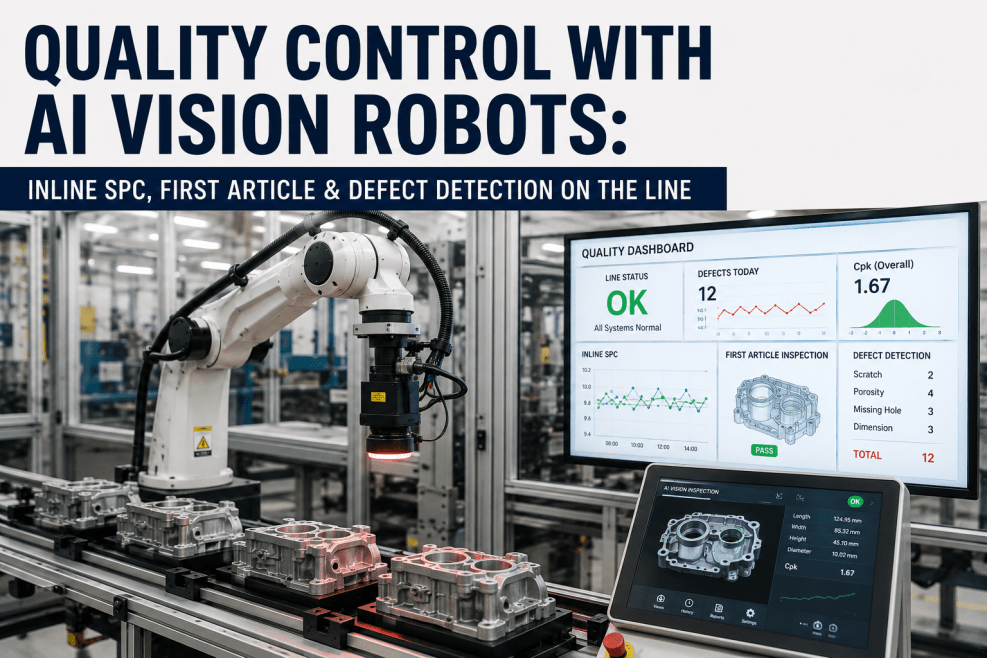
Quality Control with AI Vision Robots: Inline SPC, First Article & Defect Detection on the Line
By Daniel Brooks on May 27, 2026
Manufacturing quality control in the United States has reached an inflection point where traditional end-of-line inspection and manual statistical process control simply cannot keep pace with the throughput, complexity, and tolerance demands of modern production. AI vision robots are reshaping how plants approach quality—moving inspection from a post-production audit function into a real-time, inline process control discipline that catches defects as they emerge rather than after they ship. The convergence of high-resolution machine vision, deep learning defect classifiers, and robotic manipulation now enables what Quality 4.0 promised: continuous inline SPC monitoring with CpK calculations updating in real time, automated first article inspection that compresses changeover validation from hours to minutes, and defect detection systems that learn from every part they inspect. For U.S. manufacturers facing labor shortages in skilled inspection roles, escalating customer quality requirements (PPAP, IATF 16949, AS9100), and the cost pressures of warranty claims and scrap, AI vision robotics is no longer a research project—it is operational infrastructure. iFactory's AI Vision Camera and Robotics AI capabilities integrate directly with manufacturing execution systems to deliver inline SPC, defect classification, and first article inspection workflows configured for U.S. plant environments. For a conversation about how iFactory's quality automation platform applies to your production line, Book a Demo with our quality engineering team.
Quality Control with AI Vision Robots: Inline SPC, First Article & Defect Detection on the Line
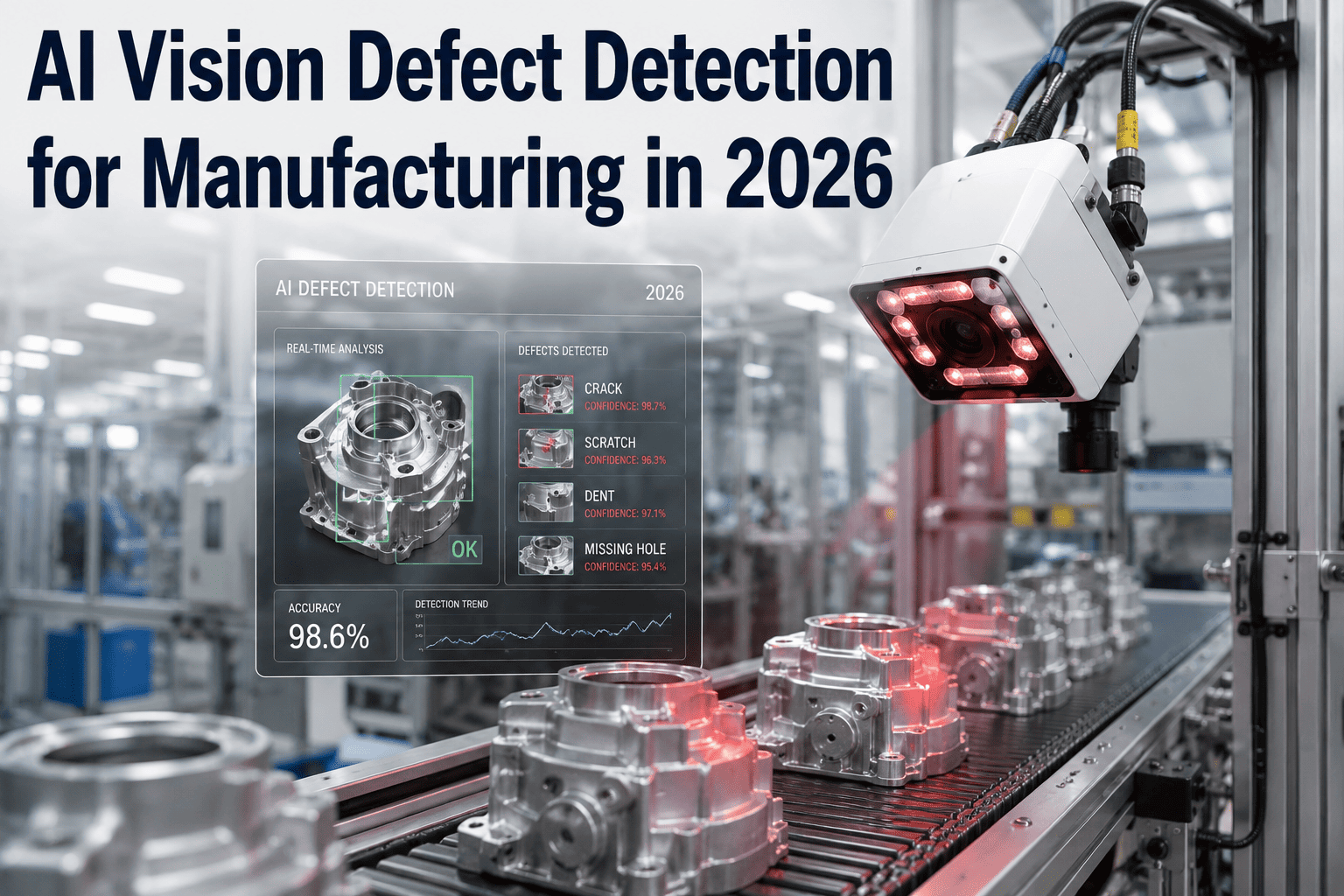
iFactory's AI vision robotics platform delivers inline statistical process control, automated first article inspection, and deep-learning defect detection — turning the production line into a continuous quality intelligence system rather than a downstream audit point.
100%Inline inspection coverage vs. sample-based AQL — every part inspected, not just audit lots
90%+Defect detection accuracy with deep learning vision models on trained part families
Real-timeCpK and Cp updating per-part rather than per-shift — process drift visible immediately
5–15 minFirst article inspection cycle vs. 1–3 hour manual FAI — changeover validation compressed
Why Traditional Quality Control Cannot Keep Up With Modern Manufacturing
The quality control models that U.S. plants have relied on for decades—AQL-based sample inspection, post-production gauging, manual SPC chart maintenance, and end-of-line visual inspection—were built for a manufacturing environment that no longer exists. Production cycles have compressed, mix complexity has increased, customer tolerance windows have tightened, and skilled inspector labor has become harder to recruit and retain. The result is a structural mismatch between the quality challenges plants face and the quality systems they operate.
Sample Inspection Misses Drift Events
AQL sampling inspects 0.5–3% of production. Between samples, process drift can produce hundreds of defective parts before the next sample reveals the shift. By the time a control chart point goes out of spec, the defective inventory is already built, packed, and in some cases shipped to customers.
97%+ of parts pass through uninspected under standard AQL plans
Human Visual Inspection Variability
Repeatability studies consistently show human visual inspection accuracy degrading from ~85% in the first hour to under 60% after four hours of continuous work. Inspector-to-inspector variation introduces additional noise. The same defect can be accepted by one shift and rejected by the next, creating both customer complaints and internal scrap inconsistencies.
25–40% accuracy degradation across a single inspection shift
Manual FAI Creates Changeover Bottlenecks
First article inspection on a part with 20–50 critical characteristics can take 1–3 hours of measurement, documentation, and approval. On high-mix lines running 8–15 changeovers per shift, FAI becomes the binding constraint on OEE. Production waits for quality, and quality is constrained by the speed of human measurement and form completion.
15–30% of available shift time consumed by manual FAI on high-mix lines
Paper SPC Charts Are Reactive, Not Predictive
Manual SPC chart updates—even daily—mean process shifts are detected hours or days after they begin. Western Electric rule violations get flagged after the damaging parts are already produced. Real Quality 4.0 requires CpK and Cp values that update with every measurement, not at the end of a sampling interval.
4–24 hr typical delay between process drift and SPC chart detection
The Quality 4.0 Threshold
Quality 4.0 is not about adding more inspection stations or installing more cameras—it is about restructuring the quality function so that every part contributes to the SPC dataset, every defect feeds a learning model, and every changeover is validated automatically against the engineering specification. AI vision robotics is the operational layer that makes this restructuring possible without expanding the inspection workforce.
How AI Vision Robotics Restructures the Quality Function
iFactory's AI Vision Camera and Robotics AI capabilities deliver four integrated layers that move quality control from sample-based audit into continuous inline intelligence. Each layer addresses a specific failure mode of traditional QC and is configured to integrate with existing MES, ERP, and customer reporting systems that U.S. manufacturers already operate.
100% Inline Vision Inspection
High-resolution cameras paired with deep learning defect classifiers inspect every part at production rate. Surface defects, dimensional deviations, missing features, assembly errors, and cosmetic issues are detected in cycle time. The inspection coverage moves from AQL sampling (0.5–3%) to full population inspection without adding labor or extending cycle time.
Real-Time Inline SPC
Every dimensional measurement captured by the vision system feeds the SPC engine directly. Control charts (X-bar, R, individuals, moving range) update with each part. CpK and Cp values recalculate continuously. Western Electric and Nelson rule violations trigger automatic alerts to production and quality teams the moment they occur—not at the end of a sampling interval.
Automated First Article Inspection
At every changeover, the vision robot performs full first article inspection against the engineering drawing automatically—measuring all critical characteristics, generating the FAI report in AS9102 or PPAP format, and either releasing the line for production or holding it for quality engineering review. FAI cycle time compresses from 1–3 hours to 5–15 minutes.
Continuous Model Learning
Every part inspected adds to the training dataset. Defect classifiers retrain on new examples as they emerge, capturing process-specific failure modes that generic vision systems miss. Engineering review of borderline cases feeds back into the model, progressively improving accuracy and reducing the rate of operator escalations over the first 90–180 days of deployment.
iFactory Quality Automation — Key Capabilities
100%
Inline Inspection CoverageEvery part inspected vs. AQL sampling 0.5–3%
90%+
Defect Detection AccuracyDeep learning classifiers on trained part families
85%
FAI Cycle Time ReductionFrom 1–3 hours manual to 5–15 minutes automated
Live
CpK & Cp UpdatingPer-part recalculation vs. per-shift manual update
Want to see how iFactory's vision robotics and inline SPC apply to your specific part family and inspection requirements? Book a Demo with iFactory's quality automation engineering team.
The Quality 4.0 Workflow: From Sensor to SPC Dashboard
The operational difference between a vision inspection station and an integrated Quality 4.0 system is the data path. A standalone vision system catches defects; a Quality 4.0 system catches defects, feeds SPC, triggers process adjustments, updates customer quality records, and retrains the defect model—all within a single integrated workflow. iFactory's platform connects each stage of this workflow into one continuous data flow.
01
Image Capture
High-resolution camera arrays capture multi-angle images of each part at production rate. Strobe lighting, telecentric lenses, and motion-synchronized triggering eliminate motion blur even at high line speeds.
02
Deep Learning Inference
Trained CNN models classify defects (scratch, dent, contamination, missing feature, dimensional deviation) and extract dimensional measurements. Inference runs on edge GPU hardware to meet cycle-time constraints.
03
SPC Engine Update
Measurement data streams into the SPC engine in real time. Control limits, CpK, Cp, and process performance indices recalculate per part. Western Electric and Nelson rule monitors evaluate every new data point.
04
Action & Feedback
Out-of-spec parts are diverted by the robot, operators receive immediate alerts, process adjustments trigger automatically where authorized, and quality records update MES, PPAP packets, and customer reporting systems.
AI Vision vs. Traditional Inspection: A Side-by-Side Comparison
The decision to deploy AI vision robotics is typically evaluated against the existing inspection baseline—whether that is manual visual inspection, traditional rule-based machine vision, or AOI systems. The performance differences across the dimensions that matter most for U.S. manufacturers are significant and quantifiable.
Scroll to compare
Quality Dimension
Manual Visual Inspection
Rule-Based Machine Vision
iFactory AI Vision Robotics
Inspection Coverage
AQL sample 0.5–3%
100% on specific features only
100% multi-feature, all critical characteristics
Defect Detection Accuracy
60–85% (degrades over shift)
80–90% on known defects, poor on novel
90%+ including novel defect generalization
SPC Data Generation
Manual gauge entry, batch update
Limited to programmed measurements
Continuous per-part real-time stream
First Article Inspection Time
1–3 hours per changeover
30–60 minutes (limited automation)
5–15 minutes fully automated
New Part Setup
Training inspector days–weeks
Vision engineer programs 1–3 weeks
Drawing import + sample images, 1–5 days
Adaptation to Process Drift
No adaptation
Manual reprogramming required
Continuous model learning from production data
Customer Reporting (PPAP/AS9102)
Manual form completion
Partial export, manual assembly
Automated report generation in customer format
Deploy AI Vision Quality Control on Your Production Line
iFactory's quality automation team has configured AI vision robotics deployments across automotive, aerospace, medical device, and electronics manufacturing in the United States. We understand the PPAP, AS9102, and IATF 16949 reporting obligations your customers require, and we deliver the inline SPC and defect detection capabilities that make Quality 4.0 operational rather than aspirational.
Core Technologies in iFactory's AI Vision Quality Platform
iFactory's quality automation platform delivers six integrated technology capabilities that translate the Quality 4.0 concept into operational reality on U.S. production lines. Each capability is configurable for the part family, inspection requirements, and customer reporting obligations of the specific manufacturing environment.
Multi-Camera Vision Arrays
High-resolution camera arrays capture multi-angle, multi-spectral imagery of each part. Configurations support area scan, line scan, 3D structured light, and X-ray inspection depending on the defect classes and dimensional characteristics being inspected. Strobe lighting and telecentric optics maintain accuracy at production speed.
AI Vision Camera
Deep Learning Defect Classification
Convolutional neural networks trained on part-specific defect libraries classify defects by type, severity, and location. Models generalize across the variability that rule-based vision systems struggle with—lighting variation, part orientation, minor surface texture differences—and improve continuously as new examples enter the training set.
Robotics AI
Real-Time SPC Engine
Statistical process control calculations run continuously against the measurement stream. Control charts for individuals, moving range, X-bar, and R update per part. CpK, Cp, Pp, Ppk recalculate continuously. Western Electric and Nelson rule monitors detect process shifts the moment they cross threshold conditions.
Statistical Quality Control
Automated FAI Generation
First article inspection reports generate automatically against the engineering drawing—measuring all critical characteristics, populating AS9102 forms for aerospace or PPAP forms for automotive, and producing the documentation that customer quality systems require. Changeover validation compresses from hours to minutes.
Inspection Management
MES & ERP Integration
Quality data flows directly into MES production records, ERP quality cost accounting, and customer reporting interfaces. Defect events trigger work order updates, scrap accounting, and—where authorized—process parameter adjustments via OPC-UA connections to PLC and DCS systems on the line.
Manufacturing Execution System
Real-Time Quality Dashboards
Production floor displays show live SPC charts, CpK trends, defect Pareto analyses, and changeover status. Plant management dashboards roll up first-pass yield, scrap rate, customer complaint correlation, and quality cost metrics in real time. Mobile alerts notify quality engineering of rule violations the moment they occur.
Analytics Reporting
Ready to see iFactory's AI vision quality platform configured for your production environment? Book a Demo with our quality automation engineers—we configure demonstrations for your specific part family, defect classes, and customer reporting requirements.
Expert Perspective
The shift to AI vision robotics is the most consequential change in manufacturing quality control in the last thirty years—and the manufacturers who recognize that early are building structural advantages that their competitors will struggle to close. The reason is not that AI vision catches more defects than human inspectors, although it does. The reason is that AI vision generates SPC data on every part, and that data fundamentally changes how the quality function operates. When you have CpK updating continuously rather than per-shift, process drift becomes visible in minutes rather than hours. When first article inspection compresses from three hours to fifteen minutes, your line OEE improves on every changeover, not just the long runs. When defect classification models learn from every part, your detection capability improves continuously rather than degrading with inspector fatigue. The plants I work with that have deployed Quality 4.0 properly are reporting first-pass yield improvements of three to seven percentage points, scrap reductions of twenty to thirty percent, and customer complaint reductions of fifty percent or more. These are not marginal gains—they are step-changes that show up in financial reporting within the first year. But the deployments only deliver these results when the AI vision system is integrated with MES, SPC, and customer reporting—not when it operates as a standalone inspection station. That integration is where iFactory's platform creates the value differential.
— Quality Engineering Director, U.S. Tier-1 Automotive Manufacturer · 22 Years Manufacturing Quality Experience · ASQ Certified Manager of Quality/Organizational Excellence · IATF 16949 Lead Auditor · Former Six Sigma Master Black Belt at Fortune 500 Industrial OEM
What U.S. Manufacturers Achieve with iFactory Quality Automation
3–7%
First-Pass Yield Improvement
100% inline inspection catching defects that AQL sampling misses, combined with real-time SPC enabling immediate process correction before defective inventory accumulates
20–30%
Scrap Cost Reduction
Earlier defect detection means fewer parts produced after process drift begins. Reduced rework, reduced material waste, reduced labor expended on defective product
50%+
Customer Complaint Reduction
100% inspection eliminates the AQL-pass-through defects that drive customer complaints. PPAP and AS9102 documentation quality improves through automated generation
85%
FAI Time Reduction
Automated first article inspection compresses changeover validation from 1–3 hours to 5–15 minutes, recovering OEE on high-mix production lines
Conclusion: The Operational Case for AI Vision Quality Control
The transition from sample-based quality audit to inline AI vision quality control is not a technology upgrade—it is a restructuring of how the quality function contributes to manufacturing performance. Plants that complete this transition gain four operational capabilities that fundamentally change their competitive position: complete inspection coverage replaces statistical sampling assumptions; real-time SPC enables process correction before defects accumulate; automated FAI removes the changeover bottleneck that constrains high-mix lines; and continuous model learning means the inspection system improves rather than degrades over time. These capabilities translate directly into yield improvement, scrap reduction, customer complaint reduction, and OEE recovery—measurable outcomes that justify the deployment investment within the first year of operation for most U.S. manufacturers. iFactory's integrated AI Vision Camera, Robotics AI, Statistical Quality Control, and Quality Control Management capabilities deliver this restructuring as a coordinated platform rather than as disconnected point solutions, which is the configuration that determines whether Quality 4.0 produces real operational results or remains a slide-deck initiative.
iFactory for AI Vision Quality Control — Built for U.S. Manufacturing
Inline SPC. Automated first article inspection. Deep learning defect detection. Real-time CpK. MES and customer reporting integration. iFactory delivers the AI vision quality platform that U.S. manufacturing operations require to make Quality 4.0 operational—not the disconnected inspection point solutions that leave the structural quality problems unsolved.
How long does it take to deploy iFactory's AI vision quality system on an existing production line?
Typical deployment timelines for iFactory's AI vision quality platform on an existing U.S. manufacturing line range from 8 to 16 weeks from contract execution to production cutover, depending on the complexity of the part family, the number of inspection stations being deployed, and the integration scope with existing MES and ERP systems. The first 2–4 weeks focus on physical installation of cameras, lighting, robotic manipulation hardware where needed, and edge GPU compute infrastructure. Weeks 4–8 cover initial model training against sample parts—both known-good and known-defective examples drawn from the customer's production—and the configuration of inspection routines for each part number. Weeks 8–12 involve parallel operation alongside existing inspection methods, during which the AI model accuracy is validated against the customer's quality requirements and the SPC integration is verified against historical control limits. Weeks 12–16 transition to primary inspection responsibility with engineering oversight, followed by full production cutover once accuracy and reliability targets are met. Book a Demo to discuss the specific timeline appropriate for your part family and inspection scope.
Can iFactory's vision system generate PPAP, AS9102, and IATF 16949 compliant documentation automatically?
Yes—automated customer reporting is a core capability of iFactory's quality automation platform. The system generates PPAP (Production Part Approval Process) documentation in AIAG-compliant formats for automotive customers, AS9102 first article inspection reports for aerospace and defense customers, and the dimensional and attribute data records required for IATF 16949 quality management system compliance. The reports populate automatically from the vision measurement stream, including dimensional results, attribute inspection outcomes, statistical process control summaries, and capability indices. For PPAP submissions, the system supports Level 1 through Level 5 documentation depth requirements and assembles the required supporting documents (control plans, FMEA references, gage R&R results, capability studies) from the connected MES and quality management modules. Engineering review and approval workflows are configurable to match the customer's specific PPAP, AS9102, or internal quality engineering approval requirements. The automation does not eliminate the quality engineering review function—it eliminates the manual data assembly and form completion work that consumes most of the engineering hours currently spent on customer documentation.
How does the deep learning defect classifier handle new defect types that weren't in the original training set?
iFactory's defect classification approach combines two model layers to handle novel defects gracefully. The primary classifier is trained on the part-specific defect library and recognizes known defect classes with high confidence. The secondary anomaly detection layer uses unsupervised learning techniques to flag parts that deviate from the learned distribution of acceptable parts—even when the deviation does not match any known defect class. When the anomaly layer flags a part that the primary classifier did not categorize, the part is diverted to engineering review rather than being released as acceptable. Engineering review either confirms the part as acceptable (in which case the model updates its acceptable-part distribution) or characterizes the new defect and adds it to the training library for the primary classifier. This dual-layer approach prevents the failure mode common to single-classifier systems, where novel defects pass through because they don't match any trained category. Over the first 90–180 days of deployment, the primary classifier progressively absorbs the new defect categories that emerge from real production, and the anomaly detection layer's escalation rate decreases as the trained defect library becomes more complete.
What MES, ERP, and quality management systems does iFactory integrate with for U.S. manufacturing deployments?
iFactory integrates with the major MES, ERP, and quality management systems deployed across U.S. manufacturing through standard data exchange protocols and pre-configured connectors. On the MES side, integrations are supported for SAP Manufacturing Execution, Rockwell FactoryTalk ProductionCentre, Siemens Opcenter Execution, GE Proficy, Aveva MES, and iFactory's own MES module for plants without an existing MES deployment. ERP integrations cover SAP S/4HANA and ECC, Oracle Fusion and JD Edwards, Microsoft Dynamics 365, Infor CloudSuite Industrial, and Epicor Kinetic. Quality management system integrations include SAP QM, Hexagon Q-DAS, InfinityQS ProFicient, Pilgrim SmartSolve, MasterControl, and ETQ Reliance. For plant-floor data integration, the platform supports OPC-UA, OPC-DA, MODBUS TCP/RTU, and direct historian integration with OSIsoft PI System, Aveva Wonderware Historian, and Rockwell FactoryTalk Historian. The integration architecture is configured for each deployment based on the customer's existing system inventory and data governance requirements—pre-built connectors handle the common cases, and custom integration is supported where customer-specific systems require it.
What types of manufacturing operations and part families benefit most from AI vision quality control?
AI vision quality control delivers the highest operational return in manufacturing environments where one or more of four conditions apply. First, high-volume production where AQL sampling means 97%+ of parts go uninspected and process drift between samples produces meaningful defect populations—automotive stamping, electronic component assembly, and consumer packaged goods filling are typical examples. Second, high-mix production where changeover frequency makes manual FAI a binding constraint on OEE—precision machining job shops, aerospace machined components, and contract electronics manufacturing. Third, high-criticality products where customer quality requirements (PPAP, AS9102, FDA 21 CFR Part 820 for medical devices) demand documentation and traceability beyond what manual processes can sustain. Fourth, operations with significant scrap and warranty cost exposure where the financial incentive for first-pass yield improvement justifies the investment. The platform applies across automotive, aerospace, defense, medical device, electronics, food and beverage packaging, and industrial component manufacturing—configurations differ by industry, but the core inline SPC and defect detection workflow is consistent. Book a Demo to discuss the specific application fit for your manufacturing environment.