Painted and coated surfaces are one of the hardest inspection categories to standardize, because so much of what makes a finish acceptable or unacceptable depends on subtle visual judgment — how deep is too deep for orange peel, how long is too long for a run, how much color drift is still within an acceptable batch tolerance. Two experienced inspectors looking at the same panel can reasonably disagree, and that disagreement is not a training failure so much as a limitation of relying on human visual memory to hold a consistent standard across a full shift. This guide covers how AI vision inspection approaches surface defect detection at line speed, and where iFactory's team typically starts when bringing it onto a paint or coating line.
Catch Orange Peel, Runs, and Color Drift at Full Line Speed
Why Coated Surfaces Are Genuinely Hard to Inspect Consistently
Surface finish defects rarely present as a clean binary of present or absent. Orange peel exists on a spectrum from barely noticeable texture to a clearly unacceptable finish, and where exactly that line sits is something plants define through written standards and reference panels, but applying that written standard consistently under real lighting conditions, on a real production surface, after eight hours of the same repetitive visual task, is genuinely difficult for even a skilled inspector to do the same way every time. Fatigue, lighting variation across a shift, and simple attention drift all affect human visual judgment in ways that have nothing to do with training or skill level.
Vision-based AI inspection does not eliminate the need for a defined standard — it still needs reference images and severity thresholds set by people who understand what acceptable looks like for that specific product and coating process. What it changes is the consistency of applying that standard once it is defined, scoring every panel against the same criteria at hour one and hour eight of a shift with no variation introduced by fatigue or attention.
| Defect Type | Why Manual Inspection Struggles | How Vision AI Approaches It |
|---|---|---|
| Orange peel texture | Subjective severity judgment, varies by inspector and lighting | Texture measured against a calibrated severity scale |
| Runs and sags | Easy to catch when obvious, missed when subtle or small | Edge and contour detection flags any deviation from flat |
| Color variation | Human eye adapts to gradual shift, misses slow drift | Colorimetric comparison against a fixed reference value |
| Surface contamination | Small particles or specks easy to miss at line speed | High-resolution imaging catches sub-millimeter defects |
| Scratch detection | Depends on lighting angle and inspector attentiveness | Multi-angle lighting designed to expose surface disruption |
How Defect Detection Actually Works at Line Speed
Curious how this would perform against your own finish standard? Send sample images from your current inspection process and we will run a comparison.
Color Variation: The Defect That Slips Past the Human Eye Most Often
Of all the defect categories on a painted or coated surface, gradual color drift is the one manual inspection is least equipped to catch, for a simple physiological reason — the human eye adapts to slowly changing color over time in a way that makes a shift occurring across many panels genuinely difficult to perceive, even for an inspector actively looking for it. A batch that has drifted meaningfully from the target color by the end of a run can look completely normal to someone who has been looking at that same drifting color all shift, because their visual baseline moved along with it.
Colorimetric measurement does not have this adaptation problem, since every panel is compared against a fixed digital reference value rather than the inspector's shifting internal sense of what normal looks like. This is one of the clearer cases where AI vision inspection is not simply matching human performance but catching something a human inspector is structurally disadvantaged to catch consistently, regardless of skill or attentiveness.
Common Pitfalls When Deploying Vision Inspection on a Finish Line
Why Multi-Angle Lighting Matters More Than Camera Resolution
It is a common assumption that better defect detection is mostly a matter of higher resolution cameras, but for most surface finish defects, lighting geometry matters considerably more than raw resolution. Orange peel texture, for instance, is essentially invisible under flat, direct lighting and only becomes visible under raking light striking the surface at a shallow angle, which is exactly why an experienced human inspector tilts a panel or shifts a handheld light source when checking for it manually. A vision system needs the same physical setup — lighting positioned at the angle that actually reveals the defect — or even an extremely high-resolution camera will simply capture a flat image that shows nothing unusual.
This is why a proper deployment typically involves multiple lighting angles captured for each panel rather than a single fixed camera and light source, with different defect categories relying on different angles to become visible. Getting this physical setup right during installation is one of the areas where experience with paint and coating inspection specifically, rather than generic machine vision experience, tends to make a meaningful difference in how well the system performs once it is running in production.
What a Rollout on a Paint or Coating Line Typically Looks Like
The starting point for most rollouts is capturing a representative image set from the existing line — a mix of acceptable panels and known defect examples across the categories that matter most for that specific product and process. This image set becomes the foundation for both training the initial model and setting severity thresholds that match the plant's existing written quality standard, rather than an arbitrary default. Running the vision system in parallel with existing manual inspection for a validation period lets both quality and production confirm the flagged findings actually match what an experienced inspector would catch, before the system starts making live routing decisions.
Once that validation period builds confidence in the detection accuracy, plants typically shift the vision system into the primary inspection role, with manual inspection continuing on a reduced, spot-check basis rather than disappearing entirely. Operators and inspectors generally shift their time toward validating flagged findings and investigating systemic trend issues, which tends to be viewed as a more engaged use of their expertise than performing the same repetitive visual scan on every single panel all shift.
Using Defect Trends to Catch Process Problems Before They Compound
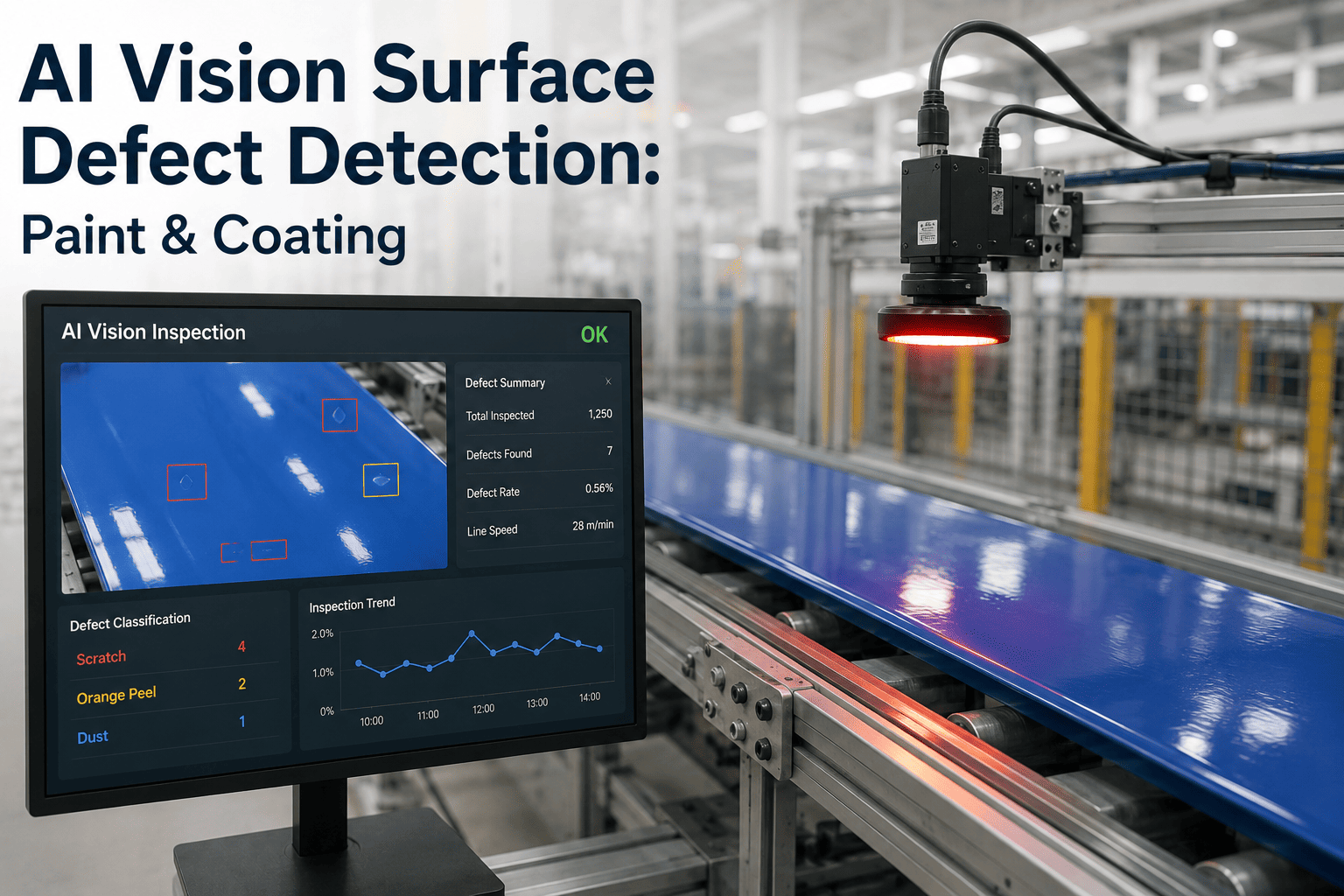
A single flagged panel is a quality event. A rising trend in the same defect category concentrated at the same booth or station over several hours is a process signal, and catching that signal early is often where vision inspection delivers the most value beyond simply sorting good panels from bad ones. A slow increase in orange peel severity across an afternoon shift might trace back to a spray booth's air pressure drifting out of its normal range, or a viscosity change in the coating material itself, and a trend view that surfaces this pattern gives maintenance and process engineering the chance to intervene before dozens of panels accumulate the same defect.
This trend-level view is where the difference between a simple inspection camera and a full monitoring system becomes clear. A camera that only reports pass or fail on each individual panel misses the pattern entirely, since no single panel in the early part of that drift would necessarily fail on its own. A system logging severity scores continuously and tracking them against booth, station, and time makes the developing pattern visible well before any individual panel actually crosses a reject threshold.
How Vision Inspection Changes the Role of the Line Inspector
The most common concern raised early in a vision inspection rollout is what happens to the people currently performing manual finish inspection, and the honest answer is that their role shifts rather than disappears. The repetitive part of the job — visually scanning every single panel for the same set of defect categories, shift after shift — is what the vision system takes over. What remains, and often grows in importance, is reviewing flagged findings, making judgment calls on genuinely borderline cases the model surfaces for review, and investigating the trend patterns the system logs over time. That is generally a more varied and more engaging use of an experienced inspector's actual expertise than performing the same visual scan on every panel all day.
Plants that introduce this change by involving their inspection team in defining the training image set and the severity thresholds tend to see a much smoother transition than those that simply install the system and announce the change afterward. Inspectors who helped define what counts as a reject in the model's training data tend to trust the system's findings more readily, since they recognize the standard being applied as the same one they have been enforcing manually all along, just applied with more consistency than a full shift of manual review can reliably achieve.
Handling Product Variety Without Retraining From Scratch Every Time
Plants running multiple colors, substrates, or finish types on the same line often worry that vision inspection will require a completely separate model and setup process for every product variant, which would make the effort of deployment scale linearly with the number of products run. In practice, a well-structured model separates the defect detection logic, which stays largely consistent across products, from the color and finish reference values, which are what actually differ from one product to the next. Adding a new color or substrate to an already-deployed system is typically closer to adding a new reference profile than rebuilding the detection model from the ground up.
This distinction matters most for plants running frequent changeovers or a wide product mix, since it determines how much ongoing effort is required to keep the system current as the product lineup evolves. Confirming how a given system handles this separation between detection logic and product-specific reference values is a reasonable question to raise early in a rollout conversation, particularly for lines that rarely run the same product configuration for more than a few days at a time.