Weld shops adopting AI inspection quickly run into a decision that rule-based QA never forced: should the model judge a weld while the arc is still moving, or after the part comes off the line and cools? The two approaches look similar on a slide deck but behave very differently on a real production floor, where cycle time, camera placement, and rework cost all pull in different directions. Getting this choice wrong either slows a fast line down to a crawl or lets marginal welds slip through for hours before anyone reviews the footage. iFactory's vision platform supports both inline and offline weld inspection models, and a quick session with our team can map which one fits your specific weld cell.
AI WELD INSPECTION · INLINE VS OFFLINE · PRODUCTION SPEED
Inline or Offline AI Weld Inspection — The Speed and Accuracy Trade-Off Nobody Explains Up Front
Both approaches use the same neural network. The difference is when the decision happens relative to the weld itself, and that timing choice changes throughput, false-reject behavior, and how much rework travels down the line before anyone catches it.
<40ms
Typical inline decision latency per weld pass
2-8hrs
Typical lag before offline batch review flags a defect
3-5x
More sensor detail available per weld in offline mode
TWO WAYS TO ASK THE SAME QUESTION
Inline and Offline Inspection Solve the Same Problem From Opposite Ends of the Clock
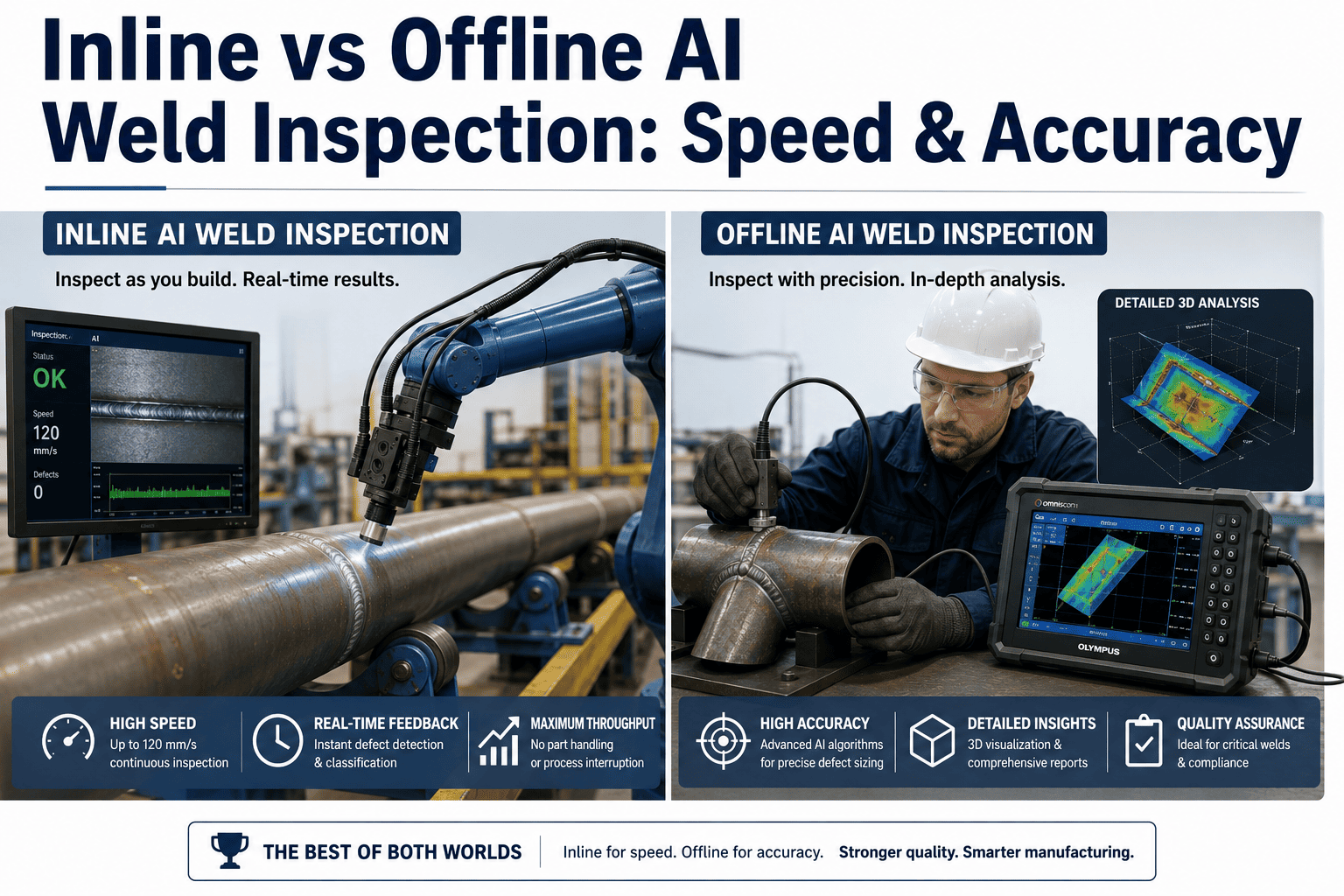
Both methods try to answer one question: is this weld acceptable? Inline inspection answers it during or immediately after the weld pass, using cameras mounted directly on the torch, tooling, or fixture. Offline inspection answers the same question later, using images or sensor logs pulled from a part after it has left the weld cell, often during a dedicated QA station or a batch review shift.
INLINE INSPECTION
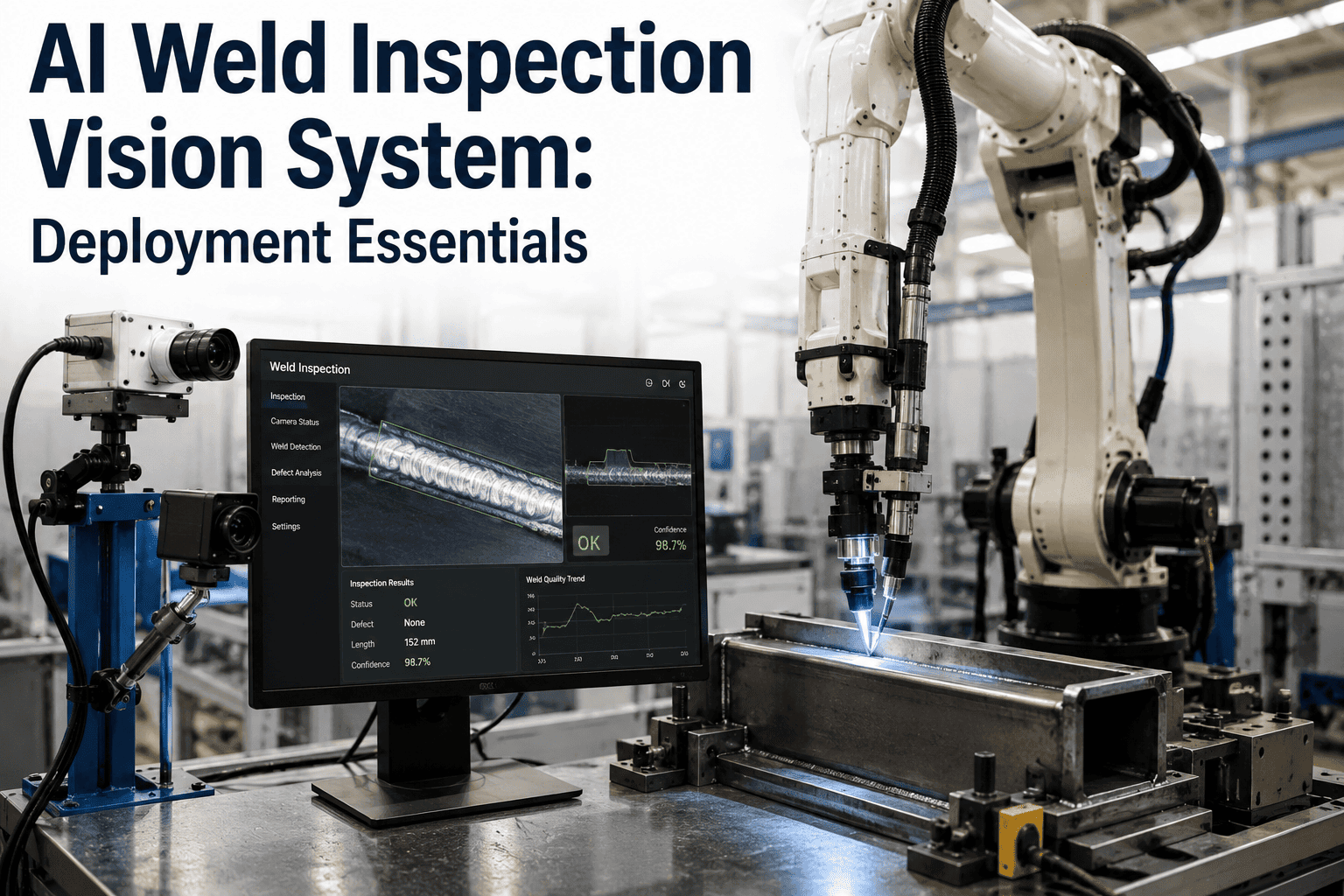
The model receives a frame or sensor stream while the weld is being deposited or within seconds of the arc going out. Decisions are made at line speed, and a reject signal can trigger a stop, a rework flag, or a robot path adjustment before the next part arrives.
OFFLINE INSPECTION
Images, radiographs, or ultrasonic scans are captured and queued for review after the weld cycle finishes. The model processes a batch of parts together, often with more compute available per image and more sensor modalities combined into one decision.
The technology underneath is often the same convolutional or transformer-based model. What changes is the compute budget per decision, the sensor data available at decision time, and how far downstream a missed defect can travel before someone notices.
HOW EACH PATH MOVES THROUGH THE LINE
The Same Weld, Two Different Journeys to a Pass or Fail Result
Following a single weld through each pipeline shows exactly where the extra time in offline inspection gets spent, and why inline inspection has to compress every one of these steps into a fraction of a second.
INLINE PATH
1 Camera captures frame during or immediately after the pass
2 Edge device runs the model on a single lightweight frame
3 Confidence score compared against a fixed threshold
4 Pass, reject, or flag signal sent to the PLC in real time
5 Next weld begins with no operator wait time
OFFLINE PATH
1 Part completes all welds and moves to a staging area
2 Images, radiographs, or ultrasonic data are captured or pulled
3 Batch job runs the model across many parts at once
4 Results compiled into a report reviewed by a quality engineer
5 Disposition decision made hours after the weld was made
SPEED AND LATENCY, MEASURED
What the Timing Difference Actually Costs or Saves on the Floor
The gap between the two approaches is not academic. It shows up directly in how many welds per minute a line can sustain, how quickly a bad weld gets caught, and how much rework accumulates before anyone acts on the data.
Not Sure Which Approach Fits Your Weld Cell Speed?
iFactory can run both inline and offline models against your current production data and show you the throughput and accuracy difference before you commit to either path.
WHERE ACCURACY DIVERGES
Five Weld Conditions Where Inline and Offline Models Reach Different Conclusions
Speed is not the only variable that shifts between the two approaches. The amount of data available at decision time changes what the model can actually see, and certain weld conditions expose that gap more than others.
Thin-Gauge Sheet Metal Welds
A single inline frame can miss subtle burn-through that only becomes visible once the part cools and contracts. Offline review, taken after cooling, catches distortion-related defects that an inline camera captures too early to see.
Multi-Pass Structural Welds
Inline inspection can validate each individual pass as it is laid down, catching inter-pass defects before they get buried under the next layer. Offline inspection only sees the finished joint, after earlier passes are no longer visible.
Reflective or Spatter-Heavy Surfaces
Inline cameras working at line speed have less time to compensate for arc glare and spatter obscuring the bead. Offline systems can apply heavier image preprocessing and multiple exposure passes since they are not racing the cycle time.
Complex Joint Geometries
Corner joints, T-joints, and overlapping seams often need more than one camera angle to fully characterize. Offline stations can rotate a part through several views, while inline systems are usually fixed to one mounting position per pass.
Internal Defects Below the Surface
Porosity, lack of fusion, and subsurface cracking are invisible to any camera, inline or offline. These require radiographic or ultrasonic offline inspection regardless of how fast the vision-based inline system runs.
High-Mix, Low-Volume Production
Frequent product changeovers give inline models less time per part type to build confidence. Offline batch review can group similar parts together and apply a more tailored threshold per weld type before disposition.
DECISION FRAMEWORK
Matching the Approach to Your Actual Production Speed
The right answer usually depends less on preference and more on how fast parts are actually moving through the weld cell and what happens to a defective part if it is not caught immediately.
COST AND INFRASTRUCTURE
What Each Approach Actually Requires to Run on Your Floor
Beyond the model itself, the two approaches ask for different hardware, staffing, and data handling, and those differences affect total cost of ownership more than the software license does.
Hardware Footprint
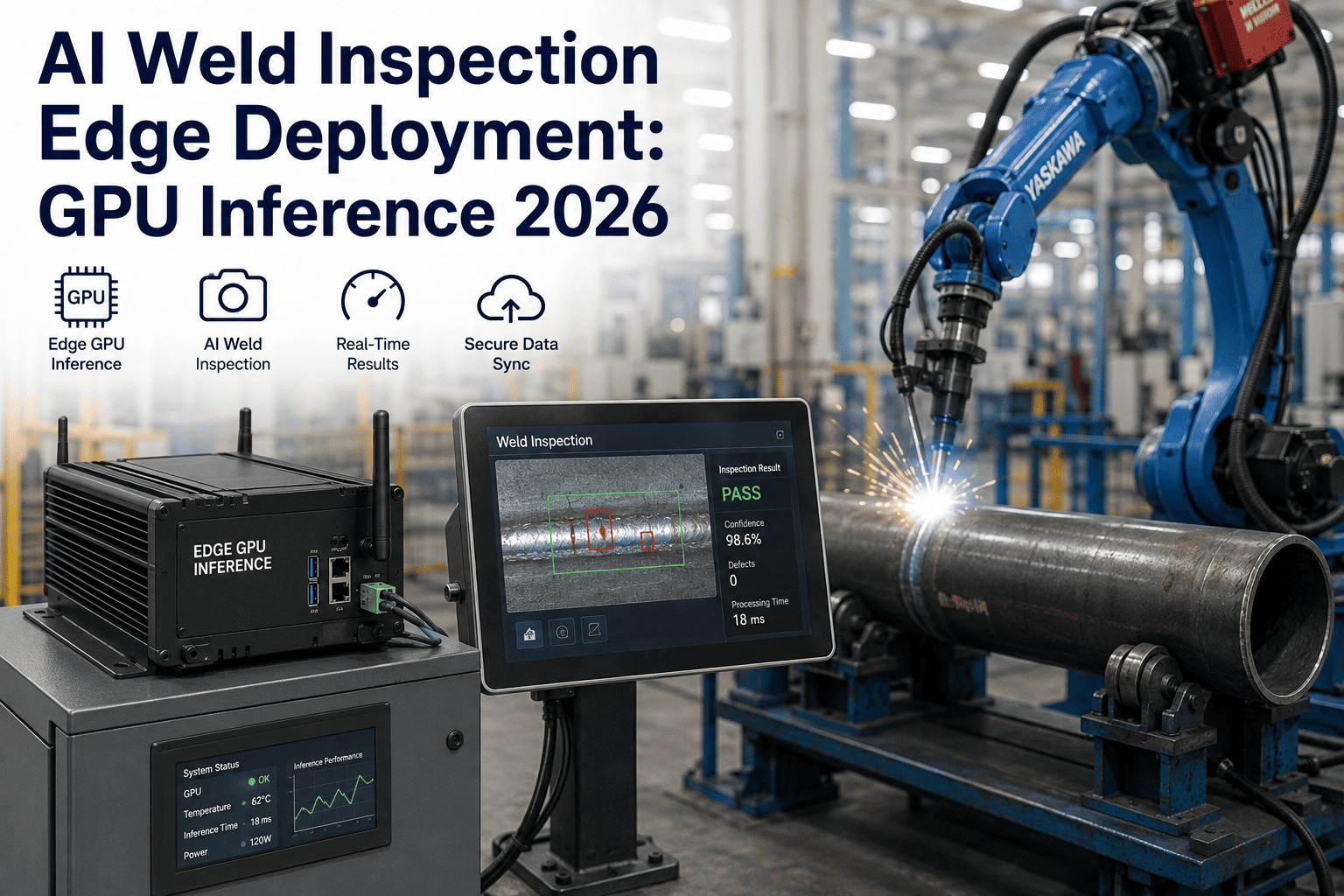
Inline needs an edge inference device per station capable of sub-40-millisecond processing. Offline can centralize compute in a server room since it is not tied to individual weld cells.
Staffing Model
Inline reduces manual review time since the pass or fail call happens automatically. Offline still needs a quality engineer or technician to review flagged results and confirm disposition.
Integration Complexity
Inline requires a real-time signal path into the PLC or robot controller. Offline typically integrates with a QA reporting system or MES rather than the weld cell controls directly.
Data Storage and Traceability
Offline naturally produces a stored image or scan per part for audit records. Inline systems need a separate configuration decision about which frames to retain for traceability.
A COMPOSITE CASE SCENARIO
What Changed When One Fabricator Split Inline and Offline by Weld Type
BEFORE
A structural fabricator ran every weld through the same offline batch review station, regardless of joint type. Robotic fillet welds on standard brackets sat in the same review queue as code-required structural butt welds, creating a backlog that delayed shipment on straightforward parts by up to a full shift.
AFTER
Routine robotic fillet welds moved to inline inspection with automatic pass or fail signals at the cell, clearing the review queue for structural welds that genuinely needed radiographic confirmation. Standard brackets shipped the same shift, while structural parts kept full offline NDT coverage without competing for the same review time.
GETTING STARTED
Four Steps to Deciding Between Inline and Offline for Your Line
Map current weld cycle times against the decision latency each approach would add
Identify which weld types carry code-required NDT and which can rely on vision alone
Estimate how far a missed defect can travel downstream before it becomes expensive
Pilot both approaches on a small weld sample before committing to a single method line-wide
FREQUENTLY ASKED QUESTIONS
Common Questions About Inline vs Offline AI Weld Inspection
Can the same AI model be used for both inline and offline weld inspection?
Often the underlying model architecture can be shared, but the deployment differs significantly. Inline deployment typically requires a lighter, optimized version of the model running on edge hardware to hit the latency budget, while offline deployment can run the full model with more compute per image. iFactory configures both from the same training pipeline so the two deployments stay consistent in what they flag.
Contact our support team to discuss which configuration fits your existing model if you already have one in production.
Does inline inspection slow down a fast robotic welding cell?
When the inference latency is kept under the available cycle time, inline inspection adds no measurable delay to the weld cell. The risk appears when a model is too large for the edge hardware it runs on, forcing the line to wait for a decision. Sizing the model to the hardware and the cycle time together is the key step, and
a demo session can show real latency numbers against your specific line speed.
Is offline inspection still worth using if we already have inline vision on the line?
Yes, particularly for weld types that require code-required nondestructive testing or for confirming borderline cases that inline inspection flags but does not definitively reject. Many production lines run inline inspection as a fast first pass and reserve offline radiographic or ultrasonic review for structural or safety-critical joints where a vision-only decision is not sufficient for certification.
How much training data does each approach need before it performs reliably?
Both approaches need labeled examples of acceptable and defective welds, but inline models often need additional examples captured under production lighting and cycle-time conditions since the frame quality differs from a dedicated offline inspection station. Offline models can sometimes start with fewer examples because higher-resolution captures make each labeled sample more informative to the training process.
What happens when inline and offline results disagree on the same weld?
Disagreement usually signals a borderline weld near the confidence threshold on one or both systems, and it is valuable diagnostic information rather than a system failure. Reviewing these disagreement cases regularly helps tune thresholds on both deployments and often reveals which weld conditions genuinely need the additional data an offline capture provides.
Reach out to support if you want help setting up a disagreement-tracking workflow.
Pick the Right Inspection Timing Before You Scale Across the Plant
iFactory helps you pilot inline and offline AI weld inspection side by side on real production data, so the throughput and accuracy trade-offs are measured, not guessed at.