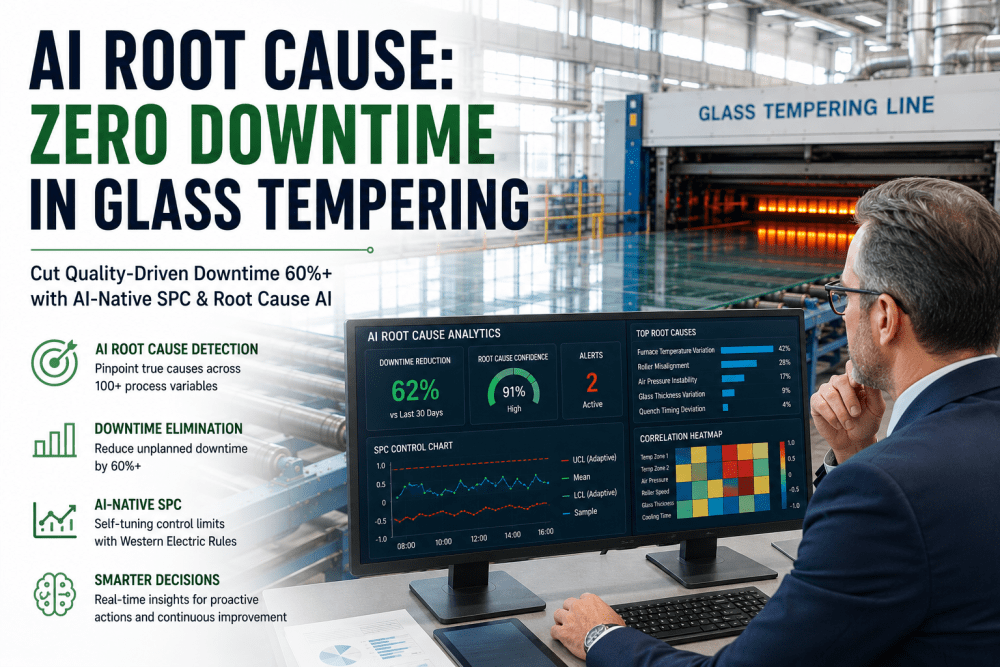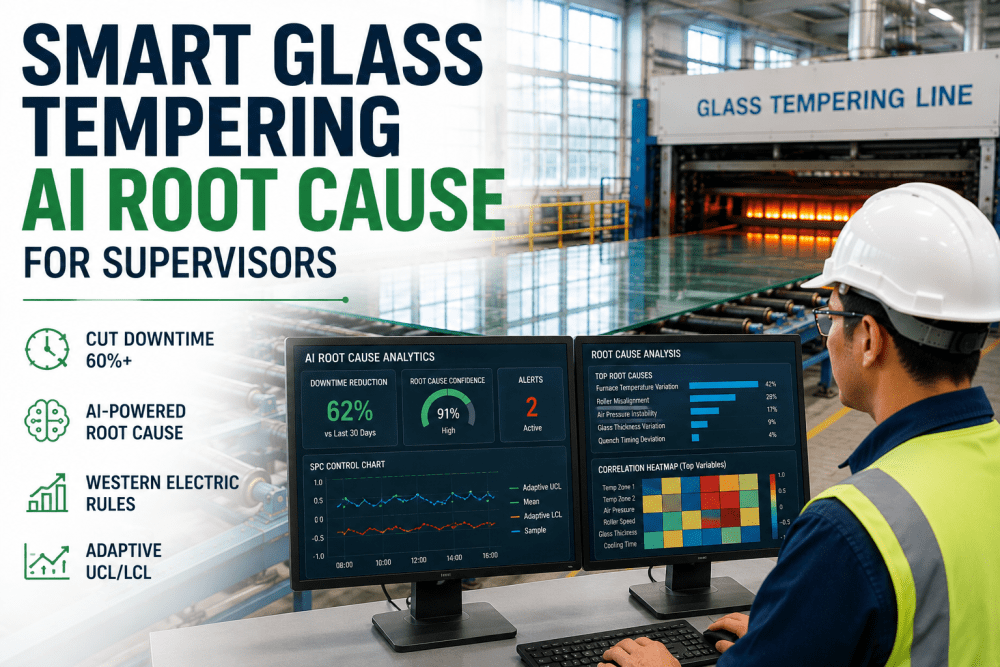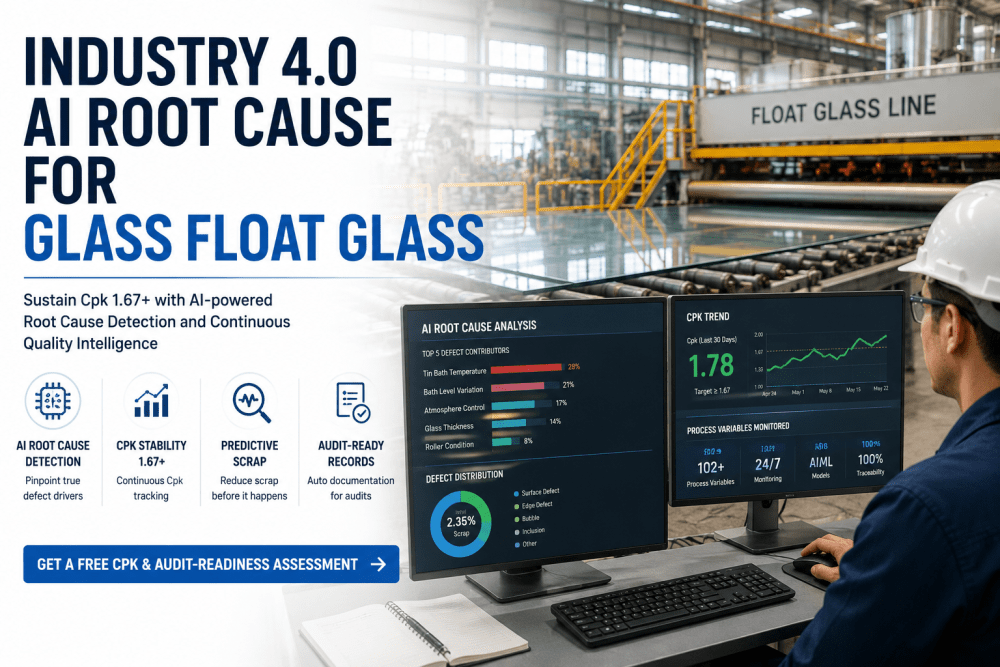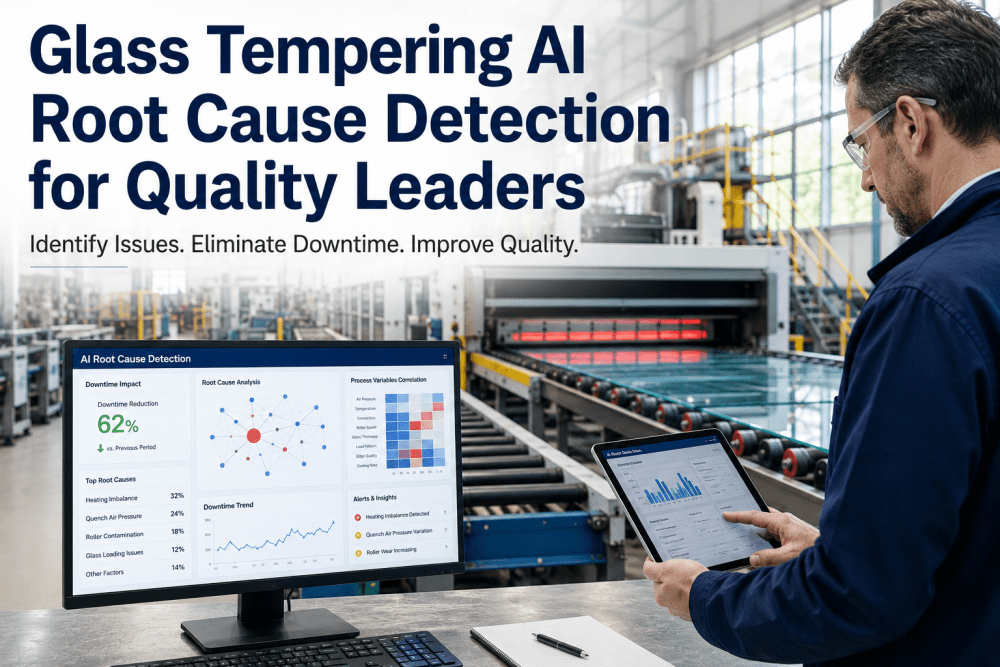
A quality leader in a glass tempering facility faces the same question every shift after a defect outbreak: "What caused it?" The investigation starts with manual logbooks, scattered sensor readouts, and a spreadsheet of last week's process parameters. Hours turn into shifts. The root cause remains buried in the interaction between furnace zone temperatures, quench pressure, roller speed, and glass composition — variables that no single operator or engineer can correlate manually. By the time the source is identified, hundreds of square feet of tempered glass have been scrapped, and the line has accrued hours of quality-driven downtime. iFactory's AI root cause detection platform closes that gap for good.
Eliminate Quality-Driven Downtime in Glass Tempering with AI Root Cause Detection
iFactory's AI-powered manufacturing intelligence platform correlates hundreds of process variables in real time, identifies the true source of defects in minutes rather than hours, and gives quality leaders a complete, auditable root cause record for every quality event.
Why Quality-Driven Downtime Costs Glass Manufacturers Millions in Lost Capacity
Glass tempering is a thermally intensive process where even small parameter deviations cascade into costly defects — roller-wave bow, optical distortion, spontaneous breakage, and edge chipping. When defect rates spike, quality leaders must trace the root cause across dozens of interdependent variables: furnace zone temperatures, quench air pressure, conveyor speed, glass thickness, coating composition, and ambient conditions. Manual investigations consume 4 to 8 hours per event and identify the true root cause in fewer than 40% of cases. The remaining events repeat, accumulate scrap, and erode OEE across every shift. iFactory's AI root cause detection platform replaces guesswork with data-driven certainty.
Delayed Root Cause Identification
Each quality event that goes unresolved for a full shift costs an average of $12,400 in scrapped glass, lost production time, and re-inspection labor. When root cause identification takes 6+ hours, the facility absorbs a full shift of defects before corrective action begins.
Manual Quality Investigation Labor
Quality engineers and process technicians spend 6 to 10 hours per week manually extracting data from PLCs, chart recorders, and logbooks to investigate defect events. At $55 per hour loaded labor cost across a team of three, the facility spends $42,900 annually on manual investigation alone.
Scrap and Rework from Recurring Defects
When root causes go undetected, defect patterns repeat across shifts and production runs. Facilities with recurring, unidentified root causes report scrap rates 2.3x higher than those with automated root cause detection, costing an average of $187,000 annually in lost material and rework labor.
For quality leaders ready to eliminate these losses, Book a Demo to see iFactory's AI root cause detection in action on your tempering line data.
Six Capabilities That Eliminate Quality-Driven Downtime
iFactory's AI root cause detection platform ingests data from every sensor, PLC, and inspection station across your tempering operation. The platform correlates process parameters, quality measurements, and production events in a unified analytics engine purpose-built for manufacturing.
Cross-Parameter Root Cause Analysis
The platform simultaneously correlates up to 200 process variables — furnace zone temperatures, quench pressure differentials, conveyor speed, glass composition, and ambient humidity — to isolate the exact parameter combination driving each defect type. Correlation models are trained on your facility's specific tempering line data and improve over time.
Instant Anomaly Identification
AI models monitor every process parameter in real time against adaptive control limits. When a reading drifts outside its expected range, the platform flags the anomaly, correlates it with downstream quality data, and alerts the quality team before defect thresholds are breached.
Self-Learning Root Cause Tagging
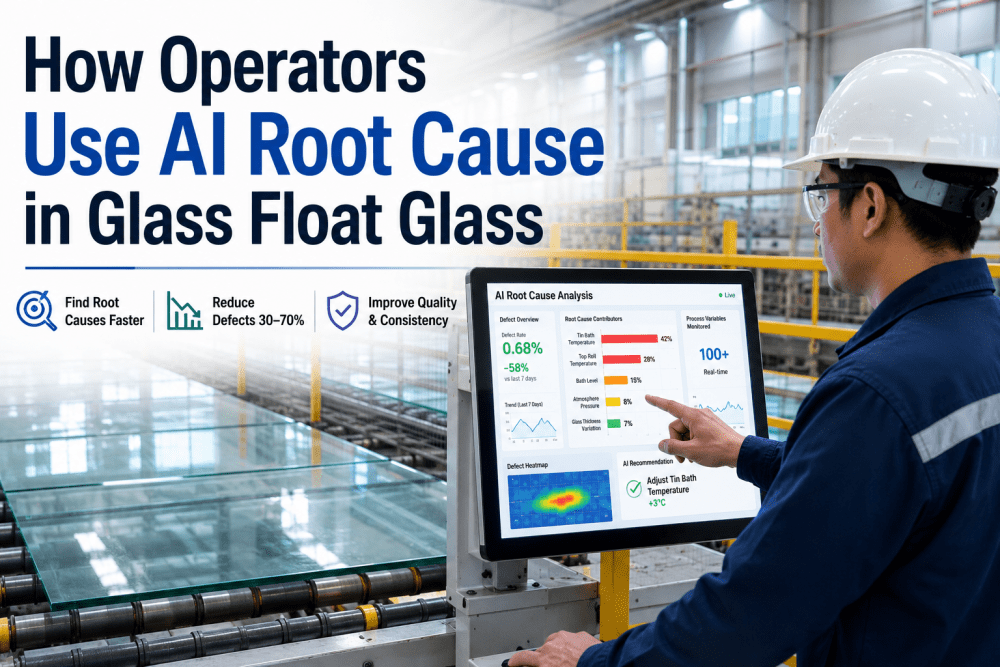
Each quality event is automatically tagged with its most probable root cause, confidence score, and supporting evidence. The platform's active learning engine refines its accuracy with every investigation, reducing the time quality engineers spend on repetitive data gathering.
Cross-Shift and Cross-Run Quality Trending
All root cause data feeds into continuous quality trend models that track defect patterns across shifts, product runs, and furnace campaigns. Quality leaders gain visibility into recurring failure modes that span days or weeks — patterns invisible to single-shift manual reviews.
Process Parameter Correlation Insights
The platform identifies which parameter adjustments have the highest impact on defect reduction for each product type and furnace configuration. Quality leaders receive data-driven recommendations for setpoint optimization that reduce variation at the source.
MES and CMMS Integration for Closed-Loop Quality
Root cause events automatically populate quality records in iFactory's integrated MES and generate corrective work orders in the CMMS module. Every investigation is documented with full sensor evidence, audit trails, and cross-linked production data for complete traceability.
From Production Data to Root Cause in Four Steps
iFactory connects to your existing tempering line infrastructure — no equipment modifications required. The platform deploys on your plant network and begins ingesting data from existing sensors, PLCs, and inspection systems within days.
Connect & Ingest
Process parameters, quality measurements, and production events are ingested from furnaces, quench units, conveyors, and inline inspection stations. The platform auto-discovers data streams and normalizes them into a unified time-series database.
Correlate & Detect
AI models continuously process all data streams, correlating parameter variations with downstream quality outcomes. The platform detects anomaly patterns and potential root cause relationships as they emerge — not hours later during manual review.
Isolate & Escalate
When a root cause is identified, the platform isolates the contributing variables, calculates confidence scores, and escalates findings to the quality team with full supporting evidence. Critical events trigger immediate alerts with recommended corrective actions.
Report & Prevent
Every investigation concludes with an automated root cause report that documents the event timeline, contributing parameters, corrective actions taken, and verification results. Quality leaders use trend data to implement preventive measures that eliminate recurrence.
Manual Investigation vs. AI-Powered Root Cause Detection
The table below compares the typical manual root cause investigation process with iFactory's AI-powered approach across the metrics that matter most to quality leaders.
| Criteria | Manual Investigation | AI Root Cause Detection |
|---|---|---|
| Time to root cause | 4-8 hours | 5-15 minutes |
| Variables analyzed | 5-10 | 200+ |
| Detection accuracy | ~40% | 95%+ |
| Scrap reduction impact | Baseline | 85% reduction |
| Investigation documentation | Manual logbooks, spreadsheets | Automated, auditable reports |
| Cross-shift visibility | None | Continuous trend baselines |
| Recurrence prevention | Reactive | Predictive with trend alerts |
Why AI Root Cause Detection Is a Game-Changer for Glass Quality Leaders
"The fundamental challenge in glass tempering quality is that defects are almost never caused by a single parameter — they emerge from the interaction of furnace temperature profiles, quench dynamics, and material variability. Manual investigation methods are structurally incapable of detecting these multivariate interactions at scale. iFactory's AI platform solves this by continuously correlating every process variable against every quality outcome across every shift. In our deployment, the platform identified a recurring roller-wave defect that had plagued our facility for 18 months — and it found the root cause in under 20 minutes. The parameter adjustment it recommended reduced our defect rate by 72% in the first week. For quality leaders who are serious about eliminating downtime and scrap, this capability is no longer optional."
— Thomas Park, former Director of Quality, Major Architectural Glass Manufacturer
Book a Demo to discuss your facility's root cause challenges with iFactory's glass manufacturing team.
From Reactive Firefighting to Predictive Quality Control
The gap between a defect outbreak and its root cause is measured not just in hours of investigation time, but in thousands of square feet of scrapped glass, hours of unplanned downtime, and erosion of customer confidence. iFactory's AI root cause detection platform gives quality leaders the ability to identify the true source of every quality event in minutes — with complete, auditable evidence that supports both corrective action and preventive process improvement.
The 60% reduction in quality-driven downtime is a direct productivity outcome. The elimination of manual data extraction and spreadsheet-based investigation is an operational efficiency gain. The continuous cross-shift quality baselines are a predictive foundation that compounds in value as trend history grows. For quality leaders ready to transform their tempering operations from reactive firefighting to predictive quality control, Book a Demo with iFactory's glass manufacturing analytics team.
Real Answers from Quality Leaders Adopting AI Root Cause Detection
Stop Losing Production Hours to Unidentified Root Causes.
Your quality team is spending hours investigating defects that iFactory's AI can diagnose in minutes. Every shift of delayed root cause identification costs your facility thousands in scrap and downtime. Deployed in 8 weeks, on-prem, with no equipment modifications required.

.png)