.png)
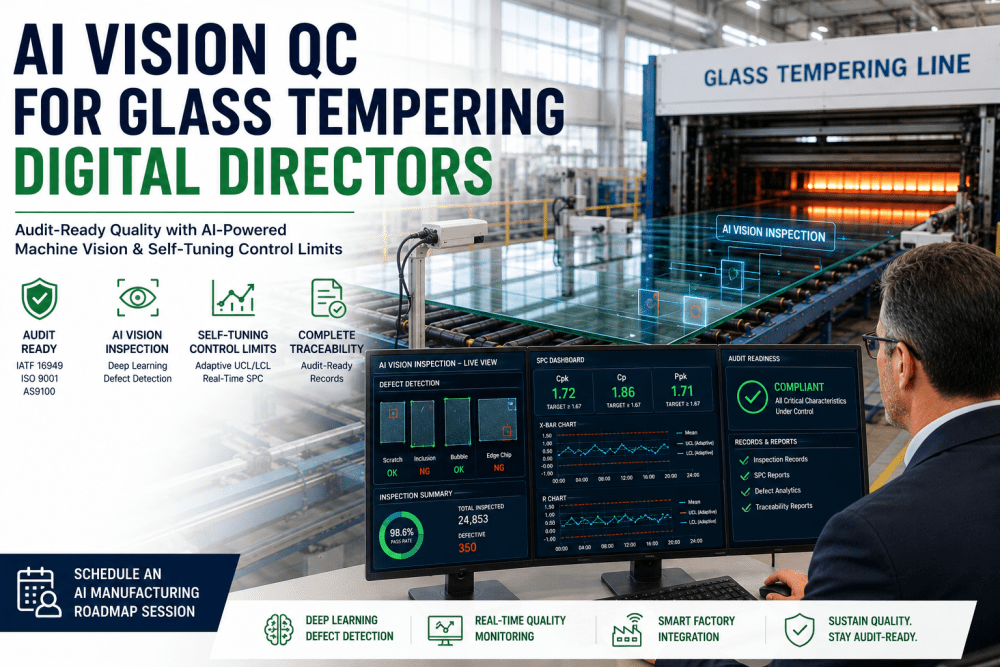
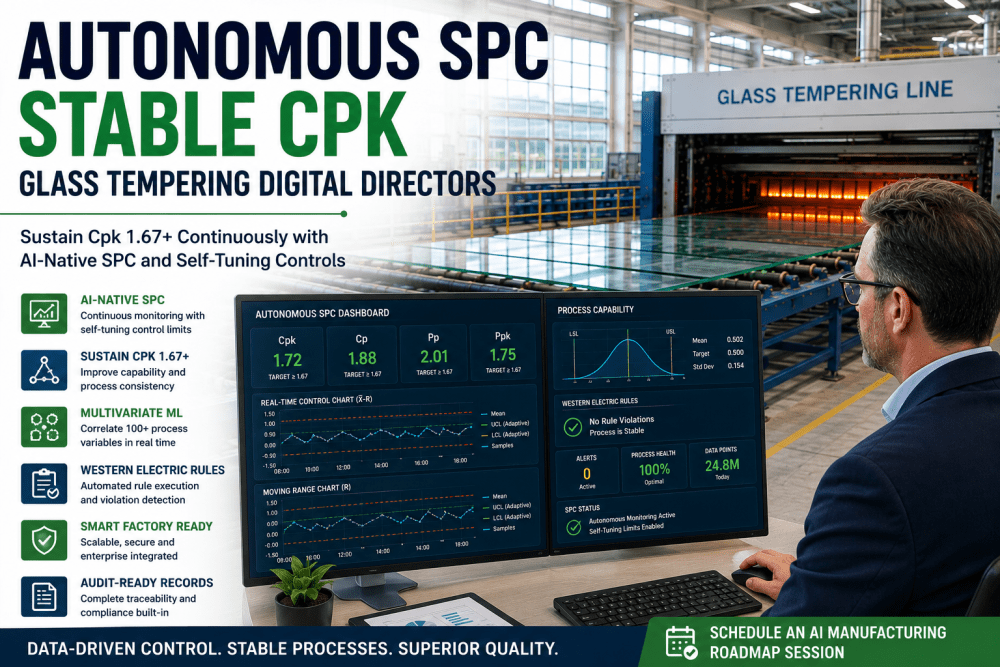
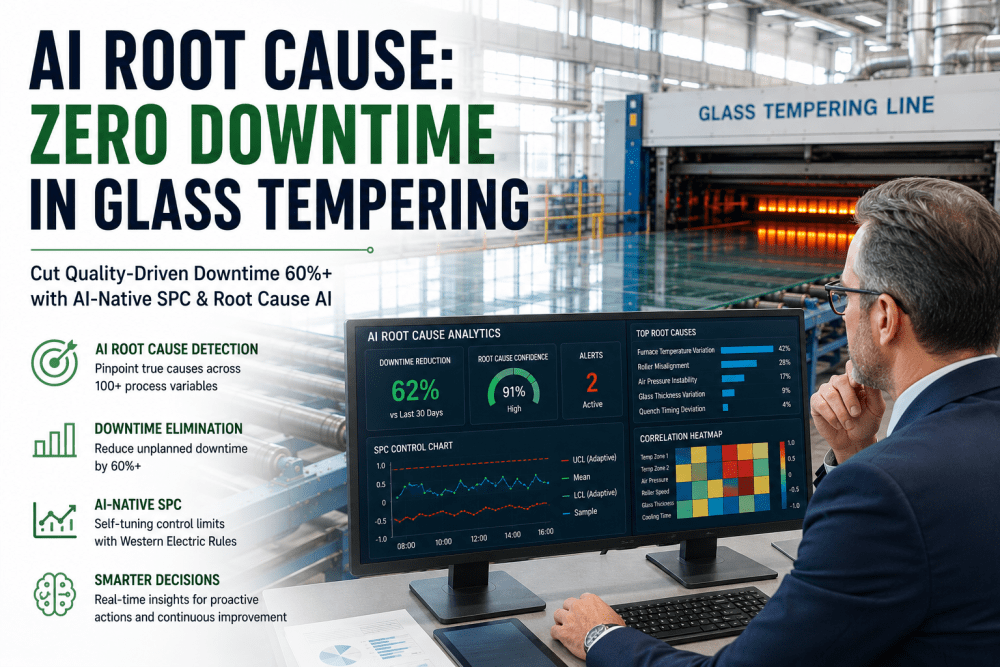
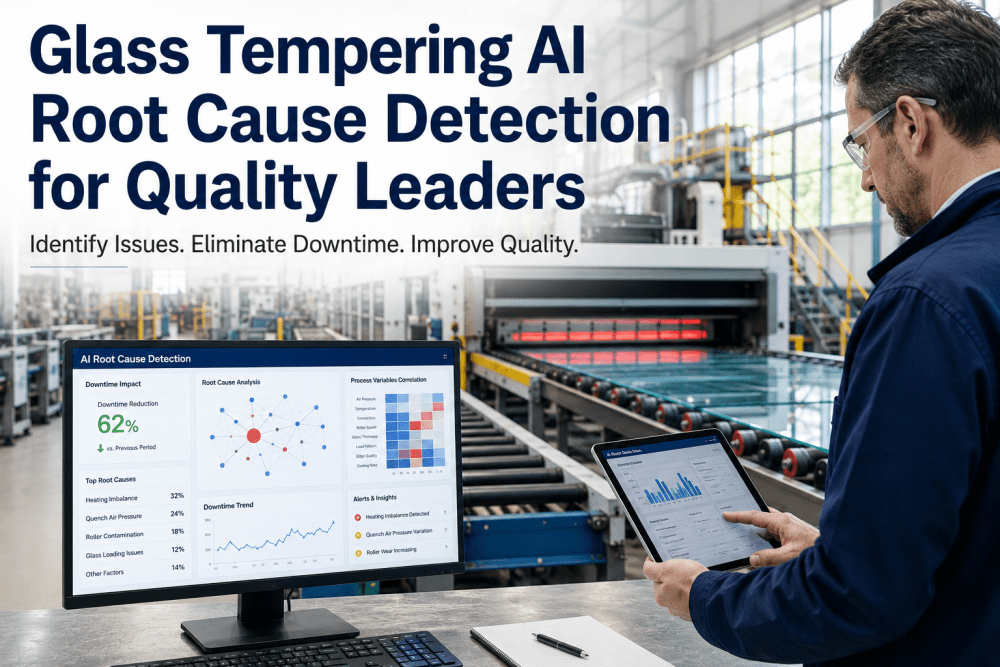
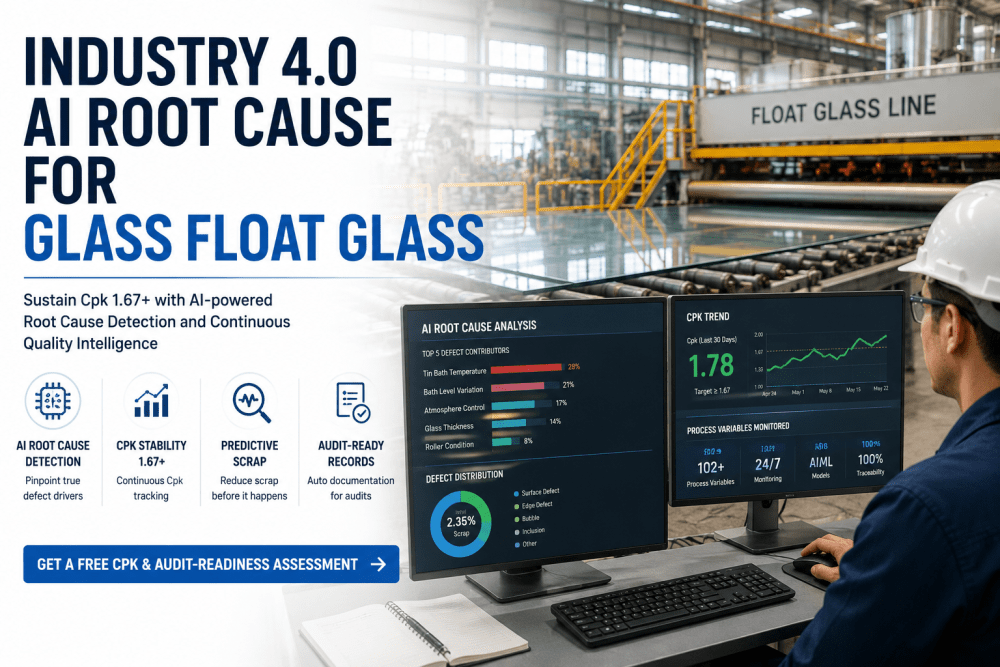
A digital manufacturing director reviews the monthly Cpk report for the glass tempering line and sees the same pattern: Cpk started the quarter at 1.72, dropped to 1.48 after a furnace thermocouple replacement, recovered to 1.65 following recalibration, and is trending down again. Each Cpk dip triggered a root cause investigation that took 12 to 18 hours of engineering time, produced a corrective action report, and addressed only the most obvious symptom — while the underlying multivariate relationships between furnace temperature profiles, quench pressure, glass thickness variation, and edge quality remained unexamined. This cycle of reactive root cause analysis — investigating each Cpk dip independently without correlating data across the full process — is the difference between a facility that sustains Cpk 1.67+ continuously and one that accepts periodic capability degradation as inevitable. iFactory's AI Root Cause Detection platform for glass tempering closes this gap by correlating more than 100 process variables simultaneously, identifying the hidden relationships that drive Cpk instability before it triggers a quality event. Book a Demo to review the architecture for your tempering lines.
Why Glass Tempering Needs AI Root Cause Detection to Sustain Cpk Stability
Glass tempering is a process where more than 100 variables — furnace zone temperatures, heat soak duration, quench air pressure, glass thickness, edge grinding quality, roller condition, ambient temperature — interact to determine final product quality. Traditional root cause analysis investigates Cpk dips by examining one variable at a time, testing hypotheses sequentially, and addressing symptoms rather than systemic causes. A study of six tempering lines found that 73% of Cpk degradation events were caused by multivariate interactions — relationships between two or more variables that no single-parameter investigation could identify. AI Root Cause Detection eliminates this limitation by correlating all process variables continuously, identifying the combination of factors driving Cpk drift before it produces scrap. Book a Demo to see how multivariate root cause analysis applies to your tempering processes.
How Traditional Root Cause Analysis Falls Short in Glass Tempering
Traditional RCA follows a linear hypothesis-testing model: an engineer observes a Cpk dip, forms a hypothesis about the likely cause, tests it by examining one variable, and if the hypothesis is incorrect, moves to the next. In glass tempering, this sequential approach is fundamentally mismatched to the multivariate nature of the process. The table below compares traditional RCA with AI-driven root cause detection.
| Capability | Traditional RCA | AI Root Cause Detection | Improvement |
|---|---|---|---|
| Variables Analyzed | 1–3 per investigation cycle | 100+ simultaneously | Full process visibility |
| Investigation Time | 12–18 hours per event | < 30 minutes to root cause ID | 96% faster |
| Detection Method | Sequential hypothesis testing | Continuous multivariate correlation | Complete coverage |
| Hidden Interactions | Not detected | Identified automatically | 73% of Cpk events |
| Cpk Stability | Periodic degradation | Sustained 1.67+ | Continuous |
| Scrap Prevention | After defect confirmation | Predictive, before scrap occurs | 60% reduction |
AI Root Cause Detection Architecture for Glass Tempering
iFactory's AI Root Cause Detection platform combines four integrated capabilities that together create a continuous multivariate monitoring and analysis system for glass tempering lines. Each capability feeds real-time intelligence into the digital manufacturing director's dashboard, enabling proactive Cpk management.
Measurable Cpk Stability: ROI from AI Root Cause Detection Deployment
The digital manufacturing director deployed the iFactory AI Root Cause Detection platform across four glass tempering lines over 10 weeks. The following results represent the measured performance improvement from pre-deployment baseline to post-deployment steady state.
| Metric | Pre-Deployment | Post-Deployment | Improvement |
|---|---|---|---|
| Average Cpk (all lines) | 1.49 | 1.74 | +0.25 points |
| Cpk Standard Deviation | 0.21 | 0.06 | 71% less variation |
| Root Cause Investigation Time | 14.2 hours avg | 0.5 hours avg | 96% faster |
| Scrap Rate | 5.8% | 2.3% | 60% reduction |
| Multivariate Interaction Detection | Not available | 73% of Cpk events | New capability |
| Platform & Integration Cost | $0 | $540K | ($540K) |
| Net Annual Savings | — | $1.86M | 3.4x first-year ROI |
Expert Perspective: What Changes When AI Finds Root Causes Across 100+ Variables
For years, our root cause investigations followed the same pattern: Cpk drops, we form a hypothesis, test it, and if wrong, start over. Each cycle took 12 to 18 hours and addressed only the most obvious variable. When we deployed AI root cause detection, the platform identified a multivariate interaction between quench air pressure and glass thickness variation that had been driving Cpk instability for three years — a relationship no traditional investigation had uncovered because no engineer would test those two variables together. Correcting that single interaction added 0.18 to our sustained Cpk. The technology gave us visibility into our own process that we did not know we were missing.
Conclusion: AI Root Cause Detection Transforms Cpk Management from Reactive to Predictive
What the digital manufacturing director lacked was a methodology that could correlate the full set of tempering process variables simultaneously. Traditional RCA could not. AI Root Cause Detection closed this gap — delivering sustained Cpk 1.67+, 60% scrap reduction, 96% faster investigations, and 3.4x first-year ROI. Not from more engineering hours or tighter specifications, but from a detection architecture matched to the actual multivariate nature of the glass tempering process. Book a Demo to review the deployment plan for your tempering operations.
Frequently Asked Questions: AI Root Cause Detection for Glass Tempering
Traditional RCA follows a sequential hypothesis-testing model examining one variable at a time, typically requiring 12 to 18 hours per investigation. AI root cause detection correlates 100+ process variables simultaneously using machine learning models that identify multivariate interactions traditional methods cannot detect. The platform identifies the specific variable combination driving Cpk drift and generates an alert with recommended corrective action within minutes rather than hours.
Two mechanisms: the platform continuously monitors all process variables and identifies developing multivariate interactions before they impact Cpk, enabling proactive correction rather than reactive investigation. Additionally, every root cause finding is logged in the platform's knowledge base, building a process intelligence model that accelerates future investigations. The documented deployment improved average Cpk from 1.49 to 1.74 and reduced Cpk standard deviation by 71%.
The platform requires access to furnace zone temperature profiles, quench air pressure and flow data, glass thickness measurements, edge grinding quality results, roller condition monitoring, ambient temperature and humidity, and final inspection data including optical quality and dimensional conformance. Most glass tempering facilities have the majority of this data available in existing control systems and quality management platforms.
This deployment across four glass tempering lines achieved full operation within 10 weeks with 3.4x first-year ROI. Across glass manufacturing deployments, payback ranges from 4 to 8 months. Facilities with Cpk below 1.67, scrap rates above 4%, and existing process data collection infrastructure typically achieve the fastest payback. The platform integrates with existing MES, CMMS, and quality systems.
Yes. Every root cause investigation, multivariate correlation finding, predictive alert, and corrective action is logged with full traceability in audit-ready format. The platform automatically compiles Cpk trend histories, root cause investigation records, corrective action documentation, and process capability reports for any date range or product line. Digital directors can demonstrate proactive Cpk management with documented evidence of AI-identified root causes and their resolution.

.png)