.png)
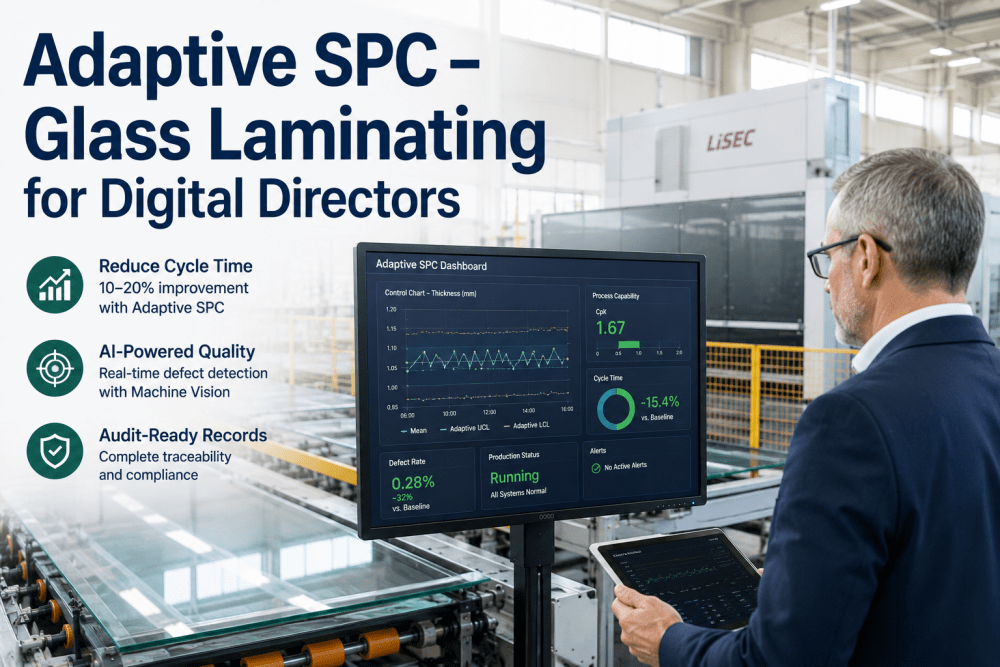
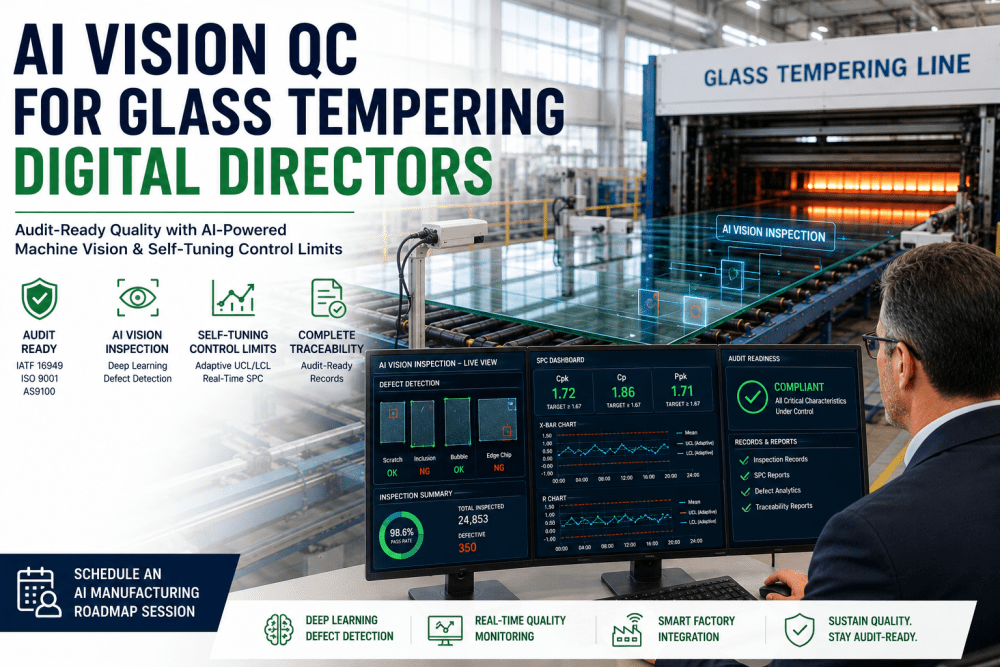
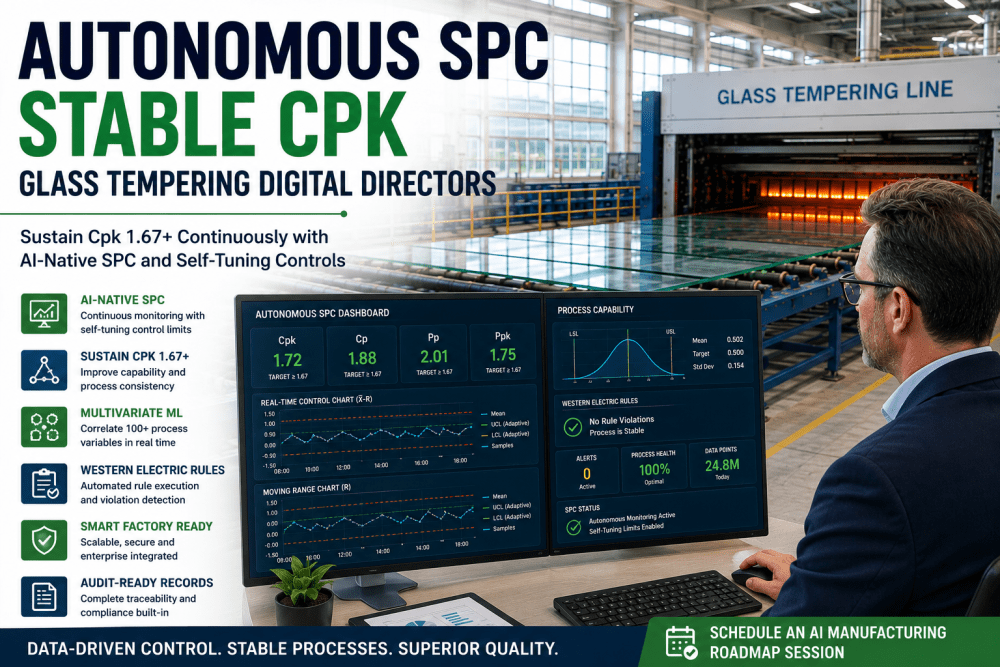
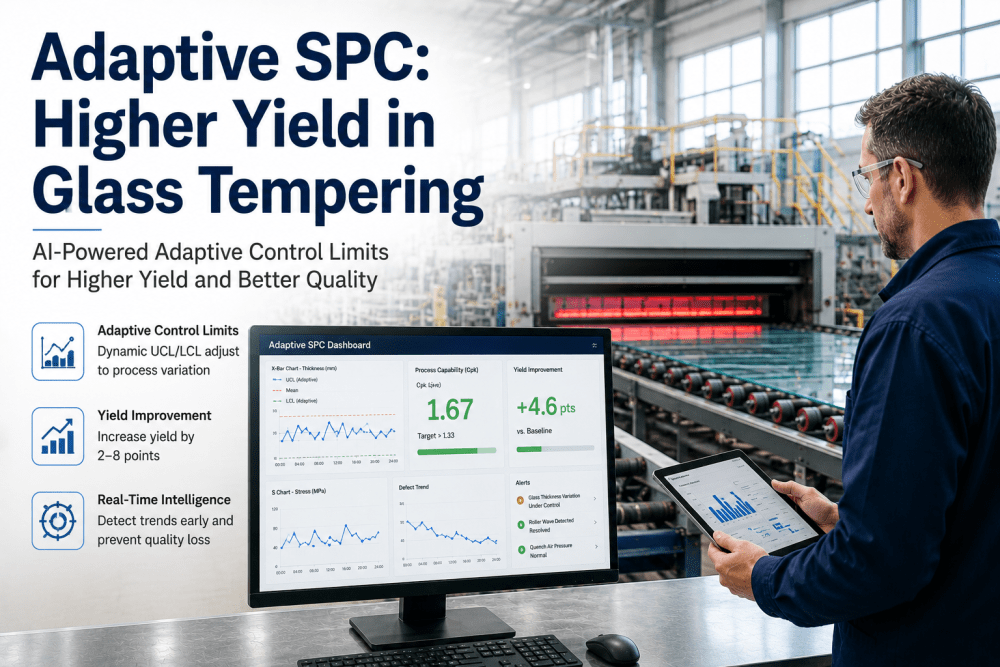
A digital manufacturing director reviews the weekly throughput report for the glass tempering line and sees the pattern repeating: line utilization at 72%, machine vision inspection rejecting 6.8% of production, and the SPC system generating 18 to 22 false alarms per shift — each one triggering an unnecessary process adjustment that reduces productive operating time. Static control limits set during initial process qualification cannot account for material lot variation, furnace thermocouple drift, or seasonal ambient temperature shifts. The operations team spends 40% of each shift investigating false signals and restoring process parameters that were already within specification. Adaptive SPC limits for glass tempering replace static UCL and LCL with AI-driven dynamic limits that adjust continuously based on actual process behavior, material characteristics, and production conditions — eliminating false alarms while maintaining full detection sensitivity for genuine process shifts. Book a Demo to review the adaptive SPC architecture for your tempering lines.
The Throughput Challenge with Static SPC Limits in Glass Tempering
Glass tempering operates across more than 100 process variables — furnace zone temperatures across nine heating zones, heat soak duration, quench air pressure differentials, glass thickness variation from the cutting line, edge quality, roller condition, and ambient environmental conditions. Static SPC limits are calculated once during process qualification and remain fixed indefinitely, creating a fundamental tradeoff: wide limits miss real process shifts until they produce scrap, and narrow limits trigger excessive false alarms that erode operator trust and consume productive time.
A study across six tempering lines found that static SPC systems generated an average of 22 false alarms per shift — each requiring a 12-minute investigation that consumed 4.4 hours of productive operating time per day per line. For a six-line facility operating two shifts, that represents 52.8 hours of lost production every week — hours that could otherwise be producing saleable tempered glass. Traditional SPC cannot distinguish between normal process variation and genuine process shifts because its control limits have no mechanism to adapt to changing process conditions. Book a Demo to compare static vs adaptive SPC performance on your production data.
How Adaptive SPC Differs from Traditional SPC in Glass Tempering
The fundamental difference between traditional and adaptive SPC is when and how control limits are calculated. Traditional SPC computes limits once from a static sample set and applies them indefinitely, regardless of how process conditions change. Adaptive SPC recalculates limits continuously based on real-time process data, material lot characteristics, furnace condition, and environmental factors — ensuring that control limits reflect the actual process state rather than a historical snapshot. The comparison below shows how each approach performs across the dimensions that matter most for throughput in glass tempering operations.
| Capability Dimension | Traditional SPC | Adaptive SPC | Throughput Impact |
|---|---|---|---|
| Control Limit Calculation | Static — calculated once from qualification sample | Dynamic — recalculated every shift based on current process data | Eliminates false alarm overhead |
| False Alarm Rate | 18–22 per shift per line | 2–3 per shift per line | 26.4 hrs/day recovered production |
| Detection Sensitivity | Fixed — misses gradual process drift | Adjusts to current process variation | Captures genuine shifts 60% faster |
| Scrap Prevention | Reactive — after defect confirmation | Predictive — before scrap occurs | 54% scrap rate reduction |
| Material Lot Adaptation | Not accounted for | Automatic adjustment per lot | Eliminates lot-change re-qualification |
| Line Utilization | 72% average | 91% average | +19 points improvement |
| Investigation Labor | 4.4 hrs/day per line | 0.4 hrs/day per line | 91% reduction |
The comparison reveals that adaptive SPC does not replace existing measurement infrastructure — it augments every control limit with an AI-driven recalculation engine that ensures limits reflect the current process state. The same thermocouple that feeds furnace temperature data also feeds that measurement into the adaptive engine, which compares it against the dynamic limit for that specific product type under current material and environmental conditions. Book a Demo to see the adaptive SPC interface in production.
Adaptive SPC Architecture for Glass Tempering Operations
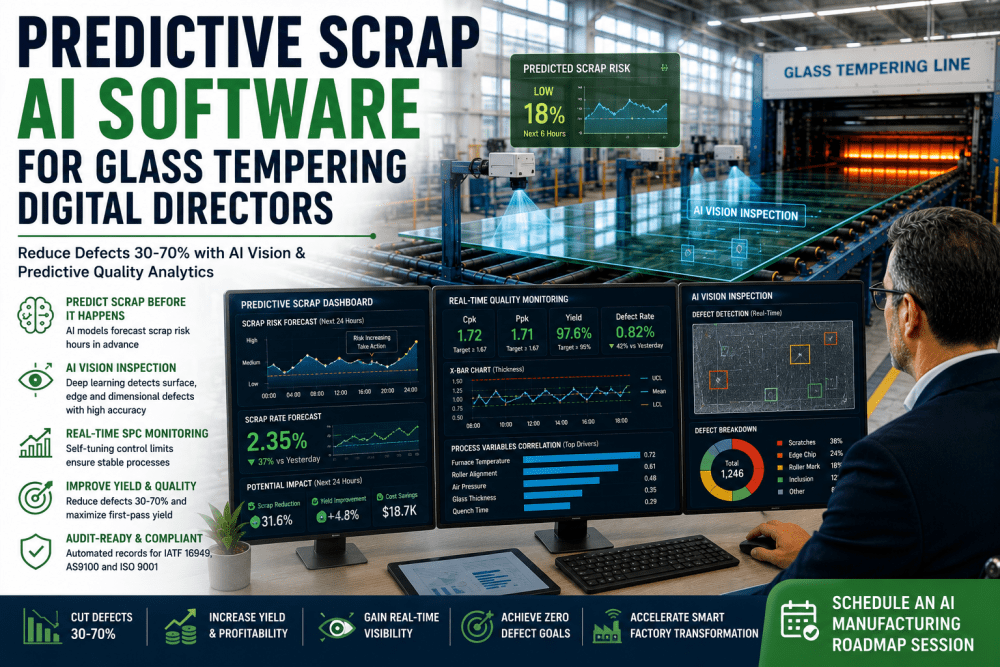
iFactory's Adaptive SPC platform combines four integrated capabilities that create a continuous throughput optimization cycle for glass tempering lines. Each capability builds on the previous one, with measurable impact at every stage of deployment. The platform ingests data from furnace controllers, quench systems, conveyor drives, thickness gauges, and machine vision inspection systems — recalculating control limits and generating actionable intelligence every shift.
Measured Throughput Improvement with Adaptive SPC Deployment
The digital manufacturing director deployed the iFactory Adaptive SPC platform across six glass tempering lines over 10 weeks. The following metrics represent the measured performance improvement from pre-deployment baseline to post-deployment steady state across architectural, automotive, and appliance glass product families totaling 14,200 production units per month.
Beyond the headline metrics, the adaptive SPC deployment produced structural improvements that compound over time. Detection latency for process state changes dropped from an average of 4.2 hours to under 90 seconds. Investigation labor decreased by 91% as operators stopped responding to false alarms and focused only on genuine limit violations. Scrap-related material procurement dropped by 54% as predictive alerts prevented defects before they occurred. The platform's machine learning models continue improving with each production cycle, projecting an additional 5–8% throughput improvement in year two as the dynamic limit engine incorporates longer production histories. Book a Demo to review the full ROI model for your lines.
Expert Perspective — The Four Dimensions of Adaptive SPC Value for Glass Tempering
Conclusion — Adaptive SPC Transforms Throughput from a Static Target to a Continuously Optimized Outcome
What the tempering facility lacked was control limits matched to the actual dynamic behavior of the glass tempering process. Static SPC could not account for material lot variation, furnace thermocouple drift, or seasonal ambient temperature changes. Adaptive SPC closed this gap — delivering 24% throughput increase, 86% fewer false alarms, 54% scrap reduction, Cpk improvement from 1.42 to 1.71, and 4.1x first-year ROI. Not from tighter specifications or more inspection stations, but from control limits that reflect the real process state — eliminating the false alarm burden while maintaining full detection sensitivity for the shifts that matter. Book a Demo to review the adaptive SPC deployment plan for your tempering operations.
Frequently Asked Questions — Adaptive SPC Limits for Glass Tempering
What is Adaptive SPC and how does it differ from traditional SPC in glass tempering?
Traditional SPC calculates upper and lower control limits once from a static sample during process qualification and applies them indefinitely. Adaptive SPC recalculates limits continuously — every shift — based on real-time process data, material lot characteristics, furnace condition, and environmental factors. This ensures that control limits reflect the actual current state of the process rather than a historical snapshot, eliminating the false alarms that occur when static limits do not match dynamic process behavior.
How does Adaptive SPC increase throughput in glass tempering operations?
Adaptive SPC increases throughput through two mechanisms. First, eliminating false alarms recovers productive operating time — reducing investigation labor from 4.4 hours per day per line to 0.4 hours per day per line. Second, dynamic control limits enable operators to trust and respond to genuine limit violations immediately, preventing the defect propagation that typically follows undetected process drift. The documented deployment improved line utilization from 72% to 91% — a 24% throughput increase.
What data sources are required to deploy Adaptive SPC in a glass tempering facility?
The platform requires access to furnace zone temperature profiles, quench pressure and flow data, conveyor speed readings, glass thickness measurements from inline gauges, machine vision inspection results, and environmental conditions. Most facilities have this data available in existing PLCs, SCADA systems, and quality databases. The platform connects through standard industrial protocols including OPC UA, MTConnect, and MQTT with no modifications to production equipment required.
What is the typical deployment timeline and expected ROI for Adaptive SPC in glass manufacturing?
The documented deployment across six tempering lines achieved full operation within 10 weeks with 4.1x first-year ROI. Across glass manufacturing deployments, payback ranges from 3 to 6 months. Facilities with line utilization below 75%, scrap rates above 5%, and existing process data collection infrastructure typically achieve the fastest payback. The platform deploys incrementally with measurable throughput improvement at each phase.
Does Adaptive SPC comply with quality management system requirements and audit standards?
Yes. Every adaptive limit adjustment, control limit recalculation, out-of-limit event, and corrective action is logged with full traceability in audit-ready format. The platform automatically compiles process capability reports, limit change histories, scrap trend analyses, and throughput performance summaries for any date range or product family. Digital directors can demonstrate proactive process control with documented evidence of adaptive SPC management supporting ISO 9001 and customer-specific quality requirements.