.png)
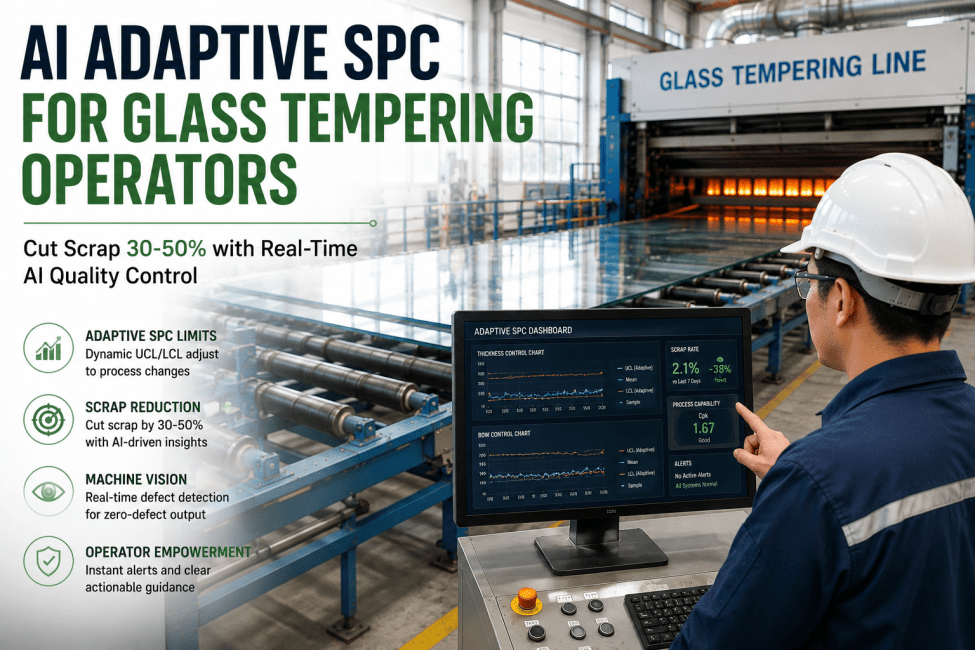
For operators running glass laminating lines, static SPC control limits create a fundamental blind spot: fixed UCL and LCL thresholds calculated from historical data cannot distinguish between legitimate process variation and emerging defect patterns. When autoclave temperature profiles drift, PVB interlayer moisture shifts with seasonal humidity, or glass alignment tolerances change with batch setup, static limits either flood operators with false alarms or miss genuine out-of-control conditions until defects reach final inspection. Adaptive SPC limits replace fixed thresholds with dynamic boundaries that self-adjust to current process conditions, enabling operators to detect and respond to drift before defects occur. Laminating line operators evaluating next-generation process control Book a Demo to see adaptive SPC in live glass laminating environments with dynamic UCL/LCL monitoring.
Why Static Control Limits Fail in Glass Laminating
Traditional SPC applies fixed UCL and LCL thresholds from historical capability studies. In glass laminating, this creates systematic blind spots: autoclave zone drift, PVB interlayer moisture variation, glass supplier lot changes, and ambient temperature shifts cause legitimate process variation that static limits either over-flag as false alarms or miss entirely. Operators evaluating their control limit strategy Book a Demo to see how adaptive thresholds resolve these failure modes across laminating lines.
| Failure Mode | Impact on Glass Laminating Quality | How Adaptive SPC Resolves It |
|---|---|---|
| Over-Flagging False Alarms | Static limits flag normal process variation as out-of-control, overwhelming operators with false alerts and eroding trust in the SPC system | Dynamic limits self-adjust for known variation, reducing false alarm rate from 8-15% to 2-4% and restoring operator confidence in alerts |
| Missed Process Drift | Limits set too wide miss autoclave temperature drift or pressure deviation until defective panels reach final inspection | Limits track current process state in real time, detecting shifts within 1-2 batches instead of 3-7, enabling intervention before defects occur |
| Manual Recalculation Burden | Operators and engineers spend hours recalculating limits after each recipe or material change instead of focusing on process improvement | Continuous automated recalculation eliminates manual limit maintenance, freeing operators for defect prevention and root cause analysis |
| Low-Volume Product Limitations | Insufficient data for meaningful static limits on low-volume glass configurations, custom laminated products, or new material combinations | Bayesian and ML methods leverage prior knowledge and multivariate inputs to generate valid control limits even with sparse production data |
Adaptive SPC Methodologies for Glass Laminating
Adaptive SPC dynamically recalculates control limits using algorithms that account for known sources of laminating process variation. The tabs below detail three primary methodologies. Operators comparing approaches Book a Demo to see which fits their laminating process profile.
Rolling Window SPC maintains a fixed-size moving window of recent laminating batches and recalculates limits from that window alone. New data enters, old data exits, naturally tracking gradual shifts like autoclave aging, seasonal ambient humidity changes, and PVB material lot drift. Window size of 20-50 batches balances sensitivity versus stability. Computationally lightweight, fully interpretable, and straightforward to validate for quality audits. Best suited for high-volume laminating operations with consistent product configurations and cycle types.
Bayesian Adaptive SPC uses prior distributions from historical process capability studies and updates them with each new laminating batch. The posterior distribution produces limits that incorporate both established process knowledge and emerging signals. Particularly effective for facilities running diverse product mixes where limited batch history exists for any single glass configuration, thickness, or interlayer combination. Limits naturally tighten as confidence grows with repeated production runs and appropriately widen when new material combinations are introduced.
ML-Based Adaptive SPC uses regression or time series models trained on multivariate data—autoclave zone temperatures, ramp rates, soak times, load configuration, glass thickness, PVB grade—to predict expected lamination quality attributes. Control limits derive from prediction error distribution rather than raw output measurements. Detects subtle multivariate drift patterns that univariate methods miss, such as interactions between autoclave temperature imbalance and load positioning that precede delamination defects.
Adaptive vs. Traditional SPC: A Comparison for Operators
The table below evaluates adaptive and traditional SPC across the metrics that matter most to glass laminating operators focused on defect elimination and process stability.
| Capability | Traditional Static SPC | Adaptive SPC |
|---|---|---|
| Limit Calculation | Fixed from historical study, recalculated quarterly or after major changes | Continuously updated from rolling window, Bayesian posterior, or ML prediction error distribution |
| False Alarm Rate | 8-15% of batches flagged unnecessarily, causing alert fatigue | 2-4% false alarm rate; limits self-adjust for known laminating process variation |
| Drift Detection Speed | 3-7 batches before drift crosses static UCL or LCL threshold | 1-2 batches; limits track process shift in real time for early intervention |
| Recipe Change Handling | Requires manual recalculation and revalidation before next production run | Automatically adapts to new recipes using prior knowledge and multivariate inputs |
| Low-Volume Products | Poor performance; insufficient data for meaningful control limits on custom configurations | Strong performance; Bayesian and ML methods leverage prior knowledge for sparse data scenarios |
| Defect Reduction | Baseline performance; escapes occur during drift-to-limit detection gap | 30-70% defect reduction through earlier detection and reduced false alarm noise |
Implementation Roadmap for Glass Laminating Lines
Deploying adaptive control limits follows a structured five-phase sequence ensuring process understanding, data quality, and operator readiness advance in parallel with technical implementation.
Expert Perspective — Adaptive SPC in Glass Laminating
We deployed adaptive SPC across our six autoclave laminating lines approximately five months ago. False alarms dropped from roughly eight per week to two. Our operators stopped ignoring alerts and started trusting the system to tell them when something needed attention. The Bayesian approach for our custom laminated glass products has been particularly valuable—we now run SPC on combinations that previously had insufficient data for meaningful static limits. For operators evaluating this technology, adaptive SPC does not replace your judgment; it removes the noise so you can focus on preventing defects before they happen.
— Senior Laminating Operations Manager, Architectural and Automotive Glass ManufacturerConclusion
Adaptive control limits deliver a fundamental improvement over static SPC for glass laminating operators focused on defect elimination. Dynamic UCL and LCL thresholds enable earlier drift detection, fewer false alarms, and 30-70% defect reduction. Rolling window SPC suits high-volume standard products. Bayesian methods excel with diverse product mixes and custom configurations. ML-driven limits capture complex multivariate drift patterns across autoclave zones and material variables. Laminating line operators ready to move beyond static charts Book a Demo to see iFactory adaptive SPC deployed in live glass laminating environments with real-time dynamic UCL/LCL monitoring and full quality system integration.
Frequently Asked Questions
Adaptive SPC platforms maintain independent limit models per autoclave, product configuration, and cycle type—each with its own window, prior, or ML model. The system auto-selects the correct model based on equipment ID and recipe parameters when a batch starts, eliminating cross-contamination of limits across different product profiles and material combinations.
Yes. iFactory adaptive SPC connects to existing autoclave controllers via OPC-UA or Modbus TCP, and to inspection systems through standard data interfaces. The platform handles data normalization, time synchronization, and integration with existing quality databases without requiring changes to production control systems or sensor infrastructure.
Minimum requirements include digital autoclave temperature and pressure data, PVB interlayer inspection results, glass quality measurements, and production cycle records. iFactory adaptive SPC handles data normalization and integration with existing furnace controls and quality databases through edge connectors that read data without interfering with production systems.
Most facilities see measurable defect reduction within the first 30-60 days. Initial gains come from eliminating false alarm noise and detecting genuine process drift earlier. Sustained improvement of 30-70% defect reduction typically compounds as models accumulate more training data and operators gain confidence in acting on adaptive SPC alerts across additional product configurations and laminating lines.
Adaptive SPC complements rather than replaces Western Electric run rules. Dynamic limits replace fixed zone boundaries while the same run rules still apply against adaptive thresholds. The platform also adds trend detection against the moving limit trajectory and multivariate statistics for combined sensor readings, providing operators with more comprehensive process intelligence than static charts alone.
.png)
.png)